
1. Define the panel-cutting job before comparing machines
An automatic panel-cutting vertical band saw should be selected against the material, panel format and repeatability required by the production line. A product title can describe the machine family, but it does not by itself define the largest panel, allowable thickness variation, feed method, cut tolerance, blade configuration or finished-edge requirement. Buyers should therefore begin with a cut list and a sample acceptance plan rather than a price comparison based only on the listing title.
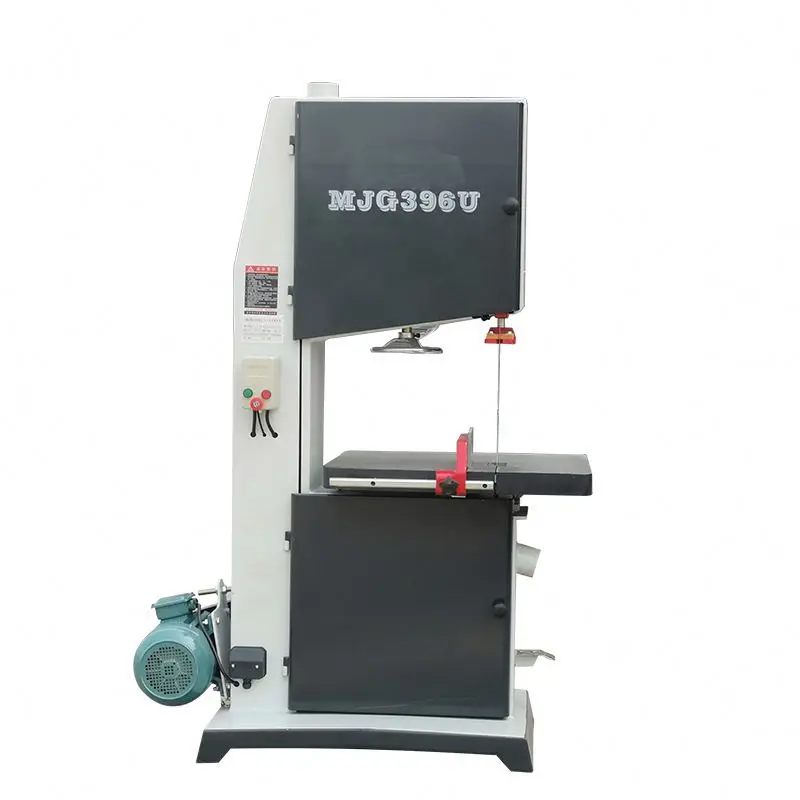
The supplied TEBAK record identifies product ID 1601358302932 as an MJG396U woodworking automatic panel cutting vertical band saw machine. The record also describes it as an industrial multi-function wood band saw machine. These are the confirmed product anchors. They identify the quotation target, but they do not establish every operating limit. The final RFQ should keep the confirmed data separate from the fields that the supplier must still document.
For a first RFQ, describe panel material, thickness range, length and width, surface finish, grain direction, daily quantity, cut pattern, acceptable deviation, operator workflow and downstream process. Include the hardest panel and the most frequent panel so the supplier can recommend a configuration that is useful in real production instead of merely demonstrating an easy sample.
2. Confirmed MJG396U specifications
The product record supplies four useful fields for the purchasing file: model MJG396U, table size 820x700mm, motor power 5.5kw/7.5kw, and overall dimension 1220x930x2100 mm. These values should be copied into the quotation reference and checked against the nameplate, technical drawing and packing documentation before shipment.
The two motor-power values should not be treated as one guaranteed operating value. Ask the supplier to explain whether 5.5kw and 7.5kw represent selectable configurations, regional electrical options, or different machine versions. Confirm voltage, phase, frequency, protection, starting method and the exact motor fitted to the quoted machine.
The table size and overall dimension also need context. Confirm whether 820x700mm is the usable table surface or an external measurement, and whether 1220x930x2100 mm is the operating dimension or the machine body dimension. Request a dimensioned drawing that shows access, panel clearance, blade path, loading space and maintenance space.
| Confirmed field | Supplied value | Buyer verification |
|---|---|---|
| Product ID | 1601358302932 | Match the quotation and nameplate reference |
| Model | MJG396U | Confirm the exact automatic panel-cutting configuration |
| Table size | 820x700mm | Confirm usable surface, support and fence arrangement |
| Motor power | 5.5kw/7.5kw | Confirm selected motor, voltage, phase and frequency |
| Overall dimension | 1220x930x2100 mm | Confirm drawing, access clearance and packing dimension |
3. Match the table and work envelope to the panel flow
A table size of 820x700mm is a confirmed listing value, but the buyer should verify how it supports the actual panel. Ask whether the stated size is the complete table, the usable cutting surface, or a reference measurement that excludes fences, guides and loading fixtures. Confirm the table material, flatness reference, support points, fence system and the method used to hold a panel during a long straight cut.
The product record does not state maximum panel length, maximum panel width, maximum cutting height, throat depth, panel thickness range or cutting speed. These are not safe to infer from the model name or overall machine dimensions. Send the supplier the largest panel drawing and ask for a written confirmation of the supported work envelope, including loading and unloading conditions.
For an automatic panel workflow, also ask how the panel is positioned, how the operator starts and stops a cycle, how a repeat cut is referenced, and how a panel is supported after it leaves the blade. A machine can fit the workshop footprint while still requiring extra infeed or outfeed space. Use the overall dimension 1220x930x2100 mm as a starting point for a layout drawing, not as the complete cell footprint.
4. Clarify automatic operation and repeatability
The word automatic must be defined in the quotation. Ask the supplier which steps are automated: panel positioning, feeding, clamping, cutting, return, indexing, or only a motorized part of the process. Request a cycle description and an operator sequence that shows what happens before, during and after a cut.
For repeat production, define the reference edge, measuring method, stop or fence adjustment, indexing procedure and allowable deviation. Ask the supplier to demonstrate several repeated cuts from the same panel specification and record setup time, cycle time, operator interventions, visible edge quality and dimensional results. Do not turn a general automatic claim into a throughput promise without a controlled test.
The controller, sensors, limit switches and safety interlocks should be listed in the configuration sheet. Confirm whether the machine stores recipes, whether parameters can be locked, how a fault is displayed, how the operator resumes after a stop, and how the system behaves after power interruption. These questions are especially important when the two motor options are associated with different electrical or control configurations.
5. Motor and electrical configuration checklist
The supplied record lists motor power as 5.5kw/7.5kw. Treat this as a configuration choice that needs written confirmation. Ask for rated voltage, phase, frequency, current, motor brand, protection class, control cabinet specification, emergency-stop circuit and the recommended upstream protection. The buyer's electrician should compare the selected configuration with the destination site's available supply before the order is finalized.
Confirm whether the quoted motor drives the blade wheel, the feed system, or a combined machine arrangement. Ask for the relationship between blade speed, feed speed and material condition. If the machine uses separate motors for cutting and feeding, request the rating and control method of each motor rather than recording only the headline motor power.
Use the motor information during acceptance inspection. Check the nameplate, direction of rotation, unloaded operation, emergency stop, restart behavior, abnormal heat, vibration and noise. Record the actual supplied motor and electrical details in the receiving file so future spare-parts and maintenance requests identify the correct configuration.
6. Blade, guide, fence and cut-quality questions
The queue record does not provide blade length, width, thickness, tooth pitch, blade material, wheel diameter, blade speed or tension range. These fields must be requested from the supplier. They determine whether the machine is appropriate for the buyer's panel material and whether replacement blades can be sourced locally or from the original supplier.
Ask how the blade is tracked and tensioned, how the guides are adjusted, and which parts are considered consumables. During a sample cut, inspect straightness, kerf, burn marks, vibration, edge tear-out, surface damage and the amount of manual correction required. The test should use the buyer's own panel or an agreed material with documented thickness and surface condition.
Confirm the fence and reference system for both a first setup and repeated production. Ask how the machine handles a panel with a slightly uneven edge, how the operator corrects drift, and how a blade change affects calibration. A written setup procedure and a spare-parts list are more useful for procurement than an unsupported claim of high precision.
7. Safety, guarding and dust extraction
A vertical band saw combines a moving blade, rotating wheels, stored tension, panel movement and wood dust. The RFQ should request wheel covers, blade guards, access-door interlocks, emergency-stop behavior, restart behavior after power loss, tension-release procedure, table opening protection and operator access limits. Ask the supplier to provide the operating manual and safety instructions before shipment.
The supplied product record does not state dust-port diameter, airflow requirement, extraction arrangement or noise level. Do not fill these gaps from generic woodworking assumptions. Ask for the port size, recommended airflow, connection position and cleaning access, then compare them with the buyer's existing collector. Confirm that dust routing does not interfere with blade tracking, guide adjustment or panel handling.
The acceptance test should include an unloaded run, guard and interlock check, emergency-stop test, controlled sample cut, dust-leakage observation, blade-tracking check and a restart test. Record abnormal vibration, smoke, heat, noise, blade movement or dust buildup. If any safety item is not documented, mark it as open before approving shipment.
- Confirm MJG396U and product ID 1601358302932 on the order and nameplate.
- Verify table size 820x700mm as usable support surface, not only an external measurement.
- Confirm whether 5.5kw or 7.5kw is the selected motor configuration.
- Match 1220x930x2100 mm to the dimensioned drawing and workshop clearance plan.
- Run the buyer's own panel sample and record cut quality and repeatability.
- Confirm guards, interlocks, emergency stop, dust extraction and spare parts.
8. Commercial RFQ and acceptance plan
A useful quotation request should include destination country, electrical standard, panel material, thickness range, dimensions, quantity, cut pattern, acceptable edge quality, target tolerance, dust-collection arrangement and the required operator workflow. Attach a panel drawing and identify the hardest cut. Ask the supplier to state every assumption used in the quotation.
Request one configuration sheet covering the machine model, table, motor option, blade system, guides, fence, control system, maximum work envelope, safety equipment, dust connection, dimensions, weight, packing, accessories, spare blades, warranty, lead time, installation and training. The confirmed dimension 1220x930x2100 mm should be checked against both machine and packing information, because transport planning uses different measurements.
For a sample acceptance test, agree on material, panel dimensions, selected motor configuration, blade type, setup method, number of repeated cuts and measurement method. Record dimensional results, edge condition, cycle sequence, operator actions, dust behavior and any adjustment made during the test. Keep the report with the purchase order so the delivered machine can be compared with the quoted configuration.
For pricing, compare the complete landed-workflow cost rather than only the machine line. Include blades, spare guides, electrical installation, extraction adaptation, inspection, packing, freight, commissioning and operator training. For the selected MJG396U configuration, ask the TEBAK team to confirm pricing, MOQ, lead time and the exact motor option at info@cntebak.cn.
| RFQ area | Supplier confirmation required | Acceptance evidence |
|---|---|---|
| Configuration | MJG396U, table and selected motor | Nameplate and configuration sheet |
| Work envelope | Panel size, thickness, support and feed path | Dimensioned drawing and sample |
| Cut quality | Blade, guides, fence and tolerance | Measured repeated cuts |
| Electrical | Voltage, phase, frequency and protection | Electrician and nameplate check |
| Safety and dust | Guards, interlocks, stop circuit and extraction | Receiving and unloaded-run checklist |
| Delivery | Machine/packing dimensions, weight, accessories and lead time | Packing list and commissioning record |
9. Conclusion: purchase the documented MJG396U configuration
The TEBAK MJG396U is a defined procurement target for automatic panel cutting with a woodworking vertical band saw machine. The supplied record confirms the model, the 820x700mm table-size value, the 5.5kw/7.5kw motor-power options and the 1220x930x2100 mm overall-dimension value. Those details give the buyer a usable starting point for a structured RFQ.
The final decision should still depend on the selected motor configuration, actual panel work envelope, blade and guide system, automatic workflow, safety arrangement, dust connection, electrical compatibility and sample result. Send the supplier a cut list and panel drawing, request a written configuration sheet, and keep every unconfirmed field visible until it is supported by documentation or a controlled test.
Key specifications
- Model
- MJG396U
- Table size
- 820x700mm
- Motor power
- 5.5kw/7.5kw
- Overall dimension
- 1220x930x2100 mm
Frequently asked questions
- What model is listed in the product record?
- The supplied product record lists model MJG396U.
- What confirmed table size is supplied?
- The supplied record lists a table size of 820x700mm.
- What motor power is listed?
- The record lists 5.5kw/7.5kw; the buyer should confirm which configuration is quoted.
- What are the listed overall dimensions?
- The supplied record lists 1220x930x2100 mm; request a dimensioned drawing and packing dimensions.
- What other specifications must be confirmed?
- Confirm panel work envelope, blade system, feed workflow, electrical details, safety, dust extraction, accessories, delivery and sample acceptance results.