
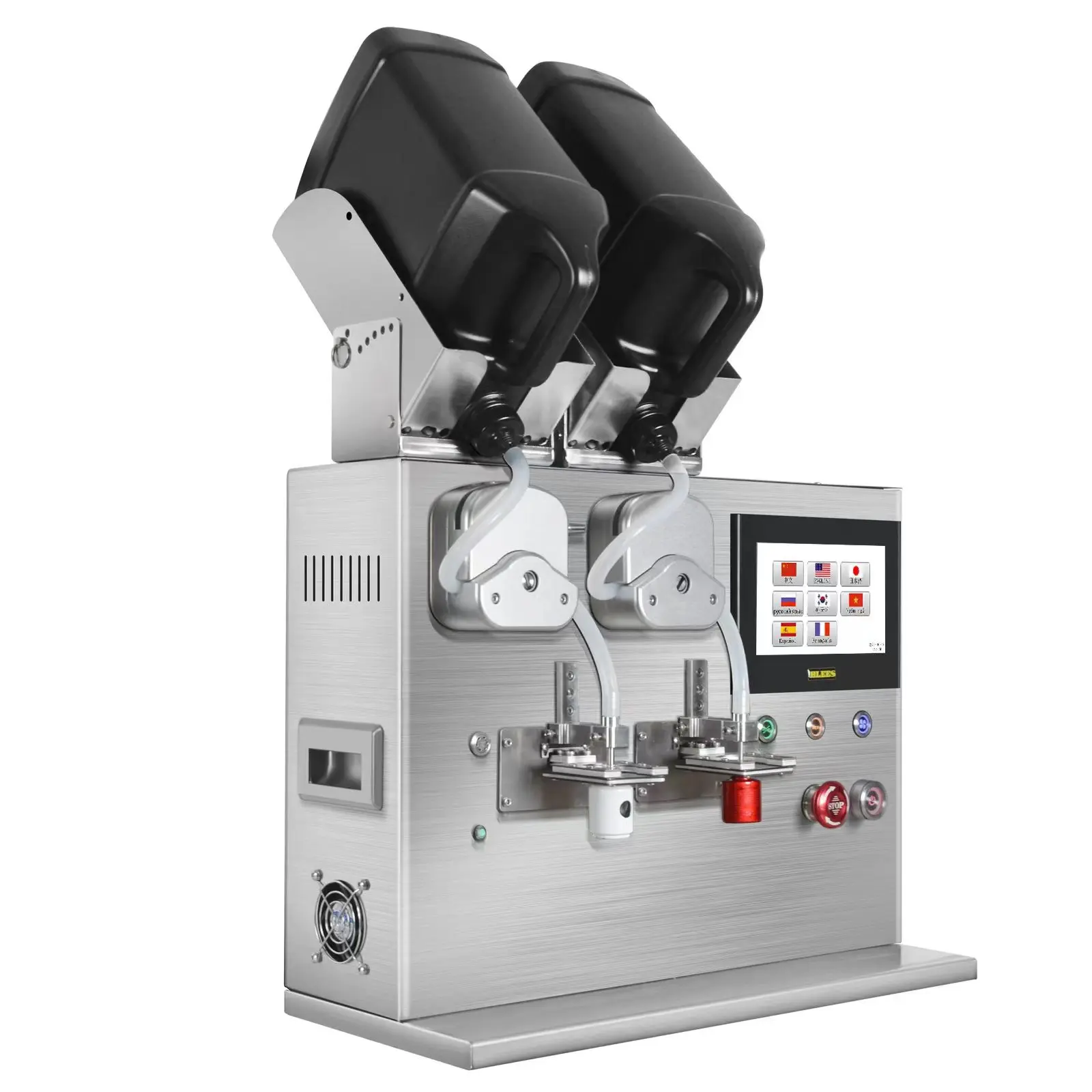
What the machine actually is
Strip away the marketing slides and the photographs show a benchtop stainless cabinet with two peristaltic pump heads, a colour touchscreen, three push-buttons and two nozzles over an adjustable-height chute. Above the cabinet sit one or two black cylindrical supply pots. There is no conveyor, no capping station, no label head and no accumulation table, so the word production line in the description describes an intention rather than the contents of the crate.
The pumps are the important detail. A peristaltic head squeezes a flexible tube between rollers, so the product touches nothing but the tube and the nozzle. For a pigmented gel that cures under UV, that is the right architecture: no cylinder to clean, no seals to swell, and a product path you can replace for the price of a length of tubing.
It also explains the supply arrangement. Product is not poured into an open hopper; it stays in its own pot, clamped above the pump, and is drawn through the tube. One image shows the optional angle clamp that tips the pot from 90° to 150° so a viscous gel can drain toward the pickup instead of clinging to the bottom — quoted for a 1 kg bottle and a 5 kg pot.
Three parameters, and one of them has no unit
This is the entire parameter block, verbatim:
| Label | Value as published | What is missing |
|---|---|---|
| product name | 30-300 ml electric nail gel polish filling machine | No model number, no manufacturer, no serial format |
| filling head | single or double | Whether the price covers one head or two |
| accuracy | 0.01 | No unit at all — not ml, not g, not percent |
There is no weight, no power rating, no voltage, no dimensions, no cycle time, no viscosity range, no tube specification, no air requirement, no warranty and no production rate. For a machine whose entire job is to deliver a measured volume, the measurement claim is the one parameter that cannot be read.
The bottle necks say nine to fifteen millilitres; the parameter block says thirty to three hundred
One of the feature slides carries a line that reads: “one piece for dual use, large hole hanger, 15 bottle with caliber, 13 caliber bottle with small hole”. That is a translation of a Chinese note about interchangeable hangers for two bottle-mouth sizes, 13 and 15.
In nail packaging those numbers are not arbitrary. 13/415 and 15/415 are the two standard neck finishes for nail polish and UV gel bottles, and bottles made to those finishes hold roughly 9 to 15 millilitres — the 15/415 is commonly sold as a 15 ml bottle, the 13/415 as 9 to 15 ml.
So the hardware is built around bottles that hold at most about 15 ml, while the parameter block states a minimum fill of 30 ml. A 30 ml fill does not fit in a 15 ml bottle. The two statements cannot both be true of the same machine:
| Bottle | Capacity | vs 2 ml min | vs 10 ml min | vs 30 ml min |
|---|---|---|---|---|
| 13/415 | 9 ml | fits | impossible | impossible |
| 13/415 | 15 ml | fits | fits | impossible |
| 15/415 | 15 ml | fits | fits | impossible |
This is the single most useful thing on the page, and it is not in the parameter block. If you are filling 10 ml gel polish bottles — the normal case — the “30-300 ml” figure is simply wrong, and the machine will do the job as long as the pump can be calibrated small enough. If you are filling 100 ml remover bottles, the 13 and 15 hangers are the wrong fittings and you need different ones.
Either way, the number you need is which hanger and which tube size, not the range printed in the title.
Three listings, three ranges, same photographs
This catalogue carries more than twenty filling-machine listings. Four of them are nail polish and gel fillers, and their published volumes disagree:
| Listing | Stated fill range | Accuracy field |
|---|---|---|
| This one | 30–300 ml | 0.01 (no unit) |
| Sibling A | 2–300 ml | 0.01 (no unit) |
| Sibling B | 10 ml and 50 ml | “high precision filling” |
All seven of this listing's product photographs also appear on sibling B, which is the clearest possible evidence that they are the same machine described three ways. The intersection of the three ranges is 30 to 50 ml — and that band sits entirely above the capacity of the 13/415 and 15/415 bottles the machine is built to hold.
In other words: the only fill volume all three listings agree on is one the hardware cannot physically accommodate. That is not a rounding difference; it means nobody has reconciled these pages, and no page can be used as a specification.
What “0.01” could mean, and how far apart the readings are
A unitless 0.01 has four plausible readings, and they describe machines that differ by more than an order of magnitude in price and construction.
| Reading | Error at 30 ml | Error at 300 ml | Comment |
|---|---|---|---|
| 0.01 ml | 0.033 % | 0.0033 % | One fifth of a drop. Extraordinary for a peristaltic pump |
| 0.01 g | 0.033 % | 0.0033 % | Same figure, if the machine is gravimetric and the gel is about 1 g/ml |
| 0.01 % | 0.0030 ml | 0.030 ml | Better than most laboratory dispensers |
| 99.9 % accurate | 0.030 ml | 0.300 ml | What the starburst on the first image says |
At 30 ml the widest readings are 0.01 ml and 0.03 ml, a factor of three. At 300 ml they are 0.01 ml and 0.30 ml, a factor of thirty. The size of the disagreement grows with the fill, which is exactly what you would expect from a number that was never fixed in the first place.
Two calibrations are worth carrying in your head. A drop of thin liquid is about 0.05 ml, so a claim of ±0.01 ml is a claim to control a fifth of a drop of viscous gel. And a neighbouring machine in the same catalogue — a different, weighing-type filler — publishes its error honestly as ≤0.5 g. If the 0.01 here means millilitres, this listing claims to be fifty times tighter than the machine next to it on the same shelf.
Ask for the figure with its unit, the fill volume it applies to, and the standard it was measured against. An accuracy without a test volume is not a specification.
The starburst says 99.9%, which contradicts the parameter block
The hero image carries a yellow starburst reading “accurate improvement 99.9%”. Set beside the parameter block, the page now contains two accuracy claims: 0.01 and 99.9%.
They are not the same claim. Ninety-nine point nine per cent accurate means a 0.1% error, which at 30 ml is 0.03 ml — three times the 0.01 ml reading. If instead 0.01 means 0.01%, that is 99.99% accurate, which is ten times better than the starburst. Graphics are not specifications, but a buyer comparing two suppliers will read both numbers on this page and have no way to know which one the seller believes.
Peristaltic pumps: excellent for gel, poor at holding a fixed number
The pump choice is genuinely well suited to the product. It also has one unavoidable property that no listing in this category mentions.
A peristaltic pump meters by squeezing a tube a fixed number of times. The volume per squeeze depends on the tube's internal diameter and wall thickness, and both change as the tube fatigues. Over a shift the delivered volume drifts; over a month the tube must be replaced. That is normal and acceptable in cosmetics filling, but it means three things must be specified and none of them are here: the tube material, the tube size, and the replacement interval.
Tube material matters more than usual for this application. Silicone is the common choice and handles most gels, but it is attacked by some solvents. If you intend to run nail polish remover through this — and the description explicitly offers remover — ask for the tube material and confirm compatibility with the solvent in your formula.
The practical consequence for a buyer: budget for tubing as a consumable, and expect the accuracy to be a fresh-tube figure. Ask what the drift is at the end of a tube's life.
The supply pot decides your batch size, not the pump
The slides quote a 1 kg bottle and a 5 kg pot as supply vessels. That is a far more useful number than the fill range, because it sets how often an operator stops filling to refill.
| Supply | Fill volume | Fills before refill | Practical meaning |
|---|---|---|---|
| 1 kg pot | 10 ml | 100 | Routine |
| 1 kg pot | 30 ml | 33 | A refill roughly every half hour of steady work |
| 1 kg pot | 300 ml | 3.3 | The pot empties every third bottle |
| 5 kg pot | 10 ml | 500 | Half a shift |
| 5 kg pot | 30 ml | 167 | Comfortable |
| 5 kg pot | 300 ml | 16.7 | Still a refill every seventeen bottles |
The arithmetic assumes a density of about 1 g/ml, which is close for a gel polish and is stated here as an assumption rather than a measurement.
Two conclusions follow. If you fill 10 to 30 ml — the realistic range for gel polish — the 1 kg pot is workable and the 5 kg pot is comfortable. If you actually fill 300 ml, no pot on this machine is big enough to run continuously, which is a strong hint that the 30-300 ml figure was copied from a different product rather than measured on this one.
Is it weighing or volumetric? The title and the parameters disagree
The hero image is headed full automatic weighing and filling machine. The parameter block calls it an electric nail gel polish filling machine and never mentions weight. The photographs show a small pedestal under each nozzle that could be a load cell, or could simply be a bottle rest.
This is not a semantic quibble, because the two architectures fail differently.
A gravimetric filler dispenses until a target weight is reached. Its accuracy is in grams, it is unaffected by viscosity drift or tube wear, and it is the only way to get a repeatable net weight into a labelled bottle. A volumetric peristaltic filler dispenses a set number of pump revolutions. Its accuracy depends on the tube, the product viscosity and the back pressure, and it drifts.
The presence of peristaltic heads plus the words “weighing and filling” suggests a hybrid: pump until the scale says stop. If that is what it is, the 0.01 is almost certainly grams and the machine is better than the parameter block makes it sound. Ask the direct question: does it stop on weight or on revolutions?
Acetone, remover and the wrong machine for the job
The description offers the machine for nail polish, gel polish, remover and oil. Remover is mostly acetone, and acetone changes the safety analysis of a benchtop appliance.
Acetone is highly flammable and has a flash point well below room temperature, so vapour accumulates at bench level while you are filling open bottles. The cabinet in the photographs has an IEC inlet, a cooling fan and ventilation slots — a normal appliance enclosure, not an explosion-protected one. The fan draws shop air and its motor is not declared as flameproof anywhere on the page.
The listing does not claim certification for solvent filling, so this is a question rather than a defect. But if remover is part of your product line, ask it before you buy: is the machine approved for acetone, what is the electrical protection rating, and what tube and seal materials are supplied for solvent service? If the answer is silence, fill remover on a different machine and keep this one for gel.
The other material question is light. Some gel formulas are UV-curable and must not be left exposed; the machine's open filling position and transparent guard do nothing to protect the product. If your formula is light-sensitive, ask about an opaque tube and a shielded nozzle.
Six numbers nobody published
| Missing | Why you need it |
|---|---|
| Cycle time or fills per hour | The only number that sets your labour cost. The page substitutes the word “efficient” |
| Viscosity range | Peristaltic output depends on viscosity; a gel and a remover are not the same duty |
| Tube size and material | Sets the volume per revolution and the solvent compatibility |
| Power rating and voltage | A sibling listing in the same catalogue quotes 180 W at 220 V for a comparable machine; this page quotes nothing |
| Weight and dimensions | Decides the bench, the crate and the freight. The packing photographs show two substantial plywood cases with no dimensions at all |
| Warranty and spare parts | No warranty field exists in the parameter block |
Throughput you can work out without the seller
Another filler in this catalogue publishes a maximum discharge of 1,500 ml per head per minute. That is a different machine, so treat it as a benchmark, not a promise — but it lets you put a floor under the pumping time:
| Fill | Pumping time at 1,500 ml/min | What dominates |
|---|---|---|
| 10 ml | 0.4 s | Operator handling, entirely |
| 30 ml | 1.2 s | Operator handling |
| 50 ml | 2.0 s | Handling still dominates |
| 300 ml | 12.0 s | Pumping starts to matter |
This is why the missing cycle time is the most expensive omission on the page. At 10 to 50 ml, the pump is never the bottleneck — the person loading and unloading bottles is. A realistic throughput for a benchtop single-head machine with manual loading is set by how fast a human can place, fill, remove and cap, and no amount of pump capacity changes it. If you are planning production, the question to ask is not “how many millilitres per minute” but “what is the cycle time from bottle-in to bottle-out, with the chute set for my bottle”.
The brand on the screen is not the brand on the listing
Zoom into the touchscreen bezel and the machine carries a different manufacturer's mark, complete with a logo and a Chinese wordmark, on the display surround and again on the home screen. This listing sells it under a different brand entirely.
That is normal in this trade and not by itself a reason to walk away, but it has one concrete consequence: the machine has an existing manufacturer, so a manual, a parameter list and spare parts exist somewhere. Ask for them by the mark on the screen, not by the storefront name. A supplier who cannot name the manufacturer cannot get you a pump head in two years.
One more thing worth noticing. The product description ends with a company profile describing a supplier of “Product Machine, CNC Carbide inserts, Turning tools and Milling tools”. The same paragraph appears word for word on this catalogue's hydrogen generator listing. It is a template, not a description of the factory that builds this machine — which is another reason to ask who actually builds it.
What to put in the request for quotation
| # | Question | Why |
|---|---|---|
| 1 | Which bottle neck does the supplied hanger fit, 13/415 or 15/415, and are both included? | The slides mention 13 and 15 caliber; the price may cover one |
| 2 | Minimum and maximum fill volume for that hanger, in ml | The published ranges are 2-300, 30-300 and 10/50 ml |
| 3 | Accuracy with its unit, at a stated fill volume, and the test method | “0.01” has no unit and the starburst says something else |
| 4 | Does it stop on weight or on pump revolutions? | Decides whether accuracy drifts with tube wear |
| 5 | Tube material, internal diameter and replacement interval | The tube is a consumable and sets the accuracy |
| 6 | Cycle time in seconds from bottle-in to bottle-out at my fill volume | Nobody published a throughput figure |
| 7 | Viscosity range in mPa·s or cps | Gel and remover are different duties |
| 8 | Supply pot sizes available, and whether 1 kg and 5 kg are both included | The slides show both; the offer may include neither |
| 9 | Power rating, voltage, and whether 110 V is available | Nothing on the page; a sibling quotes 180 W at 220 V |
| 10 | Approval for acetone or remover, with the electrical protection rating | The fan and inlet are standard appliance parts |
| 11 | Packing dimensions and gross weight of each crate | Two crates are photographed with no measurements |
| 12 | Manufacturer name and model number behind the mark on the screen | Needed for manuals and spares |
| 13 | Warranty period, and what is excluded | No warranty field exists |
| 14 | Whether the price is for one head or two | The parameter says “single or double” without saying which you are buying |
The two to insist on are question 1 and question 2. Everything else follows from knowing which bottle you are filling: once the hanger and the fill volume are fixed, the accuracy claim, the pot size and the cycle time all become answerable. Without them, you are choosing between three numbers on three pages that describe one machine.
What this machine is good for
As a benchtop filler for small cosmetic bottles, the design is sensible: peristaltic pumping keeps the product inside its own container and out of the mechanism, the pots let you work from a supplier's own 1 kg bottle, the angle clamp drains viscous gel properly, the fill height adjusts, and the interface is offered in eight languages. For a small cosmetics workshop filling a few hundred bottles a day by hand, that is a reasonable tool.
It is not a production line, it is not automatic in the sense the hero image implies, and its published fill range cannot be reconciled with the bottle necks it is built around. The honest version of this product page would say: benchtop peristaltic filler, 13/415 and 15/415 hangers, one or two heads, 1 kg or 5 kg pot, suitable for gel polish and similar viscosities, fill volume set by tube size.
Everything needed to write that sentence is already in the seller's own photographs. It is just not in the parameters.
Key specifications
- product name
- 30-300 ml electric nail gel polish filling machine
- filling head
- single or double
- accuracy
- 0.01
Frequently asked questions
- What fill volume does this machine actually do?
- That is the problem with the page. This listing says 30 to 300 ml, a sibling listing of the same machine says 2 to 300 ml, and a third says 10 ml and 50 ml, while all seven product photographs are shared between them. The intersection is 30 to 50 ml, which is above the capacity of the 13/415 and 15/415 bottles the machine is built to hold. Ask the seller to state the range for the specific hanger supplied.
- What does the accuracy figure 0.01 mean?
- It has no unit. It could be 0.01 ml, 0.01 g, or 0.01 percent, and the hero image separately claims 99.9 percent accuracy. At a 30 ml fill the readings span 0.01 to 0.03 ml; at 300 ml they span 0.01 to 0.30 ml. Ask for the figure with its unit, the fill volume it applies to, and how it was measured.
- Can it fill standard 10 ml gel polish bottles?
- Probably yes, but not according to its own parameter block. The slides show hangers for 13 and 15 caliber necks, which are the 13/415 and 15/415 finishes used on 9 to 15 ml nail polish bottles. A 10 ml fill is below the stated 30 ml minimum, so you need confirmation that the pump can be calibrated that small and that the hanger suits your bottle.
- Is it a weighing machine or a volumetric one?
- The hero image says automatic weighing and filling, while the parameter block calls it an electric filling machine and gives no weight. The pumps visible in the photographs are peristaltic, which is a volumetric method, but there appears to be a platform under the nozzle. Ask directly whether the machine stops on weight or on a set number of pump revolutions.
- How often do I have to refill the pot?
- With the 1 kg pot, a 10 ml fill gives about 100 bottles, 30 ml gives about 33, and 300 ml empties the pot every third bottle. With the 5 kg pot the figures are about 500, 167 and 17 respectively, assuming a density near 1 g/ml. For realistic gel polish volumes the 5 kg pot is the comfortable choice.
- Can it fill nail polish remover?
- The description offers remover, but remover is mostly acetone, which is highly flammable and needs solvent-compatible tubing. The cabinet shown has a standard IEC inlet, a cooling fan and vents, with no explosion protection declared. Ask whether the machine is approved for acetone and what the electrical protection rating is before running solvents through it.
- Who actually makes it?
- The touchscreen bezel and home screen carry a different manufacturer's brand from the one the listing is sold under, so the machine has an existing maker and a manual exists. Ask for the manufacturer and model number behind the mark on the screen, because that is what you will need in two years when a pump head or a length of tubing has to be replaced.