
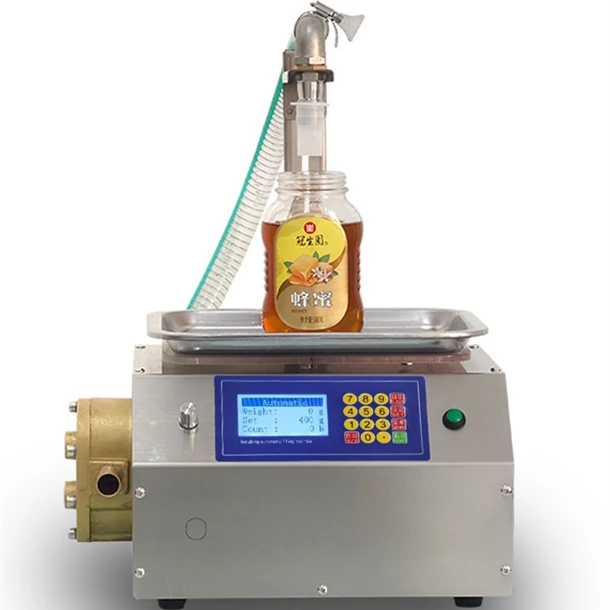
Source-controlled product identity
The Hoting queue identifies Product ID 1601244350547 as a filling machine listed under the title "Packing Automatic Weighing Filling Machine Bottle Perfume Liquid Sub Honey Spray Sesame Paste Edible Oil Glue Viscous Volumetric". The recorded description opens with its own product name: "Diaphragm Pump Weighing Liquid Filling Machine Laundry Detergent Honey, glue, tahini Gel Viscous Liquid Filling Machine".
Unlike several other records in this queue, this one carries a real parameter block. It is structured as a four-row table in which the first row is the column header and the following three rows are three machine models: CSY-1200, CSY-L15 and CSY-L13. The article below reproduces that table in full, maps each column to its model, and then separates the figures that are stated for a given model from the figures that are missing for that model.
The recorded parameter table, as stated
The record's own header row names three columns: Weight, Package size and Detail description. Reproduced with each value placed under its model:
| Model | Weight | Package size | Detail description as recorded |
|---|---|---|---|
| CSY-1200 | 3kg | 35*23*19 | 1. Filling range: 2-300g. 2. Use: commonly used for liquid filling of potions, 502 glue, eyelash glue, nail polish glue, serum, liquid trial pack, chemical reagents and so on. 3. The maximum weight of the machine is 500g. 4. Flow rate: 1.2L/min. 5. 220V / 20w. 6. Error: ≤0.5g |
| CSY-L15 | 15kg | 40*35*35 | 1. Filling range: 20-8000g. 2. Use: honey, sesame paste, various oils, glue, autumn pear paste, edible oil, sweet flour paste, chocolate paste, lubricating oil, grease, bean paste and other paste and sticky liquid. 3. The maximum weight of this machine is 10KG. 4. Flow rate: 7L/min. 5. |
| CSY-L13 | 9kg | 36*36*35 | 1. Filling range: 30-1000g. 2. Use: vegetable oil, glass water, detergent, shampoo, yogurt, white wine, soy sauce vinegar, bee, wood glue and other drinks. 3. The maximum weight of this machine is 15KG. 4. Flow rate: 12L/min. 5. 220V / 150w. 6. Error: ≤2g |
The package size column carries no unit in the record. Taking it as centimetres, the three cartons are 35 x 23 x 19 cm, 40 x 35 x 35 cm and 36 x 36 x 35 cm, but the unit must be confirmed rather than assumed.
Two structural points in the table
The first point is that the weight column is unlabelled beyond the word "Weight". It is not stated whether the figure for each model is the net weight of the machine, the gross weight of the packed carton, or the weight of some other part of the shipment. For CSY-L15 the figure is 15kg while the same row states that the maximum weight of the machine is 10KG, and for CSY-L13 the weight column shows 9kg while the row states a maximum of 15KG. Those pairs run in opposite directions, which is a strong indication that the column and the phrase in the description are measuring two different things, but the record does not say which is which.
Ask the supplier to state, for each model, the net weight of the machine, the gross weight of one packed unit, and what the phrase "the maximum weight of this machine" refers to. The most likely reading of that phrase, discussed below, is a filling or weighing capacity rather than a physical mass, but it must be confirmed because the difference changes both the freight cost and the model selection.
The second point is that the detail description for CSY-L15 ends at the numeral 5 with no content after it. Every other model lists a power rating at position 5 and an accuracy figure at position 6. For CSY-L15 both are therefore absent from the record: there is no voltage or power figure, and no accuracy figure. Those two missing values are the two most important figures for comparing the models, and the buyer should not infer them from the other rows.
The first real conflict: weighing filling or volumetric filling
The title describes the machine as a weighing filling machine and, in the same title, as volumetric. Those are two different filling principles and the choice between them determines the machine the buyer receives.
A weighing filling machine dispenses product into the container while a load cell measures the weight in real time, and the pump stops when the target weight is reached. Its accuracy is expressed in grams and is largely independent of the product's density and of temperature changes. A volumetric filling machine dispenses a fixed volume per cycle, by piston stroke, by peristaltic or diaphragm pump timing, or by a flow meter, and its accuracy is expressed as a percentage of the set volume. A volumetric machine is faster and simpler, while a weighing machine is more accurate on products whose density varies.
The recorded description names a diaphragm pump and describes the machine as a weighing machine, and both models in the table express their accuracy in grams. Together those point to a weighing machine that uses diaphragm pumps as the dispensing element, which would explain why the flow rate is quoted in litres per minute for each model.
The word volumetric in the title may therefore be a keyword rather than a description. It matters because on a weighing machine the achievable accuracy depends on the load cell and on the pump's ability to stop promptly, while on a volumetric machine it depends on the repeatability of the piston or pump timing: two different specifications to verify, and two different prices. Ask the supplier to state the filling principle explicitly, and to state the accuracy as it is verified in practice, including the fill size at which that accuracy applies.
Choosing between CSY-1200, CSY-L15 and CSY-L13
The three models differ in fill range, flow rate, power and accuracy, and the selection question is which one covers the buyer's product and container.
CSY-1200 has a filling range of 2-300g and a stated flow rate of 1.2L/min, with an accuracy of ≤0.5g and a power figure of 220V / 20w. Its recorded use list names potions, 502 glue, eyelash glue, nail polish glue, serum, liquid trial packs and chemical reagents. This is a small-dose machine for low volumes, and the 2g minimum fill is the lowest of the three, which makes it the only model suited to very small trial packs.
CSY-L13 has a filling range of 30-1000g, a flow rate of 12L/min, an accuracy of ≤2g and a power figure of 220V / 150w. Its use list names vegetable oil, glass water, detergent, shampoo, yogurt, white wine, soy sauce and vinegar, wood glue and other drinks.
CSY-L15 has by far the widest filling range at 20-8000g with a flow rate of 7L/min, and its use list names honey, sesame paste, various oils, glue, autumn pear paste, edible oil, sweet flour paste, chocolate paste, lubricating oil, grease and bean paste, described as pastes and sticky liquids. With no power or accuracy figure recorded, it is the least documented of the three.
There are two overlaps the buyer should resolve before ordering. First, honey and edible oil appear in the CSY-L15 use list while vegetable oil appears in the CSY-L13 use list, so for an oil product both models are candidates and the decision must be made on fill size, viscosity and accuracy rather than on the use list. Second, the CSY-L13 accuracy of ≤2g is stated without a fill size, and on a machine with a 1000g maximum that figure may be a percentage of a reference fill rather than an absolute figure across the range.
One entry in the CSY-L13 use list reads simply "bee". That is almost certainly a truncated reference to a honey or bee product, which would duplicate the CSY-L15 list, but it should be confirmed rather than interpreted. Note also that edible and non-edible uses are mixed within single use lists, with chemical reagents in the CSY-1200 list and lubricating oil and grease in the CSY-L15 list alongside food products. A machine used for both food and non-food products needs a cleaning procedure that satisfies the buyer's own hygiene requirements, which is a separate question from the machine's specification.
What "the maximum weight of the machine" most likely means, and why it must be confirmed
Each row states a filling range and then a separate sentence giving a maximum weight: 500g for CSY-1200, 10KG for CSY-L15 and 15KG for CSY-L13. Read as a physical mass, those figures are inconsistent with the other data in the same rows, since the weight column gives 3kg, 15kg and 9kg for the same three models. Read as a weighing capacity, the figures make more sense: a machine with a 500g capacity filling 2-300g, and a machine with a 10kg capacity filling 20-8000g, are internally consistent.
The CSY-L13 row is the exception that shows why confirmation is needed. Its filling range tops out at 1000g while its stated maximum is 15KG, which is a much larger margin than the other two models show, and larger than the 10KG figure given for CSY-L15, the model with the wider fill range. Either the figure is a capacity and the model is over-specified for its stated range, or the figure means something else entirely.
Ask the supplier to define the term, and to state whether it is the capacity of the weighing platform, the maximum fill the machine will accept, or the maximum container weight the platform supports. Ask also what happens at the limits: whether the machine refuses an over-range fill, alarms, or dispenses inaccurately. On a batch-filling machine the behaviour at the range limits determines whether an operator can fill a slightly heavy container without a rework step.
Accuracy, flow rate and what the figures do not say
Two of the three models state an accuracy figure, ≤0.5g for CSY-1200 and ≤2g for CSY-L13, and neither states the fill size at which that figure is achieved or how the figure is verified. Ask for the accuracy at the bottom, middle and top of each model's fill range, because a machine that holds and 0.5g at a 300g fill may behave differently at a 2g fill, and the small fills are the ones where a fixed error matters most.
Ask what the accuracy figure represents in practice: the repeatability of successive fills on the same machine, or the deviation of a single fill from the target weight. Those are different numbers and buyers often need both, the first for process capability and the second for compliance with a declared net quantity.
The flow rates of 1.2, 7 and 12 litres per minute are given for the three models, and no fill cycle time is recorded. Flow rate alone does not determine throughput, because a weighing machine spends time approaching the target weight slowly, so ask for a realistic cycle time for a stated fill size and product, and ask whether the machine can be set to fill one container or several at a time.
Ask also what limits the machine on viscous products. A machine that fills water at 12 litres per minute will not fill honey or bean paste at that rate, and the record's flow figures do not state the product and temperature at which they were measured. For paste filling, ask for the maximum viscosity the pump can handle, the suction lift, and the tube or hose specification, since on a diaphragm pump machine the tube diameter sets a practical ceiling on both flow and viscosity.
Electrical supply, and the model with no power figure
CSY-1200 is recorded as 220V / 20w and CSY-L13 as 220V / 150w. CSY-L15 records no voltage or power figure at all.
Ask for the voltage, frequency and phase for each model, and specifically whether 110V versions are available for markets that require them, and whether the frequency is fixed at 50Hz or 60Hz or selectable. Ask for the plug type supplied, since a machine supplied with a plug that does not match the buyer's market requires the buyer to re-terminate the cable, which affects both compliance and warranty.
Ask also for the current draw and the recommended circuit protection, since a 20W and a 150W machine have very different characteristics even though both are described as 220V, and confirm whether the machines require a protective earth.
Materials, food contact and cleaning
The recorded use lists for CSY-L15 and CSY-L13 are dominated by food and beverage products: honey, sesame paste, edible oil, sweet flour paste, chocolate paste, bean paste, yogurt, white wine, soy sauce and vinegar. Food filling brings requirements that a machine specification alone does not satisfy.
Ask which parts of the product path are in contact with the product, and what material each is made from, including the pump diaphragm, the internal valves, any tube or hose, the nozzle and the product hopper or tank. Ask whether the supplier can provide a food contact material declaration or certificate for those parts for the buyer's market, and treat the answer as a document to be obtained rather than as an assurance in an email.
Ask how the product path is cleaned between products and between production days, whether the parts that touch product can be dismantled by hand or with simple tools, and whether cleaning requires the pump to be flushed with a cleaning liquid. On viscous products the cleaning question is not cosmetic: a machine that is difficult to clean between a honey product and a lubricating oil product costs production time on every changeover.
Ask finally whether the machine is supplied with any washable or replaceable product path components, such as a spare tube set or a spare diaphragm, and their prices, since on a diaphragm pump filling machine those are the wearing parts.
Missing information to request before ordering
- Confirmation of the filling principle: weighing with a load cell, volumetric, or a combination.
- The CSY-L15 voltage, frequency, power and accuracy figure, which the record omits.
- The unit of the package size column, and confirmation whether each figure is centimetres.
- For each model, the net weight of the machine and the gross weight of one packed unit, and what the weight column actually represents.
- The meaning of the maximum weight figure for each model, and the machine's behaviour at the range limits.
- Accuracy at the bottom, middle and top of each model's fill range, and whether the figure is repeatability or deviation from target.
- Realistic cycle time for a stated fill size and a stated product, for each model.
- Maximum product viscosity, suction lift and the tube or hose specification for each model.
- The product and temperature at which each recorded flow rate was measured.
- Voltage, frequency and phase for each model, availability of 110V versions, plug type, current draw and circuit protection.
- Materials of all product-contact parts, with a food contact declaration for the buyer's market.
- Cleaning method between products, whether product path parts are hand dismantable, and whether cleaning accessories are supplied.
- Wearing parts and consumables: diaphragms, tubes, valves and nozzles, with part numbers, prices and lead times.
- Nozzle type, size and any optional nozzle for bottle filling, since the title names bottles and spray but the record does not describe a nozzle.
- Container handling: the range of container heights and diameters accepted, and whether a stand, a conveyor, a foot pedal or a container holder is supplied.
- Whether the machine requires a compressed air supply, and at what pressure and consumption.
- Whether the fill weight can be stored per product or per recipe, and how recipes are entered.
- Hopper or tank capacity, and whether a larger tank is available.
- Machine dimensions, since only package size is recorded, and bench or floor mounting requirements.
- Certification held for each model, and whether any certificate covers electrical safety or food contact for the buyer's market.
- Assembly and operating manual, with the language of the document.
- Warranty period and coverage, and the price and lead time of the parts most likely to fail.
- MOQ, unit price per model at the target quantity, sample or trial unit terms, lead time and shipping terms.
Acceptance and incoming inspection
Because two of the three models are only partially documented, the purchase order should state the model, the fill range required, the accuracy required and the electrical configuration, and the delivered machine should be tested against those statements on the buyer's own product.
On arrival, confirm the model number against the order and check that the electrical configuration matches, including voltage, frequency and plug. Inspect the product path for the materials claimed, and check for any damage to tubes, the pump and the nozzle in transit, since a diaphragm pump is easily damaged by rough handling.
Then run a filling trial on the buyer's own product at the smallest, a mid-range and the largest fill weight the buyer intends to use. Weigh each filled container on an independent scale rather than on the machine's own display, and record the deviation of every fill. Twenty fills at each of the three fill sizes is enough to show whether the accuracy claim holds and whether the deviation drifts as the machine warms up.
Test the machine on the most viscous product the buyer intends to fill, because a machine that passes a water test may fail on honey or paste, and the flow rate recorded for the model does not state the product it was measured on. Note the cycle time at each fill size, and compare it with any figure the supplier quoted, since throughput on a weighing machine depends on the product as much as on the machine.
Test the cleaning procedure before accepting the machine, dismantling the product path if that is what the procedure requires, and time how long a full changeover takes. Finally, confirm that the documented items listed above are present, including the manual and any food contact documentation, and order a spare tube set or diaphragm with the machine if the supplier stocks them.
Buyer decision framework
The source for this guide is a title, a recorded description that names the machine as a diaphragm pump weighing filling machine, and a four-row parameter table covering three models with their weights, package sizes, fill ranges, flow rates, uses and, for two of the three models, their power and accuracy figures.
Two unanswered questions should be settled before a model is chosen. First, whether the machine is a weighing machine or a volumetric machine, because the title says both and the two principles have different accuracy characteristics and different prices. Second, what the maximum weight figure means for each model, because the three recorded figures do not scale consistently with the three fill ranges and one of them appears over-specified for its stated range.
Thereafter the model choice follows the fill size. CSY-1200 is the small-dose model with the 2-300g range and the tightest recorded accuracy at ≤0.5g, and it is the only model in the record that covers fills below 20g. CSY-L13 covers 30-1000g at the highest recorded flow rate of 12L/min with an accuracy of ≤2g. CSY-L15 covers by far the widest range at 20-8000g, and is the only model described as handling pastes and sticky liquids, but it is also the model with no recorded power or accuracy figure, so it should be the model on which the supplier is asked to supply the most written detail.
Buyers filling food products should treat the food contact documentation and the cleaning procedure as part of the purchase decision rather than as an afterthought, and buyers filling products outside the recorded use lists should ask for a trial on their own product before ordering. Where the supplier can provide the missing CSY-L15 figures, an accuracy figure against fill size for the chosen model, and a trial result on the buyer's own product, a single trial unit is a reasonable next step.
Frequently asked questions
Is this a weighing machine or a volumetric machine?
The title says weighing and volumetric in the same sentence, while the description names a diaphragm pump weighing machine and two of the three model rows state accuracy in grams. The evidence points to a weighing machine using diaphragm pumps, but ask the supplier to state the principle explicitly before ordering.
Why is there no power figure for CSY-L15?
The recorded detail description for CSY-L15 stops at the numeral 5 with no content after it, and the accuracy line is absent as well. Do not infer those figures from the other models; request them in writing.
What does "the maximum weight of the machine" mean?
Read most plausibly as a weighing or fill capacity rather than a physical mass, since the weight column already gives a separate figure for each model. The CSY-L13 row states 15KG against a 1000g maximum fill, which is the inconsistency that makes written confirmation necessary.
Can one machine fill both honey and edible oil?
The CSY-L15 use list names honey and edible oil, while the CSY-L13 list names vegetable oil. Both are candidates for an oil product, so choose on fill size, viscosity and the accuracy figure at the buyer's actual fill weight, and test with the buyer's own product.
Can these machines fill bottles, and is a nozzle included?
The title names bottles and spray, but the record describes no nozzle, no container handling and no conveyor. Ask for the nozzle type and size, the container height and diameter range accepted, and whether a stand, holder or foot pedal is supplied.
Is the machine suitable for food products?
The use lists for CSY-L15 and CSY-L13 are dominated by food and beverage products, and CSY-1200 names chemical reagents. Ask for the materials of all product-contact parts and a food contact declaration for the buyer's market, and ask how the product path is cleaned between products.
What is the actual throughput?
Only flow rates are recorded, at 1.2, 7 and 12 litres per minute, with no fill cycle time and no statement of the product and temperature at which each figure was measured. Ask for a realistic cycle time at the buyer's fill size, and verify it in a trial.
Which parts wear out?
On a diaphragm pump filling machine the diaphragm, the tubes, the valves and the nozzle are the parts that wear. Ask for part numbers, prices, lead times and whether a spare set is available, and order a spare with the machine.
Source and contact
This guide is based on the Hoting queue record for Product ID 1601244350547. The record carries a real parameter table covering three models, CSY-1200, CSY-L15 and CSY-L13, and this article reproduces that table in full with each value mapped to its model, including the point at which the CSY-L15 description ends without stating a power rating or an accuracy figure. The weighing and volumetric readings of the title are kept separate rather than merged, the meaning of the maximum weight figures is presented as a question to confirm rather than as a resolved specification, and no claim of certification or food contact approval is made for any model.
Request the filling principle, the complete CSY-L15 figures, the accuracy figures against fill size, the electrical configuration for the buyer's market, the product-contact material list, the cleaning procedure, the nozzle and container handling details, and the consumables prices through the TEBAK sales inquiry channel before placing an order.
Key specifications
- Model number
- Weight | Package size | Detail description
- CSY-1200
- 3kg | 35*23*19 | 1. Filling range: 2-300g 2. Use: Commonly used for liquid filling of potions, 502 glue, eyelash glue, nail polish glue, serum, liquid trial pack, chemical reagents and so on 3.The maximum weight of the machine is 500g 4. Flow rate :1.2L/ min 5.220 V / 20 w 6. Error :<=0.5g
- CSY-L15
- 15kg | 40*35*35 | 1. Filling range: 20-8000g 2. Use: honey, sesame paste, various oils, glue, autumn pear paste, edible oil, sweet flour paste, chocolate paste, lubricating oil, grease, bean paste and other paste and sticky liquid 3. The maximum weight of this machine is 10KG 4. Flow rate :7L/ min 5
- CSY-L13
- 9kg | 36*36*35 | 1. Filling range: 30-1000g 2. Use: vegetable oil, glass water, detergent, shampoo, yogurt, white wine, soy sauce vinegar, bee, wood glue and other drinks 3. The maximum weight of this machine is 15KG 4. Flow rate :12L/ min 5.220 V / 150 w 6. Error :<=2g