
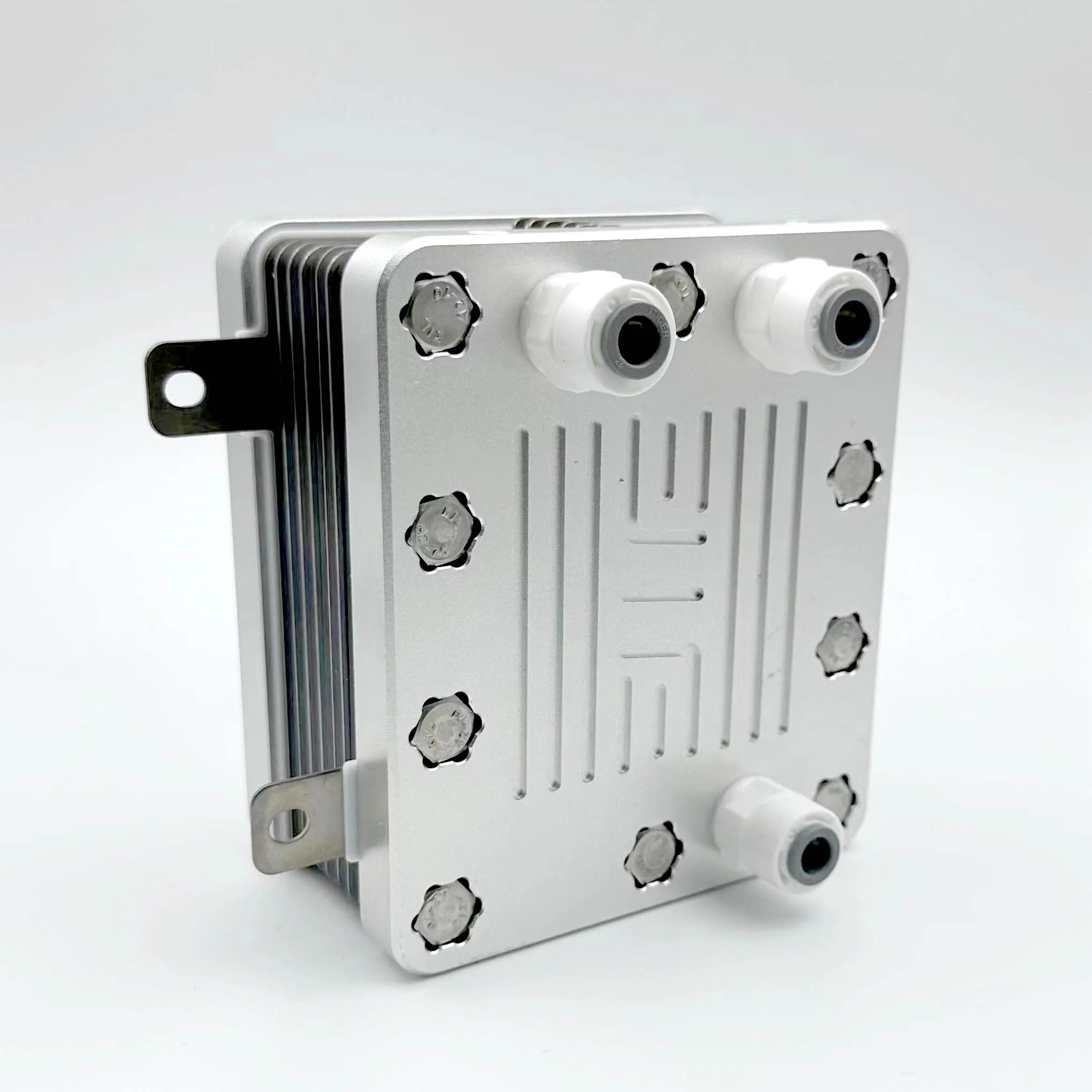
What arrives is a cell, not a generator
The title calls this a H2 hydrogen generator. The photographs show a rectangular plate with fins, held together by eight bolts, with three pneumatic push-fittings on the face. There is no power supply, no water tank, no gas dryer, no pressure regulator, no frame, no control panel and no display in any image. The seller's own table calls the product Electrolytic Cell.
That distinction decides whether this listing is useful to you. A hydrogen generator is a system: it takes mains power and tap water and delivers dry hydrogen at a regulated pressure. An electrolytic cell is one component of that system — the part where the electrochemistry happens. Everything else you must specify, buy and assemble yourself, and this page does not tell you what that involves.
The parameter block is empty. No fields, no values, no warranty, no weight, no dimensions, no electrical rating. The only specification on the entire listing is a table that exists as a photograph, and we are going to read it carefully.
The table is headed with a different company's name
The specification image opens with a company name that is not TEBAK, gives a mobile number registered to a different entity from the storefront, and carries two further watermarks across the table itself — one of them the TEBAK mark, laid diagonally over the rows, the other a polymer-manufacturing slogan. Three identities on one slide.
That does not make the numbers wrong. It tells you the sheet was assembled from a supplier's document and re-branded, which has two practical consequences. First, nobody at the seller's end may have verified the figures, because they did not write them. Second, the numbers describe the original manufacturer's cells, not necessarily the cells in the photograph — the picture shows plates with a water-jet-cut logo and machined port labels, and nothing on the sheet ties a model number to a specific plate.
So treat the table as a menu of possible configurations, not as a specification of what you will receive. That is not pedantry: the whole point of the Faraday check below is that some rows of this menu cannot physically exist.
The eighteen models, as printed
Transcribed from the image without correction. Pressures are in MPa, water in ml/h, current in amps, voltage in volts.
| Model | H2 | O2 | Water | Pressure | Current | Voltage |
|---|---|---|---|---|---|---|
| TK-50 | 50 ml/min | 25 ml/min | ≥6 ml/h | 0.1–1.0 | 7 A | 3.5–5 V |
| TK-100 | 100 ml/min | 50 ml/min | ≥12 ml/h | 0.1–1.0 | 13 A | 3.5–5 V |
| TK-150 | 150 ml/min | 75 ml/min | ≥18 ml/h | 0.1–1.3 | 20 A | 2.5 V |
| TK-300 | 300 ml/min | 150 ml/min | ≥36 ml/h | 0.1–1.0 | 20 A | 5 V |
| TK-450 | 450 ml/min | 225 ml/min | ≥54 ml/h | 0.1–1.0 | 20 A | 7.5 V |
| TK-600 | 600 ml/min | 300 ml/min | ≥72 ml/h | 0.1–1.0 | 20 A | 10 V |
| TK-1000 | 1000 ml/min | 500 ml/min | ≥120 ml/h | 0.1–1.0 | 25 A | 12.5 V |
| TK-1200 | 1200 ml/min | 600 ml/min | ≥144 ml/h | 0.1–1.0 | 25 A | 15 V |
| TK-1400 | 1400 ml/min | 700 ml/min | ≥168 ml/h | 0.1–1.0 | 25 A | 17.5 V |
| TK-1600 | 1600 ml/min | 800 ml/min | ≥192 ml/h | 0.1–1.0 | 25 A | 20 V |
| TK-1800 | 1800 ml/min | 900 ml/min | ≥216 ml/h | 0.1–1.0 | 25 A | 22.5 V |
| TK-2000 | 2000 ml/min | 1000 ml/min | ≥240 ml/h | 0.1–1.0 | 25 A | 25 V |
| TK-3000 | 3000 ml/min | 1500 ml/min | ≥360 ml/h | 0.1–1.0 | 67 A | 18 V |
| TK-4000 | 4000 ml/min | 2000 ml/min | ≥480 ml/h | 0.1–1.0 | 67 A | 24 V |
| TK-4500 | 4500 ml/min | 2250 ml/min | ≥540 ml/h | 0.1–1.0 | 67 A | 27 V |
| TK-5000 | 5000 ml/min | 2500 ml/min | ≥600 ml/h | 0.1–1.0 | 67 A | 30 V |
| TK-5500 | 5500 ml/min | 2750 ml/min | ≥660 ml/h | 0.1–1.0 | 67 A | 33 V |
| TK-6000 | 6000 ml/min | 3000 ml/min | ≥720 ml/h | 0.1–1.0 | 67 A | 36 V |
The range spans 120 times, from 50 to 6,000 ml/min. That is not one product range in any normal sense: a 35 W cell and a 2.4 kW cell are different hardware, different power supplies and different plumbing.
Faraday's law decides which rows can exist
Hydrogen production from electrolysis is not a design choice — it is fixed by the charge you pass. One amp through one cell liberates 0.4182 litres of hydrogen per hour at standard conditions, which is 6.97 ml/min. That number comes from the charge on an electron and Avogadro's constant, and no manufacturer can exceed it.
So for each row we can ask: how many cells would this voltage and current need in order to deliver the claimed output, and what cell voltage does that imply? A real PEM cell runs at roughly 1.8 to 2.2 volts; anything much above that is wasting energy as heat.
| Model group | Current | Cells implied by the claim | Volts per cell | Energy per Nm³ of H2 | Verdict |
|---|---|---|---|---|---|
| TK-50 | 7 A | 1.02 | 4.88 | 11.7 kWh | Physically impossible |
| TK-100 | 13 A | 1.10 | 4.53 | 10.8 kWh | Physically impossible |
| TK-150 to TK-600 | 20 A | 1.08 to 4.30 | 2.50 | 5.6 kWh | Plausible, high side |
| TK-1000 to TK-2000 | 25 A | 5.74 to 11.48 | 2.18 | 5.2 kWh | Plausible |
| TK-3000 to TK-6000 | 67 A | 6.42 to 12.85 | 2.80 to 3.00 | 6.7 kWh | Plausible but inefficient |
Three things fall out of this arithmetic.
TK-50 and TK-100 cannot work as printed. To make 50 ml/min at 7 A you need one cell at under 2 volts, not 3.5 to 5 volts. If the cell really is running at 3.5 to 5 volts, the same current would produce 90 to 128 ml/min — two and a half times the claim. One of the three numbers in those rows is wrong, and the buyer cannot tell which.
No row gives a whole number of cells. Real stacks have one, two, six, eleven cells. The implied counts here are 1.02, 2.15, 3.23, 4.30, 5.74, 8.03, 11.48, 12.85 — a smooth arithmetic progression, not a set of integers. This is the signature of a table generated by scaling a formula rather than measured from built units, which is why the voltage column jumps in blocks (2.50, then 2.18, then 2.80) instead of stepping with cell count.
The efficiency band is believable, except at the ends. 5.2 to 5.6 kWh per normal cubic metre is right for practical PEM electrolysis, so the middle of the table is credible. The 67 A block at 6.7 kWh/Nm³ is about a third worse than that, and the two smallest models at 10.8 to 11.7 kWh/Nm³ are roughly twice as power-hungry — which is normal for tiny cells but should not be sold as the same technology.
The practical instruction: for anything under 1,000 ml/min, ask for the measured polarisation curve, or accept that the voltage column is decorative. For anything over 2,000 ml/min, ask how many cells are physically in the stack, because the claim requires a specific integer and the table never states one.
The one column that is exactly right, and the one that is exactly a formula
The oxygen column is correct in all eighteen rows: every model produces exactly half as much oxygen as hydrogen, by volume. That is what the stoichiometry of water splitting requires, and the table gets it right everywhere.
The water column is consistent too — suspiciously so. One litre of water yields about 1,244 litres of hydrogen, so a cell making 3 litres of hydrogen an hour needs 2.4 ml of water an hour. The table says 6. The next row says 12 where 4.8 is stoichiometric. Every single row is exactly 2.49 times the stoichiometric figure:
| Model | H2 | Water needed by chemistry | Water in the table | Ratio |
|---|---|---|---|---|
| TK-50 | 3.0 L/h | 2.41 ml/h | 6 ml/h | 2.49 |
| TK-1000 | 60.0 L/h | 48.2 ml/h | 120 ml/h | 2.49 |
| TK-3000 | 180.0 L/h | 144.6 ml/h | 360 ml/h | 2.49 |
| TK-6000 | 360.0 L/h | 289.3 ml/h | 720 ml/h | 2.49 |
A constant multiple across eighteen rows is a calculation, not a measurement. A 2.49 safety factor on feed water is harmless — running dry destroys the membrane — but it tells you the column was derived, and it means the figure is a floor, not an operating instruction. Two things the number does not cover: the water must be deionised to a conductivity the cell maker specifies, and in most installations the oxygen side carries water away, so the feed rate is set by the separator loop, not by consumption.
The port labels in the description contradict the ports on the plate
This is the most consequential error on the page, and it is a wiring error.
The plate in the photographs has three push-fittings, moulded with these labels: O2 OUT, H2 OUT and H2O IN.
The description explains the ports as follows, quoted exactly:
- “H2O Out: Represents the outlet of hydrogen, connected to the hydrogen pipe.”
- “H Out: It represents the outlet of oxygen, and it is also the return water outlet.”
There is no H2O Out port on the plate, and no H port. The text names two ports that do not exist and assigns the hydrogen outlet to a water-named fitting while calling the oxygen outlet H. A technician working from the written description rather than the photograph would connect the hydrogen line to the wrong fitting — on a device that makes hydrogen and oxygen in the same pressure vessel.
Two further points follow. First, the stack has no separate return-water port, so the “return water” narrative in the description belongs to a different, complete system, not to this part. Second, the ports are pneumatic push-fittings of the kind used for shop air. Ask what tubing and what pressure rating they accept, because the sheet says the cell runs to 1.0 MPa and push-fittings are not all rated for hydrogen at that pressure.
“High purity” is a word on this page, not a number
The title says high purity. Nowhere on the listing is there a purity figure, an impurity list or a measurement method. That matters more for hydrogen than for most gases, because the number that matters is not one percentage but a set of them.
A buyer of a generator needs, at minimum: H2O dew point, O2, N2, CO, CO2, total hydrocarbons, and for some applications sulphur. A cell with a good membrane will give you roughly four nines straight out of the wet gas path; five nines requires a dryer and usually a catalytic de-oxo stage downstream. Those parts are not in the photographs and not on the table.
So the honest reading is: this is a cell that can be the front end of a high-purity system, and the purity you achieve is determined by equipment you have not bought yet. Ask for the purity specification with the dryer model that achieves it, and ask at what flow rate the figure holds — purities quoted at 50 ml/min rarely survive at 5,000.
Pressure, temperature and current density: three absent parameters
Pressure. The table says recommended pressure 0.1 to 1.0 MPa, which is 1 to 10 bar. One row, TK-150, quietly says 0.1 to 1.3. That is the only pressure difference in eighteen rows and there is no explanation for it. What the sheet does not say is which side must be held higher. In a membrane cell the differential across the membrane must be controlled and never reversed, or the gases can cross and mix. Ask for the maximum allowable differential and whether a differential-pressure trip is part of the recommended installation.
Temperature. There is no operating temperature anywhere. PEM cells are normally run warm, and output and efficiency both depend on it. Without a temperature the voltage column cannot be interpreted at all — the same stack gives different voltages cold and hot.
Current density. The title claims high current density, which is the one parameter that would let you compare this cell with any other. It needs an active area, and no active area is given. Current density is amps divided by square centimetres of membrane; 67 A means nothing until you know whether the membrane is 100 cm² or 1,000. Ask for the active area and the rated current density in A/cm².
The ten things a working generator needs that this page does not sell
If you are buying this to actually produce hydrogen, budget for the system, not the cell. In rough order of what people forget:
| # | Part | Why it is not optional |
|---|---|---|
| 1 | Constant-current DC supply | The cell is current-driven; a bench supply that droops will not hold output. Ratings run from 5 V/7 A to 36 V/67 A across the table |
| 2 | Deionised water feed | Tap water carries ions that poison the membrane permanently |
| 3 | Water tank and level control | Running dry destroys the cell; the water column is a floor, not a control |
| 4 | Gas–water separator on the oxygen side | Oxygen leaves wet; the description itself mentions a separator but does not supply one |
| 5 | Back-pressure regulator | The 0.1–1.0 MPa figure is an operating pressure, not a delivered one |
| 6 | Hydrogen dryer or purifier | Without it the four nines become two; five nines needs a de-oxo stage |
| 7 | Non-return valves on both gas lines | Stops one gas backing into the other when the cell stops |
| 8 | Pressure relief and vent | Hydrogen is flammable from 4% to 75% by volume in air; the vent must go somewhere safe |
| 9 | Hydrogen detection | Hydrogen burns with a nearly invisible flame, so smell and sight do not warn you |
| 10 | Enclosure with ventilation at the top | Hydrogen is the lightest gas and collects at the ceiling |
Each of those is a specification you now have to write. The cell is the easy part; the sheet gives you its voltage and current, and those two numbers are exactly what you need to size the power supply. Everything else on this page is silent.
What six litres a minute actually means
The top of the range is the number buyers fix on, so it is worth translating. 6,000 ml/min is 360 litres an hour, which is 0.36 normal cubic metres per hour — about 32 grams of hydrogen an hour, and about 1.1 kilowatt-hours of chemical energy.
That is a laboratory or instrument-scale quantity. It will run a small fuel cell test bench, supply a gas chromatograph carrier line, purge a glovebox, or fill small balloons. It will not fill a vehicle, and it will not run a furnace. If your requirement is measured in cubic metres per hour rather than litres per minute, this range is the wrong one and no amount of stacking these cells gets you there economically — the 67 A block is already at 6.7 kWh per cubic metre, a third worse than the mid-range models.
Water consumption at the top end is 289 ml an hour by chemistry, so the table's 720 ml/h is a sensible allowance to plan the tank around. Power is 36 volts at 67 amps, or 2.4 kW, which is a dedicated circuit in most labs.
Six listings for one product family
This catalogue carries at least six hydrogen-generator listings: five of them are separate listings of the same product family, and the photographs here are shared with two of the others. Between the six, five publish no parameters at all.
For a buyer the consequence is simple and mildly awkward: you may find two or three pages that look like different products, with different titles and different price anchors, and they are the same cells photographed from the same angles. Compare the model numbers in the table, not the page. If a page has no TK- table, it cannot be compared with this one at all.
For anyone maintaining a catalogue, six near-identical listings split whatever ranking signal the product has. That is a catalogue problem rather than a buyer's problem, but it is the reason a search for this part surfaces pages that cannot be told apart.
What the eight images are, and what none of them shows
All eight gallery images are content-unique among themselves, but five of them are shared with two sibling hydrogen listings, two are reused across the wider catalogue — one appears in 65 other listings and another in 57 — and one of those two is a payment-and-shipping logo banner that carries no product information whatsoever.
What is genuinely useful: two photographs of bare stacks on a workshop bench, one of them showing four units of visibly different thickness side by side with a hand-written mark on the plates, and one close-up of the port face with the O2 OUT / H2 OUT / H2O IN labels legible. Those three are the only places on the page where the product is shown as it is.
What is missing: no power supply, no assembled system, no nameplate, no dimensioned drawing, no polarisation curve, no purity certificate, no photograph of the cell running. For an electrolyser, the two images that would actually sell it are a polarisation curve and a certificate of analysis for the gas. Neither is here.
Matching the model to the job
If you know what you are doing with the hydrogen, the model choice is mostly arithmetic. Flow needed, divided by 6.97 ml/min per amp per cell, gives you the total amps and cells required; then pick the smallest table row that covers it with margin.
| Application | Typical need | Row that fits | What to watch |
|---|---|---|---|
| Gas chromatography carrier | 20–60 ml/min, very steady | TK-50 to TK-100 | The two rows with impossible voltages — verify against a curve |
| Fuel cell test bench | 200–1,000 ml/min, variable | TK-300 to TK-1000 | Needs pressure control and a dryer downstream |
| Glovebox or furnace purge | 1–3 L/min continuous | TK-1000 to TK-3000 | Continuous duty; check the duty cycle is published — it is not |
| Leak testing or small balloon fill | Intermittent, high burst | TK-3000 and above | Cell may not tolerate repeated stop-start; ask |
| Metal annealing atmosphere | Cubic metres per hour | None of these | Range tops out at 0.36 Nm³/h |
One row deserves a warning. The gas chromatography row looks like the easiest application, and on paper it is — but it is also the one that punishes the two impossible models, because a GC cares about flow stability at low rates and about purity, and neither is specified here.
What to put in the request for quotation
| # | Question | Why |
|---|---|---|
| 1 | Which model, and is the price for a cell, a stack, or a complete generator? | The photos show a cell; the title says generator |
| 2 | Number of cells in the stack, and active membrane area in cm² | The table implies non-integer cell counts and gives no area |
| 3 | Rated current density in A/cm² | The title claims high current density and never quantifies it |
| 4 | Polarisation curve at the operating temperature | The only way to check the voltage column |
| 5 | Operating temperature range, and whether output is rated hot or cold | No temperature appears anywhere on the page |
| 6 | Measured H2 flow at the rated current, on a calibrated flow meter | Two rows fail Faraday's law as printed |
| 7 | Purity specification with impurity limits, and the dryer that achieves it | “High purity” has no number |
| 8 | Maximum allowable pressure differential, and which side must be higher | Cross-leak risk across the membrane |
| 9 | Fitting type, thread and pressure rating of the three ports | Push-fittings rated for air are not automatically rated for hydrogen at 10 bar |
| 10 | Corrected port diagram, since the description contradicts the plate | The written text names two ports that do not exist |
| 11 | Water quality specification, conductivity or resistivity | “Pure water” is not a specification |
| 12 | Duty cycle and expected stack life in hours | Neither is published |
| 13 | Who manufactures the membrane and the plates | The spec sheet carries a different company's name |
| 14 | Warranty length and what voids it | No warranty field exists on the listing |
| 15 | Mass, dimensions and packing | Nothing published; decides the bench and the freight |
Questions 2, 3, 4 and 6 are the ones to insist on. A supplier who can send a polarisation curve and a calibrated flow measurement at the rated current has a real product. A supplier who answers only in watts and millilitres is quoting a table somebody else drew.
Where this part makes sense
Strip out the misleading title and the impossible rows, and what remains is a legitimate component: a compact PEM electrolytic cell with three ports, available from 50 ml/min to several litres a minute, that will produce hydrogen from deionised water and DC current for years if you feed it properly and never let it run dry.
It makes sense for an engineer building or repairing a hydrogen system who already owns the power supply, the water loop and the safety hardware, and who wants to buy the electrochemical core as a part. In that role the table is genuinely useful: the voltage and current for each model are exactly what you need to size the DC supply.
It does not make sense as a first purchase by someone who wants “a hydrogen generator”. There is no power supply in the box, no dryer, no regulator, and no statement of purity that would let you decide whether the gas is good enough for your instrument. Buying this expecting a finished appliance means discovering the other ten parts after the cell arrives — and discovering, from the port diagram, that the instructions would have had you connect hydrogen to the wrong fitting.
Frequently asked questions
- Is this a complete hydrogen generator or just a cell?
- On the evidence of the photographs and the seller's own table, it is an electrolytic cell. The images show a bolted plate with three push-fittings and no power supply, water tank, gas dryer, pressure regulator, frame or controls, and the specification table is titled 'Electrolytic Cell'. A generator is a system containing all of those parts.
- Why do two models in the table look impossible?
- One amp through one cell produces 0.4182 litres of hydrogen per hour, or 6.97 ml/min, which is fixed by Faraday's law. TK-50 claims 50 ml/min at 7 A, which needs one cell at under 2 volts, but states 3.5 to 5 volts. At that voltage the same current would give 90 to 128 ml/min. Either the flow, the current or the voltage in those two rows is wrong.
- How many cells are in the stack?
- The table never says, and the implied counts are not whole numbers. Dividing the claimed output by 6.97 ml/min per amp gives 1.02, 2.15, 3.23, 4.30, 5.74, 8.03, 11.48 and 12.85 cells across the range. A real stack has an integer number of cells, so the voltage column appears to be calculated rather than measured. Ask for the physical cell count and the active membrane area.
- What purity will I get?
- No purity figure appears anywhere on the listing. A membrane cell gives roughly four nines from the wet gas path; reaching five nines requires a dryer and usually a catalytic de-oxygenation stage, neither of which is part of this offer. Ask for a purity specification with individual impurity limits, together with the dryer model that achieves it and the flow rate at which the figure holds.
- Which port is the hydrogen outlet?
- The plate is moulded O2 OUT, H2 OUT and H2O IN. The description, however, calls the hydrogen outlet 'H2O Out' and the oxygen outlet 'H'. Neither name exists on the plate. Follow the photograph, not the text, and ask the seller for a corrected port diagram before plumbing anything.
- What else do I need to buy?
- At minimum a constant-current DC supply rated for the model, a deionised water feed and tank with level control, a gas-water separator on the oxygen side, a back-pressure regulator, a hydrogen dryer if you need high purity, non-return valves on both gas lines, pressure relief and venting, hydrogen detection, and a ventilated enclosure with the vent at the top.
- Can it run continuously?
- The listing does not publish a duty cycle, an operating temperature or an expected stack life, so that cannot be answered from the page. For continuous duty you would need all three in writing, plus the water quality specification, because a cell run dry or fed with hard water will fail at the membrane and no warranty field exists on this listing to cover it.