
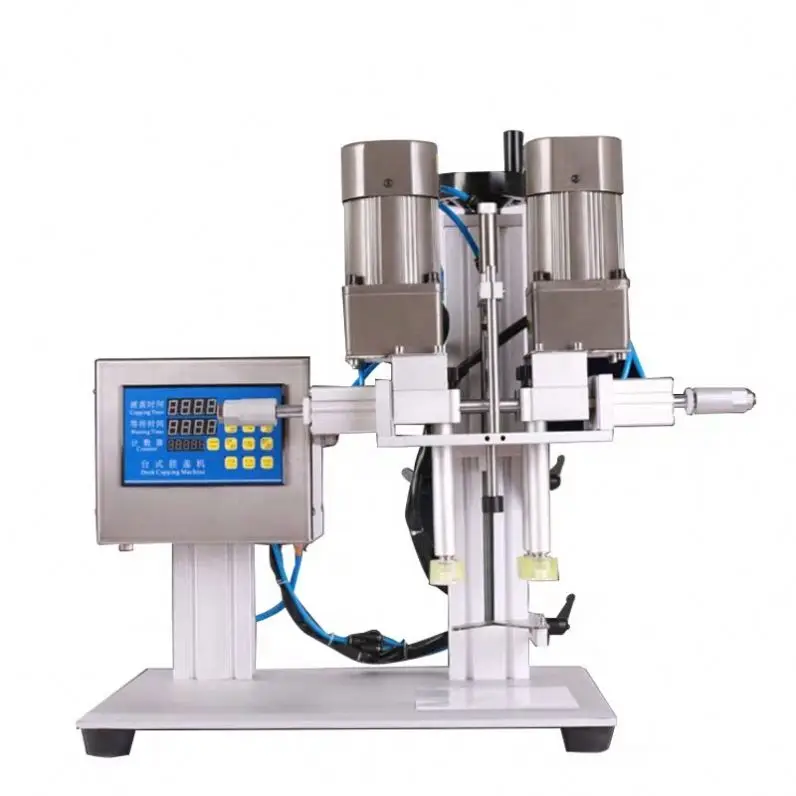
Source-controlled product identity
The Hoting queue identifies Product ID 1601247333528 as a desktop pneumatic twist-off and trigger spray capping and sealing machine for liquid perfume pump bottles, using a crimping and pressing action. The recorded structured fields are Material 304/316L, Voltage 110v/220v, 120w, Working Speed 20-50pcs/min, Size 480*500*580mm and Weight 30kg.
Two of the recorded fields need to be read carefully before a purchase order is placed. First, the title describes the machine as pneumatic, while the structured record lists a mains voltage and a 120w figure. A purely pneumatic machine is driven by compressed air and does not carry a wattage rating of this kind. The record therefore describes one of three things: an air-operated head with an electrically driven control or auxiliary, an electrically driven machine that the listing loosely calls pneumatic, or an inconsistency between the title and the data table. This guide does not merge the two readings and treats the point as a written confirmation item.
Second, the title combines two different closure families. A twist-off trigger sprayer is normally screwed or twisted onto a bottle neck, while a perfume pump is usually crimped or pressed onto the neck so that the ferrule is mechanically closed around it. Those two actions need different heads and tooling. The quoted configuration must state which family the machine is built for.
The record does not contain the cap diameter range, the bottle neck diameter range, the bottle height range, the air pressure or air consumption, the crimping head geometry, the control mode, the cycle accuracy, the noise level, the electrical protection rating, the certification set, the MOQ, the lead time or the warranty terms. Every one of those gaps is treated below as a procurement question rather than an assumption.
This machine category is relevant to small and mid-volume filling operations for perfume, eau de toilette, cosmetic liquids, household trigger-spray products, sanitiser, essential-oil blends and similar liquid consumer goods, where a desktop unit is preferred over an inline capper because of floor space, capital budget or batch variety.
Recorded specification table
| Field | Recorded value |
|---|---|
| Source Product ID | 1601247333528 |
| Material | 304/316L |
| Voltage | 110v/220v, 120w |
| Working Speed | 20-50pcs/min |
| Size | 480*500*580mm |
| Weight | 30kg |
These five values are the complete structured specification set in the source record. They are reproduced without conversion, rounding or reinterpretation. In particular, 110v/220v, 120w is preserved exactly, and the working speed is preserved as the range 20-50pcs/min rather than as a single output figure.
Two capping families inside one title
The title states twist-off trigger spray capping, desktop liquid perfume pump bottle crimping, and pressing capping in the same sentence. In production these are not interchangeable operations.
A trigger sprayer closure is a screw-type or twist-type action that engages thread or a lug arrangement on the bottle neck. The critical variables are thread standard, neck finish, torque and the alignment of the sprayer-to-bottle orientation.
A perfume pump crimp is a deformation process. A metal or metallised ferrule is compressed onto the neck so that the pump body is retained. The critical variables are crimp diameter, crimp height, jaw or collet geometry, the material and thickness of the ferrule, and the insertion depth of the pump stem into the bottle neck.
Because both families are named, ask the supplier to state in writing which head is supplied with the quoted unit, whether the alternate head is available as an option, what tooling each head requires, and whether the changeover between head types is tool-less or requires a change part set. A machine quoted for crimping will not close a trigger sprayer simply because the listing mentions trigger spray, and the reverse is equally true.
Drive and utility discrepancy
The single most important clarification for this product is the drive principle. Treat the listing word pneumatic and the recorded 110v/220v, 120w field as unresolved until the supplier confirms the configuration in writing.
If the machine is air-operated, the RFQ must request the working air pressure expressed in MPa or bar, the air consumption in L/min at that pressure, the inlet port size and thread, and whether filtration, regulation and lubrication are required upstream. It must also state whether a compressor, dryer, filter-regulator and air hose are included in the offered scope or purchased separately. None of those values appear in the record, and none of them can be inferred from the word pneumatic.
If the machine is electrically driven, the RFQ must request the supply voltage and whether both 110v and 220v are genuinely supported by the delivered unit or whether the buyer selects one at order time, the phase, the frequency, the current draw, the plug and cable standard, the control voltage, the earth requirement, the fuse or breaker rating and the protection class. The record lists 110v/220v but does not state the frequency, the phase or the plug type.
The recorded 120w figure must be clarified as installed motor power, rated input power or control-circuit consumption. If the unit contains both an air circuit and an electrical circuit, the RFQ must identify what each one drives and what happens to the pneumatic action during a power interruption.
Working speed and realistic throughput
The recorded working speed is 20-50pcs/min. The range is wide and the source does not state the test condition behind it. Before using this figure for capacity planning, confirm the cap type, the bottle size, the bottle material, whether bottles are fed by hand or by a feeder, the operator skill assumed, whether the rate includes loading and unloading, and whether the figure was measured on a continuous run or a short burst.
For planning purposes, use the lower bound of the recorded range as the conservative case and treat the upper bound as an aspiration that must be demonstrated on the buyer's own caps and bottles during a sample run. A desktop capper that reaches 50pcs/min with a single easy cap geometry may never reach that rate with a different neck finish, a heavier ferrule or a taller bottle.
Ask for the rate to be expressed as pieces per minute at a stated cap and bottle combination, with the sample size, the duration of the run and the number of rejects. Ask also for the practical changeover time between two different products, because a desktop machine is usually bought precisely because the production mix changes often.
Material and product-contact hygiene
The record lists Material 304/316L. Stainless steel of those grades is appropriate for equipment that may contact cosmetic or alcohol-based liquids, but the record does not state which parts are made from which grade.
Ask the supplier to identify the components supplied in 304 and those supplied in 316L, and to confirm which surfaces are product-contact surfaces. On a crimping or capping machine the product-contact exposure is limited, but splashes, drips and condensation around the neck still occur, so the frame, the base plate and the collection tray matter for cleaning and corrosion resistance.
Ask about surface finish, weld dressing, crevices and the ability to wipe down the working area with the cleaning agents normally used for alcohol-based fragrance products. The record does not provide a food-grade, pharmaceutical-grade or hygiene certification, and none should be assumed.
Footprint, bench and line layout
The recorded machine size is 480*500*580mm and the recorded weight is 30kg. This is a desktop or bench-top envelope. Before ordering, check the available bench length, the bench load rating, the working height relative to the operator, the clearance needed for the tallest bottle plus sprayer, and the route of the air hose or power cable.
Confirm whether the unit needs to be bolted down in service, whether the base has feet or a mounting flange, and how the finished bottles leave the machine, whether by hand, by a chute or by gravity. Also confirm whether the dimensions include the handle, the air regulator, the control box and the bottle support, because a stated size sometimes excludes accessories.
Tooling, changeover and spare parts
For a crimping or capping machine, the tooling is the part of the purchase that determines long-run performance. The RFQ should request the jaw or collet set, the head assembly, the bottle support and locating parts, the number of interchangeable sizes included, and the price of each additional size.
Ask how the cap or ferrule size is set, whether adjustment is by dial, by a threaded stop or by a dedicated change part set, and how long a change takes with the machine in production. Ask whether a sample tooling set is available for the buyer's own cap and bottle before the main order, and whether the supplier will confirm crimp dimensions on the buyer's samples.
Request the recommended spare parts list with lead times, including seals, springs, jaws, locating pins, control components and any air-circuit service items, together with guidance on routine maintenance intervals and lubrication.
RFQ checklist
- Exact model, drive principle and whether the quoted head is for trigger-spray twist-on or for pump crimping.
- Written resolution of the pneumatic description against the recorded 110v/220v, 120w electrical field.
- Air pressure in MPa or bar, air consumption in L/min, inlet port size and thread, filtration and lubrication requirements.
- Supply voltage, frequency, phase, current, plug standard, control voltage, earthing and protection class for the electrical section.
- Cap or ferrule diameter range and bottle neck diameter range supported by the quoted tooling.
- Bottle height and diameter range, including the tallest bottle plus closure combination.
- Meaning, sample size and test condition behind the 20-50pcs/min working speed.
- Crimp diameter, crimp height and the measurement method used to set and verify them.
- Insertion depth control for pump stems, and how the machine detects a badly seated pump.
- Torque control or torque verification method for twist-type closures.
- Changeover time and tooling set required to move between two products.
- Which components are 304 and which are 316L, and which are product-contact surfaces.
- Surface finish, cleaning method and compatibility with alcohol-based fragrance liquids.
- Machine size, weight, bench load, mounting method and clearance for bottles and accessories.
- Control mode, whether foot pedal, sensor or automatic cycle, and the cycle-start logic.
- Safety devices: guard, emergency stop, overload protection, start inhibit and restart behaviour.
- Documents: manual, wiring diagram, pneumatic diagram, tooling drawing, spare-part list and any certification.
- Sample and trial terms, MOQ, unit price at the target quantity, lead time, packaging and shipping terms.
- Warranty period, service response time and the price of the most likely wearing parts.
Acceptance and factory tests
Agree a written acceptance plan before the order is placed, because the specification gaps in this record cannot be closed after shipment.
Ask for a factory run on the buyer's own caps, ferrules and bottles where possible, and otherwise on samples that share the same neck finish and ferrule material. Record the settings used, the crimp or torque measurements, the reject count, the reject reasons and the observed rate.
For crimp-type closures, measure the crimp diameter and crimp height on the agreed number of samples and compare them against the drawing tolerance. Perform a pull-off or retention check and a leak or seepage check after a short settling period. Confirm that the pump stem is not over-compressed and that the actuator still travels freely.
For twist-type closures, verify the applied torque on a sample set and confirm that the sprayer orientation is repeatable where orientation matters for the finished pack. Check for thread damage and for any scuffing on the closure.
Verify the electrical nameplate, the air-pressure setting at the machine inlet and the safety devices during the same visit. Record the serial number, the firmware or control revision where applicable, and the setting values in the handover document so that the delivered unit can be compared with the tested one.
Packaging, shipping and after-sales
Confirm how the unit is packed for export, whether the head assembly, bottle support and tooling are packed separately and protected, what documentation travels with the shipment, and whether the crate is suitable for the intended mode of transport.
Request the warranty period, what is covered and what is excluded, the response time for technical questions, the availability of remote support and the procedure for obtaining spare parts after the warranty period.
Because the machine is compact and light in this record at 30kg, freight is unlikely to be the dominant cost, but confirm the packed dimensions and packed weight, which are not stated in the source.
Buyer decision framework
The source confirms a desktop capping and sealing machine with 304/316L material, a recorded 110v/220v, 120w electrical field, a 20-50pcs/min working speed, a 480*500*580mm size and a 30kg weight.
The purchasing decision is not driven by the headline description. It is driven by four questions. Which closure family does the quoted head actually handle. Is the machine air-operated or electrically driven, and what utilities must be supplied on site. What cap, ferrule and bottle range does the included tooling support. And what verified rate and crimp or torque result can the supplier demonstrate on the buyer's own components.
Compare suppliers on the same cap, the same bottle, the same ferrule material, the same sample count and the same measurement method. A quotation that answers the four questions above in writing is worth more than a lower price that leaves them open.
Frequently asked questions
Is this machine pneumatic or electric?
The title describes it as pneumatic, while the structured record lists 110v/220v and 120w. Those two readings are not automatically compatible. Confirm the drive principle, the air requirement or the electrical requirement, and the delivered configuration in writing before ordering.
Does it crimp perfume pumps or close trigger sprayers?
The title names both. Crimping and twist-on closing use different heads and tooling. Ask which head is included in the quotation and whether the other is available as an option.
What is the working speed?
The record lists 20-50pcs/min. Confirm the cap and bottle combination, the feed method and the measurement conditions behind that range, and use the lower bound for conservative planning.
What material is used?
The record lists 304/316L. Ask which parts are made from each grade and which surfaces are product-contact surfaces.
What is the machine size and weight?
The record lists 480*500*580mm and 30kg. Confirm whether accessories, the control box and the bottle support are included in those figures.
Is a compressor included?
The record does not state a compressor, an air pressure or an air consumption figure. If the machine is air-operated, treat the air supply as a separate item to be specified and quoted.
What certifications are provided?
The record does not list any certification. Request the available certification set, the electrical nameplate details and the conformity documents applicable to the destination market.
Source and contact
This guide is based on the Hoting queue record for Product ID 1601247333528. It preserves the five recorded fields exactly as supplied, including the 110v/220v, 120w entry and the 20-50pcs/min range, and it deliberately keeps the pneumatic description and the electrical field separate rather than merging them into a single assumption.
Request the drive confirmation, closure-family confirmation, tooling list, utility data, drawings, factory test plan, safety documents and spare-part prices through the TEBAK sales inquiry channel before placing an order.
Key specifications
- Source Product ID
- 1601247333528
- Material
- 304/316L
- Voltage
- 110v/220v, 120w
- Working Speed
- 20-50pcs/min
- Size
- 480*500*580mm
- Weight(Kg)
- 30kg