
One listing, three products
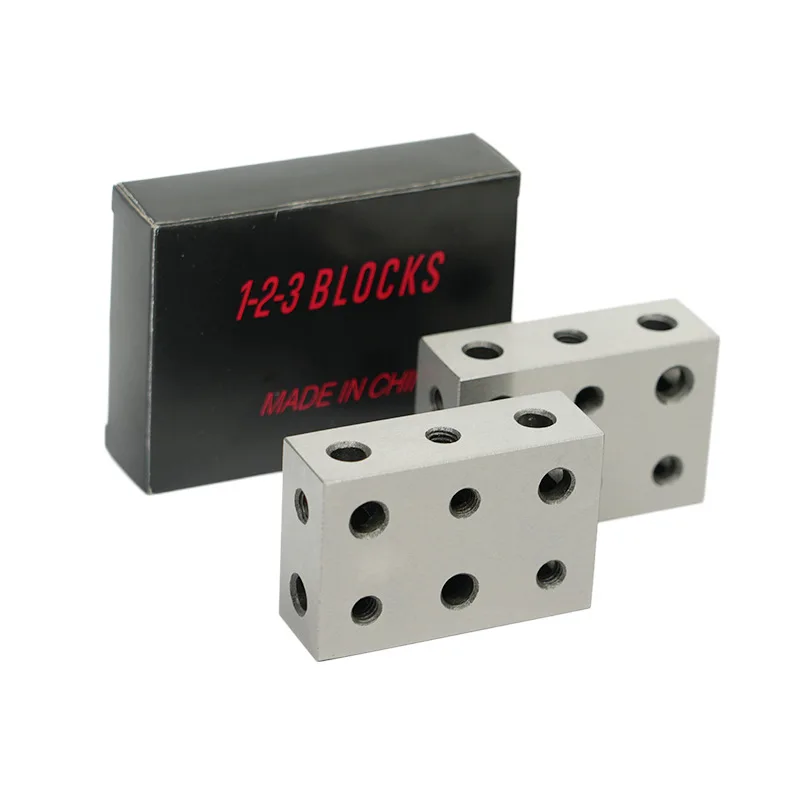
This page sells what looks like a single item and is in fact three different things wearing one title. The headline says Precision 1-2-3 Parallel Setup Block. The main photographs show a matched pair of 1-2-3 blocks in a black cardboard box printed MADE IN CHINA, with four socket-head cap screws and a hex key tucked into a moulded case. The structured parameter block describes neither of those: it carries two order numbers, PB153-1 and PB153-2, whose specification is a 24-piece assortment of thin parallel blocks in 125 mm or 150 mm lengths. And the gallery adds a third layer, a row of photographs of parallel sets in wooden cases with captions like (8x200) 8 pairs of parallel blocks.
None of that is unusual in this corner of the catalogue trade, and none of it is necessarily dishonest. A trading house carries a family, the photographer shoots what is in the showroom, and the person filling in the parameter form pastes whichever order codes are current. But it does mean that a buyer who orders from this page without asking which of the three they are buying has a real chance of receiving something they did not picture. The rest of this guide separates the three, publishes the arithmetic that the parallel table implies, and lists what the listing never states.
What the photographs show: a pair of 1-2-3 blocks
Four photographs in the listing are of the same product, shot on a white surface and inside an open case. Each shows two rectangular steel blocks standing side by side. On the largest face of each block there is a two-by-three array of threaded holes; further holes are visible on the adjacent faces and on the ends, which is the geometry that lets a 1-2-3 block be clamped, bolted or dowelled from any direction. The blocks sit in a moulded insert with four socket-head cap screws and one hex key in dedicated pockets, one version of the case in red and one in black.
That is a recognisable product: a matched pair of setup blocks, sold with the hardware to bolt them to a fixture plate. It is also, and this is the point, a product with no dimensions anywhere in the listing. Not one of the four photographs carries a scale, a marking or a dimension, and the parameter block does not describe these blocks at all. So the name is doing all the work, and the name is ambiguous: 1-2-3 is a description of proportions in inches, not a size.
What the name 1-2-3 actually commits the supplier to
The convention behind the name is a block measuring one inch by two inches by three inches, which is 25.4 mm by 50.8 mm by 76.2 mm. In imperial shops that is the whole specification, and it is why the blocks can be stacked, used as spacers under a workpiece, or stood on edge to gain a known height of exactly one, two or three inches. The holes are placed so that a block can be bolted down at those increments and stay square.
The moment a supplier sells into a metric market, four things can happen to that convention and only one of them is honoured by the name:
- True imperial: 25.4 × 50.8 × 76.2 mm, toleranced in inches or in micrometres. The name is accurate and the block stacks with imperial gauge blocks and spacers.
- Metric nominal: 25 × 50 × 75 mm. Visually identical, dimensionally not, and a 1.2 mm error over three inches is enough to scrap a stack-up calculation.
- Metric approximation with a stated deviation: for example 25.4 mm on one axis and 76 mm on another, with the departure published. Rare, but honest.
- Nothing at all: the block is whatever the factory's drawing says this month, and the name is decoration.
Nothing in this listing tells you which of the four applies, because the block dimensions are not printed anywhere. That is the first thing to settle in an enquiry, and it is not a small thing: if you are buying setup blocks to establish a known height, the height is the product.
What the parameter block does specify: the PB153 parallel set
Strip out the title and the photographs and read the two rows that carry data. Order number PB153-1 specifies four cross-sections at a common length of 125 mm, each with a family of heights, and a piece count of 24×2. Order number PB153-2 is the same table with the length changed to 150 mm. Written out, PB153-1 reads:
| Cross-section, L × W (mm) | Heights supplied (mm) | Pieces | Solid volume (mm³) | Envelope mass (kg) |
|---|---|---|---|---|
| 125 × 8 | 11, 16, 21, 26, 31, 36 | 6 | 141,000 | 1.11 |
| 125 × 10 | 13, 18, 23, 28, 33, 38 | 6 | 191,250 | 1.5 |
| 125 × 12 | 15, 20, 25, 30, 35, 40 | 6 | 247,500 | 1.94 |
| 125 × 14 | 17, 22, 27, 32, 37, 42 | 6 | 309,750 | 2.43 |
That is a genuine specification, and a reasonably precise one: four widths of thin parallel, six heights per width, twenty-four pieces to a set. The mass column is arithmetic on the published dimensions at 7.85 g/cm³ and is a ceiling, because the real blocks are not solid prisms; it is there so you can size a shipment without asking. The whole 125 mm set comes to 889,500 mm³ and about 6.98 kg of steel before any packing at all.
PB153-2 is the same twenty-four pieces at 150 mm:
| Cross-section, L × W (mm) | Heights supplied (mm) | Pieces | Solid volume (mm³) | Envelope mass (kg) |
|---|---|---|---|---|
| 150 × 8 | 11, 16, 21, 26, 31, 36 | 6 | 169,200 | 1.33 |
| 150 × 10 | 13, 18, 23, 28, 33, 38 | 6 | 229,500 | 1.8 |
| 150 × 12 | 15, 20, 25, 30, 35, 40 | 6 | 297,000 | 2.33 |
| 150 × 14 | 17, 22, 27, 32, 37, 42 | 6 | 371,700 | 2.92 |
The 150 mm set is 1,067,400 mm³ and about 8.38 kg. Neither table describes the blocks in the photographs, and neither is a 1-2-3 block: a 125 mm long parallel is half again as long as a three-inch block and a fraction of its thickness.
The rule hidden inside the height columns
Four widths, six heights, twenty-four pieces, and the pattern is not arbitrary. Within any one width the heights advance in exact 5 mm steps: 11, 16, 21, 26, 31, 36 for the 8 mm wide block, 13, 18, 23, 28, 33, 38 for the 10 mm, and so on. Across the widths the first height is always the width plus 3 mm: 8 gives 11, 10 gives 13, 12 gives 15, 14 gives 17.
Put together, every one of the twenty-four heights is generated by a single expression: height = width + 3 + 5k, where k runs from 0 to 5. That is a useful thing to know for three reasons. It means the set covers a continuous 25 mm band of heights for each width rather than an arbitrary scatter, so there are no gaps to shim around. It means you can predict the exact contents of an order number without trusting a photograph. And it means a replacement for one lost block can be specified by expression rather than by description: an 8 mm wide block at k=4 is 36 mm high, and there is no need to explain that in words.
The step of 5 mm also sets the practical resolution of the set. If your stack-up needs 3 mm, this assortment will not give it to you; it gives multiples of five offset from a per-width base. Buyers who need finer increments are looking at a different product line, not a different order number.
125 or 150: the only difference between the two order numbers
Compare the two tables and the change is a single dimension. Widths are identical, heights are identical, the piece count is identical, the rule is identical. Only the length moves, from 125 mm to 150 mm, and with it the mass per set rises by exactly the ratio of the two lengths, twenty percent.
That is worth pausing on because it is the kind of choice buyers get wrong in the other direction. There is no accuracy argument for the longer block, and no capacity argument for the shorter one; there is only the question of what span your work needs and what your machine table or fixture plate can carry. A 150 mm parallel is a 150 mm span, and if the workpiece overhangs the block the extra length earns nothing while the extra mass and cost stay. Conversely, a 125 mm block bridging a 130 mm gap does not bridge it.
There is one mechanical consequence that is not in the table. A thin parallel 8 mm wide and 36 mm high, standing on edge, is a tall narrow section: the bending stiffness in the direction that matters falls with the cube of the height and only linearly with the width. The 125 mm set's tallest block, 14 × 42, is a ratio of three to one; the same block at 150 mm length is a longer span carrying the same section. If your operation involves clamping force applied near the middle of the span, the shorter set is the stiffer one for the same cross-section.
The piece count that decides what you receive
Both order numbers carry the same entry in the quantity column: 24×2. There are at least three readings and the listing does not choose between them. Twenty-four pieces, two sets, so forty-eight blocks in the shipment. Twenty-four pieces in total, arranged as two of each of the twelve distinct cross-section-and-height combinations. Or twenty-four pieces where the “2” refers to the pair of wooden cases in the gallery photographs and not to a multiple at all.
The first reading gives exactly the twenty-four combinations this article derives, doubled, which is what a shop buying a matched pair of each size would want. The second reading cannot be satisfied by the table as printed, because four widths times six heights is twenty-four distinct blocks and there is no room for two of each. So the arithmetic favours the first reading, and the arithmetic is the only evidence there is.
Ask. A forty-eight piece set is twice the freight and twice the invoice of a twenty-four piece set, and the difference is a single character in a table cell.
The gallery is a fourth product family, not a decoration
Below the specification the listing carries a grid of photographs of parallel sets in wooden cases. Each is captioned, and the captions are the most specific content on the whole page:
| Caption as printed | What it describes |
|---|---|
| Corrugated parallel iron | Parallels with a corrugated or grooved face, in a fitted case |
| 6 pieces of adjustable parallel iron | A set labelled A to F, with individual size markings stencilled on the case lid |
| 9 pairs of special-shaped parallel blocks | Eighteen pieces in nine pairs of stepped or relieved profile |
| (4X100) 9 pairs of parallel blocks | 4 mm thick, 100 mm long, nine matched pairs |
| (4x120) 6 pairs of parallel blocks | 4 mm thick, 120 mm long, six matched pairs |
| (8x160) 8 pairs of parallel blocks | 8 mm thick, 160 mm long, eight matched pairs |
| (8x200) 8 pairs of parallel blocks | 8 mm thick, 200 mm long, eight matched pairs |
| (8.5x150) 9 pairs of parallel blocks | 8.5 mm thick, 150 mm long, nine matched pairs |
Those captions use a convention the PB153 tables do not: thickness by length, with the height implied by the set. They also introduce the word pairs, which the PB153 rows never use, and pairing is not a cosmetic detail — a pair of parallels is worth owning only if the two members are matched in height to within the tolerance you are working to.
So the page carries at least four distinct offerings: the 1-2-3 block pair in the photographs, the PB153 24-piece sets, the captioned pairs in wooden cases, and the corrugated and adjustable variants. If you are enquiring, name the one you want by caption or by order number, not by the page title.
What the listing never states
Six numbers decide whether a setup block or a parallel is worth its price, and this listing publishes none of them.
- Material grade. No steel grade appears anywhere. Blocks and parallels are commonly made from a case-hardening or through-hardening steel, but which one is not stated, and the two behave differently under a clamp screw.
- Hardness. Not stated for any product on the page. Hardness is what stops a block from being dented by swarf under a clamp, and a dented face is a block that no longer sits flat.
- Flatness and parallelism. Not stated. These are the entire reason to buy a precision block rather than a piece of key stock cut to length. A parallel that is not parallel is a shim.
- Pair matching. Not stated, although the gallery captions sell pairs. If two blocks in a pair differ in height by 0.02 mm, every setup built on them inherits that error.
- Hole threads. The photographs clearly show threaded holes, but no thread size is printed. A 1-2-3 block is bought partly for its hole pattern; without the thread callout the fixture design cannot start.
- Dimensional tolerances. The PB153 tables give nominal length, width and height and no tolerance band on any of the three.
There is also no weight published for anything, which is why this guide derives envelope masses instead of quoting them: they are ceilings computed from the published dimensions, useful for freight and useless as a specification.
Why each missing number has a price attached
It is tempting to treat the gaps as paperwork. They are not; each one maps to a failure mode that shows up on the shop floor.
Hardness. A soft block dents under a clamp screw or a dropped cutter and then sits proud on three corners. The error is small, local, and invisible until a part comes out out-of-parallel. If the listing cannot state a hardness, ask for it by scale and window, and test one block on arrival.
Flatness. A setup block is a reference surface. Flatness error transfers directly into the part, and unlike a dimensional error it cannot be compensated for by touching off differently. Ask for the flatness figure per face and for the method used to measure it.
Parallelism. For the thin parallels, parallelism between the two large faces is the whole specification. A 4 mm thick parallel that is 0.03 mm out over 100 mm will tilt a workpiece by more than most finishing operations allow. The question to ask is not “is it parallel” but “parallel to what, over what length, measured how”.
Pair matching. When blocks are sold in pairs, the pair is the unit of accuracy. Ask what the permitted height difference within a pair is, and whether the pairs in a set are matched to each other or only internally.
Hole threads. Without the callout you cannot order the bolts, and worse, you cannot know whether the holes are through-holes or blind. A blind hole that is 2 mm shallower than you assumed turns a planned clamp into a spacer.
Material grade. It decides whether the block can be re-ground when it eventually wears, and whether a rust bloom in a humid shop is cosmetic or structural. A grade callout also makes the part reorderable in two years, which is the difference between a tool and a consumable.
Incoming inspection that costs an hour
Neither product is expensive enough to justify a full metrology report, and both are precise enough that skipping inspection is a false economy. The checks below use a surface plate, a micrometer, a dial indicator and a set of gauge blocks.
- Dimensional check on the PB153 set. Measure length, width and thickness of every piece with a micrometer. With twenty-four pieces this takes twenty minutes and it immediately resolves the 24×2 question: count what arrived.
- Confirm the height rule. Sort the pieces by width and check that the heights run width + 3 + 5k. A missing k is a missing block, and it is much easier to spot against the rule than against the invoice.
- Flatness. Wipe the surface plate, lay each block down, and try a 0.02 mm feeler at the four corners. This is crude, and it is enough to catch a block that rocks.
- Parallelism on the thin parallels. Stand the piece on edge and sweep both large faces with a dial indicator on a surface plate; the difference between the two readings at the same height is the parallelism error.
- Pair matching. For each pair, measure both members at the same point and subtract. Record the spread; if it exceeds what you asked for, the whole set is suspect, not just that pair.
- Hardness. One or two readings per set with a portable tester, in a non-critical area. Record the scale.
- Hole check on the 1-2-3 blocks. Confirm the thread with a go/no-go gauge, count the holes per face and compare with the drawing, and check that the holes are perpendicular to the face they are in.
- Burrs and edges. Run a finger along every edge. A raised burr on a reference face is a 0.05 mm error waiting to happen.
What to put in the RFQ
Every line below exists because the listing does not answer it, and the first line exists because the listing answers it three different ways.
| Item to confirm | Why it changes the order |
|---|---|
| Which product: 1-2-3 block pair, PB153 24-piece set, or captioned pair set | The page describes all three and the parameter block covers only one |
| Block dimensions: true imperial 25.4 x 50.8 x 76.2 mm or metric nominal | A 1.2 mm difference over three inches invalidates any stack-up using the block as a spacer |
| Meaning of 24x2 in the quantity column | Doubles or halves the invoice, the freight and the crate count |
| Length choice: 125 mm (PB153-1) or 150 mm (PB153-2) | Only difference between the two order numbers; sets the span you can bridge |
| Material grade | Determines whether the block can be re-ground and how it resists corrosion |
| Hardness with scale and window | A soft block dents and then sits proud on three corners |
| Flatness per face, with the measuring method | A setup block is a reference surface; its flatness error transfers to the part |
| Parallelism of the thin parallels, over what length | This is the specification of a parallel; without it the part is a shim |
| Pair matching tolerance within a pair and across the set | Pairs are sold as the unit of accuracy but no matching figure is published |
| Hole thread size, through or blind, and depth | The fixture design cannot begin without it |
| Tolerances on L, W and H | The tables give nominal dimensions only |
| Mass per set and per piece | The envelope figures in this guide are ceilings; freight needs the real number |
| Surface treatment and rust preventive | Decides survival in a humid shop or a sea container |
| Case type: moulded case, wooden case, or bulk | The photographs show at least three packaging styles across the family |
| MOQ, price breaks and lead time, per order number | Not published for any item on the page |
Using the two products, and when neither is the answer
The 1-2-3 block pair and the thin parallel set do different jobs and a shop usually ends up with both. The blocks are for building: a workpiece sits on one, two or three inches of known height, or a block is bolted to a plate to act as a stop, a spacer or a square shoulder. The thin parallels are for levelling and for repeatable elevation: they sit under a workpiece in a vise or on a plate, and their value is that a 5 mm step is a 5 mm step every time.
Neither replaces a sine bar, an angle plate or a set of adjustable parallels, and neither is a substitute for a proper fixture when the part is complex. What they buy you is speed on the ordinary jobs: the setup that would otherwise be shimmed from a coffee can of scrap. That is also why the accuracy questions in this guide matter more than the price question. A block that is 0.05 mm out is not a cheap block; it is an error generator that you will chase for a week.
For the size of order this page implies — a set of twenty-four thin parallels is roughly seven kilograms of steel at 125 mm and eight and a half at 150 mm before packing — freight is a real line in the quotation, and a wooden case is not free. Ask for the packed weight and the carton dimensions together with the price, because the cheapest quotation per set is frequently not the cheapest delivered.
What we will and will not quote from this page
This guide publishes the two order numbers exactly as the parameter block states them, derives the twenty-four piece assortment and the height rule from those numbers, and reproduces the gallery captions verbatim. The mass figures are arithmetic on the published dimensions at steel density, computed per cross-section and labelled as envelopes, because the listing publishes no weight at all.
What we will not do is invent the missing six. There is no material grade, no hardness, no flatness, no parallelism, no pair-matching tolerance and no thread size anywhere in the source data for these items, and none appears in this article as though it were known. They are the first six lines of the enquiry, not the last.
The parts are supplied through TEBAK from Hebei, China, with OEM marking available. Send the order number you are considering, the dimensions of the work you intend to set up, and the tolerance you need to hold, and the reply will address those three rather than the page title.
Key specifications
- Order No.
- L×W×H | Pcs
- PB153-1
- 125×8×11(16,21,26,31,36) 125×10×13(18,23,28,33,38) 125×12×15(20,25,30,35,40) 125×14×17(22,27,32,37,42) | 24×2
- PB153-2
- 150×8×11(16,21,26,31,36) 150×10×13(18,23,28,33,38) 150×12×15(20,25,30,35,40) 150×14×17(22,27,32,37,42) | 24×2
Frequently asked questions
- Is this a 1-2-3 block or a set of parallels?
- The page is both, plus more. The photographs show a matched pair of 1-2-3 blocks in a moulded case with four socket-head screws and a hex key. The structured parameter block describes neither of those: it gives order numbers PB153-1 and PB153-2, each a 24-piece assortment of thin parallels in four widths and six heights, at 125 mm and 150 mm length respectively. The gallery then shows parallel sets in wooden cases with their own captions. Identify the product you want by order number or by caption, not by the title.
- What are the actual dimensions of the 1-2-3 blocks?
- They are not published anywhere in the listing. The name implies the imperial convention of one inch by two inches by three inches, which is 25.4 x 50.8 x 76.2 mm, but no dimension, tolerance or marking appears on the photographs or in the parameter block. Confirm both the dimensions and whether the supplier means true imperial or metric nominal, because 25 x 50 x 75 mm is visually identical and dimensionally different.
- What exactly is in a PB153 set?
- Twenty-four thin parallel blocks: four widths (8, 10, 12 and 14 mm) and six heights per width, all at a common length of 125 mm for PB153-1 or 150 mm for PB153-2. The heights follow a single rule, height = width + 3 + 5k for k from 0 to 5, which gives 11, 16, 21, 26, 31, 36 mm for the 8 mm width, 13 through 38 mm for the 10 mm width, and so on. The quantity column reads 24x2, and the listing does not explain whether that means two sets of twenty-four.
- How much does a set weigh?
- No weight is published. Multiplying the published dimensions and applying steel density at 7.85 g/cm3 gives arithmetic ceilings of about 6.98 kg for the 125 mm set and 8.38 kg for the 150 mm set, before packing. Those figures assume solid prisms, so the real parts are lighter. Ask for the actual mass and the packed carton dimensions, because the crate is a separate line in most quotations.
- What material and hardness are these made from?
- The listing does not state either. No steel grade and no hardness value appear for any product on the page. Both matter: hardness decides whether a block dents under a clamp and then sits proud on three corners, and the grade decides whether the block can be re-ground when it wears. Request the grade and the hardness with its scale and measuring location.
- How straight and how parallel are they?
- No flatness, parallelism or pair-matching figure is published. For a setup block, flatness is the reason to buy it rather than a piece of key stock; for a thin parallel, parallelism between the two large faces is the entire specification. Ask for both figures with the length over which they apply and the method used to measure them, and check a sample on arrival with a surface plate and a dial indicator.
- What thread are the holes in the blocks?
- The photographs clearly show threaded holes in a two-by-three array on the largest face, with further holes on adjacent faces and the ends, but no thread size is printed and the listing does not say whether the holes are through or blind. A 1-2-3 block is bought partly for its hole pattern, so the thread callout and the hole depth belong in the enquiry before any fixture is designed.