
Two parameter rows that hold four fields
The Hoting queue carries Product ID 1601274018296 as a professional stainless steel 304 sauce dispenser gun with a sauce bottle. Its parameter block publishes two rows, and neither row is a single field. The first row is labelled name and its value reads Sauce dispenser gun, material, SS304, which is a product name, a field label and a material specification run together. The second is labelled capacity, misspelled, and its value reads 1/3Oz, 1/2Oz or 1/1Oz, output, 10g or 20g or 30g, which is two lists and a second field label run together.
The block therefore holds four pieces of information, not two, and it holds them in a form that a purchasing system cannot read: a machine importing this record will store the material as part of the product name and the dose output as part of the capacity string. That matters beyond tidiness, because the two lists inside that second row are the two that disagree, and a buyer who reads only the row's first half will quote an ounce and a buyer who reads only its second half will quote a gram, and they will be quoting different portions. The description text then adds two more lists, so the record quotes the same dose in four different ways, which is where this guide starts.
Four dose lists, and no two of them agree on all three sizes
The record states the dose in the ounce fractions of the capacity field, in the grams of the output field, in the grams of the description text, and in the millilitres of the description text. The three sizes are consistent across the lists only if the conversions agree, so the conversions are worth doing properly. One avoirdupois ounce is 28.3495 grams, and one US fluid ounce is 29.5735 millilitres, and the record writes the unit as Oz without saying which of the two it means, so both readings are shown.
| Where the figure comes from | Small | Medium | Large |
|---|---|---|---|
| The record's capacity list, in ounces | 1/3 Oz | 1/2 Oz | 1/1 Oz |
| The same ounce fractions converted as weight | 9.5 g | 14.2 g | 28.3 g |
| The same ounce fractions converted as fluid volume | 9.9 mL | 14.8 mL | 29.6 mL |
| The record's output field, in grams | 10 g | 20 g | 30 g |
| The record's description, in grams | 10 g | 15 g | 20 g |
| The record's description, in millilitres | 10 mL | 20 mL | 30 mL |
Three conclusions follow, and they are arithmetic rather than opinion. The small size agrees everywhere: a third of an ounce is 9.5 grams by weight or 9.9 millilitres by volume, and every list that mentions the small size says 10. The medium size is contested: half an ounce is 14.2 grams or 14.8 millilitres, so the description's 15 grams agrees with the ounce list and the parameter block's 20 grams and the description's 20 millilitres do not, because 20 grams would be 0.68 of an ounce rather than half of one. The large size is contested in the other direction: one ounce is 28.3 grams or 29.6 millilitres, so the output field's 30 grams and the description's 30 millilitres agree with the ounce list, and the description's own gram list does not, because 20 grams is 0.68 of an ounce there too.
Put the two disagreements together and the shape of the problem is visible. Two of the record's lists treat the three sizes as a doubling progression, from 10 to 20 to 30, and the other two treat the sizes as the ounce fractions, which gives 10, 15 and 30. The record cannot be read as one product. A buyer who orders the middle size may receive a portion of 15 millilitres or of 20 millilitres, and a buyer who orders the large size may receive 20 grams or 30 millilitres, and the difference between those readings is a third of the portion, which over a trading year is the difference between two portion control policies.
There is one further reading worth considering before the discrepancy is blamed on careless listing. A fixed chamber piston dispenser has a chamber of a set volume and the three sizes are three chambers, which is what the ounce fractions describe. A cartridge bottle gun in the caulking style dispenses from a bottle and the portion depends on how far the trigger travels, so its portions are set by the operator and not by a chamber. Both forms appear in this record's photographs, and the two capacity systems in the text may well belong to the two forms rather than to one product. That possibility is examined in its own section below, because it changes which question to ask first.
The dose is a volume, so the grams depend on the sauce
Every dispenser in this family meters a volume. The chamber holds a fixed amount of space, or the trigger stroke sweeps a fixed amount of space, and the mass of sauce that comes out is that volume multiplied by the density of whatever is in the bottle. One millilitre of water weighs one gram, and nothing else in a kitchen does.
The densities below are approximate typical values for the sauces the record's own images name, and they are given to show the size of the effect rather than to be used as specifications. A buyer should weigh their own sauce rather than rely on them, and the method for doing that is at the end of this section.
| Sauce | Approximate density in grams per millilitre | Mass at 1/3 Oz, 9.86 mL | Mass at 1/2 Oz, 14.79 mL | Mass at 1 Oz, 29.57 mL |
|---|---|---|---|---|
| Water, for reference | 1.00 | 9.9 g | 14.8 g | 29.6 g |
| Mayonnaise | 0.91 | 9.0 g | 13.5 g | 26.9 g |
| Sweet chilli sauce | 1.05 | 10.4 g | 15.5 g | 31.1 g |
| Mustard | 1.05 | 10.4 g | 15.5 g | 31.1 g |
| Tomato ketchup | 1.10 | 10.8 g | 16.3 g | 32.5 g |
| Soy sauce | 1.20 | 11.8 g | 17.7 g | 35.5 g |
| Honey | 1.42 | 14.0 g | 21.0 g | 42.0 g |
At the small setting the same dispenser puts 9.0 grams of mayonnaise or 14.0 grams of honey on a bun, a spread of 56 per cent between the lightest and the heaviest sauce in the table, and the spread is the same proportion at every size. This is the reason the gram figures in a listing cannot be treated as a specification. The machine controls a volume, the recipe controls a mass, and the conversion between them belongs to the kitchen rather than to the supplier.
It also explains why the four dose lists disagree in the way they do. A supplier writing a specification for a fixed chamber would naturally quote the chamber in the units the chamber was designed in, which here are ounce fractions, and a supplier filling in a marketplace template would naturally convert those to the grams and millilitres the template asks for, choosing a density of one because that is the only assumption a template can make. The ounce list is the design, and the gram and millilitre lists are conversions of it, which is why the ounce list is the one to quote in the order and the others are the ones to check.
To convert for a particular sauce, weigh a measuring jug empty, fill it to a round mark such as 250 millilitres with the sauce, weigh it again, subtract the jug, and divide the mass in grams by the volume in millilitres. That gives the density directly, and multiplying it by the chamber volume gives the portion in grams for that sauce. Doing it once per sauce is enough, and it is the only way a portion specification can be written that survives a change of recipe.
What the grams mean for portion cost
Once the dose is known as a volume, the cost arithmetic is simple and it is the reason a third of a portion is worth arguing about. Portions per kilogram of sauce is a thousand divided by the portion in grams, and the batch arithmetic follows from that.
| Dose | Portions per kilogram of sauce | Sauce used for 1,000 portions | Sauce used for 10,000 portions | Sauce used for 300,000 portions |
|---|---|---|---|---|
| 10 g | 100 | 10 kg | 100 kg | 3,000 kg |
| 15 g | 67 | 15 kg | 150 kg | 4,500 kg |
| 20 g | 50 | 20 kg | 200 kg | 6,000 kg |
| 30 g | 33 | 30 kg | 300 kg | 9,000 kg |
The gap between the two readings of the middle size is 5 kilograms per thousand portions, 50 kilograms per ten thousand, and one and a half tonnes across three hundred thousand portions. That last figure is the useful one to put beside a quotation, because it says that the difference between buying a 15 gram dispenser and a 20 gram dispenser is measurable in tonnes of sauce over the life of the equipment, and that the dispenser is therefore a portion control device rather than a kitchen accessory. It also means the dispenser with the graduated rack, which two of the record's images show, is worth more than the one without, because a setting that can be read and repeated is what makes a portion specification enforceable.
There is a second cost that is easier to miss. A dispenser that over-delivers by a third costs a third more sauce on every bun, but a dispenser that under-delivers costs complaints and re-makes, and a dispenser whose dose drifts as the seal wears costs both. So the questions worth asking about the mechanism are not only the dose but the repeatability of the dose at the start and end of a bottle, and what happens to the dose as the piston seal ages. Ask whether the supplier quotes a dose tolerance, and ask what the seal replacement interval is in portions rather than in months.
Which of the three product forms is actually being sold
Two of the record's eight images show one machine and five show another, and the record's parameters describe a third arrangement. The forms are worth naming because they are not interchangeable and they are not priced alike.
| Form | Where it appears in the record | How the dose is set |
|---|---|---|
| A cartridge bottle gun in the caulking style, with a translucent bottle and a short spout | The first image, which shows the gun from two angles, the bottle, and a plain kraft carton | By the trigger stroke, since the chamber is the bottle and the bottle has no fixed division |
| A gun with a long thin metal nozzle, held in a gloved hand | The second image, captioned sauce gun, with 304 stainless steel and four sauce bowls below | By the trigger stroke, as above; the long nozzle is a filling or drizzling nozzle rather than a portioning one |
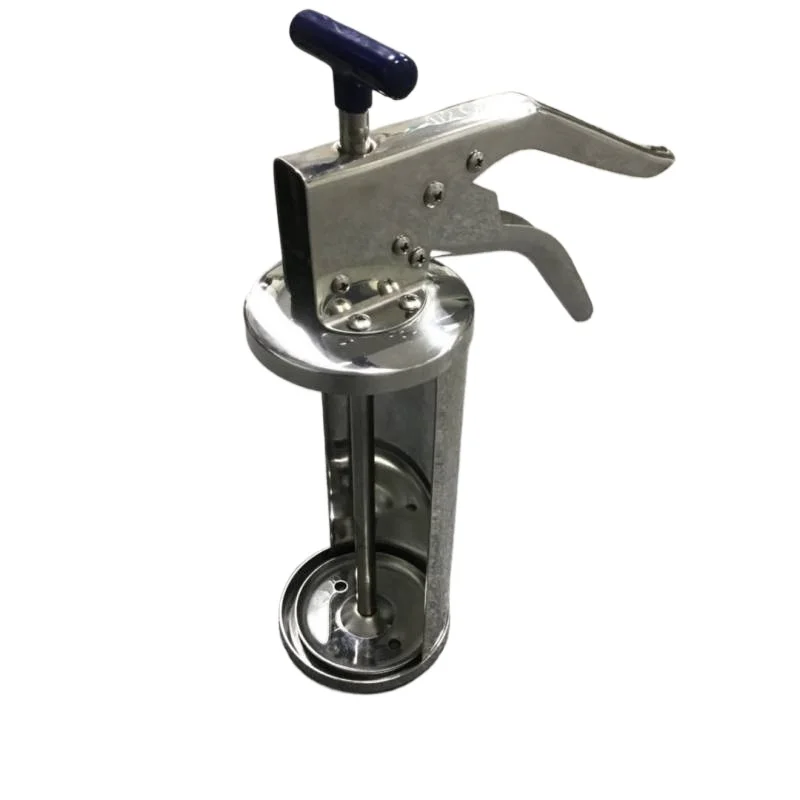
| A vertical piston dispenser with a trigger lever, a T handle on top and a graduated rack | The third, fourth, fifth, sixth, seventh and eighth images | By the chamber and by the position of the graduated rack, so the dose is set and readable |
The parameters describe the first form, because the capacity field names a bottle and the capacity list names three ounce fractions, and the description text says the unit is supplied with a reusable cartridge bottle. The photographs are dominated by the third form, which has no bottle at all and instead has a stainless chamber with a rack that carries a scale. The second form appears once and is a different configuration again, with a nozzle long enough to reach into a container rather than to portion onto food.
The practical consequence is that the record does not answer the first question a buyer asks. If the shipment is a cartridge bottle gun, the three ounce fractions in the parameters are the capacities of three bottles and the dose is whatever the operator's trigger stroke delivers, so a portion specification cannot be written from the listing at all. If the shipment is the vertical dispenser, the ounce fractions are three chambers and the rack scale sets the dose, and the listing's capacity field is describing the wrong product.
The question to ask is therefore not which dose is correct but which article number is being quoted, followed by a request for a photograph of the exact unit with the chamber or the bottle visible beside a ruler. Ask also whether the bottle in the first image is included with the vertical dispenser, and whether the two forms share any parts at all, because a spare parts list that mixes them will not be usable.
The wall thickness, and the grade question that vinegar raises
One of the record's images states a specification that the parameter block omits: the stainless tube is 1.2 millimetres thick, shown with a magnified inset of the tube wall, and captioned 304 stainless steel. That is the most useful number in the record and the one most likely to be reduced without notice, because tube wall is invisible in a photograph and a buyer cannot measure it without cutting the unit open. It belongs in the purchase order by name, with a tolerance and a statement of the method by which it will be checked, which in practice means a micrometer reading on a sectioned sample or on the open end of the tube.
The grade is the second question, and the record's own description text is what makes it worth asking. The description lists the unit as suitable for sauce, oil, vinegar, ketchup, mustard and mayonnaise. Vinegar is the difficult one. Acetic acid in the concentrations used in a kitchen attacks grade 304 stainless steel by pitting, and the attack is worse where the surface is not polished, where there are weld seams, and where the part is left wet. Salt makes it worse again, and a sauce that is both acidic and salty is the worst case in a kitchen.
Two things follow. The first is a question about the grade: whether 316 is offered at a different price, and whether the supplier recommends 304 for continuous vinegar service or only for occasional use. The second is a question about the surface: whether the inside of the tube and the inside of the nozzle are polished, and whether the assembly has welded seams in contact with the sauce. A polished seamless bore resists pitting far better than a rough welded one, and this is the difference between a dispenser that lasts several seasons and one that develops pits and a metallic taste.
The third question in this group is the one the record cannot answer at all, because it names only food grade plastics. The parts that are not stainless are the ones the sauce actually sits against at the sealing surfaces: the piston seal or seals, any gasket at the head, and any valve in the nozzle. Those materials decide chemical compatibility as much as the steel does, and they are also the parts that wear. Ask for the material of each, whether silicone, nitrile, EPDM or polytetrafluoroethylene, and ask for the food contact declaration covering them.
What to ask about food contact, and why it is not a formality
The record states food grade plastics and provides no certificate, no test standard and no country of origin. For a product that will be sold into food service in a regulated market, the document that matters is the food contact declaration for the plastic and elastomer parts, against a named standard for the destination market, with the material grades listed. Ask for that document by market, since a declaration written for one market is not automatically accepted in another, and ask whether the declaration covers the seals as well as the body. A declaration that covers only the stainless steel is easy to obtain and does not answer the question, because stainless steel is the part that is already compliant.
The dimensions, and the figure that has no unit
One of the record's images is a dimensioned drawing, which is a better source than the text, and it carries four figures: 29cm printed along the height, 19cm printed across the trigger lever, 8.5cm printed across the base plate at the foot of the unit, and 5.5cm printed at the top of the body. The drawing is a welcome exception in a record whose text supplies almost no dimensions at all, and the four figures are enough to tell a buyer whether the unit will fit under a shelf and whether it will stand on a counter beside a fry station.
They are not enough to tell a buyer the one dimension that decides whether the unit can be used with standard consumables, which is the internal diameter of the chamber or the neck of the bottle. The drawing dimension of 5.5 centimetres at the top of the body is the closest candidate, but whether it describes the outside of the body, the top plate, or the handle is not unambiguous from the drawing, and the only way to settle it is to ask. The chamber bore decides whether a standard cartridge fits, whether a standard nozzle fits, and what the chamber volume is, and it is worth obtaining as a bore in millimetres with a tolerance rather than as an outside dimension.
The description text then contributes a dimension that cannot be used. It reads, in full, Pot Dia: Approx.16, and the sentence ends there with no unit and no further text. Read against the record's own drawing, neither reading works: 16 centimetres is nearly twice the 8.5 centimetre base plate on the same unit, so a 16 centimetre pot cannot sit on it, and 16 millimetres is smaller than the neck of any sauce bottle in the record's photographs. So the figure has lost its unit, or its meaning, or both, and a purchase order that copies it will be quoting a dimension that cannot be manufactured as written. Ask for the pot diameter as a value in millimetres together with the dimension it refers to, and ask whether the pot is the bottle or the stainless chamber.
The bottle, and how many portions a fill gives
The record states that the unit is supplied with a reusable cartridge bottle, written as 1 reusable cartridge bottles, with the number and the noun disagreeing, and it never states the bottle's volume. That omission is more serious than it looks, because the bottle volume decides how often the operator stops to refill, and the stop is the real labour cost in a dispensary.
The arithmetic is the bottle volume divided by the dose, and it is worth doing at the doses the record lists rather than at one of them:
| Bottle volume | Portions at 10 mL | Portions at 15 mL | Portions at 20 mL | Portions at 30 mL |
|---|---|---|---|---|
| 250 mL | 25 | 16 | 12 | 8 |
| 350 mL | 35 | 23 | 17 | 11 |
| 500 mL | 50 | 33 | 25 | 16 |
| 650 mL | 65 | 43 | 32 | 21 |
| 1000 mL | 100 | 66 | 50 | 33 |
Across a lunch service of three hundred portions the difference is easy to see. At 15 millilitres a portion the service consumes 4.5 litres, which is nine refills of a half litre bottle, and at 20 millilitres it consumes 6 litres, which is twelve refills. Three extra refills per service is three extra stoppages, and if each takes a minute it is three minutes of an operator's time per shift, which over a year is measured in working days. So the bottle volume is a productivity specification and not a detail.
Three questions follow. What is the volume of the supplied bottle in millilitres, and how many bottles are supplied, since the field's grammar leaves that open. Is a second bottle supplied so that a full one can be waiting while an empty one is washed, because filling from a bulk container at the station wastes more time than changing a bottle. And is the bottle available as a spare part, since a reusable bottle that cannot be reordered turns a reusable dispenser into a disposable one.
Cleaning, and the two sentences the record garbles
Two of the record's descriptive sentences are damaged, and both of them are about function rather than about style, which is why they are worth reading twice. The first reads Simply pull the sauce is fired onto your food, which appears to be a mangled instruction about the trigger action. The second reads the end of the stop any leakage, which appears to be a mangled claim about the nozzle or the end cap preventing drips. Neither can be relied on, and one of them addresses the single most annoying fault in a sauce dispenser, which is a nozzle that keeps dripping after the stroke.
The question to ask is therefore the question those sentences fail to answer: what stops the flow when the trigger is released, and does the nozzle have a check valve or an anti-drip valve. In a kitchen the answer matters because a dispenser that drips leaves sauce on the counter, on the operator's glove and on the outside of the bottle, and the resulting cleaning is a daily labour cost. If there is a valve, ask what it is made of, because it is a food contact part, and ask whether it can be removed for cleaning.
Cleaning is the second half of the same question, and it is where this class of equipment fails inspection. Ask whether the unit can be stripped without tools, whether every food contact part is removable, whether the piston seal is a user replaceable item and how it is retained, and whether the parts are dishwasher safe at a stated temperature. Ask also whether the chamber and the nozzle can be reached with a bottle brush, because a stroke of sauce left in a blind corner of a tube is what a food safety inspection finds. The record's own photographs are useful evidence here: the sixth image shows the unit with the piston and its central rod visible, which suggests the body can be opened, and the fifth and eighth images show the chamber as a pair of curved plates around the graduated rack, which suggests the assembly is separable. Ask the supplier to confirm the sections the photographs imply rather than relying on the implication.
Titles, brand names and the captions in the gallery
The record's title names a well known international burger chain as a product descriptor, and the parameters and description text are otherwise written in the neutral vocabulary of a catering supplier. Naming another company's brand in a product title is a commercial risk rather than a specification problem: it suggests an association or an equivalence that the supplier has no right to assert, it invites a complaint from the brand owner, and on some marketplaces it is a listing violation in itself. A buyer who republishes the title, or who builds a catalogue from a feed containing it, inherits that exposure, and the safer construction is to describe the function rather than the customer, as a quantitative sauce dispenser for burgers, salads and sandwiches.
The gallery carries a smaller version of the same problem in its captions. One of the sauce bowls in the second image is captioned with a misspelling of salad, and the same image carries the words 304 stainless steel as a standalone claim. The misspelling is trivial in itself, but it is evidence about the care taken with the record's text, and it belongs in the same list as the four disagreeing dose lists, the truncated pot diameter and the garbled sentences about the trigger and the leakage. Taken together these are not product faults; they are documentation faults, and they mean that every specification this purchase relies on should be restated by the buyer in the order in the buyer's own units and confirmed back in the same form.
One further caution belongs in this section. Several of the record's images show the unit held in a gloved hand or standing on a plain surface, and one of them shows the stainless body against a fabric background. None of the images shows the unit packed for export, and the only packing photograph in the record is a plain kraft carton shown on its own with no quantity, weight or dimensions. So the export packing, the carton count and the unit net weight have to be asked for rather than read, and the answer should be a number for a carton of a stated quantity rather than a description of a carton.
Questions to put to the supplier before ordering
- Which of the forms in the record's photographs is the quoted article: the cartridge bottle gun, the gun with the long nozzle, or the vertical piston dispenser with the graduated rack?
- Is there a separate article number for each form, and which article number is on the quotation?
- Is the supplied capacity a chamber volume or a bottle volume, and for which of the two is the ounce fraction quoted?
- The capacity is listed as a third, a half and one ounce and also as 10, 20 and 30 grams and as 10, 15, 20 grams and 10, 20, 30 millilitres. Which set is correct, and is half an ounce fifteen grams or twenty?
- Is the dose set by the chamber or by the trigger stroke, and if by the trigger stroke, what is the stroke adjustment range in millilitres?
- What is the dose tolerance, expressed as a percentage of the nominal dose?
- What does the graduated rack on the vertical dispenser measure, what is its smallest division, and is it a dose scale or a travel scale?
- Does the dose change as the bottle empties or as the piston seal wears, and by how much over a full bottle?
- What is the internal bore of the chamber in millimetres, and what is the internal diameter of the bottle neck?
- Is the 1.2 millimetre wall thickness on the tube the minimum or the nominal figure, and what tolerance applies to it?
- Is the tube seamless or welded, is the bore polished, and are there weld seams in contact with the sauce?
- Is grade 316 available, and does the supplier recommend 304 for continuous vinegar and salt service?
- What is the material of the piston seal, the head gasket and any nozzle valve, and what is the food contact declaration covering each?
- Is there a check valve or anti drip valve in the nozzle, and what is it made of?
- Can the unit be stripped without tools, and is every food contact part removable for cleaning?
- Are the parts dishwasher safe, and at what temperature?
- Is the piston seal a user replaceable part, how is it retained, and what is its price?
- What is the volume of the supplied bottle in millilitres, and how many bottles are supplied, since the record writes one reusable cartridge bottles?
- Is a spare bottle available separately, and what is the price of a bottle and of a spare seal?
- What is the pot diameter, written as a value in millimetres, and to which part does it refer?
- What are the overall dimensions and the net weight of the unit, and what is the weight of the unit in its carton?
- What is the export packing, how many units go in a carton, and what are the carton dimensions and gross weight?
- What is the price, the minimum order quantity, the trade term, the production lead time and the warranty?
- What certificates are held for this item, and what is the country of origin declared on the documents?
- Can the supplier supply the four dose lists again in one consistent unit, with the density assumed in the conversion stated?
Questions one, four, nine, twelve and thirteen are the ones that decide whether a quotation can be compared with another or with the buyer's own requirement. Until question one is answered the other twenty four are being asked about an unknown article, and until question four is answered the buyer does not know whether the middle dose is fifteen or twenty grams, which the cost arithmetic above shows to be the difference between two portion control policies.
Incoming inspection when a shipment arrives
- Confirm against the packing list which form arrived, and compare it with a photograph of the exact quoted article rather than with the listing's gallery.
- Count the units and the bottles separately, and record whether the number of bottles matches the quotation.
- Weigh the unit and compare with the quoted net weight, and weigh a complete carton and compare with the quoted gross weight.
- Measure the overall height, the base diameter and the lever length, and compare with 29, 8.5 and 19 centimetres from the record's own drawing.
- Measure the chamber bore with a caliper and record it, since the record states no bore.
- Measure the tube wall thickness at the open end with a micrometer and compare with the 1.2 millimetre figure, taking readings at four positions around the circumference.
- Fill with water and dispense ten strokes, weighing each delivery, to establish the dose in grams per stroke and the spread between the lightest and the heaviest stroke.
- Repeat the ten stroke weighing with the sauce actually used, and calculate the dose in grams using the density of that sauce.
- Set the rack or the stroke adjustment to each of the three settings and weigh the delivery at each, to establish what the three settings actually deliver.
- Leave the unit loaded for an hour and inspect the nozzle for dripping, since the record's own sentence about leakage is unreadable and this is the check that replaces it.
- Fill with vinegar or with the most acidic sauce in the range, leave it standing overnight, and inspect the bore and the seals for discoloration or odour afterwards.
- Strip the unit without tools and list every removable part, then confirm that each can be reached with a brush and washed.
- Inspect the seals and gaskets under magnification for flash or parting lines, which are where leaks begin.
- Check the inside of the bore and the nozzle for weld seams, polishing marks and roughness by feel and by a visual inspection with a light.
- Run a shift's worth of portions and record how many refills were needed, to confirm the bottle volume suits the service.
- Record the article number, the date and the readings in a file with photographs of the unit and of the micrometer reading, so that the second order can be checked against the first.
The sixth, seventh and eighth checks are the ones that turn this record into a specification, because the wall thickness, the dose in grams and the spread between strokes are the three figures the record either omits or quotes inconsistently, and all three can be measured in an afternoon with a micrometer and a scale.
Answers to the questions this record raises most often
Is half an ounce fifteen grams or twenty?
Half an ounce is 14.2 grams by weight or 14.8 millilitres by volume, so fifteen is the figure that agrees with the ounce list and twenty is not, since twenty grams would be about 0.68 of an ounce. The record contains both, in two different fields.
How many portions does one bottle give?
The record does not state the bottle volume, so it cannot be worked out from the listing. At a half litre bottle the answer is fifty portions at 10 millilitres, thirty three at 15 and twenty five at 20, so the bottle volume must be obtained before the figure means anything.
What does the 1.2 millimetre figure refer to?
The wall thickness of the stainless tube, as stated and illustrated in one of the record's own images. It is the specification most likely to be reduced without notice, since it cannot be seen in a photograph, and it should be named in the purchase order with a tolerance.
Is grade 304 good enough for vinegar?
The record lists vinegar among the uses and does not discuss the grade. Vinegar attacks grade 304 by pitting, worse on a rough or welded surface, so the questions to ask are whether 316 is available, whether the bore is polished, and whether vinegar is recommended for continuous service or occasional use only.
Does the dispenser have a drip valve?
The record's sentence about leakage is garbled and cannot be relied on. Ask directly what stops the flow when the trigger is released, whether there is a check or anti drip valve, and what it is made of.
Which unit does the photograph show?
The photographs show a vertical piston dispenser with a trigger and a graduated rack in six of the eight images, a cartridge bottle gun in the first, and a long nozzle gun in the second, while the parameters and the description text describe the bottle gun. Confirm the article number and ask for a photograph of that exact article.
Is the graduated rack a dose scale?
Two of the images show a rack with fine divisions running down the chamber to the piston, and the record quotes no figures for it. The rack is what makes a portion repeatable, so its meaning, its smallest division and whether it is a dose or a travel scale are worth confirming.
What is the pot diameter?
The description text reads Approx.16 and stops, with no unit. Against the record's own drawing, which shows an 8.5 centimetre base, 16 centimetres is impossible for a pot and 16 millimetres is too small, so the figure is unreadable as written and should be obtained again in millimetres with the part it describes named.
Can the title name another company's brand?
The record's title names a well known burger chain as a descriptor. That is a commercial risk for anyone republishing the title, and the safer construction is a functional description such as a quantitative sauce dispenser for burgers, salads and sandwiches.
What is not in this record at all?
The bottle volume in millilitres; the chamber bore; the dose tolerance; the seal, gasket and valve materials; the food contact certificate and the test standard; the packing quantity, carton dimensions and unit net weight; the price and minimum order quantity; the trade term and lead time; the warranty and the spare parts list; the country of origin; and any statement of which of the three photographed forms is the article being sold.
Source, scope and what this guide does not claim
This guide is based on the Hoting queue record for Product ID 1601274018296, a stainless steel sauce dispenser with a sauce bottle, and on the eight detail images that accompany it. All eight images were examined.
The published parameter block supplies the product name, the material as SS304, the capacity as one third, one half or one whole ounce, and the output as 10, 20 or 30 grams, with a field label and a second specification concatenated into each of the two rows. The description text supplies the same capacity in three further lists, of which one repeats the ounce fractions, one gives 10, 15 and 20 grams and one gives 10, 20 and 30 millilitres; it also supplies the material as stainless steel 304 plus food grade plastics, the statement that the unit is supplied with one reusable cartridge bottle, a list of sauces including sauce, oil, vinegar, ketchup, mustard and mayonnaise, a statement about use in restaurants, hamburger shops and home kitchens, the truncated line reading pot diameter approximately 16 with no unit, and two sentences about the trigger and about leakage that are damaged and are quoted as damaged.
Four further figures are read from the record's own images and are identified in the text as coming from images rather than from the listing: the 1.2 millimetre wall thickness of the stainless tube, with a magnified inset of the wall; the four dimension figures printed on the dimensioned drawing, which are 29 centimetres along the height, 19 centimetres across the lever, 8.5 centimetres across the base plate and 5.5 centimetres at the top of the body; the graduated rack running down the chamber to the piston, visible in two images; and the fact that six of the eight images show a vertical piston dispenser with a trigger, one shows a cartridge bottle gun with a translucent bottle and a plain kraft carton, and one shows a gun with a long thin nozzle held in a gloved hand. The sauce names used in the density table are taken from the four bowls captioned in the second image, and the misspelling in one of those captions is noted without reproducing it.
Several passages are the author's arithmetic or reading rather than published data, and are set out here so they are not mistaken for specifications. The conversions from ounce fractions to grams use 28.3495 grams to the ounce, and to millilitres use 29.5735 millilitres to the fluid ounce. The densities in the sauce table are approximate typical values given to show the size of the effect, and a buyer should measure the density of their own sauce by weighing a known volume rather than relying on them. The portions per kilogram are a thousand divided by the dose in grams, and the batch figures multiply that. The portions per bottle are the bottle volume divided by the dose. The comparison of the four dose lists is arithmetic on the record's own figures.
Unless a figure appears in the lists above, it is not in this article because it is not in the record. This record states no bottle volume, no chamber bore or volume, no dose tolerance, no stroke adjustment range, no seal, gasket or valve material, no food contact certificate or test standard, no net weight, no packing quantity or carton dimensions, no country of origin, no price, no minimum order quantity, no trade term, no lead time, no warranty, no spare parts list and no identification of which of the three photographed forms is the article being sold.
A buyer can close the whole specification with five requests and one measurement: the article number and a photograph of the exact article; one consistent dose list with the density assumed in the conversion stated, in the units the chamber was designed in; the chamber bore, the bottle volume in millilitres and the dose tolerance; the wall thickness with a tolerance together with the grade answer on vinegar service; and the material and food contact declaration for every non stainless part. The measurement is a ten stroke weighing with the buyer's own sauce, which settles the dose in grams, the spread between strokes and the accuracy of the rack in one afternoon through the TEBAK sales inquiry channel.
Key specifications
- Name field of the parameter block
- Sauce dispenser gun, material, SS304, three items concatenated into one field value
- Capacity field of the parameter block
- 1/3Oz, 1/2Oz or 1/1Oz, output, 10g or 20g or 30g, again concatenated into one field value
- Material
- SS304 in the parameter block, stainless steel 304 plus food grade plastics in the description text
- Capacity in the description text, first list
- 1/3Oz, 1/2Oz or 1/1Oz
- Capacity in the description text, second list
- 10g, 15g, 20g
- Capacity in the description text, third list
- 10mL, 20mL, 30mL
- Wall thickness of the stainless tube, from the record's own image
- 1.2mm thick
- Dimensions from the record's own dimensioned image
- 29cm, 19cm, 8.5cm and 5.5cm printed on the drawing
- Pot diameter in the description text
- Approx.16 with no unit and the sentence cut off
- Bottle supplied
- written as 1 reusable cartridge bottles
- Bottle volume in millilitres
- not stated anywhere in the record or its eight images
- Seal and gasket material
- not stated
- Dose adjustment
- a graduated rack visible in two of the record's images, with no figures quoted
- Packing seen in the record's own image
- a plain kraft carton, with no quantity, weight or dimensions given