
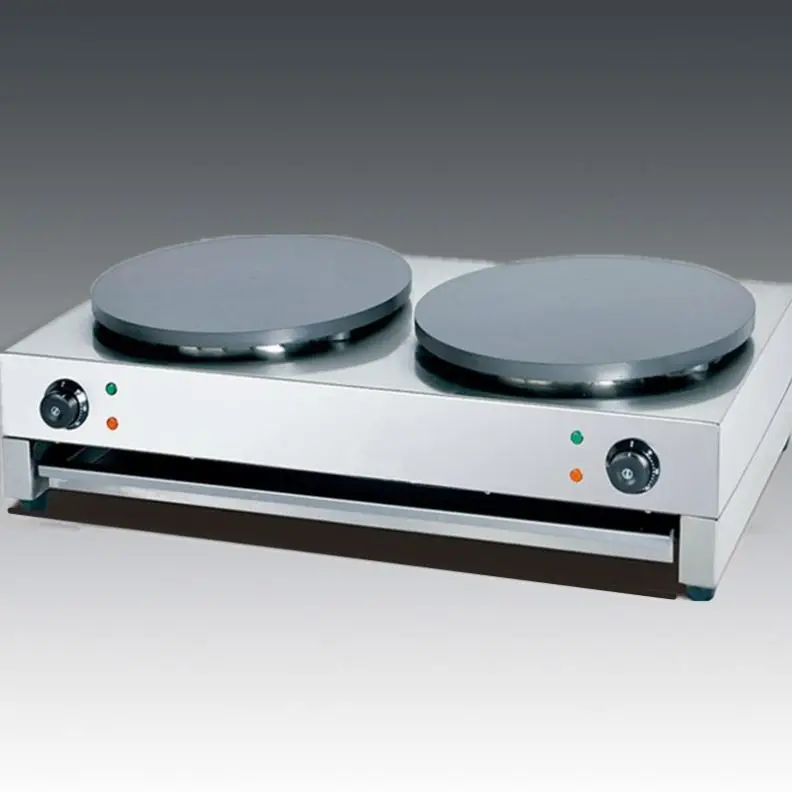
Source-controlled product identity
The Hoting queue identifies Product ID 1601390929445 as an electric crepe machine for commercial use, listed under the title "Rotating French Large Pancake Automatic Hot Plate Electric Crepe Machine Making Crepe Machine Commercial Crepe Machine". The description repeats the title and then carries a parameter block with four rows, all of them populated, followed by a packing and shipping heading with nothing under it.
Four rows is enough to establish what the machine is and what it draws, and it is not enough to buy a crepe machine. The four rows give the product name, the model AK-31, a voltage of 220 volts and a power of 3000 watts. They do not give the diameter of the plate, its thickness, its material, whether it is coated, what temperature the thermostat holds, how long it takes to recover between crepes, what the machine weighs, how big it is, how it is packed, or what certification it carries.
Two of the four rows are more useful than they look, because they combine into a figure the record does not state. Taking the stated power and the stated voltage together gives the current the machine draws, and that current decides whether the machine can be plugged into the circuit the buyer has. At 220 volts a 3000 watt appliance draws about 13.6 amps, and that figure sits on the wrong side of a boundary that matters in several markets.
The title also makes three claims that no row supports. It calls the machine rotating, automatic and large, and none of the recorded parameters says how the rotation works, what is automated, or how large the plate is. Those three questions are the first ones a buyer should ask, and each of them changes what the machine can do in a kitchen.
The four recorded parameters, verbatim
| Parameter | Recorded value |
|---|---|
| Product Name | Electric Crepe Machine |
| Model | AK - 31 |
| Voltage | 220 Volts |
| Power | 3000 Watts |
Below the table the description carries a heading reading PACKING SHIPPING with no content beneath it, and then a company introduction, which is quoted at the end of this article. The empty heading is worth noting because on a machine of this type the packing is not a formality: a large circular plate that has to arrive flat and unmarked needs more than a box, and the record says nothing about how it is protected.
What "rotating" and "automatic" actually mean
Both words are in the title and neither is defined, and on a crepe machine they can describe three quite different arrangements.
In the first arrangement the plate itself turns while the batter is poured at the centre, and the rotation spreads the batter outward into a round crepe. The operator pours and the machine does the spreading. In this design the rotation is the spreading mechanism.
In the second arrangement the plate is fixed and a powered arm sweeps over it, spreading the batter the way a hand-held spreader would. The plate is static and the tool rotates.
In the third arrangement the plate turns for convenience, so that the operator can reach different parts of a large crepe without walking around the machine, but the batter is still spread by hand with a spreader. Here the rotation is an ergonomic feature rather than a process.
These are not variations on a theme. The first two decide who or what spreads the batter and therefore how consistent the crepe is and how much skill the operator needs, while the third decides nothing about the crepe at all. Ask which one the AK-31 is, and ask for a photograph or a short video of the machine working, because a still image cannot distinguish them.
Ask also what is automated, because the word automatic in a listing of this kind often means nothing more than that the plate is motor driven. Ask whether the rotation speed is fixed or adjustable, and if adjustable over what range, since a batter's consistency and a kitchen's ambient temperature both change how fast it spreads. Ask in which direction the plate turns and whether it can be stopped for loading and unloading, or whether it turns continuously and the operator works around it. Ask whether the rotation is reversed or whether there is a brake, because a plate that cannot be held still makes it harder to turn a crepe or to remove it cleanly.
If the machine has a motor and a rotating plate, also ask about the mechanism rather than only the result. Ask whether the drive is a gearbox or a belt, whether the plate sits on a bearing that can be cleaned, and what the machine's manual says about lubricating or servicing it, because a rotating machine has wear points that a static one does not. Ask whether the rotation stops when the machine is opened or when a guard is lifted, if there is a guard at all, since a powered rotating plate is a place where a hand, a sleeve or a cloth can be caught.
The plate: the specification that decides everything
On a crepe machine the plate is the product. Everything else, the housing, the controls and the frame, exists to hold the plate at a temperature and to keep it turning. The record gives no plate specification at all, and four figures must be established before the machine can be compared with anything else.
The first is the diameter. The title says large, which is not a dimension, and crepe machines are made in a range of diameters from under 30 centimetres to over 40. The diameter decides the size of the finished crepe, how many crepes a given volume of batter yields, and whether the machine fits the counter. It also decides whether folded, rolled or quartered presentation works, since a crepe folded into quarters must fit the plate it was cooked on. Ask for the plate diameter in centimetres, and ask whether the finished crepe measures the same as the plate or a little less, because the batter does not reach the outermost edge.
The second is the thickness of the plate, which is what determines how the machine behaves under load. A thick plate holds a large amount of heat, so when cold batter is poured onto it the surface temperature falls less and returns faster, and the crepes come out evenly coloured from the first to the last. A thin plate heats quickly and responds quickly to the thermostat, but it gives up its heat to the batter and takes longer to come back. Both designs are sold, and the difference shows up not when the machine is idling but during a rush. Ask for the plate thickness in millimetres and for its material, since a plate is often cast iron, steel or aluminium, and the three differ in how much heat they store, how fast they conduct it and how they behave when they are scraped.
The third is the heating arrangement. Most machines of this type have an electric element or elements beneath the plate. Ask whether the heat is distributed evenly across the whole plate or concentrated towards one area, whether there is more than one heating zone, and whether the outer edge runs cooler than the centre, which is a common complaint on machines with a single central element. Ask for the surface temperature at the centre and at the edge at the thermostat's normal setting, because a plate that is hot in the middle and cool at the rim produces crepes with a pale edge.
The fourth is the surface finish, which is treated in the next section because it decides what tools the operator may use.
Coated or seasoned, and the tools that follow from it
A crepe plate is either bare metal that is seasoned by use, in the way a carbon steel pan is seasoned, or it carries a non-stick coating. The record says nothing about which, and the choice has consequences that a buyer only notices in service.
A seasoned bare plate is durable and can be worked with a metal spatula or a metal spreader, which many crepe makers prefer because it gives better control of the batter. It needs to be seasoned before first use and cared for afterwards, and it does not tolerate being scrubbed or left wet, but it can be re-seasoned and refurbished almost indefinitely, and there is no coating to wear through.
A coated plate is non-stick from the first crepe and is easier to clean, but the coating has a temperature limit and a working life. It must not be cut or scraped with metal tools, since a scratch becomes a place where the coating lifts and where batter sticks, and once the coating is damaged the machine's performance changes permanently. A coating also imposes an upper limit on how hot the plate may be run, which interacts with the thermostat setting.
Ask which the AK-31 has. If it is coated, ask what the coating is, what its maximum working temperature is and what tools the manual permits. If it is bare, ask what the material is and whether the supplier's instructions for seasoning and for daily care are supplied. Ask in either case what the manual says about cleaning, because a rotating plate is more awkward to clean than a fixed one and the cleaning method may be constrained by what is underneath.
Ask also whether the plate can be removed for cleaning or for replacement. On a rotating machine the plate usually sits on its drive rather than lifting off, and the buyer should know whether a plate can be replaced at all, at what cost and with what lead time, since the plate is the part that wears, warps or loses its surface over the life of the machine.
Recovery, not baking speed, is what sets throughput
The number of crepes a machine produces in an hour is not determined by how fast it cooks a single crepe. It is determined by the total cycle: pouring the batter, spreading or rotating it, letting it cook, turning or removing it, and letting the plate come back to temperature before the next pour.
That last step is the one buyers underestimate. Batter is wet and often cold from a refrigerator, and when it lands on a hot plate it takes heat out of the metal. A plate that has stored a great deal of heat loses less and recovers quickly, so the operator can pour the next crepe at once. A plate with little stored heat drops sharply and the operator has to wait. The two machines may quote the same power and even the same thermostat range, and they will produce very different numbers in a service, because the limiting factor is the wait between crepes rather than the baking itself.
The arithmetic is simple and is worth stating because it shows which figure to demand. The crepes per hour equal sixty divided by the total cycle time in minutes, and the cycle time includes the recovery, so the buyer needs the bake time, the handling time and the recovery time. Ask the supplier for the time the plate takes to return to its set temperature after a measured volume of batter is poured, and ask under what conditions that figure was obtained, since a figure quoted without a batter volume and a starting temperature is not comparable.
Ask also for the time to heat the plate from cold to working temperature, because that is time lost at the start of every service, and for the number of crepes the machine can produce before the operator must pause, which is the practical measure of whether one machine is enough for a stall or whether two are needed.
And ask about the finished crepe rather than only the count. A machine that produces many crepes with uneven colour is not a machine that produces many good crepes, so the buyer should ask how the machine is adjusted when the first crepe of a batch is paler than the last, which is the symptom of a plate that has lost heat and cannot recover. On a well designed machine the correction is a slightly longer rest between crepes; on a poor one there is no correction available.
Temperature control, and what the record does not say about it
The record gives a power figure and no temperature figure, and on a crepe machine the temperature matters at least as much as the power.
Ask for the range of the thermostat and for the accuracy with which it holds the plate temperature, because a plate that swings widely produces crepes that vary in colour from one to the next even when the operator does nothing differently. Ask whether there is an indicator that shows when the element is on and when the thermostat has cycled off, since an operator works to that signal, and ask whether the control is a thermostat with a dial, a digital controller or a simple on and off switch with no temperature setting at all, which is common on inexpensive machines and makes repeatable results harder.
Ask whether there is a high temperature limit that acts independently of the thermostat, in case the thermostat fails and the plate keeps heating. Ask what the surface temperature is at the thermostat's normal setting, measured at the centre and near the edge rather than stated as a dial position, since a dial number is not a temperature. Ask about the heat-up time from cold. And ask whether the machine is intended for continuous commercial use or is a light duty appliance, because a machine designed for intermittent use will not hold its temperature through a busy service.
The power figure, and the circuit it has to live on
The record states 3000 watts at 220 volts, and dividing one by the other gives the current the machine draws. That calculation produces about 13.6 amps at 220 volts, about 13.0 amps at 230 volts, and about 12.5 amps at 240 volts. The exact figure therefore depends on the actual supply voltage in the place the machine is installed, and a buyer should compute it rather than assume.
The reason this matters is that in several markets a standard domestic plug is fitted with a fuse rated at 13 amps, and a machine that draws 13.6 amps exceeds it. On a supply of 240 volts the same machine draws 12.5 amps and is marginally inside the limit, which means the same appliance can be acceptable in one place and unacceptable in another that looks similar. The buyer should take the actual supply voltage in their kitchen, compute the current, and compare it with both the fuse or circuit breaker protecting the socket and the rating of the cable behind it.
The likely outcome for a machine of this size is that it should have a dedicated circuit rather than sharing one with other equipment, because a 3 kilowatt load is close to the capacity of a general purpose circuit and because a kitchen that adds a second appliance to the same circuit will trip it. Ask the supplier for the plug and cord that are supplied and for the connection the machine expects, ask whether the machine is available in other voltages, and ask whether a 110 volt version exists for markets that use it, since the record states only 220 volts.
Ask also whether the machine is single phase, which a 3 kilowatt appliance at this voltage normally is, and whether the cord length is sufficient for where the machine will stand, since extending a cord on a high current appliance is not something to improvise. Where the machine is installed, the electrical work belongs to a competent person working to the rules of the destination market, and the buyer should have the manual's connection requirements before the machine arrives rather than after.
Energy cost follows the same arithmetic used for any appliance. The energy consumed equals the power multiplied by the time the element is actually on, and because a thermostat cycles, the machine does not draw its full rating continuously once it is at temperature. The cost per hour is the average draw in kilowatts multiplied by the tariff, and the cost per crepe is that hourly cost divided by the crepes produced in the hour, which brings the arithmetic back to recovery time, since a machine that spends longer between crepes costs more per crepe even if it draws the same power.
Cleaning, hot surfaces and the rotating mechanism
A crepe machine lives in a kitchen and comes into contact with batter, oil, sugar and steam, so the questions about cleaning and about safety are practical rather than formal.
Ask how the machine is cleaned, whether the plate is wiped while hot as is usual with this type of appliance, and what the manual says must not be used on it. Ask whether the electrical parts are protected from spillage and from a wet cloth, what the enclosure's protection from water and dust is stated to be, and whether any part of the machine may be washed. Ask where batter and debris collect, whether there are traps where material can build up around the rotating plate or its bearing, and how those are cleaned.
Ask about the hot surfaces. A plate at crepe temperature will burn, so the buyer should know whether the machine has any guard, handle or cool area where an operator can rest a hand, and whether the manual requires any warning labelling. Ask about the rotating plate as a mechanical hazard: whether there is a guard over the drive or the plate's edge, and whether anything prevents an operator's sleeve, a cloth or a tool from being drawn into the mechanism. This matters more on a machine where the plate turns under power than on a static one.
Ask about the machine's stability, since a large plate on a rotating bearing is a machine that can be pushed, and ask whether it is intended for a counter or a stand and whether feet or fixing points are provided. Ask for the machine's weight, which the record does not give, because a machine that has to be lifted for cleaning and that holds a hot plate is heavier in practice than its dry weight suggests.
Documentation for a machine that touches food and carries mains power
The record lists no certification. This appliance both contacts food and draws mains power at a high current, so two sets of documents are relevant.
On the food contact side, ask which parts come into contact with the batter and what they are made of, whether the plate material or its coating has documentation for food contact suitability, and what the supplier holds for the destination market. On the electrical side, ask which safety marks the machine carries, for the test reports behind them, and for the name of the legal entity that holds each one, since a mark attached to a different variant does not transfer to the variant being bought. Ask for the operating and installation manual and for any required labelling in the language of the destination market.
What is required in any given market is a matter for that market's rules and for the buyer's own compliance adviser, and nothing in this guide should be read as a statement of what any market requires. The practical point is that the buyer should establish the answer before ordering, because a document obtained after delivery is of no use at the port.
Packing, for a machine with a large circular plate
The description carries the heading PACKING SHIPPING with nothing under it, and on this machine the packing deserves its own questions.
A crepe machine's plate is a large flat circular surface, and a flat surface is what suffers when a carton is dropped or stacked. Ask what the machine is packed in, what the carton grade is, whether there is foam or a moulded insert above and below the plate, whether the machine is fixed to a pallet, and what the loaded carton's dimensions and weight are. Ask how many units fit a pallet and how the cartons stack, since stacking pressure is what deforms a large plate in transit. Ask whether the cord and any accessories such as a spreader are packed separately, and whether they are inside the carton with the machine or in a separate box that can be lost.
Ask about the trade term and who arranges the shipment, since a machine of this size and weight is more likely to move as part of a consolidated load than as a parcel, and the buyer needs the packed volume and weight to obtain a freight rate. The record gives neither dimension nor weight for either the product or the package, so both must be requested.
What a buyer should request before ordering
- What rotates and what is automatic: whether the plate turns to spread the batter, whether a powered arm spreads it over a fixed plate, or whether the rotation is only for the operator's convenience.
- The rotation speed and whether it is adjustable, the direction, whether rotation can be stopped or braked, and what kind of drive and bearing the plate sits on.
- The plate diameter in centimetres, and whether the finished crepe measures the same as the plate.
- The plate thickness in millimetres and its material.
- Whether the plate is bare and seasoned or coated, what the coating is, its maximum working temperature and the tools the manual permits, and whether the plate can be replaced and at what cost.
- The heating arrangement, whether there is more than one zone, and the surface temperature at the centre and at the edge at the normal setting.
- The thermostat range and accuracy, whether there is an indicator of element operation, whether there is an independent high temperature limit, and the heat-up time from cold.
- The recovery time after a measured volume of batter, with the conditions under which it was measured, and the number of crepes per hour that results.
- Whether the machine is rated for continuous commercial use.
- The actual supply voltage in the buyer's kitchen and the current the machine will draw there, the plug and cord supplied, whether a dedicated circuit is required, and whether other voltage versions exist.
- Cleaning method, what the manual forbids, how the rotating mechanism and its bearing are cleaned, and the stated protection of the electrical parts against water and dust.
- Guards or handles around the hot plate and around the rotating mechanism, any required warning labels, stability and whether the machine is for a counter or a stand.
- Machine dimensions and weight, and the packed dimensions, packed weight, carton grade, internal protection, palletisation and units per pallet.
- Food contact materials and the documentation held for the destination market.
- Electrical safety marks, the test reports behind them, the certificate holder, and the manual and labels in the destination market's language.
- Warranty period, what it covers, and the terms for a cross-border claim including who pays the return freight.
- Spare parts, particularly the plate, the thermostat and the drive, with part numbers, prices and lead times.
- Price at the buyer's quantity, minimum order quantity, trade term, payment terms and lead time.
Acceptance and incoming inspection
The record states four figures and leaves everything else open, so the buyer's own measurements on the first machine become the specification for the ones that follow. The ten checks below are the ones worth writing into the order.
Measure the plate. Record the diameter with a tape across the centre and the thickness at the edge, since a machine delivered with a smaller or thinner plate than expected is the most likely deviation on this type of product. Record its material and, if it is coated, look for scratches or lifted coating before the machine is ever used.
Measure the temperature. Bring the machine to its normal setting and measure the surface at the centre, at the mid radius and near the edge with a contact probe or an infrared thermometer, and record the spread. Then measure the recovery: pour a measured volume of batter at a typical consistency, time the return of the surface to its set temperature, and record both the volume and the result, because without the volume the figure means nothing. Repeat it five times and record whether the recovery time grows as the machine heats through, which is a sign of an inadequate plate or heater.
Make crepes and count them. Produce a batch at a normal working pace and record the number of good crepes obtained, the number discarded, the time taken and the colour consistency between the first and the last. This is the only check that measures the machine as a production tool rather than as a set of parts, and the first-crepe-versus-last-crepe comparison is what reveals whether the plate stores enough heat.
Test the controls and the mechanism. Confirm the thermostat's range and that it holds, confirm the operation of any indicator, confirm the presence and the action of the independent high temperature limit by the method the manual specifies, and confirm that the rotation works at every speed setting and that it can be stopped where the machine is supposed to allow it. With the machine running, check whether anything about the plate or the mechanism could catch a sleeve or a cloth.
Check the installation figures. Confirm the rating plate matches the order and that the voltage corresponds to the supply, then verify with a current meter that the machine draws approximately the figure computed from its rating at the actual supply voltage, which will also show whether the supply is what the buyer believes it to be. Confirm the circuit and the protective device are adequate before the machine is used in service rather than after it trips during a rush. Confirm the cord and plug are as ordered and that the length suits the position.
Finally, record the physical figures for the file. Weigh the packed carton and the machine, confirm the packed dimensions, and note the condition of the packing on arrival, particularly whether the plate is flat and whether the packing protected it. Those figures are what a future reorder and a future freight quote will be based on, and they are also what establishes a claim if the next shipment arrives worse.
Buyer decision framework
The source for this guide is a record with four populated parameters, a packing heading with no content and a company introduction. The four rows identify an electric crepe machine, model AK-31, at 220 volts and 3000 watts.
Two rows are directly usable. The model number is the key to spares and manuals, which is more useful on a machine with a motor and a hot plate than on a simple appliance. The voltage and power together give the current, which is about 13.6 amps at 220 volts, about 13.0 at 230 and about 12.5 at 240, and that figure decides whether the machine can be connected to the circuit the buyer has and whether it requires a dedicated supply.
Neither of the other two rows is a specification of the product: the product name is a category and the model number identifies a variant, so nothing in the record describes the machine's actual working parts.
The purchase becomes a decision once four things are known. First, what rotates and what is automatic, since the three possible arrangements produce different machines and different crepes. Second, the plate's diameter, thickness, material and surface, since the plate is the product and everything else supports it. Third, the recovery time and the resulting crepes per hour, since recovery rather than baking speed sets throughput and the plateau between crepes is what an operator actually does with their time. Fourth, the installation consequence of the 3000 watt rating at the buyer's actual voltage, together with the cord, plug and circuit it requires.
Until those four answers are in hand, this record describes a 3 kilowatt electric crepe machine with a model number and a voltage, and it does not describe a plate that can be compared with another machine or a machine that can be ordered against a kitchen's production target. Each of the four gaps is a question for the supplier rather than an inference, and asking them costs nothing while assuming an answer costs a shipment.
Frequently asked questions
Does the plate rotate to spread the batter, or does the operator spread it?
The title says rotating and automatic but does not say what turns. Three arrangements exist: a turning plate that spreads the batter, a fixed plate with a powered spreading arm, and a turning plate that is only for the operator's convenience with spreading still done by hand. Ask which one it is and ask for a video of the machine working.
What size crepe does it make?
Not stated. The title says large, which is not a dimension. Ask for the plate diameter in centimetres and for whether the finished crepe measures the same as the plate.
What is the plate made of, and how thick is it?
Not stated. The thickness determines how much heat the plate stores and therefore how quickly it recovers between crepes. Ask for the thickness in millimetres and the material, and ask for the surface temperature at the centre and at the edge.
Is the plate coated or bare?
Not stated. A coated plate is non-stick and easier to clean but limits the tools that may be used and has a working life, while a bare seasoned plate tolerates metal tools and can be refurbished. Ask which it is and what the manual permits.
How many crepes per hour does it produce?
Not stated, and it is not the same number as the baking time suggests. Crepes per hour equals sixty divided by the total cycle time, which includes the plate's recovery between pours. Ask for the recovery time after a measured volume of batter, and for the heat-up time from cold.
What temperature does it run at?
Not stated. Ask for the thermostat range and its accuracy, the surface temperature at the normal setting measured at the centre and near the edge, whether there is an indicator of element operation, and whether there is an independent high temperature limit.
Can it be plugged into a normal socket?
That depends on the supply and the circuit. At 220 volts the machine draws about 13.6 amps, at 230 about 13.0 and at 240 about 12.5, so on supplies around 220 volts it exceeds a 13 amp fused plug and on 240 it is marginally inside. Compute the current at the buyer's actual voltage and compare it with the socket's protection and the circuit, and expect a 3 kilowatt machine to need a dedicated circuit.
Is a 110 volt version available?
The record states 220 volts only. Ask whether other voltages exist, what plug and cord are supplied, and whether the machine is single phase.
How is it packed?
The description has a packing heading with no content. Ask for carton dimensions, packed weight, carton grade, internal protection above and below the plate, palletisation and units per pallet, since a large flat plate is what suffers if the carton is dropped or stacked.
What spares will be needed?
On a machine with a motor and a heated plate the parts to ask about are the plate itself, the thermostat, the heating element and the drive or bearing. Ask for part numbers, prices and lead times before ordering, and ask whether the plate can be replaced at all on this design.
What is missing from the record altogether?
The plate diameter, thickness, material and coating, the rotation arrangement and speed, the heating arrangement, the thermostat range and accuracy, the heat-up and recovery times, the crepes per hour, the dimensions and weight of both the machine and the package, the cord and plug, the certification, the warranty, the price, the minimum order quantity and the lead time. None of these is a defect in the product; all of them are gaps the buyer must close before ordering.
Source and contact
This guide is based on the Hoting queue record for Product ID 1601390929445. All four recorded parameters are reproduced above verbatim: the product name "Electric Crepe Machine", the model "AK - 31", the voltage "220 Volts" and the power "3000 Watts". The title describing the machine as a rotating French large pancake automatic hot plate electric crepe machine for commercial use is reproduced from the record, as is the packing and shipping heading that appears with no content beneath it and the company introduction naming Hengshui Mengshang Trading Co., Ltd. and the TEBAK brand. No plate diameter, plate thickness, plate material, surface coating, rotation speed, drive type, heating arrangement, thermostat specification, temperature limit, heat-up time, recovery time, output rate, machine dimension, machine weight, package dimension, package weight, cord or plug specification, certification, warranty, spare part price, price, minimum order quantity or lead time appears in this article because the record contains none. The division of the stated power by the stated voltage at 220, 230 and 240 volts, the observation about a 13 amp fuse and about the resulting need for a dedicated circuit, the formula relating crepes per hour to cycle time, the explanation of how a plate's stored heat affects recovery, the description of the three possible rotation arrangements and the general properties of seasoned and coated plates, of cast iron, steel and aluminium, and of food service appliance cleaning and guarding are reasoning, arithmetic and general engineering and food service knowledge rather than claims about this product, and every point about the machine's rotation, plate, controls, output, installation, cleaning, packing and documentation is a question for the supplier rather than a statement of what the machine has. Electrical installation and testing belong to a competent person working to the rules of the destination market, and nothing in this article is an instruction for working on electrical equipment.
Request written confirmation of what rotates and what is automated, with the rotation speed and range, the direction and whether rotation can be stopped or braked, and whether the drive is a gearbox or a belt with a cleanable bearing; the plate diameter in centimetres and whether the finished crepe measures the same; the plate thickness in millimetres and its material; whether the plate is coated or bare and seasoned, with the coating's maximum working temperature, the permitted tools, and whether the plate can be replaced and at what cost; the heating arrangement, the number of zones and the surface temperature at the centre and at the edge; the thermostat range and accuracy, whether there is an element indicator and an independent high temperature limit, and the heat-up time from cold; the recovery time after a measured volume of batter with its measurement conditions and the crepes per hour that follow from it, plus whether the machine is rated for continuous commercial use; the voltage versions available, the plug and cord supplied, whether a dedicated circuit is required and what the current will be at the buyer's actual supply voltage; the cleaning method, what the manual forbids, how the rotating mechanism and bearing are cleaned, and the stated protection of the electrical parts; guards and handles around the hot plate and the rotating mechanism, any required warning labels, and the machine's stability and intended surface; the machine and packed dimensions and weights, the carton grade, internal protection for the plate, palletisation and units per pallet; the food contact materials and the documentation held for the destination market; the electrical safety marks with the test reports behind them and the certificate holder, and the manual and labels in the destination market's language; the warranty terms for a cross-border claim; the spare parts, particularly the plate, thermostat, element and drive, with part numbers, prices and lead times; and the price, minimum order quantity, trade term, payment terms and lead time, quoted through the TEBAK sales inquiry channel before ordering.
Key specifications
- Product Name
- Electric Crepe Machine
- Model
- AK - 31
- Voltage
- 220 Volts
- Power
- 3000 Watts