
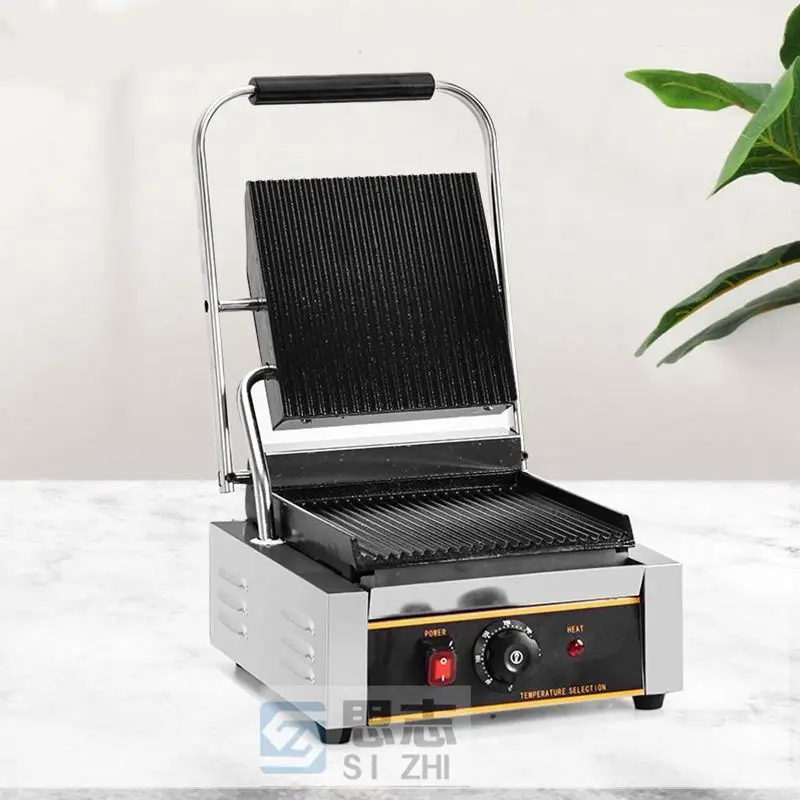
Source-controlled product identity
This TEBAK Hoting queue record describes an electric sandwich grill, panini maker, panini grill and panini press for commercial steak frying and sandwich preparation. The source title supplies the product identity and application terms, but it does not include structured technical parameters. This guide therefore treats the listing as a sourcing lead and keeps all electrical, thermal, dimensional, capacity and compliance details in the RFQ confirmation list.
Product ID 1601390951483 should appear on the quotation, specification sheet, drawing, sample approval record, packing list and spare-parts list. The queue record does not provide voltage, frequency, power, phase, plug, plate size, plate material, temperature range, warm-up time, output, weight, footprint, hinge opening, control type, timer, thermostat, certification, warranty, MOQ or lead time. None of those values should be inferred from the product title.
What the source establishes
| Source wording | Procurement meaning | Buyer confirmation required |
|---|---|---|
| Sandwich grill / panini maker | The equipment is presented for heated sandwich preparation. | Exact operating cycle, product envelope, heating method, control method and approved food-contact surfaces. |
| Panini grill / panini press | The source indicates contact pressing may be part of the intended use. | Plate geometry, opening angle, hinge travel, pressure adjustment, product thickness and even contact across the food. |
| Electric | The title presents an electrically powered machine. | Voltage, frequency, phase, current, rated power, plug, cable, earthing and destination-market electrical documents. |
| Commercial | The listing is marketed toward commercial use. | Duty cycle, continuous-use limits, heat recovery, cleaning routine, service parts, warranty and acceptance-test conditions. |
| Steak frying machine | The title also mentions steak frying as an application. | Approved food types, plate temperature, grease management, smoke control, clearance and safe handling procedure. |
Define the menu and product envelope
Do not buy a panini press from the title alone. Prepare a menu matrix showing every item that will be cooked: bread size, sandwich height, filling type, moisture, fat content, frozen or chilled state, wrap or unwrapped presentation, and required finish. Include steaks or other products only if the supplier confirms that the same configuration is designed for them.
Record the largest and smallest product dimensions, including diagonal placement when relevant. Ask the supplier for the usable plate area and the maximum product height with the top plate closed. A commercial unit can have a large external body while offering a smaller cooking area, and a hinge may not allow the advertised opening to remain parallel on thick products.
Send representative samples or dimensioned drawings for approval. Test thin sandwiches, tall sandwiches, open-faced items, products with uneven fillings and items that release liquid or grease. Request a written statement of which products are included in the quoted configuration and which require a different plate, accessory or operating method.
Heating and temperature control
No temperature range, heating power, warm-up time or recovery time is provided. Ask whether heating is by embedded elements, a separate heating plate or another arrangement, and request the exact rated power for the quoted model. Confirm whether the upper and lower plates are controlled together or independently.
Define the temperature measurement method. A controller display, surface reading and food-contact temperature are different measurements. Request the sensor location, control tolerance, overshoot behavior and calibration method. During a sample test, record ambient conditions, starting product temperature, plate condition, setpoint if available, actual measured surface temperature and time to the agreed result.
Test heat recovery after the plates are opened and loaded repeatedly. A headline temperature may be reached with an empty machine but fall substantially during a busy service period. Record the time between loads, the number of products per cycle, the recovery time and the quality result for each cycle.
Ask how the machine behaves after a power interruption, thermostat fault, over-temperature condition or emergency stop. Confirm whether the operator can identify a fault and restart safely without exposing food to an uncontrolled temperature.
Plate design and food-contact surfaces
The source does not state whether the plates are smooth, grooved, ribbed, removable, hinged, coated or made from a named material. Request a drawing and a complete plate specification. Confirm the groove pattern, groove depth, usable area, edge profile, drainage path and any difference between upper and lower plates.
Ask whether plates can be removed without special tools and whether replacements are available separately. For a press used on sandwiches and a grill used on steak, surface geometry can change browning, grease movement, sticking and cleaning time. Require the supplier to state the approved food applications for the exact plate set.
Verify the food-contact material and coating documentation separately from general quality-system claims. Request the material name, coating type, temperature limit, abrasion guidance and destination-market food-contact documents when applicable. Do not describe an unconfirmed surface as non-stick, stainless steel, cast iron or ceramic.
Run a release test using the buyer's bread, oil, cheese, sauces and meat. Inspect sticking, coating transfer, discoloration and product damage. Repeat the test after the agreed cleaning cycle to check whether release performance changes after use.
Hinge, pressure and operator control
Ask the supplier to document the hinge construction, opening angle, floating or fixed upper plate, pressure adjustment and handle clearance. Confirm whether the upper plate follows an uneven sandwich or applies a fixed position. Record the maximum product thickness and the pressure behavior at that thickness.
Define the operator cycle as loading, closing, heating, pressing, opening, inspection and unloading. The source does not state whether a timer, buzzer, foot switch, counter or automatic opening function is included. Require the quotation to list each control and each manual action.
Test the machine with one trained operator and a second operator. Compare loading time, closing force, product alignment, burn risk, handle temperature, access to the plates and the repeatability of the finished result. If the operator must use a timer outside the machine, include that step in the acceptance protocol instead of assuming an integrated timer.
Check safe access around the handle, hinge and plate edges. Identify pinch points, hot surfaces, grease paths and areas where steam may escape. Request safety labels, operating instructions and cleaning isolation steps in the destination-market language.
Commercial duty cycle and throughput
No output rate or duty cycle is supplied. Ask the supplier to define the expected workload in cycles per hour, continuous operating time, rest periods, heat recovery and maximum daily use for the exact configuration. Do not convert the word “commercial” into a numeric capacity claim.
Use a test protocol that separates gross cycles from accepted products. Record product loading time, heating time, pressing time, unloading time, inspection time, plate cleaning, grease removal, rejected products and downtime. Report accepted sandwiches or steaks per hour under the buyer's actual menu conditions.
Run start-up, steady-state, peak-service, cleaning and restart trials. Repeat with the smallest and largest approved products and with the most difficult filling or moisture condition. A machine that performs well in a short demonstration may require longer recovery or more cleaning in continuous service.
Write the agreed test variables into the purchase order: product dimensions, ingredient temperature, plate setting, load pattern, operator count, cycle definition, quality limits, ambient conditions and accepted output. This prevents a supplier demonstration using an easier product from becoming an untestable production promise.
Electrical specification and installation
The queue record provides no voltage, frequency, phase, rated power, current, plug or cable information. Request the nameplate and wiring diagram for the exact machine. Confirm the destination electrical system, circuit protection, earthing, residual-current protection, cable length and plug type before ordering.
Ask whether the unit requires a dedicated circuit and whether the rated power is continuous or intermittent. Confirm startup current, heat-up load and any separate control circuit. Do not assume that a product described as electric can be connected to the buyer's outlet without a documented match.
Request footprint, working height, net weight, packed dimensions, gross weight, bench load, ventilation clearance and service access. “Commercial” does not define the installation space. Check the clearance around the handle, hinge, hot plates, power cable and cleaning area, especially if the unit is placed below a hood or near other cooking equipment.
Confirm whether a ventilation hood, grease tray, splash guard or heat shield is included. If the buyer intends to fry steak, discuss smoke, grease and odor management with the supplier and the local installation specialist. The listing does not establish a complete cooking-line configuration.
Cleaning, grease and maintenance
Request a daily, weekly and periodic maintenance schedule. The supplier should identify removable parts, cleaning agents, water restrictions, grease-tray capacity, plate access, hinge lubrication and inspection points. Do not immerse an electrically powered unit unless the manual explicitly permits it.
Test cleaning after cheese, sauces, oil, meat juices and burnt residue. Measure the time required to reach the agreed clean condition and record whether the operator needs tools. Check that cleaning does not damage the plate surface, seals, wiring, thermostat or hinge.
Ask for a list of wear parts and replacement intervals. At minimum, clarify plate assemblies, handles, thermostats, heating elements, indicator lamps, timers, trays, hinges, seals and fasteners only if they are present on the quoted model. The source record does not confirm any of these parts, so the supplier must identify the actual configuration.
Food safety and compliance documents
No certification or compliance document is provided in the queue record. Request the operating manual, risk information, electrical safety documents and destination-market documents for the exact model. If food-contact claims are made, request the relevant declarations for the actual plate and coating materials.
Keep management-system certification separate from product compliance. A supplier's quality-system statement does not by itself prove electrical safety, machinery safety, electromagnetic compatibility, food-contact suitability or local commercial-kitchen compliance. Record document title, revision, issuing entity, scope and applicability in the procurement file.
Ask for the model and serial-number format, nameplate photograph, factory test record and packing-list identification. The documents should match product ID 1601390951483 and the exact plate, control and electrical configuration being purchased.
Factory acceptance test proposal
- Verify product ID 1601390951483, exact model, plate configuration, controls, accessories and drawing revision.
- Approve a menu matrix with product dimensions, filling, moisture, fat, starting temperature and required finish.
- Measure usable plate area, maximum product height, hinge opening, pressure behavior and handle clearance.
- Record electrical nameplate data, voltage, frequency, phase, rated power, current, plug, cable and earthing.
- Measure heat-up time, surface temperature method, control tolerance and recovery after repeated loading.
- Run start-up, steady-state, peak-service, interruption, restart and cleaning trials with the buyer's products.
- Count accepted products, rejects, rework, cycle time, downtime, cleaning time and operator count.
- Inspect browning, sealing, sticking, crushing, filling leakage, grease handling and product damage.
- Verify hot-surface warnings, pinch-point controls, emergency behavior, manual, spare parts and maintenance plan.
- Review electrical, food-contact and destination-market documents before release for shipment.
RFQ checklist
- Exact model and product ID 1601390951483 on the quotation, drawing, nameplate and packing list.
- Usable lower and upper plate dimensions, groove pattern, surface material, coating and food-contact documents.
- Maximum product height, hinge opening, floating-plate behavior, pressure adjustment and handle clearance.
- Voltage, frequency, phase, rated power, current, plug, cable, earthing, circuit and protection requirements.
- Temperature range, sensor location, control tolerance, warm-up time, heat recovery and calibration method.
- Timer, buzzer, counter, display, thermostat, independent plate control and every included control function.
- Commercial duty cycle, continuous-use limit, cycles per hour, rest periods and accepted-output test method.
- Approved sandwiches, panini, steaks and other products, with size, filling, moisture and temperature limits.
- Grease tray, splash guard, ventilation, smoke handling, drainage and cleaning access.
- Footprint, working height, net and gross weight, bench load, ventilation clearance and service access.
- Cleaning agents, removable parts, maintenance intervals, wear parts, spare-parts prices and warranty.
- Operating manual, safety labels, factory test record, nameplate photograph and destination-market compliance documents.
- MOQ, lead time, packaging, inspection, sample approval, after-sales response and replacement-part terms.
Buyer decision framework
This listing is a starting point for sourcing an electric commercial sandwich grill and panini press. Its source-backed scope covers the stated sandwich, panini and steak-frying application terms, but no numeric performance or installation parameters are structured in the queue record. Approve the purchase only after the supplier proves the buyer's menu, provides the complete electrical and plate specification, signs measurable heat and quality criteria, confirms cleaning and duty-cycle limits, and supplies verifiable safety and food-contact documentation.
Frequently asked questions
What voltage and power does this panini grill use?
The queue record does not provide those values. Request the exact nameplate and wiring data for the quoted model before planning the electrical circuit.
Is it suitable for continuous commercial service?
The title uses the word commercial, but no duty cycle or output figure is supplied. Require a steady-state test with the buyer's menu and an agreed accepted-output definition.
Can the machine grill steak as well as sandwiches?
The source title mentions steak frying, but it does not define plate, temperature, grease or smoke conditions. Obtain written confirmation and test the actual steak size, thickness and fat level.
Are the plates non-stick or removable?
No plate material, coating or removal method is specified. Ask for the plate drawing, food-contact documents, cleaning procedure and replacement-part list.
What should be checked before ordering?
Confirm the exact model, plate area, product envelope, electrical data, temperature behavior, duty cycle, cleaning process, safety documents, warranty, spare parts and acceptance-test method.
Source and contact
This guide is based on the Hoting queue record for product ID 1601390951483. Before purchase, request the current quotation, plate and hinge drawing, electrical nameplate, temperature test, menu compatibility report, cleaning instructions, safety documents, food-contact evidence, packing list, spare-parts offer and final machine photographs. For sourcing questions, contact the TEBAK sales team through the site's current inquiry channel.