
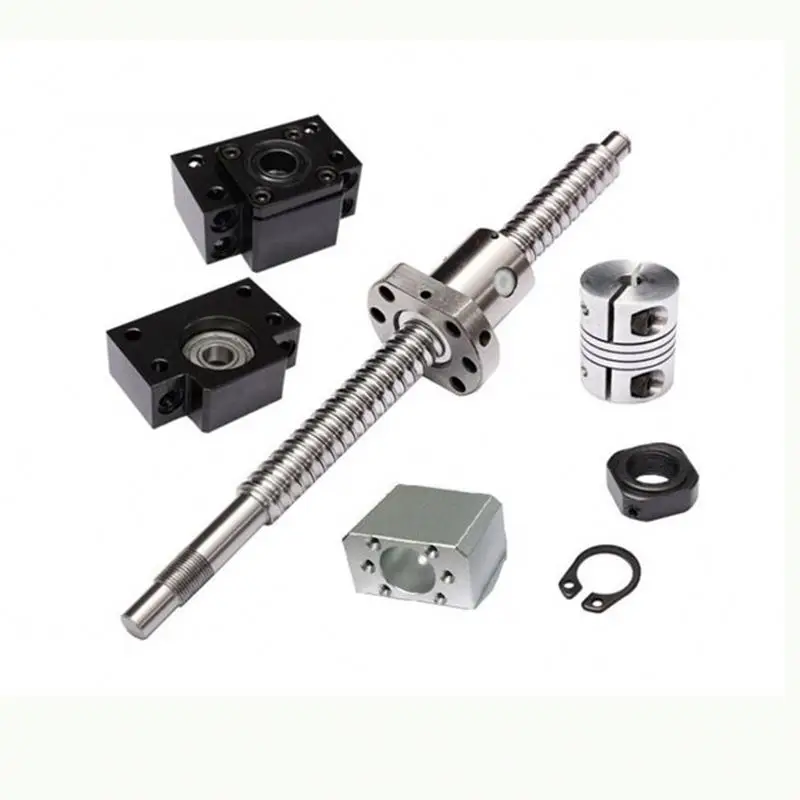
One title, three different ball screws
The full title reads: D-04 SFU1204 SFU1605 Full Set 32mm Ball Screw CNC Machine Parts Rotating Nut Ballscrews Supports Bearing Blocks BK25 BF25.
In this product family the model number is the specification. The letter code names the nut type, the first two digits give the shaft diameter in millimetres, and the last two give the lead. The datasheet reproduced in the gallery confirms it row by row:
| Code in the title | Shaft diameter d | Lead |
|---|---|---|
| SFU1204 | 12 mm | 4 mm |
| SFU1605 | 16 mm | 5 mm |
| SFU3205 | 32 mm | 5 mm |
| SFU3210 | 32 mm | 10 mm |
So the title advertises a 12 mm screw, a 16 mm screw and a 32 mm screw in the same sentence. Those are three products, not one kit. A 12 mm screw and a 32 mm screw differ by a factor of 7.1 in cross-section and by a factor of about 5.7 in rated dynamic load.
Add the support blocks and the count rises: BK25 and BF25 take a 25 mm journal, which is a fourth diameter. That one is legitimate — the ends of a ball screw are machined down to a smaller journal to fit a standard block, which is exactly what a sibling listing in this same catalogue does. But it means the title is naming four different diameters before it says anything about what you receive.
The parameter block belongs to a different kit
Six rows are published. Here they are, with what each one actually says:
| Label | Value | Assessment |
|---|---|---|
| Core Components | Bearing | A ball screw is not a bearing. This is the category field, not a specification. |
| Manufacturing Process | Milled Thread | Contradicted by the gallery, which shows the caption “precision cold rolling”. |
| Material | Carbon Steel | Not the material used for a ball screw raceway. |
| Length | 25mm | No ball screw is 25 mm long. Almost certainly a misplaced journal diameter. |
| Product name | Ballscrews Supports Bearing Blocks BK25 BF25 | Describes blocks only, and names no screw size at all. |
| Nut type | Single | The one row that is both plausible and useful. |
None of the six gives a shaft diameter, a lead, a length, a precision grade, an axial clearance, a load rating or a weight. The block is not a weak specification; it is a specification for something else.
Three sibling listings publish the same seven rows
This catalogue carries a family of these kits, and the parameter block is copy-pasted across them. Two of them are these:
| Listing | Screw it claims | Weight | Length | Blocks named |
|---|---|---|---|---|
| D-04 (this item) | SFU1204 / SFU1605 / 32mm | 5.6 kg | 25mm | BK25 / BF25 |
| D-05 — SFU2005 | 20 mm | 5.6 kg | 25mm | BK25 / BF25 |
| D-04 — SFU3205 / 3210 | 32 mm | 5.6 kg | 25mm | BK25 / BF25 |
Identical weight, identical length, identical block names, across a 20 mm kit and a 32 mm kit and a listing that mentions 12 mm. That is not possible. And the middle one contradicts itself outright: its own description lists the contents as SFU2005 screw, SFU2005 nut, 2005 nut seat, BK15 fixed seat, BF15 support seat, lock nut, card spring, coupling, while its parameter row says BK25/BF25.
The weight tells you which kit the block was written for. Calculate the bare screw mass at 7.85 g/cm³:
| Shaft | Mass per metre | 500 mm screw only |
|---|---|---|
| 12 mm | 0.888 kg/m | 0.444 kg |
| 16 mm | 1.578 kg/m | 0.789 kg |
| 20 mm | 2.466 kg/m | 1.233 kg |
| 32 mm | 6.313 kg/m | 3.157 kg |
A 12 mm kit with two small blocks and a coupling weighs nowhere near 5.6 kg. A 32 mm kit does. The published 5.6 kg is the 32 mm kit's figure, pasted onto every member of the family.
The photographs contradict the parameter block twice
Image six is a close-up of the screw thread with the caption: “Precision cold rolling and fine polishing process make the surface of the screw shine.”
The parameter row says Milled Thread. Those are different processes with different consequences. Cold rolling forms the raceway by deforming the material, which leaves a favourable residual stress pattern and is the standard process for this class of screw. Milling cuts the groove, removes the work-hardened surface, and is not how SFU series screws are made. A third listing in the same catalogue titles itself Rolled Ball Screw C7, so the seller knows the correct word. The parameter row is the outlier.
The second contradiction is the nut. Every title in this family says “Rotating Nut Ballscrews”. A rotating-nut arrangement holds the screw stationary at both ends and drives a nut carried in a bearing housing, usually by belt or pulley. But the bill of materials in the photographs and in the sibling description is a coupling plus a BK fixed block and a BF support block machined for the screw ends. That is a rotating-screw kit, driven through the coupling. The two architectures need different housings and different machine designs, and you cannot convert one into the other by bolting.
What SFU actually means, from the datasheet in the gallery
Image seven is a manufacturer's catalogue page for the SFU series, in Chinese, with a full dimension and rating table. This is the only real specification attached to this listing, and it is worth transcribing the columns that matter.
| Type | d mm | Lead mm | Ball dia. mm | Nut body D mm | Flange A mm | Nut length L mm | Circuits | Ca kgf | Coa kgf | Rigidity K |
|---|---|---|---|---|---|---|---|---|---|---|
| SFU1204-4 | 12 | 4 | 2.381 | 24 | 40 | 40 | 4 | 593 | 1,129 | 12.5 |
| SFU1604-4 | 16 | 4 | 2.381 | 28 | 48 | 40 | 4 | 629 | 1,270 | 35 |
| SFU1605-3 | 16 | 5 | 3.175 | 28 | 48 | 43 | 3 | 765 | 1,240 | 17 |
| SFU1605-4 | 16 | 5 | 3.175 | 28 | 48 | 50 | 4 | 780 | 1,790 | 20 |
| SFU2005-4 | 20 | 5 | 3.175 | 36 | 58 | 51 | 4 | 1,130 | 2,380 | 25 |
| SFU3205-4 | 32 | 5 | 3.175 | 50 | 81 | 52 | 4 | 1,450 | 4,150 | 40 |
| SFU3210-4 | 32 | 10 | 6.350 | 50 | 81 | 90 | 4 | 3,390 | 7,170 | 45 |
Every dimension in this table is in millimetres and every load in kgf, as the sheet states. Note the jump in ball diameter from 3.175 mm on the SFU3205 to 6.350 mm on the SFU3210: that is why the 3210 carries more than twice the load of the 3205 despite the same shaft.
Life, in revolutions and in kilometres
With the rated dynamic load you can compute L10, the life that 90% of a population reaches. For ball screws, L10 = (Ca / F)³ in millions of revolutions.
| Type | Ca | At 100 kgf | At 200 kgf | Travel at 200 kgf |
|---|---|---|---|---|
| SFU1204-4 | 593 kgf | 208 Mrev | 26 Mrev | 104 km |
| SFU1605-4 | 780 kgf | 475 Mrev | 59 Mrev | 297 km |
| SFU3205-4 | 1,450 kgf | 3,049 Mrev | 381 Mrev | 1,905 km |
| SFU3210-4 | 3,390 kgf | 38,958 Mrev | 4,870 Mrev | 48,698 km |
The spread is enormous and it is the reason the diameter question matters more than any other. At a 200 kgf working load, the 32 mm SFU3210 delivers about 470 times the travel of the 12 mm SFU1204. If you buy the 12 mm kit for a machine that pulls 200 kgf all day, life is measured in a hundred kilometres of travel, which a busy router can cover in months.
Load ratings assume clean lubrication and correct mounting. They do not include contamination, misalignment, or the axial load from a badly preloaded nut.
Stiffness: the micrometres you give up
The rigidity column is in kgf per micrometre, so deflection at load is simply load divided by K. This is the nut contribution only; the screw shaft itself bends and stretches on top of it.
| Type | K | At 50 kgf | At 100 kgf | At 200 kgf |
|---|---|---|---|---|
| SFU1204-4 | 12.5 | 4.0 µm | 8.0 µm | 16.0 µm |
| SFU1605-4 | 20 | 2.5 µm | 5.0 µm | 10.0 µm |
| SFU3205-4 | 40 | 1.2 µm | 2.5 µm | 5.0 µm |
| SFU3210-4 | 45 | 1.1 µm | 2.2 µm | 4.4 µm |
At 200 kgf the 12 mm nut alone deflects 16 µm under a cutting load that reverses direction, which shows up directly in the part. The 32 mm nuts deflect 4 to 5 µm. Neither figure includes shaft stretch, bearing deflection in the BK block, or thermal growth.
Lead decides resolution, torque and thrust at the same time
Lead is how far the nut moves per revolution. Everything else follows from it.
| Lead | Travel per rev | Torque per 1,000 N | Resolution, 200 step motor | Axial play 0.05 mm equals |
|---|---|---|---|---|
| 4 mm | 4 mm | 0.707 N·m | 0.0200 mm | 4.5° of motor rotation |
| 5 mm | 5 mm | 0.884 N·m | 0.0250 mm | 3.6° |
| 10 mm | 10 mm | 1.768 N·m | 0.0500 mm | 1.8° |
Torque is T = F × Ph / (2π × η) with an efficiency of 0.90. A 10 mm lead needs 2.5 times the motor torque of a 4 mm lead for the same thrust, and gives up half the resolution to get it. With 1/16 microstepping the resolution at 5 mm lead becomes 0.0016 mm, which is finer than the mechanical accuracy of the screw, so the lead choice is really about speed and torque, not resolution.
For comparison, a sliding trapezoidal screw of the same size runs at an efficiency around 0.30, so a ball screw needs roughly one third the torque. The trade is that a ball screw also backdrives: a vertical axis will fall under load when the motor is de-energised, so it needs a brake.
Single nut: the one honest parameter, and what it costs
Nut type: Single is consistent with every SFU row in the datasheet, and the -3 and -4 suffixes are the number of ball circuits, not the number of nuts. So the kit contains one nut per screw.
A single nut has no internal preload unless it was built with oversized balls or a shift-preload. This listing publishes no precision grade and no axial clearance figure, and those two numbers are what set backlash.
The consequence is not subtle. On a 5 mm lead, 0.05 mm of axial play is 3.6° of motor rotation that goes nowhere when the axis reverses. On a contouring cut that appears as a witness mark at every direction change; on a circle it appears as an ovality error. A sibling listing in the same catalogue states the grade openly as C7, so the information exists. This one does not state it at all.
Journal diameter, not screw diameter, chooses the blocks
The BK and BF blocks are sized by the machined journal at the end of the screw, not by the shaft. That is why the pairing of a 32 mm screw with BK25/BF25 blocks is not automatically wrong: the ends can be turned down from 32 mm to 25 mm.
The catalogue proves the practice. The D-05 kit uses an SFU2005 screw, which is 20 mm, and its own contents list gives BK15/BF15 — a 15 mm journal on a 20 mm shaft.
So the 25 mm in the length field is very probably the journal diameter, entered in the wrong row. That reading is consistent with BK25/BF25 and with the practice above, but it is an inference, not something the page states.
What it means practically: you cannot determine from this listing which blocks arrive, because the journal diameter is not published. It is the number that fixes the block, the bearing bore, the lock nut thread and the coupling bore.
Length is the one number you cannot work without
Every other calculation in this article needs the screw length. Critical speed — the rotational speed at which the shaft whips — falls with the square of the length. Column buckling under compressive load also depends on length and on the end fixity of the blocks. Both are ordinary checks in any ball screw selection, and both are impossible here because the only published length is 25 mm.
The photographs make the gap worse rather than better. The gallery contains screws of visibly different lengths: one image shows a screw roughly two and a half times its own diameter in the nut region, another shows a screw that runs most of the way across the frame. Whatever length you need, at least two different ones are being advertised by the same eight pictures.
Ask for the length in millimetres, and ask whether it is the total length or the threaded length, because the two differ by the machined journals at each end.
Material and grade: two more gaps
Material. The parameter says carbon steel. Ball screw raceways are made from high-carbon chromium bearing steel — SUJ2 to the Japanese standard, GCr15 to the Chinese one — because the groove has to be through-hardened to carry rolling contact fatigue. Plain carbon steel is not the material for this duty, and if it really were the material, the published load ratings would not apply. Either the field is wrong or the ratings are.
Grade. No accuracy class appears, and that single number separates a screw that will hold 0.02 mm over 300 mm from one that will not. Rolled screws are commonly supplied at C7 and ground screws at C5 or C3, with a large price difference between them. A sibling listing states C7; this one states nothing.
Hardness. Also absent. Surface hardness in HRC is the normal way to state that the raceway has actually been heat treated rather than merely polished.
The eight photographs
All eight images are content-unique, which is better than most listings in this catalogue, and six of them are shared with the D-05 listing. What they show:
| Image | Content |
|---|---|
| 1, 3, 4 | The full kit laid out: screw with flange nut, nut housing, two support blocks, coupling, lock nut, circlip. Different lengths and angles. |
| 2 | Longer screw, same component set |
| 5 | A second kit angle showing both blocks with their bearing bores |
| 6 | Thread close-up, captioned “precision cold rolling and fine polishing” |
| 7 | The SFU datasheet page transcribed above |
What is missing from the gallery: no marked length on any screw, no part number on the nut, no nameplate on a block, no dimensional drawing of the journal, and no photograph of a screw with the grade stamped on it. For a precision component, the marking is the evidence.
What to put in the request for quotation
| # | Question | Why it matters |
|---|---|---|
| 1 | Shaft diameter: 12, 16 or 32 mm — one answer | The title offers all three |
| 2 | Lead: 4, 5 or 10 mm | Sets resolution, thrust per torque and speed |
| 3 | Total length and threaded length, in mm | Needed for critical speed and buckling; published as 25 mm |
| 4 | Journal diameter at each end | Fixes the block, lock nut and coupling bore |
| 5 | Precision grade: C7, C5 or C3 | Sets achievable accuracy; absent here |
| 6 | Axial clearance or preload, in mm or N | Becomes backlash at every reversal |
| 7 | Material grade: GCr15 / SUJ2, and surface hardness in HRC | The page says carbon steel |
| 8 | Process: rolled or ground | The image says cold rolled, the table says milled |
| 9 | Blocks included, with model: BK/BF12, 15, 17, 20, 25 | The D-05 sibling contradicts its own block row |
| 10 | Confirmed Ca and Coa for the exact size you are buying | Life depends on it; the datasheet is generic |
| 11 | Rotating screw or rotating nut — and whether the coupling is included | The title says rotating nut, the contents say rotating screw |
| 12 | Actual weighed mass and crate dimensions | 5.6 kg is the 32 mm kit's figure on every listing |
| 13 | Nut lubrication: grease nipple size and interval | The datasheet shows an M6 oil hole on all sizes above 16 mm |
| 14 | Warranty and whether the nut is covered separately | No warranty field exists |
Question 1 is the one to settle first. Everything after it depends on which screw you are actually buying, and the answer is not on the page.
What this kit is good for
The components look right. The kit is complete — screw, nut, nut housing, fixed and floating blocks, coupling, lock nut and circlip — which saves a beginner from assembling a set piece by piece and is worth real money. The datasheet it ships with is a genuine SFU table with load ratings and dimensions, which is more than most listings give.
A 16 mm screw with a 5 mm lead is the sensible default for a hobby or light-production router: 0.025 mm per full step, 0.88 N·m per 1,000 N of thrust, and 297 km of travel at a 200 kgf working load. A 12 mm screw belongs on a small machine that never sees a heavy cut. A 32 mm screw belongs on a gantry where the load and the length both demand it.
What is missing is the identity of the product. One title names four diameters, the parameter block belongs to the 32 mm kit, the photograph says cold rolled while the table says milled, the material field names a steel that ball screws are not made from, and the length reads 25 mm. Settle questions 1 to 5 before you order and this becomes a straightforward purchase of a well-equipped kit.
Key specifications
- Core Components
- Bearing
- Manufacturing Process
- Milled Thread
- Material
- Carbon Steel
- Length
- 25mm
- Product name
- Ballscrews Supports Bearing Blocks BK25 BF25
- Nut type
- Single
Frequently asked questions
- What does SFU1204 mean?
- The SFU code names the nut type, and the two pairs of digits give shaft diameter and lead. SFU1204 is a 12 mm shaft with a 4 mm lead; SFU1605 is 16 mm with a 5 mm lead; SFU3205 is 32 mm with a 5 mm lead. The datasheet reproduced in gallery image seven of this listing confirms this row by row, so the title naming SFU1204, SFU1605 and 32mm in one sentence is naming three different products.
- Which screw is this listing actually selling?
- It cannot be determined from the page. The parameter block contains no shaft diameter, and the only rows naming a size refer to BK25/BF25 support blocks, which take a 25 mm machined journal rather than a 25 mm shaft. A sibling listing for the same D-04 item names SFU3205 and SFU3210, which are 32 mm, and its weight of 5.6 kg is consistent with a 32 mm kit rather than a 12 or 16 mm one. Ask for the diameter and lead in writing.
- Is the thread rolled or milled?
- The parameter row says milled thread, but gallery image six is captioned precision cold rolling and fine polishing, and a sibling listing titles itself Rolled Ball Screw C7. Cold rolling and milling are different processes: rolling forms the groove and leaves favourable residual stress, milling cuts it. For SFU series screws, rolled is the normal process, so the parameter row is the outlier.
- Why does the length say 25 mm?
- No ball screw is 25 mm long, so the field is either a leftover or a displaced journal diameter. The latter is likely: BK25/BF25 blocks take a 25 mm journal, and a sibling kit in this catalogue pairs a 20 mm SFU2005 screw with BK15/BF15 blocks, which shows the ends are machined down. The gallery also contains screws of at least two visibly different lengths. Ask for total and threaded length in millimetres.
- How long will the screw last?
- Using the datasheet ratings and L10 = (Ca/F)^3, at a 200 kgf working load the 12 mm SFU1204 gives about 26 million revolutions, which at a 4 mm lead is 104 km of travel; the 16 mm SFU1605 gives 59 million revolutions or 297 km; the 32 mm SFU3205 gives 381 million revolutions or 1,905 km. That spread is the real reason the diameter question matters more than the price.
- Does a single nut mean backlash?
- It means there is no preload unless the nut was built with oversized balls. Neither the precision grade nor the axial clearance is published, and those are the two numbers that set backlash. On a 5 mm lead, 0.05 mm of axial play equals 3.6 degrees of motor rotation lost at every reversal, which shows as a witness mark on contours and ovality on circles. A sibling listing states C7 openly; this one states nothing.
- Is carbon steel the right material?
- Ball screw raceways are made from high-carbon chromium bearing steel, SUJ2 to the Japanese standard or GCr15 to the Chinese one, and are through-hardened because the groove carries rolling contact fatigue. Plain carbon steel is not used for this duty. Either the field is wrong, or the published load ratings do not apply to the part you receive. Ask for the material grade and the surface hardness in HRC.