
What the source record confirms
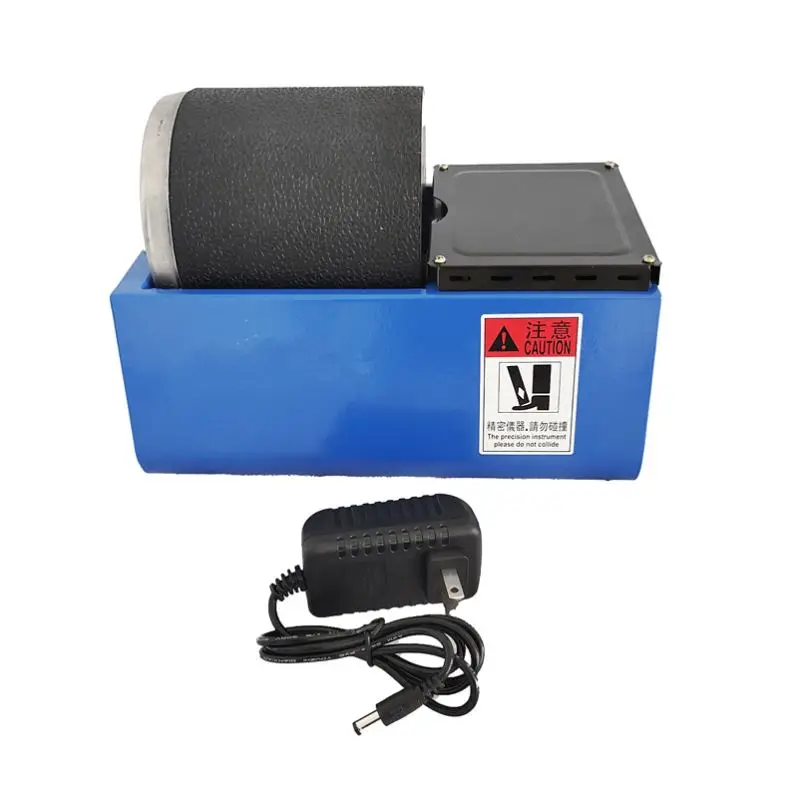
The TEBAK source record describes a small automatic silicone roller polishing machine for jewelry tools and micro polishing work. It is also described as a small rock tumbler polishing machine. This buying guide uses product ID 1601251328642 and keeps the eight structured source fields separate from performance claims that require supplier confirmation.
| Source field | Confirmed value | Procurement meaning |
|---|---|---|
| Material | Outer steel plate and inner PU rubber | Declared construction. Confirm steel grade, plate thickness, PU hardness, lining attachment and chemical compatibility. |
| Drum size | 12.5*11.5cm | Declared drum-size value. Confirm whether it means diameter × length, usable internal size or another reference. |
| Voltage | 220-230V/50HZ | Declared electrical supply. Confirm phase, current, plug, tolerance, grounding and destination-market compliance. |
| Power | 16W | Declared power value. Confirm motor input, rated consumption, startup current and whether other accessories need power. |
| Current | 0.15AMP | Declared current value. Confirm measurement condition and consistency with the 16W and 220–230V declarations. |
| Speed | cannot be adjusted | Declared non-adjustable speed. Request the actual RPM, tolerance, operating load and whether any fixed-speed variation exists. |
| Capacity | 2.5KG | Declared capacity. Confirm whether this is maximum total charge, media plus workpiece, or workpiece-only capacity. |
| Weight | 2.3KG | Declared machine weight. Confirm net or gross status and whether drum, motor, cover and accessories are included. |
The queue does not provide RPM, timer, cycle time, abrasive media, recommended load ratio, drum volume in liters, outer machine dimensions, noise, vibration, motor type, bearing type, replacement-lining specification, finish quality, output rate, certification, warranty or spare-parts information. These are RFQ confirmation items. Do not turn a product image or a general company profile into a complete polishing specification.
Use product ID 1601251328642 on the quotation, nameplate photograph, technical drawing, packing list, manual, sample test and inspection record. Ask the supplier to confirm whether the quoted unit is the small automatic silicone roller model and not a different rock tumbler or jewelry polishing configuration.
1. Procurement identity and intended use
Use the exact procurement identity: Small Automatic Silicone Roller Polishing Jewelry Tools Equipment Micro Polishing Tumbler Small Rock Tumbler Polishing Machine. The different application phrases in the source should be clarified before ordering.
Define the buyer's process: deburring, edge smoothing, light polishing, surface brightening, cleaning, or another finishing operation. The source does not establish that the machine performs mirror polishing, mass finishing, grinding or any specific surface grade.
List the actual workpieces: jewelry components, small metal parts, stones, tools, resin pieces or other items. Record material, dimensions, fragility, surface condition and acceptable defect limits.
Ask whether the supplier's term “silicone roller” refers to an inner PU-rubber lining, a separate silicone component, a roller drum or a translation variant. The structured material field says inner PU rubber, so the supplier should reconcile any different material wording in writing.
Confirm whether the machine is supplied as a complete working unit, including motor, drum, cover, switch, power cable and any control or timer. None of these inclusions should be assumed from the source record.
Request a labelled drawing showing drum, inner lining, outer steel plate, shaft, motor, bearings, cover, switch and base. The drawing should identify the 12.5*11.5cm measurement.
Ask for a nameplate photograph and model number. Product ID is a queue identifier and is not a substitute for a machine model.
Use a sample test with the buyer's workpieces and media before approving a production order. Small tumblers can produce different results depending on load, media, moisture, chemistry and cycle time.
2. Drum size and usable working volume
The source lists drum size as 12.5*11.5cm. Confirm which dimension is diameter, which is length, and whether measurements are external or internal.
Request the internal usable volume in liters and the opening size. A nominal length and diameter do not identify the available fill volume if the lining, shaft, end cap or opening reduces the working space.
Confirm drum opening, cover type, seal, locking method and loading access. Record whether the cover is removable, hinged, threaded or secured by another method.
Measure the usable loading space with the drum empty and with the recommended media charge. Keep photographs and a dimensioned drawing with the RFQ.
Ask whether the stated size applies to a cylindrical drum, a roller chamber or an external housing. Do not calculate volume until the supplier confirms geometry and measurement points.
Test the smallest and largest buyer workpieces. Verify that parts can move freely without wedging, nesting, damaging one another or contacting a bare metal surface.
Confirm whether the inner PU rubber is continuous and whether there are seams, steps, fasteners or exposed edges that can catch small jewelry parts.
Ask how the drum is balanced after loading. A small unbalanced charge may increase vibration even when total load is below the stated capacity.
3. Material and inner-lining verification
The source states “Outer steel plate and inner PU rubber.” Request the steel grade, plate thickness, corrosion protection, finish and weld or joint details.
Request PU hardness, thickness, color, temperature range, abrasion resistance and attachment method. The source does not provide these properties.
Test the lining with the actual media, water, detergent, compound or polishing chemistry planned by the buyer. Confirm swelling, softening, cracking, delamination and odor after the intended cycle.
Ask whether the inner PU rubber is replaceable. Request replacement lining part number, lead time, price, installation method and tooling.
Check for exposed steel at the drum opening, seam, shaft, cover or loading path. Small jewelry pieces can be damaged by a single exposed edge.
Confirm cleaning compatibility. A lining may be affected by alkaline, acidic, solvent-based or alcohol-based cleaners; the supplier must provide a compatibility statement for the buyer's chemicals.
Ask whether the outer steel plate is painted, plated, stainless, galvanized or otherwise protected. Do not infer the finish from photographs.
Record lining thickness and appearance before the sample test, after the test and after repeated cycles. Include photos of any wear or transfer onto the workpiece.
4. Capacity and loading plan
The source lists a capacity of 2.5KG. Confirm whether this means total charge including media and workpieces, maximum workpiece mass, maximum media mass or a recommended operating load.
Ask for the recommended fill percentage and minimum load. A tumbler may need enough media and parts to maintain stable movement, but the source gives no loading ratio.
Separate workpiece weight, media weight, water or chemical weight and total drum charge in the RFQ. Record the supplier's limits for each.
Test a light load, a nominal load and a maximum proposed load. Record vibration, noise, motor temperature, part movement, media flow and finish quality.
Do not treat 2.5KG as a throughput figure. Accepted pieces per hour depend on part size, number of pieces, media, cycle time, loading, unloading and inspection.
Ask whether fragile items require separators or a lower maximum charge. Request written limits for sharp edges, hollow items, stones, plated parts and delicate assemblies.
Confirm whether the 2.5KG value is a safety limit, a motor limit, a drum limit or a quality recommendation. These are different procurement meanings.
Weigh the complete charge before each test and document the balance between media and workpieces. Do not rely on visual fill estimation.
5. Fixed-speed operation
The source states “cannot be adjusted” for speed. Request the actual operating RPM, speed tolerance, direction of rotation and behavior under different loads.
Ask whether the fixed speed is controlled by an AC motor, gear motor, belt, direct drive or another arrangement. The source does not identify the drive system.
Confirm whether the motor starts at full speed, ramps up, reverses, stops automatically or runs continuously until switched off.
Request the supplier's recommended cycle time for the buyer's workpieces and media. Do not assume fixed speed means fixed finish time.
Test the machine at low, nominal and maximum charge. Measure or record RPM under each condition and note any speed drop, stall or unstable movement.
Ask how the operator controls process duration if the speed cannot be adjusted. Confirm whether a timer is integrated, optional or absent.
Check whether a fixed-speed machine is suitable for fragile parts. Define a stop procedure and do not attempt unauthorized speed-control modifications.
Record direction, vibration and sound at startup, steady state and shutdown. Link each observation to load weight and media type.
6. Electrical requirements
The source lists 220-230V/50HZ, 16W and 0.15AMP. Request the complete electrical nameplate and wiring details before purchase.
Clarify whether 220-230V/50HZ is single-phase and whether 50HZ is required. Confirm voltage tolerance, frequency tolerance, plug type, cable length and grounding.
Reconcile the declared 16W and 0.15AMP values with the actual electrical supply. Ask whether current is running current, rated current, no-load current or a measured sample.
Request startup current, fuse or breaker recommendation, switch rating, insulation, grounding method and over-temperature protection.
Confirm whether the 16W value includes motor, timer, lamp, fan or any other component. Do not assume the machine has no auxiliary electrical load.
Use a qualified electrician to verify destination-market connection requirements. Do not replace a plug or bypass grounding without an approved electrical review.
Test power-on, running current, startup behavior, stop behavior and restart behavior. Record supply voltage and instrument used.
Request a model-specific manual and wiring diagram. A general company certificate or a different machine's manual does not prove electrical compliance.
7. Motor, drive and maintenance questions
The queue does not specify motor type, bearings, drive ratio, shaft, belt, coupling or lubrication. Request these details for service planning.
Ask for maintenance intervals, lubrication points, belt or coupling inspection, bearing replacement and motor service instructions.
Confirm whether the drive is sealed, whether dust or polishing compound can enter the motor or bearing area, and what cleaning method is permitted.
Request replacement part numbers for motor, switch, cable, shaft, bearing, belt, cover, seal and inner PU rubber.
Ask for service access and isolation procedure. The machine must be disconnected from power before opening covers or working near rotating parts.
Test abnormal-load response, jam response and stop behavior. Ask whether the motor has overload protection and how it resets.
Record motor temperature after the buyer's intended cycle and maximum proposed charge. The source provides power but no thermal limit.
Confirm spare-part availability, lead time, warranty coverage and whether unauthorized repairs affect warranty.
8. Media, chemistry and process validation
The source does not list polishing media, compound, water, detergent or recommended chemistry. Ask the supplier for a compatible-media list.
Define the buyer's media by material, size, shape, hardness, density and intended finish. Request a sample test rather than accepting a generic recommendation.
Confirm whether the machine is intended for dry tumbling, wet tumbling or either. The product description does not establish a wet-processing capability.
Test the inner PU rubber with the planned media and liquid. Check swelling, abrasion, discoloration, contamination and adhesion.
Document media-to-workpiece ratio, liquid amount, compound concentration, cycle time, drain method and cleaning method.
Separate the machine's declared capacity from process capacity. The 2.5KG source field does not define the correct media charge for every workpiece.
Inspect workpieces after a short, nominal and extended cycle. Record burr removal, edge rounding, surface brightness, scratches, dents, stones, plating and dimensional change.
Confirm whether media can enter hollow or threaded parts and how it is removed. Include inspection and separation in the process plan.
9. Jewelry and small-part quality control
Use the buyer's actual jewelry components or representative test pieces. Include delicate edges, holes, stones, plated surfaces and mixed geometries if they will be processed.
Define acceptance criteria for scratches, dents, edge rounding, surface roughness, color change, media residue, compound residue and dimensional change.
Photograph parts before and after processing under consistent lighting. Weigh representative pieces and measure critical dimensions.
Run repeatability tests across several cycles and load batches. Record cycle time, accepted pieces, rejected pieces and defect causes.
Check whether small parts nest together or contact the metal drum. Test separators, media changes and loading patterns where necessary.
Do not claim a mirror finish, deburring grade or surface-roughness result unless it is measured or documented by the supplier's sample test.
Link test records to product ID 1601251328642, machine model, lining condition, media batch and operator.
Set a change-control rule for media, chemistry, workpiece material, charge weight and cycle time. Any change can alter the result.
10. Noise, vibration and workplace setup
The source does not provide noise, vibration, base dimensions, center of gravity or mounting requirements. Request these values before site planning.
Ask whether the machine needs a level bench, non-slip feet, clamps, a tray, a cover or a dedicated enclosure.
Test vibration with an empty drum and with the buyer's nominal and maximum charge. Record whether the machine walks, rocks or transfers vibration to the bench.
Check the drum, shaft, cover, base and motor for looseness after repeated operation. Vibration can damage small parts and accelerate wear.
Request sound level measurement conditions if noise matters. A small motor rating does not establish workplace noise.
Plan access for loading, unloading, cleaning, media storage and inspection. Keep the power switch reachable without reaching over moving parts.
Use guards and covers as supplied. Do not operate with a removed cover unless the supplier's safety procedure explicitly permits a controlled test.
Record workplace conditions and operator instructions in the acceptance file.
11. Cleaning, drainage and contamination control
Ask how to remove polishing media, liquid, compound and residue from the inner PU rubber and drum opening.
Confirm whether the drum can be tilted, removed, drained or rinsed. The source does not describe a drainage port or removable liner.
Request approved cleaning tools and chemicals. Avoid sharp tools or solvents that can damage PU rubber unless the supplier confirms compatibility.
Define cleaning between different materials, colors, precious-metal alloys or surface finishes. Prevent cross-contamination between batches.
Inspect seams, cover edges, shaft entry, lining joints and trapped areas after cleaning.
Record cleaning time and waste handling. If wet processing is used, confirm how liquid and polishing compound are disposed of under local requirements.
Ask whether the motor and electrical parts are protected from splash, dust and cleaning fluid. Do not infer an ingress rating.
Include a cleaning and inspection checklist in the work instruction.
12. Safety and compliance
Request model-specific safety instructions for rotating parts, pinch points, electrical power, moving covers, media and polishing compounds.
Confirm guarding around drum, shaft, belt, motor and coupling. Check that the operator cannot contact rotating parts during normal operation.
Ask for emergency stop or safe stop behavior. The source does not specify an emergency stop; verify whether one is included.
Identify risks from small parts, sharp media, dust, liquid, chemicals and hot motor surfaces. Define PPE according to the actual process and safety assessment.
Confirm electrical grounding, insulation, cable protection and destination-market compliance for 220-230V/50HZ operation.
Request declarations, test reports and certification for the quoted model only. Do not reuse a certificate from another tumbler or general company documentation.
Ask for warnings about opening the cover during rotation, overloading beyond 2.5KG, operating with damaged PU rubber and cleaning while connected to power.
Document operator training, lockout procedure and inspection frequency before production use.
13. Acceptance test before shipment
Write an acceptance test around product ID 1601251328642 and the supplier-confirmed model. Verify the nameplate, material construction, drum-size definition, voltage, power, current, fixed-speed statement, capacity and weight.
Inspect the outer steel plate, inner PU rubber, drum opening, seams, shaft, cover, base, switch, motor, cable and plug.
Measure or document the internal drum dimensions and confirm how 12.5*11.5cm was defined.
Run an empty test and a buyer-sample test. Record startup, direction, speed, sound, vibration, current, motor temperature and shutdown.
Run the agreed media and workpiece load. Weigh total charge and separate media and workpiece weights.
Inspect finish quality, part damage, residue, media retention and lining condition after the agreed cycle.
Test cover safety, restart behavior, overload response and power isolation. Record instrument readings and test conditions.
Photograph the machine, nameplate, drum, lining, test load, finished samples and packing. Attach the signed report to the purchase order.
14. Packing, delivery and commercial terms
Confirm whether 2.3KG is net machine weight or includes accessories and packing. Request gross weight and packed dimensions for transport planning.
Ask for impact protection around drum, lining, shaft, cover, switch and cable. Small equipment can still suffer alignment or lining damage during transit.
Request a packing list naming machine body, drum, cover, motor, cable, switch, tools, manual, media or accessories. Do not assume media is included.
Confirm whether the machine is assembled or requires cover, drum, motor, belt, cable or switch installation.
Match carton markings to product ID 1601251328642 and the supplier-confirmed model. Photograph the package before dispatch and at arrival.
Confirm price, MOQ, lead time, shipping term, insurance, duties, destination delivery, warranty, spare parts and service response in writing.
Keep the specification, drawing, sample test, inspection report, packing list and commercial terms together. Resolve any conflict before payment.
15. Commercial comparison framework
Compare complete working systems, not only the 2.5KG capacity or 16W power. Include drum, lining, motor, switch, cover, media, accessories, documents, spare parts and service.
Ask each supplier to test the same workpieces, media, charge weight, chemistry and cycle time. A generic polished sample does not support a fair comparison.
Separate declared values from verified performance. The current baseline is outer steel plate and inner PU rubber, 12.5*11.5cm drum size, 220-230V/50HZ, 16W, 0.15AMP, fixed speed, 2.5KG capacity and 2.3KG weight.
Review lining replacement cost, motor availability, switch and cable replacement, media compatibility and service lead time.
Check warranty exclusions for overloading, unsuitable chemistry, blocked drum, unauthorized speed modification, incorrect voltage, water ingress and damaged lining.
Do not treat a product image or company profile as proof of RPM, finish quality, noise, certification or production capacity.
16. RFQ checklist
- Confirm product ID 1601251328642 and exact machine model.
- Explain whether “silicone roller” and “inner PU rubber” refer to the same component.
- Define 12.5*11.5cm as internal or external diameter × length and provide a drawing.
- Confirm steel grade, plate thickness, PU hardness, lining thickness and replacement method.
- Confirm 220-230V/50HZ phase, tolerance, plug, grounding and destination-market compliance.
- Explain 16W and 0.15AMP test conditions and startup current.
- Provide fixed operating RPM, tolerance, direction and behavior under 2.5KG load.
- Confirm whether 2.5KG includes media, workpieces, water or compound.
- Confirm whether 2.3KG is net or gross weight and provide packed dimensions.
- Provide timer, cycle, media, chemistry, noise and vibration specifications.
- Provide sample test with the buyer's workpieces and agreed acceptance criteria.
- Provide safety documents, certification, warranty and spare-part pricing.
17. Questions for the supplier
What exact model corresponds to product ID 1601251328642, and can you provide a nameplate photograph?
Does 12.5*11.5cm mean internal drum diameter × length, external size or another measurement?
What are the fixed RPM, speed tolerance and rotation direction? Is speed permanently non-adjustable?
Does 2.5KG include polishing media and liquid, or is it workpiece-only capacity?
Is 2.3KG net machine weight or gross shipping weight? What are packed dimensions?
What steel grade, PU hardness, lining thickness and chemical compatibility are supplied?
Is the unit suitable for dry, wet or both polishing processes? Which media and compounds are recommended?
What timer, cycle control, overload protection, emergency stop and cover safety functions are included?
How are 16W and 0.15AMP measured, and what plug and grounding arrangement are supplied?
Which parts are included, which are consumables, and what are the prices and lead times for motor, switch, cable, shaft, bearing and PU lining?
18. What not to assume
Do not assume the product has a particular model number because the queue does not provide one.
Do not assume the listed drum size is internal volume or that it gives a specific liter capacity.
Do not assume “silicone roller” overrides the structured material value of inner PU rubber.
Do not assume “cannot be adjusted” provides a known RPM, finish or cycle time.
Do not assume 2.5KG is workpiece-only capacity or a production-throughput figure.
Do not assume 16W and 0.15AMP replace a complete electrical nameplate.
Do not assume the 2.3KG value is gross shipping weight.
Do not assume the machine can process every jewelry metal, stone, coating, chemical or media type.
Do not approve the unit without a sample test, lining inspection and safety review.
19. Final procurement decision
The source-confirmed baseline for this TEBAK small automatic roller polishing machine is product ID 1601251328642, with outer steel plate and inner PU rubber, drum size 12.5*11.5cm, 220-230V/50HZ supply, 16W power, 0.15AMP current, non-adjustable speed, 2.5KG capacity and 2.3KG weight.
Proceed to purchase only after the supplier confirms the exact model, measurement definitions, RPM and process behavior, media and chemistry compatibility, electrical configuration, lining construction, safety documents, packed dimensions, spares and commercial terms. Attach the buyer-sample test and signed acceptance report to the purchase order.
Editor's note: This guide uses the supplied Hoting queue fields and product image, preserves the stated units and wording, and marks all unreturned engineering, performance, safety and commercial information as supplier-confirmation items.
Key specifications
- Material:
- Outer steel plate and inner PU rubber
- Drum size:
- 12.5*11.5cm
- Voltage:
- 220-230V/50HZ
- Power:
- 16W
- Current:
- 0.15AMP
- Speed:
- cannot be adjusted
- Capacity:
- 2.5KG
- Weight:
- 2.3KG
Frequently asked questions
- What material is confirmed for the drum?
- The source lists an outer steel plate and inner PU rubber. Confirm steel grade, PU hardness, thickness and chemical compatibility before purchase.
- Is the polishing speed adjustable?
- The source says speed cannot be adjusted. Request the actual RPM, tolerance and load behavior from the supplier.
- What does the 2.5KG capacity include?
- The source lists 2.5KG but does not define whether it includes media, workpieces, water or compound. Confirm the loading basis in the RFQ.
- What electrical supply is listed?
- The source lists 220-230V/50HZ, 16W and 0.15AMP. Confirm phase, plug, grounding, tolerance and measurement conditions.
- What should be tested before ordering?
- Test the buyer's workpieces with agreed media and chemistry, then record finish quality, damage, vibration, current, lining condition and cycle behavior.