
A listing with no specifications at all
Most listings in this catalogue publish too little. This one publishes nothing. The parameter block is empty. The description paragraph — eight hundred characters — is a company profile that talks about CNC carbide inserts, turning tools and milling tools, mentions an ISO 9001 quality system, and never once mentions a button, a magnet or a press. The eight photographs carry no printed text, no nameplate and no dimension callout.
What is left is the title: Factory Wholesale 50*50 mm 2*2 Inch Square Magnet Button Machine Complete Set. That title contains exactly one dimensional claim, and it states it twice, in two units that do not agree.
This page takes that seriously. It works the metric and imperial figures against each other, describes what the photographs physically show, and then lists what a buyer has to obtain before sending money — because a machine tool with an empty parameter block is not a bargain, it is an unquoted risk.
The one number in the title is actually two numbers
50 × 50 mm and 2 × 2 inch are presented as the same size. They are not. Two inches is 50.8 mm. The difference is 0.8 mm on a side, which sounds negligible until you convert it into the two quantities that actually matter to a die: fit and area.
| Quantity | 50 × 50 mm die | 2 × 2 inch die | Difference |
|---|---|---|---|
| Side length | 50.0 mm | 50.8 mm | +0.8 mm (0.4 mm per side if centred) |
| Face area | 2500 mm² | 2580.64 mm² | +80.64 mm² (+3.2%) |
| Metric equivalent of 50 mm | 50.0 mm | 1.9685 inch | — |
The area difference is 3.2 percent. In a press die that is not a rounding error; it is a different part. A printed insert cut for a 2-inch die is 50.8 mm square and will not drop into a 50 mm cavity — it will buckle at the edges, and the shell will close over a creased print. Run it the other way and a 50 mm insert sits loose in a 50.8 mm cavity with 0.4 mm of slop per side, so the artwork shifts off-centre before the die closes.
The practical instruction is blunt: decide which of the two the die actually is, in writing, before you order consumables. Artwork, cutting and blanks all follow the die, and the listing will let you assume either.
What the photographs actually show: two presses, not one
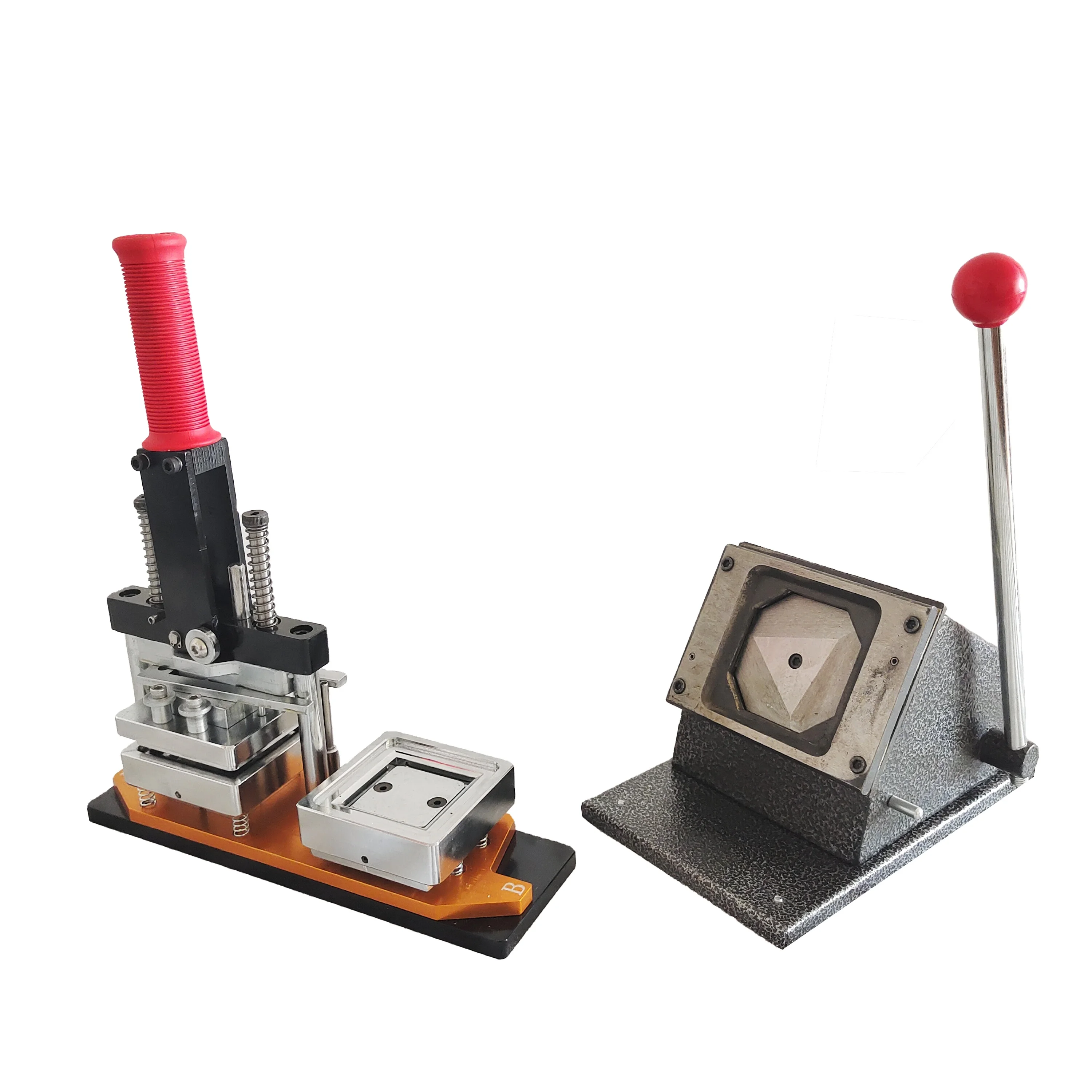
The main image and four of the gallery frames show the same pair of machines, and the pairing is the most informative thing in the listing.
The first unit is a vertical toggle press on a black baseplate with an orange sub-plate. A red ribbed handle drives a black lever arm down through a linkage; two chrome guide rods carry springs that act as a stripper, lifting the upper die clear of the work when the handle is released. Underneath sits a square die block in stainless with the cavity visible, plus a second die plate that rests on the orange sub-plate. A small letter "B" is moulded into that orange plate.
The second unit is a different machine entirely: a cast, speckled-black body with a long chrome lever and a red ball knob, carrying a square aperture fitted with an octagonal insert and, in the centre, a four-faced pyramidal punch with a small hole at its apex.
That second unit is never named or described anywhere in the listing. Its geometry is that of a lever-actuated die-cutting press, but whether it rounds corners, blanks square pieces from sheet, or punches the magnet itself is not stated. It is the single biggest unknown in the set, because a press that does the wrong operation is not an accessory — it is a paperweight.
Ships knocked down, and that is normal
One gallery frame shows the carton: a plain corrugated box, two white foam end-blocks, the chrome lever arm lying diagonally across the contents with its red ball detached, and the machine body wrapped in plastic. Nothing about that is unusual for this class of equipment — long levers are removed to keep the carton inside courier dimension limits.
What it does mean is that the first thing you do on arrival is an assembly and alignment check, not a production run. The pivot pin has to seat, the spring preload has to be right, and the die has to be checked for square to the ram before the first blank goes in. A press assembled carelessly will cut a die's life short long before the die wears out.
"Complete set" is undefined, and that is a costing problem
The title says complete set. The photographs show, beyond the two presses: a stack of large black sheets, two packets sealed in clear film, and a plastic bag of small white pieces. Those are presumably the magnet sheet, the printed-cover blanks or backing, and the transparent overlay film — but no count, size, thickness or material is given for any of them.
This matters more than it appears. On a magnet button the press is a one-time cost and the consumables are the recurring one: every finished piece consumes a cover blank, an overlay, a magnet and a back. If the set ships with fifty blanks and you need five hundred a week, the machine price tells you almost nothing about your unit cost.
Ask for a bill of materials with quantities: number of blanks, thickness in mm, whether the magnet sheet is isotropic or anisotropic, the overlay film thickness, and the price of each consumable bought separately. Then compute a landed cost per finished magnet before you decide the set is cheap.
What the press leaves out: force, die steel and springs
Three numbers decide whether a manual press can do the job, and none of them is published.
- Rated force. Crimping a magnet shell is a forming operation. Without a tonnage or a lever-ratio figure you cannot tell whether the press will close a given shell thickness — and the failure mode is not a clean refusal, it is a partly closed shell that looks acceptable and separates in the customer's hand.
- Die material and hardness. The die blocks in the photographs are bright machined steel, but whether that is a hardened tool steel or a mild steel block decides die life. A soft die in daily production will bell out at the cavity edges and start leaving a raised rim on the face of every magnet.
- Spring specification. The stripper springs are visible on the guide rods. Their rate decides how cleanly the part releases. Too soft and the part sticks in the upper die; too hard and the operator fights the handle all shift.
None of this can be read from a photograph, and a supplier who cannot state a tonnage has not tested the press. That is the first question in the RFQ below.
Capacity arithmetic, so you can plan a shift
The listing gives no cycle time, so the honest position is that throughput must be measured on arrival. What you can do now is bracket it. The table below converts a range of single-piece cycle times into output; the time column is an assumption to be replaced by your own stopwatch reading, not a supplier figure.
| Cycle per piece (assumed) | Pieces per hour | Pieces per 8-hour shift | When it applies |
|---|---|---|---|
| 4 s | 900 | 7200 | slow and careful |
| 6 s | 600 | 4800 | realistic for a two-press workflow |
| 8 s | 450 | 3600 | training or awkward artwork |
Two operational notes follow. First, this is a two-press workflow: one press forms the shell, the other cuts or finishes, so the slower of the two sets the rate and the operator walks between them. Second, on a manual press the cycle time degrades through a shift as the operator tires — the figure you measure in the first hour is not the figure you get in the eighth. Plan capacity on the afternoon number.
The description block belongs to a different business
The eight-hundred-character description names Hengshui Mengshang Trading Co., Ltd. and describes it as a supplier of CNC carbide inserts, turning tools and milling tools under the TEBAK brand, exporting to North America, Europe, South America, the Middle East, East Asia and Africa, with quality control based on ISO 9001 and an automatic machining centre.
Every sentence of that is about a cutting-tool business. Not one word describes a badge press, a die, a magnet, a blank or a button. The paragraph also stops mid-sentence at "The quality control standar", so it is not even a complete text.
This is worth understanding as a buyer, because it tells you how the listing was made: a template description was pasted under a product it does not describe. The same pattern usually means nobody checked the rest of the page either — which is consistent with an empty parameter block and gallery images that have nothing to do with the product.
For a search engine the consequence is worse than for a human. A page whose only product-specific text is a twelve-word title has almost nothing to rank on and almost nothing to distinguish it from the thousands of other thin pages on the same domain. That is a content problem dressed up as an SEO problem, and no amount of indexing requests fixes it.
Two of the eight gallery images are borrowed from another listing
Six frames in this listing show the product: the pair of presses, the press from the side, the second press head-on, the full set with consumables, and the carton. Two others — a factory gate with a company name board, and a yard of stacked wooden export crates — are packing and premises photography. Those two files are byte-identical to images used in an unrelated listing for precision 1-2-3 blocks in the same catalogue.
Reusing generic factory and crating shots across listings is common and mostly harmless, but here it displaces the frames that would have answered real questions: a nameplate, a die close-up with a ruler, a finished magnet beside its dimensions. When a buyer cannot see scale, they assume the worst.
Incoming inspection: what to do with the carton
- Photograph the carton before opening and check for crush damage at the corners, where a cast base will take the impact.
- Inventory against the bill of materials you obtained at quotation. Count blanks, overlays, magnets and backs. Anything unlisted is a claim you cannot make later.
- Assemble both presses, seat the pivot pins, and cycle them dry twenty times. Any binding, any creak, any spring that does not return fully is a rejection point.
- Measure the die cavity with a caliper in both directions, and confirm whether it is 50.0 mm or 50.8 mm. Record the number; your artwork depends on it.
- Cut and press ten pieces using the supplied consumables. Check square, check that the shell closes flush, check that the print has not shifted off-centre.
- Test the second press on scrap sheet and establish, by doing, what operation it actually performs.
- Time twenty cycles and write the number down. That is your capacity baseline, and it replaces every assumption in the table above.
RFQ checklist
Send this as a list and ask for written answers. Given that the listing publishes no parameters at all, treat every row as unanswered until the supplier replies in text.
| Item to confirm | Why it decides the purchase |
|---|---|
| Die size: exactly 50.0 mm or exactly 50.8 mm | A 3.2 percent area difference means a different insert and different artwork |
| Corner radius of the square die | Determines whether the finished magnet looks sharp or rounded |
| Rated force or tonnage of the press | Decides whether it can close your shell thickness |
| Die material and hardness (and whether hardened) | Die life is the main wear cost after consumables |
| Function of the second press, named explicitly | The listing never says what it does |
| Bill of materials with quantities and thicknesses | "Complete set" is otherwise undefined |
| Consumable prices bought separately | Recurring cost per finished piece |
| Magnet grade: isotropic or anisotropic | Holding strength on a fridge or a steel panel |
| Net weight and carton dimensions | Freight cost and courier surcharges |
| Spare parts: springs, pivot pins, spare die | A press with no spares is scrap after one worn spring |
| Cycle time as measured by the factory | Replaces the assumptions in this article |
| MOQ and price breaks | Neither is published anywhere in the listing |
What we will and will not quote from this page
The metric and imperial figures above are arithmetic on the only dimension the listing publishes, and the calculation is shown so you can check it. The description of the two presses is read directly from the photographs, including the detail that the second unit is never named. The consumables are described only as what is visible in the frames, with no counts invented.
What we will not do is supply a tonnage, a die hardness, a weight, a cycle time, a blank count or a price. Every one of those is absent from the listing, and a buying guide that filled them in would be inventing the exact numbers a buyer needs to be certain about.
If you send the checklist above with your intended shell thickness, artwork size and weekly volume, the reply can be a configured quotation rather than another photograph of a press.
Frequently asked questions
- Is this a 50 mm or a 2 inch machine?
- The listing claims both, and they are not the same. Two inches is 50.8 mm, so the die is either 50.0 mm square (2,500 mm²) or 50.8 mm square (2,580.6 mm²) — a 3.2 percent area difference. Confirm the exact cavity size in writing before ordering artwork or blanks.
- What is included in the complete set?
- The photographs show two lever presses (a vertical toggle button press with its die, and a second press with a square aperture), plus a stack of black sheets, two film-sealed packets and a bag of small white pieces. No quantities, thicknesses or materials are stated, so the set has to be defined by a bill of materials from the supplier.
- What does the second press do?
- The listing never says. Its geometry is that of a lever-actuated die-cutting press with a square aperture and a four-faced pyramidal punch, but whether it rounds corners, blanks square pieces or punches magnets is not stated anywhere. Establish it before you rely on it in a workflow.
- Does the press have enough force to close my shells?
- Unknown. No tonnage, force rating or lever ratio is published. Crimping a magnet shell is a forming operation, and the failure mode of an under-powered press is a partly closed shell that separates later, not a clean refusal. Ask for a rated force and test with your own shell.
- What die material is used?
- Not stated. The die blocks appear to be bright machined steel, but whether it is hardened tool steel decides die life. A soft die will bell out at the cavity edges and leave a raised rim on the face of every finished magnet.
- How fast is it?
- The listing gives no cycle time. Because a two-press workflow is limited by the slower station, throughput has to be measured: at 4 seconds per piece it is 900 per hour, at 6 seconds 600, at 8 seconds 450. Time twenty cycles on arrival and use the afternoon figure, not the morning one.
- Why does the description talk about CNC cutting tools?
- Because a template paragraph was pasted under a product it does not describe. The 800-character description profiles a carbide-insert and turning-tool supplier, stops mid-sentence, and never mentions a button machine — which is consistent with an empty parameter block.