
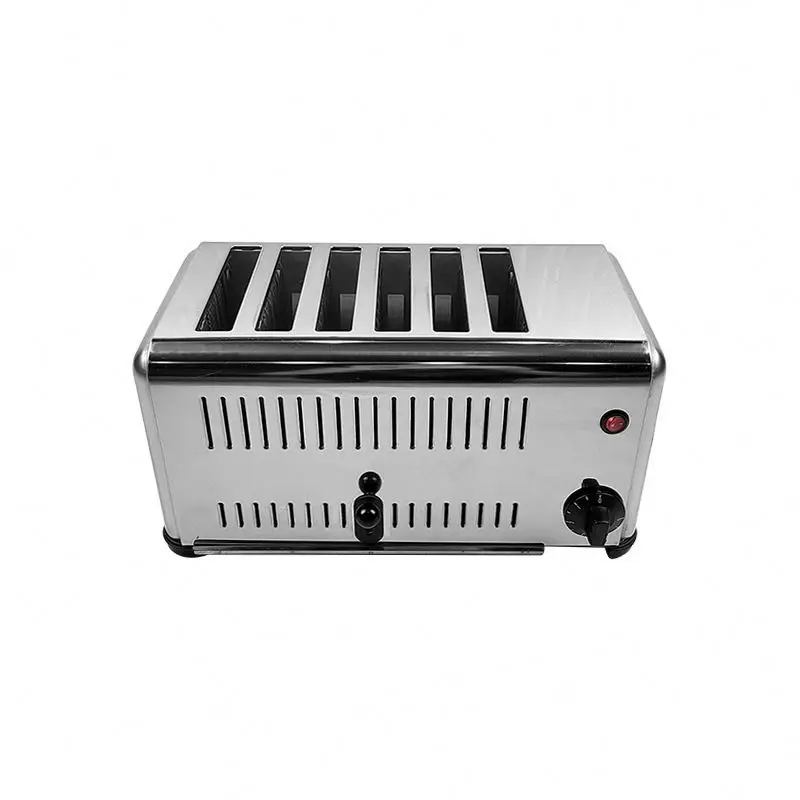
Source-controlled product identity
The Hoting queue identifies Product ID 1601391330537 as a commercial electric conveyor bread toaster, listed under the title "Stainless Steel Bread Bun Burger Electric Conveyor Commercial 4/6 Slice Bread Toaster Electric Bread Maker Toaster Oven". The structured parameter block in the record is empty, and the description carries a short block containing two labelled rows, which are reproduced below.
The title of the record names three different machines in one line: a conveyor toaster, a bread maker and a toaster oven. Only one of those describes a commercial toasting appliance, and the buyer's first task is to establish which machine is actually being offered. The two recorded rows name the product and its material, and nothing else: there is no power, no voltage, no conveyor speed, no throughput, no chamber or slot dimension, no weight and no model number.
This guide explains what a conveyor toaster is and why it differs from the other two machines in the title, derives the relationship between conveyor speed and toasting that decides both throughput and colour, gives the arithmetic a buyer should demand figures for, and lists the questions that must be answered before a commercial kitchen appliance can be specified, quoted or installed.
The recorded specification, verbatim
The structured parameter block in the record is empty. The description carries the following rows.
| Parameter | Recorded value |
|---|---|
| Product name | 4/6 Slicer Bread Toaster |
| Material | Stainles Steel |
The company introduction follows and is quoted at the end of this article. Note that the two rows above say what the machine is called and what it is made of. They do not say how much power it draws, how fast the conveyor runs, how many slices it produces in an hour, what fits through the slot, how heavy it is, what voltage it needs or what model it is.
First question: which machine is this?
The title combines three appliances that are not the same thing, and a buyer should not assume which one they are being offered until it is confirmed in writing.
A conveyor toaster is a machine with a heated chamber and a moving belt or chain that carries the product through it. The operator places bread at one end, the belt carries it past heating elements, and it emerges toasted at the other end. The machine runs continuously and its output is measured in slices per hour. This is the machine that the word conveyor in the title points to.
A bread maker is a domestic appliance with a pan and a paddle that mixes, proves and bakes a loaf from flour. It has no conveyor and no continuous output, and it is not commercial kitchen equipment in the sense the rest of the title implies.
A toaster oven is a chamber with a door and racks, loaded and unloaded by hand. It has no conveyor either, and its output is measured per batch rather than per hour.
Two of the three names in the title therefore contradict the conveyor claim. That does not necessarily mean the listing is wrong; it more often means the title was assembled from a template or from keywords. But it does mean the buyer should ask for the model number and a specification sheet, and should confirm in writing that the machine has a moving belt or chain and a slot at each end. A photograph of the loading end with the belt visible settles it faster than any description.
The absence of a model number is itself worth noting. A commercial appliance specification normally starts with a model number because it is the key to spare parts, elements and manuals. Ask for it before discussing anything else, and ask whether the same model is sold under another number in other markets.
What "4/6" can mean, and why it changes the order
The record calls the product a 4/6 Slicer Bread Toaster and the title says 4/6 slice. Three readings are possible and they lead to different machines and different prices.
The first reading is that the machine's loading width accepts four slices across, or six, depending on the model, so that 4/6 describes two variants of the same machine. Under this reading the buyer must choose a variant and the choice sets the throughput ceiling, because the number of slices per row multiplied by the rows per minute is the output.
The second reading is that one machine accepts either four or six slices at once depending on how the operator loads it, which describes a single model with a wide belt. Under this reading the number of slices is a loading decision rather than a product attribute, and the buyer needs the belt width and the slot height to know what actually fits.
The third reading, less likely but possible in listings of this kind, is that 4/6 refers to thickness settings or to slice thickness rather than to a count of slices.
Ask which reading applies, and ask for the belt width, the slot height and the slot width in millimetres, because those three dimensions settle the question regardless of which reading was intended. A machine that is sold as a four or six slice unit is being sold on a count, but what a kitchen actually needs to know is what physical size of product will pass through it.
The relationship that decides both throughput and colour
A conveyor toaster is a machine that toasts by transit. The product spends a certain time inside a heated chamber, and two things follow from that time.
The first is throughput. If the belt runs faster, more product passes through in an hour. The second is colour. Toasting is a combination of how much heat reaches the surface and for how long, so if the belt runs faster, the product collects less heat and comes out paler, unless the heating elements are made hotter to compensate.
This is the central trade-off in the machine, and it is why a conveyor toaster's specification cannot be reduced to a single number. The useful figures are the belt speed or the transit time range, the element power, and the controls the machine provides to adjust them. Two machines with the same throughput can differ completely in how they respond when a kitchen pushes them: one achieves its output with a long chamber and a gentle heat, the other with a short chamber and a fierce one, and the second will scorch if the belt is stopped at the wrong moment.
The arithmetic that relates the figures is worth stating because it is what the buyer should demand numbers for. The transit time is the chamber length divided by the belt speed. The output is the number of products per row multiplied by the number of rows per minute. The rows per minute is the belt speed divided by the spacing the operator can maintain between rows. So the three figures that determine everything are the chamber length, the belt speed range and the loading width, and not one of them appears in this record.
Ask for the transit time range in seconds or minutes rather than only a belt speed, because transit time is what connects to colour and is easier to check on delivery. Ask whether the belt speed is adjustable and over what range, and whether the adjustment is a continuous control or a set of fixed positions, since a continuous control lets an operator dial in a product while fixed steps force a compromise.
Peak service, recovery and duty rating
A commercial toaster is bought for its worst hour rather than its average one. In a hotel breakfast service, a cafe at the morning peak or a burger line during a rush, the machine is loaded continuously for a period and then idles.
Two questions follow. The first is the sustained throughput: how many slices per hour the machine actually produces when it is fed continuously, as distinct from a peak figure measured over a few minutes. The second is recovery: how the machine behaves when it is loaded heavily after a period of idling, and whether the elements and the chamber hold their temperature as the load rises. A machine whose chamber temperature sags under load will produce pale toast in the middle of a rush and dark toast at the edges of it, which is a quality problem that appears only in service.
Ask for the duty rating, for whether the machine is intended for continuous commercial operation, and for what the manufacturer says happens to output when the machine is run at its rated capacity for an extended period. Ask also what the thermal protection does, and whether the machine shuts down and needs a cool-down or recovers by itself, because a kitchen that loses its toaster during a rush loses the line.
Power, voltage and what they mean for the kitchen
The record states no power and no voltage, and for a commercial conveyor toaster these are the figures that decide whether the machine can be installed at all. A conveyor toaster heats for as long as it is switched on, so its power is drawn continuously during service rather than in a short burst, and that has consequences for the circuit it is installed on.
Ask for the rated power in watts or kilowatts, the rated voltage and the frequency, and whether the machine is available in the voltage and plug configuration of the destination market. Then compute the current, since power divided by voltage gives the current the machine draws, and compare it with the circuit the kitchen intends to use. A machine that draws more than the circuit allows will trip it, and the remedy, a dedicated circuit, is a cost the buyer must know about before ordering rather than after delivery.
Ask whether the top and bottom heating elements are on the same circuit or separately supplied, since a machine that requires two supplies is a different installation from one that requires one, and ask for the connection type: a plug, a hard-wired connection or a terminal block. Ask for the cord length and whether the machine can be installed on a counter with a socket behind it or needs its own point.
Energy cost is the other half of this question, and it is the figure that a buyer of a machine running all day should calculate. The energy used is the power multiplied by the hours of operation, and the cost is that energy multiplied by the local tariff. Stated as a formula rather than a figure, cost per hour equals power in kilowatts multiplied by the tariff per kilowatt hour, and cost per slice equals that hourly cost divided by the slices produced in the hour. A machine with a slightly higher purchase price but a lower continuous draw, or a shorter warm-up, can be the cheaper machine over a year of breakfast services. Ask for the standby or idling power as well, because a conveyor toaster is often left on between services and the idling draw is paid for continuously.
Ask also for the warm-up time from cold, since the machine cannot produce until the chamber is at temperature and that time is lost every morning.
What fits through the slot
A conveyor toaster is defined as much by its openings as by its power. The entry and exit slots set the maximum thickness and width of what can be toasted, and this is where a machine bought for bread can fail at the first burger bun.
Ask for the slot height and the slot width in millimetres. A standard slice of sandwich bread is thin, but a burger bun, a bagel, a thick slice of Texas toast, a crumpet, a panini or a filled roll are all thicker, and a machine whose slot is sized for sliced bread will refuse them. Ask whether the slot is adjustable, and if it is, whether the adjustment is a movable guide or a set of interchangeable plates.
Ask what the machine does at the exit. A conveyor toaster needs somewhere for the product to land, either a chute or a tray, and the buyer should ask for the exit arrangement and whether it can be positioned to suit the line. A machine that drops toast onto the counter in front of the operator is a different proposition from one that delivers it to the side.
One-sided and two-sided toasting, and the bun question
The title mentions bread, buns and burgers together, and those products do not want the same treatment. A slice of bread is normally toasted on both faces. A burger bun is usually toasted on the cut face only, with the crust left untoasted so that the bun stays soft, and the same is true of many filled rolls.
That difference is a specification, not a preference. Toasting one face requires either separate control of the top and bottom elements or a machine built to heat one side, and a machine without separate control cannot do it at all. Ask whether the top and bottom elements have independent controls, and whether the machine can be run with one bank off. Ask also whether the belt marks the product, since a bun toasted on a wire mesh belt takes the pattern of the mesh on its face, and whether a different belt type is available for buns.
If the intended use is buns and burgers rather than sliced bread, ask specifically which of the machines in the supplier's range is meant for that, because a bun toasting station is often a press with a heated platen rather than a conveyor, and a conveyor sized for toast may be the wrong tool for a burger line. This is the kind of question a buyer should ask before paying a deposit rather than after the line opens.
"Material: stainless steel" and the part that matters most
The second recorded row says the material is stainless steel, with the spelling as shown. That is a good sign for a commercial kitchen appliance, because stainless steel surfaces are cleanable and resist corrosion, but as a specification it is incomplete in one important respect.
It does not say which parts are stainless. On a conveyor toaster the exterior panels, the crumb tray, the chamber liner, the elements and the belt may each be a different material. The exterior matters for cleaning and appearance, but the belt matters for the product.
A conveyor belt in this class of machine is typically a woven wire mesh, a chain carrying slats or carriers, or a belt faced in a non-stick material. Each has consequences. A wire mesh belt is durable and lets crumbs fall through, but it marks the surface of what it carries and needs cleaning in place. A chain with carriers holds the product positively and can be built for thicker items, but it is more complex and has more parts to wear. A non-stick faced belt is gentler on buns and easier to clean but has a temperature limit and eventually degrades. Ask which type the machine uses, what it is made of, what its temperature limit is, whether it is removable for cleaning without tools, and what a replacement belt costs.
Ask also whether the belt can be tensioned or tracked by the operator, and what happens when it drifts, because a belt that walks off its rollers in service is a breakdown that stops the line. Ask whether the drive is a motor with a gearbox, and whether the drive components are standard parts or proprietary.
Cleaning, maintenance and the parts that wear
A toaster in commercial use collects crumbs continuously, and the crumb management is a hygiene question as much as a maintenance one. Ask where the crumbs go, whether there is a removable crumb tray, how it is accessed, and whether the machine can be cleaned without dismantling the chamber.
Ask what is expected to wear and be replaced. On a conveyor toaster these are usually the heating elements, the belt or chain, the drive motor and the switchgear, and the buyer should have prices and lead times for each before ordering, together with the part numbers. Ask whether the elements are a standard element available from more than one source or a proprietary part, because a proprietary element with a long lead time is a risk to a kitchen that depends on the machine every morning.
Ask for the cleaning instructions and for what the manual says must not be done, and ask whether the machine needs any periodic service, such as lubrication of the drive or a check of the belt tension, together with the interval.
Where the machine goes in the kitchen
A conveyor toaster has a footprint on a counter and a direction of flow, and both should be planned before the machine is ordered. Ask for the overall dimensions and the weight, and for the clearance required at the sides and above, since a machine that needs space behind it for ventilation cannot be pushed against a wall.
Ask how much heat the machine releases into the room, because a commercial kitchen's air conditioning is calculated on the heat load from its equipment, and a toaster that runs all morning contributes to it. Ask whether the machine requires a hood or extraction, or whether it is designed to operate without one, and ask about the smell and smoke it produces, since a toaster running continuously produces both.
Plan the loading and unloading positions as part of the decision. A conveyor toaster needs an operator position at the loading end and somewhere for the finished product to go, and in a tight kitchen those two requirements can decide whether the machine suits the space at all.
Documentation for a machine that touches food and carries mains power
This appliance both touches food and runs on mains electricity, so two sets of documents matter and neither appears in the record.
For the food contact side, ask which parts come into contact with the product and what they are made of, and ask for the documentation the supplier holds for food contact suitability in the destination market. For the electrical side, ask which safety marks the machine carries, for the test reports behind them, and for the manual and any warning labels in the language of the destination market. Ask the supplier to state, in writing, which market each document covers and which legal entity holds it, since a mark that belongs to another variant or another market does not transfer.
These questions are for the supplier and the buyer's own compliance adviser. What is appropriate in a given market is a matter for that market's rules, and nothing in this guide should be read as a statement of what any particular market requires.
What a buyer should request before ordering
- The model number and a specification sheet, and written confirmation that the machine is a conveyor type with a moving belt or chain and a slot at each end.
- The meaning of 4/6 in the product name, and the belt width, slot height and slot width in millimetres.
- Chamber length, belt speed range, and the transit time range in seconds or minutes, together with whether the speed control is continuous or stepped.
- Sustained output in slices per hour when fed continuously, as distinct from a short peak figure.
- Rated power, voltage, frequency and whether the machine is available in the destination market's voltage and plug configuration, together with the current it draws and whether a dedicated circuit or two supplies are required.
- Standby power, warm-up time from cold, the duty rating and what the thermal protection does under sustained load.
- Whether the top and bottom elements are independently controlled and whether the machine can be run with one bank off.
- The exit arrangement and where the finished product lands.
- The belt type and material, its temperature limit, whether it is removable without tools, how it is tensioned and tracked, and the price of a replacement.
- The crumb tray, its access and the cleaning procedure, and what the manual forbids.
- Expected wear parts, their part numbers, prices and lead times, and whether the elements and belt are standard or proprietary.
- Overall dimensions, weight, required clearances, heat release to the room, and whether a hood or extraction is required.
- Food contact materials and the documentation the supplier holds for the destination market.
- Electrical safety marks, the test reports behind them, the manual and warning labels in the destination market's language, and which market each document covers.
- Warranty period, what it covers, and the terms for a cross-border claim including who pays the return freight.
- Carton dimensions, quantity per carton, gross weight, packing method and whether the machine needs palletised handling.
- Price at the buyer's quantity, minimum order quantity, trade term, payment terms and lead time.
Acceptance and incoming inspection
Because the specification has to be established rather than checked against the record, the buyer's measurements on the first delivery become the reference for everything afterwards.
Measure the openings. Record the slot height and width and the belt width in millimetres, and test the machine with the thickest items it is intended to toast, which for a burger line means a bun and not a slice of bread. A machine that fails this test on delivery will not improve later.
Measure throughput rather than reading the claim. Load the belt at the intended spacing and count what comes out over a defined period, then repeat it after the machine has been running long enough to reach a steady state, so that the sustained figure is obtained rather than the first-minute figure. Record the transit time at the setting used by timing one item from entry to exit, and record the colour at that setting.
Test the controls that the specification claims. If the top and bottom elements are independently controlled, run the machine with one bank off and confirm that it produces the one-sided result it is supposed to. If the speed is adjustable, confirm the range and confirm that the extremes actually produce a usable product rather than a pale one at one end and a burnt one at the other.
Measure the electrical figures. Confirm the rating plate matches the order, confirm the voltage and frequency suit the destination, and if a clamp meter is available measure the running current and compare it with the computed figure, which will also show whether the machine is drawing what the label claims. Note the idle draw with the machine switched on but not loaded.
Inspect the parts the material row does not describe. Identify the belt type and material, the chamber liner, the elements and the crumb tray, record any part numbers, and try to source one element and one belt through the supplier to confirm that spares actually exist before the machine is in daily use. Run the machine long enough to see how the belt tracks at temperature, since a tracking problem that appears when the chamber is hot is the failure that stops a breakfast service.
Buyer decision framework
The source for this guide is a record whose structured parameter block is empty and whose description carries two rows, a product name reading 4/6 Slicer Bread Toaster and a material reading Stainles Steel, followed by a company introduction.
The first decision is what machine is being bought. The title names a conveyor toaster, a bread maker and a toaster oven, and only the first is a commercial toasting appliance with continuous output. Until the model number and a photograph of the loading end with the belt visible are supplied, the buyer is ordering a description rather than a machine.
The second decision is what the 4/6 means, and it should be answered with dimensions rather than with a count, because a kitchen needs to know what fits through the slot and how many items the belt carries per row, not how many slices a title claims.
The third decision is throughput against colour. A conveyor toaster's output and its toasting are linked through the transit time, so the figures that matter are the chamber length, the belt speed range and the loading width, and a buyer who asks only for slices per hour will not know what the machine does to the product at that speed.
The fourth decision is installation. Power and voltage decide whether the machine fits the electrical supply the kitchen has, and the answer may require a dedicated circuit, which is a cost that belongs in the comparison rather than in the surprises.
The purchase becomes a decision once five answers are in hand: the model number and confirmed machine type, the slot and belt dimensions, the transit time range and the sustained output, the power and voltage with the installation consequence, and the belt type with the spares prices. All five are absent from this record, and each is a question rather than an inference.
Frequently asked questions
Is this a conveyor toaster or a toaster oven?
The title names both, along with a bread maker, and only the conveyor description is consistent with a commercial machine that produces continuously. Ask for the model number and a photograph of the loading end showing the belt, and confirm in writing that the machine has a moving belt or chain.
What does 4/6 mean?
It can mean four or six slices across in two variants, four or six in one wide machine, or a thickness setting. Ask for the belt width, slot height and slot width in millimetres, which settle the question whatever was intended.
Why is the belt speed important?
Because transit time decides both output and colour. The transit time is the chamber length divided by the belt speed, and the toast darkens with the heat it receives during that time, so a faster belt means more output and paler toast unless the elements are hotter. Ask for the transit time range in seconds and for the sustained output.
How many slices per hour does it produce?
Not stated. Ask for the sustained figure when the machine is fed continuously, as distinct from a short peak, and expect it to depend on the loading width and the belt speed rather than on a single number.
What power and voltage does it need?
Not stated. Ask for the rated power and voltage, then compute the current as power divided by voltage and compare it with the circuit the kitchen intends to use. Ask whether the machine needs one supply or two, and whether the connection is a plug or hard-wired.
Can it toast burger buns?
Only if the geometry and the controls allow it. Buns are thicker than sliced bread, so the slot height matters, and buns are usually toasted on the cut face only, which requires independently controlled top and bottom elements. Ask for the slot dimensions and whether one bank of elements can be switched off, and ask which machine in the supplier's range is intended for buns.
Does the belt mark the product?
A wire mesh belt will leave its pattern on the face it carries, which matters for buns and presentation. Ask what the belt is made of, whether a different belt type is available, and whether the belt is removable for cleaning.
What does "Material: Stainles Steel" cover?
It says the machine uses stainless steel without saying which parts. Ask specifically about the chamber liner, the crumb tray, the elements and the belt, since the belt touches the product and its material and temperature limit matter most.
How much does it cost to run?
Energy cost per hour is the power in kilowatts multiplied by the local tariff per kilowatt hour, and cost per slice is that divided by the slices produced in the hour. Ask for the rated power, the standby power and the warm-up time, all three of which affect what the machine costs to own rather than to buy.
What spares will be needed?
Typically heating elements, the belt or chain, the drive motor and the switchgear. Ask for part numbers, prices and lead times before ordering, and ask whether the elements and belt are standard parts available from other sources or proprietary to the supplier.
What is missing from the record altogether?
The model number, power, voltage, chamber length, belt speed, transit time, throughput, slot dimensions, weight, overall dimensions, packing, certification documents, warranty, price, minimum order quantity and lead time. None of these is a defect in the product; all of them are gaps the buyer must close before ordering.
Source and contact
This guide is based on the Hoting queue record for Product ID 1601391330537. The structured parameter block in that record is empty, and the two labelled rows reproduced above, the product name "4/6 Slicer Bread Toaster" and the material "Stainles Steel", are quoted verbatim from the description as recorded, including the spelling. The title describing the product as a stainless steel bread bun burger electric conveyor commercial toaster with electric bread maker and toaster oven wording is reproduced from the record, as is the company introduction naming Hengshui Mengshang Trading Co., Ltd. and the TEBAK brand and stating that quality control standards are based on ISO9001 certifications, which is a statement about standards rather than a certificate and should be supported by the certificate itself if certification matters to the buyer. No model number, power, voltage, frequency, chamber length, belt speed, transit time, throughput, slot dimension, belt material, weight, overall dimension, certification, warranty, price, minimum order quantity or lead time appears in this article because the record contains none. The description of how a conveyor toaster works, the relationship between transit time, belt speed and chamber length, the arithmetic relating power, voltage and current, the formula relating operating cost to power and tariff, the explanation of one-sided toasting for buns, the character of CE, GS and UL style marks and the general properties of wire mesh, chain and non-stick belts are reasoning and general engineering and food service knowledge rather than claims about this product, and every point about the machine type, the 4/6 designation, the belt, the elements, the spares, the installation and the documentation is a question for the supplier rather than a statement of what the machine has.
Request the model number and a specification sheet with written confirmation that the machine is a conveyor type with a belt or chain and a slot at each end; the meaning of 4/6 and the belt width, slot height and slot width in millimetres; chamber length, belt speed range, transit time range in seconds and whether the speed control is continuous or stepped; sustained output in slices per hour under continuous feeding; rated power, voltage, frequency, current drawn and whether a dedicated circuit or two supplies are required, with the destination market's plug configuration and the connection type; standby power, warm-up time, duty rating and the behaviour of the thermal protection under sustained load; whether the top and bottom elements are independently controlled and whether one bank can be switched off; the exit arrangement and landing position; the belt type and material, its temperature limit, removal for cleaning, tensioning and tracking, and the replacement price; the crumb tray access and the cleaning procedure; the wear parts with part numbers, prices and lead times and whether they are standard or proprietary; overall dimensions, weight, clearances, heat release and whether a hood or extraction is required; the food contact materials and the food contact documentation held for the destination market; the electrical safety marks, the test reports behind them and the manual and warning labels in the destination market's language; the warranty terms for a cross-border claim; carton dimensions, quantity per carton, gross weight and packing method; and the price, minimum order quantity, trade term, payment terms and lead time, quoted through the TEBAK sales inquiry channel before ordering.
Key specifications
- Product name
- 4/6 Slicer Bread Toaster
- Material
- Stainles Steel