
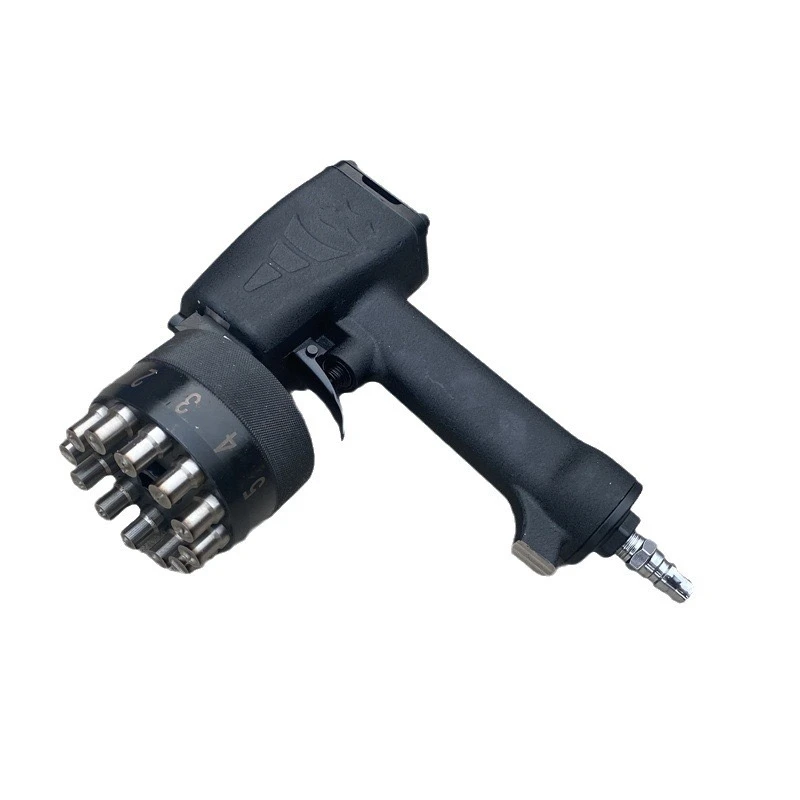
Two specification sets, and a model number the two do not share
The Hoting queue carries Product ID 1601272643097 as a TEBAK rotary pneumatic impact marking machine for pressing information into cylinders, metal plates and coded parts, and the listing publishes five parameters. The seven gallery images publish a second and much larger set: two dimensioned drawings, a real-shot panel with numbered callouts, a factory photograph, a questions-and-answers panel, a payment and shipping badge panel and a business card. Reading the two sets against each other is the quickest way to see what a buyer is actually being offered, because the model number itself does not match.
| Quantity | Listing | The record's own images |
|---|---|---|
| Model | TK-12 | LZH series pneumatic marking machine, as named in one panel |
| Working pressure | Parameter row labelled only as the unit Mpa, value 0.6-0.8Mpa | 0.6-0.8MPa on the drawing; about 0.7Ma in another panel, with the unit's last letter missing |
| Font height | 12mm | Not stated in any image |
| Weight | 6kg, with no gross and net split | Not stated in any image |
| Size | 40 by 30 by 20 cm, labelled only as Size, so it is unclear whether this is the machine or the carton | 290mm and 226mm for one variant, 230mm and 175mm for the other, with head diameters of 54mm and 78mm |
| Variant | One machine, unnamed | Two machines shown side by side, captioned Heavy Duty and Light |
| Character set | The title offers 0 to 9 numbers | Optional numbers 0-9 and 26 English letters, two of which, in one image; 10 number words and 2 English letters in the code dial, in another |
| Air supply | Nothing beyond the pressure row | A pressure recommendation, and no flow rate anywhere |
| Lubrication | Nothing | Drip pneumatic oil, work more smoothly |
| Air quality | Nothing | A warning that unclean gas in the code turntable will shorten the service life |
| Applications | Nothing | Station numbers, serial numbers, product serial numbers, production dates, automobile and parts production, pressure vessel manufacturers, aviation and rail |
Two of these rows are worth stating plainly. The first is the model. A buyer who orders a TK-12 against a listing that also carries LZH series in its own artwork is ordering an identifier that the record does not use consistently, and the model number is what the nameplate, the certificate and the spare parts list will all be keyed to. Require one model number, as printed on the machine, and use only that number in the order.
The second is the unit. The listing's parameter row has its label and its value both carrying the unit: the label reads Mpa and the value reads 0.6-0.8Mpa. The drawing prints MPa, which is the correct form for a megapascal. A caption in another panel prints about 0.7Ma, which is neither. The numbers agree with each other and the spelling does not, which is the signature of a specification written by hand rather than copied from a datasheet, and it is worth confirming that the supplied machine's nameplate carries the same numeric range.
Twelve dies on the dial: the character set decides whether your part can be marked at all
This is the parameter that decides the purchase, and it is the one the listing states least clearly. A rotary dial impact marker carries a set of steel character dies arranged around a rotating plate. To mark a character, the operator rotates the dial until the wanted die is in the striking position, places the head against the work, and triggers one impact. One impact produces one character. That geometry has a hard consequence: the machine can only ever produce the characters that are physically on the dial.
The record gives the dial's character set twice, and the two statements do not agree.
| Source in the record | Statement, as printed | How many characters that means |
|---|---|---|
| One gallery image, beside the dial | Optional numbers 0-9/26 English letters, two of which | Ambiguous; reads either as 36 characters of which two are chosen, or as 26 letters of which two are fitted |
| Another gallery panel, numbered callout | There are 10 number words and 2 English letters in the code dial | 12 characters: ten digits plus two letters |
| The listing title | 0-9numbers to Impact Information Onto Cylinder Car Repair | Ten digits, with no letters mentioned |
The difference between thirty-six characters and twelve is the difference between a machine that can mark an identification number and one that cannot, so it has to be settled before an order rather than after. The following check settles it for a buyer's own data.
Write down the longest string that will be marked, count its characters, and list the distinct letters it contains. That number of impacts is what one part costs, and the letter list is what the dial must be able to produce. Two worked examples use formats that are public and standard rather than any buyer's data. A vehicle identification number is seventeen characters long and, by the standard that defines it, excludes the letters I, O and Q to avoid confusion with digits, which still leaves twenty-three letters and ten digits available in the format. A worked example string of LHGCM82633A004352 contains six distinct letters: L, H, G, C, M and A. A dial fitted with two letters cannot produce it, whatever those two letters are, and the same is true of most engine and cylinder numbers, which routinely mix letters and digits. By contrast, a production date, a batch number, a station number or a short all-digit sequence is well within a twelve character dial, which is why the applications listed in the record's own panel read as they do: station numbers, serial numbers and production dates first.
Three questions follow from that check, and each one has a price attached. First, which two letters are fitted, since a dial carrying A and B cannot mark a part whose code contains C, and the two letters are worth naming in the order rather than accepting whatever is available. Second, whether a custom dial can be supplied with the buyer's own character set, what that costs, how long it takes and what the minimum quantity is. Third, what the dies are made of, whether a single damaged character can be replaced on its own or the whole dial has to be changed, and what a replacement dial costs, because on a machine that strikes steel the dies are the consumable that decides the cost of ownership. The record prices none of these.
There is a second consequence of the one-impact-per-character geometry that the record does not mention either. Because every character is placed by the operator, the spacing between characters and their alignment along a line depend on the operator's hand. For a plain mark that is acceptable; for a code that has to be read by a scanner, or for a row of characters that has to sit square on a plate, a jig or a fixture is needed to hold the work and index the tool. That fixture is not in the record, is not in any gallery image, and is the difference between a machine that marks one part at a time by eye and a machine that marks a production run consistently.
Why a rotary dial is not a dot peen machine
This distinction matters because the same catalogue family contains both, and the two solve different problems. A dot peen machine drives a single hard stylus into the work in a rapid series of strikes, and the pattern of dots forms the character. Because the pattern is generated, a dot peen machine can produce any character or logo that can be described, and it can change data from part to part without touching the tool. A rotary dial machine does the opposite: it stamps one solid character per impact from a fixed set of steel dies. It cannot produce a character that is not on the dial, however the data changes.
The trade is therefore legibility and depth against flexibility. The dial machine produces a deep, fully formed, forge-like character in a single strike, which is what a cylinder block, a chassis plate or a pressure vessel marking needs, and it does so without a controller, without software and without a power supply other than the air line. The dot peen machine produces a lighter, dot-formed character over a wider area, and it can be programmed. A buyer whose code is all digits, or whose code needs at most two letters that can be chosen in advance, gets a better mark and a simpler machine from the dial. A buyer whose code is a seventeen character vehicle identification number, or a mixed alphanumeric serial that changes in ways they cannot forecast, needs the dot peen route or a custom dial for every character set they will ever use. Deciding this before ordering is worth more than any other choice on this page.
The pressure figure states an input, not a force
The listing's pressure parameter, and the drawing's own line, both give a working pressure of 0.6 to 0.8 megapascals. That converts to 6 to 8 bar, or roughly 87 to 116 pounds per square inch, which is ordinary workshop pressure and within reach of most small compressors. It is also not a measure of what the machine does.
The energy a single impact delivers depends on the cylinder's bore and stroke, on the mass of the striking assembly and on the speed it reaches before contact, and none of those is in the record. The depth of the resulting mark depends on that energy, on the hardness of the work, and on the shape and sharpness of the die, and none of those is in the record either. A pressure range therefore tells a buyer that the machine will run on their air line, and nothing about whether the mark will be legible after the part has been painted, or whether it will penetrate deeply enough for a cylinder block or a pressure vessel. That has to be established by a marking test on the buyer's own material, in the buyer's own hardness and with the buyer's own character set, which is a reasonable thing to ask a supplier for before an order is placed.
There is a bigger omission next to the pressure figure. The record states no air consumption, no flow rate and no cylinder volume, so a buyer cannot work out whether their existing compressor can run this tool, how many of these tools one compressor could support, or what size of air receiver would smooth the demand. A pneumatic impact tool draws air in bursts, and burst demand is what sizes the compressor, not the steady average. Without a litres per minute figure at the stated working pressure, the compressor side of the project cannot be costed at all, and the air consumption is the single figure most worth asking for.
The air side the record asks for but does not supply
Two lines in the record's own drawings describe a requirement the listing never states. One is a caption reading drip pneumatic oil, work more smoothly, and the other, in a panel about the code dial, warns that unclean gas in the code turntable will shorten the service life. Read together, they say the tool expects lubricated air, and the dial specifically is sensitive to contamination.
That has a cost consequence a buyer should price before ordering. A pneumatic impact tool run on dry, unoiled air will wear its seals and its striking assembly early; a tool run on wet or dirty air will clog and corrode, and on this machine the dial is the part that suffers first. The usual answer is a filter-regulator-lubricator unit at the point of use, which combines a water trap, a pressure regulator set to the machine's range and an oil feeder, with the oil matched to the tool. The record does not say whether such a unit is included, recommended or required, and it is not visible in any gallery image. It is therefore an added line in the buyer's cost, along with the hose, the quick couplings and the drip line.
The air quality itself is the other half of the same question, and it is answerable in a standard form. Compressed air purity is classified in the ISO 8573-1 series, which defines classes for solid particles, water and oil separately, so instead of describing air as clean a buyer can ask the supplier to name the purity class the tool requires. That turns a vague warning about unclean gas into a number the buyer can hold their compressor and dryer to. A workshop whose compressor feeds a paint booth or a food line, and therefore runs oil free, should raise this before ordering rather than after, because the tool's own instruction to drip oil may conflict with that air system, and the remedy in that case is a point-of-use lubricator on a dedicated line rather than changing the whole workshop's air.
The record's own note that rapid exhaust reduces cylinder temperature is a hint about duty cycle. It says the design vents the cylinder quickly to keep it cool, and it implies the tool is meant for intermittent work rather than continuous running. No duty cycle is stated, so the question to ask is how many impacts per minute the machine can sustain, and for how many minutes at a time, since an operator on a production line will otherwise discover the limit by overheating the tool.
The size figure, the two variants, and what the carton does to freight
The listing's size parameter gives 40 by 30 by 20 centimetres and labels it only as Size, without saying whether it is the machine or its carton. The drawings give the machine's own length and height for two different variants, and the two do not match each other.
| Measure | Value | Note |
|---|---|---|
| Listing size | 40 by 30 by 20 cm | 0.024 cubic metres, or 24 litres; machine or carton unnamed |
| Variant captioned Heavy Duty | 290mm long, 226mm high, with a 54mm head | From the record's own drawing |
| Variant captioned Light | 230mm long, 175mm high, with heads of 54mm and 78mm | From the same drawing |
| Handle dimensions drawn | 42mm on one variant, 19mm on the other | These are the two other figures on the same drawing |
| Garbled dimension | One 8|9mm-One | As printed, beside the Heavy Duty head |
| Volumetric weight of the listed carton | 4.0 kg at a divisor of 6,000; 4.8 kg at 5,000 | Author's arithmetic from the listed size |
| Stated weight | 6 kg | Greater than the volumetric figure, so actual weight governs |
The freight consequence here is the opposite of the usual one and worth stating for that reason. Because the listed carton is small and the machine is dense, the volumetric weight of about four to five kilograms sits below the stated six kilogram actual weight, so an air or courier shipment will be charged on the machine's mass rather than on its volume. The buyer's saving would come from reducing the six kilograms, not the box. The figure that cannot be checked is which of the two variants the six kilograms refers to, since the two drawings show machines differing by sixty millimetres in length and fifty-one millimetres in height, and the heavier machine is likely to be the longer one. The record states a single weight, a single size and no variant, so the first question is which variant is quoted and the second is the weight of that variant alone.
The two variants also raise a selection question the listing does not answer. If the smaller one is the one supplied, a buyer planning to mark cylinder blocks and pressure vessels has a different tool from the one the Heavy Duty caption suggests, since the smaller machine is shorter, lower, lighter and carries the larger 78 millimetre head in the same drawing. Whether the two variants differ only in size or also in striking force, character capacity and air consumption is not stated anywhere, and those are exactly the differences that decide which one belongs on a given job.
What one part costs in operator time
Because one impact produces one character, the machine's throughput is a function of the character count rather than of the machine alone, and the record states no cycle time at all. The arithmetic is still worth doing with an assumed figure, so that the buyer can substitute their own. Suppose an operator needs about three seconds for each character, covering the dial rotation, the positioning of the head and the trigger. A nine character part number would then take about 27 seconds, which is about 133 parts per hour for one operator working continuously, and a seventeen character identification number would take about 51 seconds, or about 71 parts per hour. Halving the assumed time to 1.5 seconds per character doubles both figures.
Those numbers are the author's illustration from an assumed cycle time, not a specification, and they are written here so that they are not mistaken for one. They are also the reason the character count matters twice over: it decides whether the part can be marked, and it decides how long each part takes. A buyer comparing this machine with a dot peen machine should compare impacts per part against the slower per-character motion of a single-stylus tool, and should ask the supplier for the impact rate the machine can sustain and the recommended number of characters for a production run without a fixture.
The commercial terms live in a gallery panel, and two panels disagree
The listing's parameter rows carry no price, minimum order quantity, lead time or trade term at all. Those appear in a questions-and-answers panel among the images, which is where a buyer will find them, and the answers as printed are these: quotations are usually issued within twenty-four hours of an enquiry; samples can be offered for reference; design work is available; payment is thirty per cent deposit with seventy per cent balance before shipping, by telegraphic transfer, PayPal or Western Union; mass production lead time is about fifteen working days depending on quantity; and delivery terms accepted are EXW, FOB and CIF.
One inconsistency sits inside the same gallery. A separate badge panel displays the payment methods as trade assurance, PayPal, Western Union, escrow, letter of credit and telegraphic transfer, while the answers panel lists only three of those. A letter of credit and an escrow route are materially different terms for a buyer, so the panel that a buyer is shown first is not the panel that states the terms. The answer worth getting in writing is which of those instruments the supplier will actually accept on a first order, and at what order value each becomes available.
Three further points follow from those terms as printed. First, a seventy per cent balance before shipping places the whole of the buyer's money with the supplier before the goods leave, so the instrument matters more than the price on a first order, and a trade assurance or escrow route is worth asking for explicitly. Second, samples are offered for reference but no sample lead time, sample cost or sample carriage is stated, and for an impact marking machine the sample that matters is not a sample of the machine but a sample of the mark on the buyer's own material, which is a different request from the one the panel answers. Third, fifteen working days is stated as the lead time for mass production, and the records show this supplier quoting on machines that are made for stock and others that are configured, so the lead time for a machine with a custom dial should be asked for separately, because a custom dial is a made-to-order part and not a stock item.
Two company names appear in the record
Import paperwork is where this matters, so it is worth recording exactly what the record shows. The description text carries a company profile naming Hengshui Mengshang Trading Co., Ltd. A factory photograph among the images shows a gate sign reading 衡水梦尚贸易有限公司, which is the same name in Chinese. A business card among the same images carries the TEBAK brand mark with two entity names beneath it, TEBAK MACHINERY CO.,LTD and HENGSHUI SANRENXING TRADING CO.,LTD, together with a named sales manager and direct contact details.
None of that implies anything improper, and multi-entity supplier groups are ordinary. What it does mean is that the buyer should establish, in writing, which legal entity issues the quotation, which entity will appear on the commercial invoice, which entity receives the payment, and which entity signs the certificate of origin and any conformity document. An invoice issued in one name while payment goes to another is a routine source of queries from banks and customs, and an origin certificate whose exporter differs from the invoicing party can hold up clearance. The same panel also gives the brand and the trading entity different names, so a buyer should also confirm that the trademark they are buying under is one the invoicing entity is entitled to use, or that the machine is supplied unbranded.
Finally, the record's own gallery includes a badge panel carrying third-party payment and courier marks. Such panels are template artwork rather than a statement of the supplier's accounts, and they promise nothing by themselves. The terms that bind are the ones written into the quotation and the order, not the logos beside them.
What the record does not state at all
The gaps are as important as the figures, and each one becomes a line in the buyer's own specification.
- Which of the two variants is offered, and the length, height, head diameter and weight of that variant alone.
- Whether the listed 40 by 30 by 20 centimetres is the machine or the carton, and the carton's dimensions and packed weight as delivered.
- Air consumption in litres per minute at the stated working pressure, which is the figure needed to size or check a compressor.
- Impact energy, stroke, bore or striking mass, which is what determines marking depth and therefore whether the mark suits the buyer's material.
- The character width as distinct from the stated 12 millimetre font height, and the spacing the dial can produce between adjacent characters.
- Which two letters are fitted to the dial, and whether a custom dial can be supplied, at what price and lead time.
- The die material, whether individual dies can be replaced, and the price of a dial or a die set as a spare.
- The number of impacts per minute the machine can sustain, and its duty cycle.
- Noise level and hand-arm vibration magnitude, both of which matter for a tool that is struck against steel all day, and neither of which appears anywhere.
- The hardness range of material the machine can mark, and the maximum material thickness or section it suits.
- Whether a fixture, jig or work rest is available to keep characters in line.
- Warranty terms, any certification, the packing list, and an instruction manual or parts diagram with part numbers.
Incoming inspection when the machine arrives
- Photograph the nameplate before unpacking and record the model, the working pressure range and any serial number, then compare the model with the one on the order and with the one used in the listing's own artwork.
- Turn the dial through all of its positions by hand and write down every character it carries, then compare that list with the string the buyer intends to mark. This check takes two minutes and it is the one that decides whether the machine is fit for the job.
- Measure the machine's length, height and head diameter and record them, then compare with both drawings, since the two variants differ by sixty millimetres in length and the record supplies a single size.
- Weigh the machine alone and the complete packed carton separately, and record both, because the record gives one weight with no gross and net split.
- Inspect the dies under a magnifier for sharpness, chips and seating in the dial, and check that each die sits at the same height, since one low die produces one faint character and that failure mode is invisible from the outside.
- Check the dial's rotation for backlash and index the dial repeatedly to one character, then measure where the mark lands each time, which measures the repeatability the operator will have to live with.
- Mark a test part in the buyer's own material, at the buyer's own hardness, with the longest string they intend to use, and keep that part as the reference.
- Vary the supply pressure across the stated range and mark a test part at each end, then compare depth, legibility and edge sharpness, so the buyer learns where in the range the machine is comfortable.
- Measure the mark's depth with a depth gauge or a dial indicator on a surface plate, and record it, because depth is the figure that decides whether the mark survives painting or service wear.
- Measure the character height, width and the pitch between adjacent characters with calipers, and compare the height with the stated 12 millimetres.
- Connect the tool to the buyer's own air line with the intended hose bore and quick couplings, and check the compressor's behaviour while the tool is striking repeatedly, since burst demand is what the missing air consumption figure would have predicted.
- Fit and set the filter-regulator-lubricator, set the regulator to the machine's range, confirm the oil feed rate and record the oil used, then confirm that the air reaching the tool is dry by checking the trap after a shift.
- Run the machine for the length of a busy production block and feel the cylinder housing for excessive heat, to find the practical duty cycle the record does not state.
- Measure the noise level at one metre while the machine is striking, and record the figure in the buyer's own file, since neither noise nor vibration appears in the record.
- Check every air coupling for leaks under pressure, and confirm the tool cannot be triggered by accident when it is set down, since a trigger-operated impact tool left pressurised is the obvious hazard on a bench.
- File the delivered model, the dial's character list, the test part, the depth and noise readings and the packed weight on one sheet, so a second order can be checked against the first.
The specification to send before ordering
| Item | Answer required as |
|---|---|
| Model and variant | One model number as printed on the nameplate, and which of the two variants it is |
| Character set | The complete list of characters on the supplied dial, and the two letters if only two are fitted |
| Custom dial | Whether a dial with the buyer's own character set can be supplied, the price, the lead time and the minimum quantity |
| Character size | Character height and width in millimetres, and the pitch between adjacent characters |
| Dies | Die material, hardness, whether individual dies are replaceable, spare die and spare dial prices, and the replacement interval |
| Impact performance | Impact energy or stroke and bore, and the maximum marking depth in the buyer's material at the stated pressure |
| Material range | The hardness range and section thickness the machine can mark |
| Cycle rate | Impacts per minute sustained, and the recommended duty cycle |
| Air consumption | Litres per minute at the stated working pressure, which is required to size the compressor |
| Air quality | The ISO 8573-1 purity class required, and whether a filter-regulator-lubricator is supplied, recommended or required |
| Lubrication | The oil specification and feed rate, and what happens on an oil-free air system |
| Dimensions | Length, height and head diameter of the variant supplied, and the carton dimensions as delivered |
| Weight | Machine weight and packed weight as two separate figures |
| Fixture | Whether a jig, work rest or indexing fixture is available for consistent character alignment |
| Safety data | Noise level at one metre and hand-arm vibration magnitude |
| Consumables and spares | A parts list with part numbers for the dies, the dial, the seals and the striking assembly |
| Documentation | An instruction manual and a parts diagram, in English |
| Legal entity | Which entity quotes, invoices, receives payment and signs the origin certificate, and the trademark position |
| Commercial terms | Price, minimum order quantity, trade term, payment instrument, sample route and cost, lead time including any custom dial, and warranty |
Answers to the questions this record raises most often
How many characters can the dial mark?
The record gives three different answers. The listing title mentions 0 to 9, one gallery image says optional numbers 0-9 and 26 English letters of which two, and another panel says ten number words and two English letters in the code dial. The last of those is the most specific and the least capable. Because one impact produces one character, the dial can only mark the characters physically on it, so the complete character list has to be obtained rather than inferred, and it decides whether the machine suits the buyer's codes at all.
Can it mark a vehicle identification number?
Only if the dial carries every letter in that number. A vehicle identification number is seventeen characters long and excludes the letters I, O and Q, leaving twenty-three letters and ten digits in the format. A worked example string of LHGCM82633A004352 contains six distinct letters, and a dial fitted with two letters cannot produce it. Such work needs a custom dial for each character set, or a dot peen machine instead.
How long does one part take?
The record states no cycle time. One character costs one impact, so a nine character code costs nine impacts and a seventeen character code costs seventeen. At an assumed three seconds per character that is about 27 and about 51 seconds a part respectively; those figures are the author's illustration, not a specification, and should be replaced with a measured time on arrival.
What is the model number?
The listing says TK-12. One of the record's own panels names the LZH series pneumatic marking machine. One of the two is the model that will appear on the nameplate, the certificate and the parts list, so require a single number, as printed on the machine, and use only that number in the order.
Is 0.6 to 0.8 megapascals a lot of force?
It is an ordinary workshop pressure, equal to 6 to 8 bar or roughly 87 to 116 pounds per square inch, and most small compressors can supply it. It is not a measure of the impact the machine delivers, because that depends on the cylinder's bore and stroke and the mass of the striking assembly, none of which is stated. Marking depth has to be established by testing on the buyer's own material.
Will my compressor run it?
The record cannot answer that, because no air consumption figure is given anywhere. A pneumatic impact tool draws air in bursts, so the compressor has to cover the burst rather than the average, and the litres per minute figure at the stated working pressure is the single most important number to request. Without it the air side of the project cannot be sized.
Does the machine need oil?
Yes, by the record's own caption, which reads drip pneumatic oil, work more smoothly, and it also warns that unclean gas in the code turntable will shorten the service life. In practice that means a filter-regulator-lubricator at the point of use and a defined air purity class. If the buyer's workshop runs oil-free air, as a paint or food line would, that conflict should be settled before ordering rather than after.
Which variant is being sold?
The record does not say. Two machines appear in the drawings, captioned Heavy Duty and Light, measuring 290 by 226 millimetres and 230 by 175 millimetres respectively, with a single weight of six kilograms and a single size of 40 by 30 by 20 centimetres given for the listing as a whole. Ask which variant is quoted and for its own dimensions and weight.
Does the carton add cost?
Not much in volume terms. The listed size of 40 by 30 by 20 centimetres is 24 litres, whose volumetric weight is about 4.0 to 4.8 kilograms, below the stated six kilograms, so the shipment is charged on actual weight rather than on volume. The uncertainty is whether the six kilograms describes the longer or the shorter variant.
What does the record leave out completely?
The variant supplied, the carton as delivered, air consumption, impact energy, character width and pitch, which two letters are fitted, custom dial availability and price, die material and spare prices, impacts per minute and duty cycle, noise and vibration, the hardness range of markable material, any fixture, the warranty, any certification, the packing list and an instruction manual. Each of those becomes a line in the buyer's own specification rather than a figure read from the listing.
Source, scope and what this guide does not claim
This guide is based on the Hoting queue record for Product ID 1601272643097, titled as a TEBAK rotary pneumatic impact marking machine for pressing information onto cylinders, car repairs, metal plates and coded parts, and on the seven detail images that accompany it. All seven images were examined.
The five listing parameters are quoted as they appear: model, TK-12; a parameter row whose label is the unit Mpa and whose value is 0.6-0.8Mpa; font height, 12mm; weight, 6kg; and size, 40 by 30 by 20 centimetres. The record's own images supply the rest. One drawing prints a working pressure of 0.6-0.8MPa, the caption drip pneumatic oil, work more smoothly, the label cylinder exhaust port, the phrase rotary code plate, the sentence optional numbers 0-9/26 English letters, two of which, and the dimensions 290mm, 226mm, 230mm, 175mm, 54mm, 78mm, 42mm and 19mm, together with the garbled dimension text One 8|9mm-One and the captions Heavy Duty and Ligh t. A panel of real-shot photographs carried numbered callouts whose text lists station number, serial number, product serial number and production date as applications and, separately, automobile and parts production, high pressure vessel manufacturers, aviation and rail; the same panel names the LZH series, recommends about 0.7Ma of compressed gas as printed, states that there are 10 number words and 2 English letters in the code dial, and warns that unclean gas of the code turntable will shorten the service life. Another panel opens with the caption pneumatic number smashing machine and lists station number, serial number, product serial number and production date, then states that the main body is composed of a cylinder with a high impact force and that the header is installed with steel molds of various, the sentence ending there as printed. The caption rapid exhaust reduces cylinder temperature and the phrase start switch, simple design, simple operation are from the drawing panel. The questions-and-answers panel, the payment and shipping badge panel and the business card are described from their own text, and the factory photograph carries a Chinese gate sign reading 衡水梦尚贸易有限公司.
Several figures in this guide are the author's arithmetic rather than published data, and are identified so that they are not mistaken for specifications. The conversion of 0.6 to 0.8 megapascals into 6 to 8 bar and roughly 87 to 116 pounds per square inch uses one megapascal as ten bar and one bar as about 14.5 pounds per square inch. The carton volume of 0.024 cubic metres and 24 litres follows from the listed dimensions, and the volumetric weights of 4.0 and 4.8 kilograms use divisors of 6,000 and 5,000, which are common but carrier dependent. The estimate of about 27 seconds and about 51 seconds per part, and the resulting rates of about 133 and about 71 parts per hour, rest on an assumed three seconds per character, which is an illustration chosen to make the arithmetic visible; the record states no cycle time. The description of the vehicle identification number format, its seventeen character length and the exclusion of the letters I, O and Q is the public standard for that identifier, and the example string LHGCM82633A004352 is used only to show how many distinct letters a typical number contains. The reference to the ISO 8573-1 series describes the framework for classifying compressed air purity, and no particular class is asserted because the record names none. Nothing in this guide states what an individual named supplier did or did not do; the two entity names in the record are reported because they appear there, and the point drawn from them is procedural.
A buyer can close this specification with five answers and four measurements. The answers are the model number as printed on the nameplate and which variant it is; the complete character list on the supplied dial, and whether a custom dial can be supplied and at what price; the air consumption in litres per minute at the stated working pressure; the impact energy and the maximum marking depth in the buyer's own material; and the model's noise and vibration figures. The measurements are the mark's depth on a test part in the buyer's own material, the character height, width and pitch, the packed weight as delivered, and the practical duty cycle found by running the machine for a production block. Everything else in this guide follows from those nine answers, and none of them is in the record as it stands.
Key specifications
- Model
- TK-12
- Mpa
- 0.6-0.8Mpa
- Font height
- 12mm
- Weight
- 6kg
- Size
- 40*30*20cm
- Machine series named on the record's own image
- LZH series pneumatic marking machine
- Working pressure printed on the record's own drawing
- 0.6-0.8MPa
- Pressure recommended in the record's own text
- about 0.7Ma of compressed gas, as printed
- Character set in one of the record's images
- Optional numbers 0-9/26 English letters, two of which
- Character set in another of the record's images
- 10 number words and 2 English letters in the code dial
- Length and height drawn for the variant captioned Heavy Duty
- 290mm and 226mm
- Length and height drawn for the variant captioned Light
- 230mm and 175mm
- Head diameters drawn
- 54mm, and 78mm on the smaller variant
- Garbled dimension text on the record's own drawing
- One 8|9mm-One, as printed
- Air supply requirement stated
- compressed air, with a pressure range only; no flow rate anywhere
- Lubrication requirement stated
- drip pneumatic oil, work more smoothly
- Air quality warning stated
- unclean gas of the code turntable will shorten the service life
- Variant offered
- not stated; two variants are shown and captioned
- Character size available on the dial
- not stated beyond the listing's 12mm font height
- Gross and net weight split
- not stated
- Impact force, stroke or air consumption
- not stated
- Marking depth, duty cycle, noise, vibration
- not stated
- Spare dies, replacement parts and prices
- not stated
- Warranty, certification and packing list
- not stated