
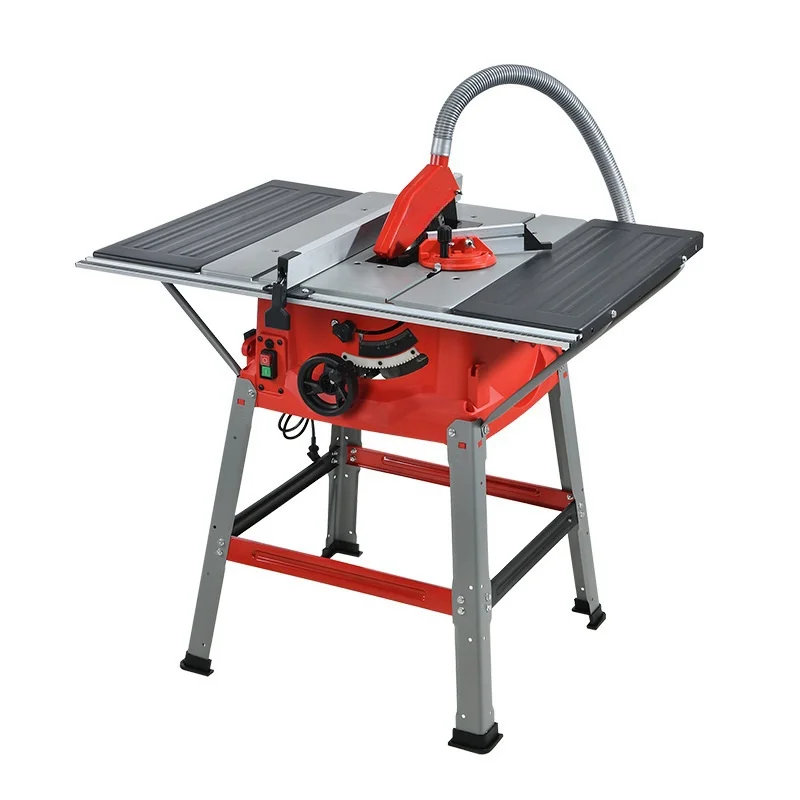
Source-controlled product identity
The Hoting queue record describes a TEBAK table saw machine for wood cutting. Its title contains the claims “10inch,” “1800W,” and “255mm,” while the structured record provides only Name: Table saw machine and Customized: Accept. This guide preserves the title wording as listing-level information. It does not treat the title as a complete technical datasheet.
Product ID 1601247396807 must appear on the quotation, nameplate photograph, drawing, test record, packing list and spare-parts list. The source record does not provide verified values for input voltage, frequency, phase, rated current, no-load speed, saw-blade bore, tooth count, arbor size, cutting depth, bevel range, rip capacity, table dimensions, fence travel, weight, noise, dust extraction, overload protection, guard design, certification, MOQ, warranty or lead time. Each missing value is a supplier confirmation item.
What the listing says and what procurement must verify
| Listing statement | Procurement interpretation | Required confirmation |
|---|---|---|
| 10inch | The title presents a nominal blade-size claim. | Exact blade outside diameter, permitted blade range, arbor/bore, kerf, tooth profile, maximum speed and compatible blade specification. |
| 1800W | The title presents a power claim. | Rated input power or motor output, voltage, frequency, phase, duty condition, efficiency and circuit requirement. |
| 255mm | The title presents a dimensional claim, but its meaning is not defined. | Whether 255mm means blade diameter, cutting width, table dimension or another feature; provide drawing and measurement reference. |
| Wood cutting | The product is marketed for wood-cutting work. | Approved wood types, moisture range, thickness range, feed method, blade requirements and prohibited materials. |
| Table saw machine | The record identifies the product category. | Table size, fence, miter gauge, guard, riving knife, stand, controls, extraction port and included accessories. |
| Customized: Accept | The supplier record says customization is accepted. | Custom options, tooling or drawing approval, MOQ, surcharge, sample process, change control and lead time. |
Resolve the 10inch and 255mm claims before ordering
Do not assume that “10inch” is the permitted blade diameter or that “255mm” is the cutting capacity. Ask the supplier to mark both values on an engineering drawing and on a product photograph. The drawing should identify the blade envelope, arbor position, table reference, fence travel and any dimension represented by 255mm.
Request the exact blade specification: outside diameter, bore, kerf, plate thickness, maximum rotational speed, tooth count, tooth geometry and approved materials. A nominal blade diameter alone does not establish the safe blade combination. Confirm whether the machine accepts only one blade size or a defined range, and whether a dado blade, stacked blade or non-standard cutter is prohibited.
Measure the supplied unit during the pre-shipment inspection. Record the blade diameter, arbor/bore, table dimensions and the dimension represented by 255mm using calibrated tools. The quotation should reference the same drawing revision and model identifier as the inspected machine.
Ask whether the title’s “10inch” value is rounded from a metric blade size. If the buyer will source replacement blades locally, confirm the local availability of the exact bore, kerf, speed rating and tooth configuration. Never substitute a blade solely because its outside diameter appears similar.
Interpret the 1800W power claim safely
The queue record contains no structured power field. Treat 1800W as a title claim that requires confirmation, not as a verified motor specification. Ask whether it refers to input power, rated motor output, peak power or a marketing value. Request the nameplate, motor datasheet, rated current, voltage, frequency, phase, no-load speed and overload rating for the exact model.
Confirm the circuit requirement for the destination site: plug, cable, protective device, earthing, extension-cable limits, generator compatibility and allowable voltage variation. A power claim without voltage and current conditions is not enough to select a circuit or generator.
Run a no-load and loaded electrical test during factory acceptance. Record supply voltage, current, input power, blade speed if measured, material, board thickness, feed condition and duration. Keep the test method and instrument identification with the acceptance record. Do not convert 1800W into a cutting-capacity promise without a controlled test.
Check start-up current and restart behavior after a power interruption. Confirm whether overload protection trips, how it is reset and whether the motor can restart unexpectedly. The buyer should approve the electrical protection scheme before shipment.
Define wood-cutting use cases
“Wood cutting” is broad. State the buyer’s actual materials: solid softwood, hardwood, plywood, MDF, particle board, laminated board or other sheet goods. Record thickness, width, length, moisture, glue or coating, batch variation and required edge quality.
Ask which materials are approved and which are excluded. A blade intended for clean sheet goods may not be suitable for wet timber, embedded fasteners, abrasive boards or composite panels. Request a blade and feed recommendation for each material in the buyer’s production mix.
Define whether the machine is for crosscutting, ripping, panel sizing, repeated batch work or occasional workshop use. The fixture, fence, gauge, guard and extraction requirement can change with the operation. Do not describe the product as suitable for production work until repeatability, thermal behavior and operator protection have been tested.
Create test coupons that represent the buyer’s smallest and largest planned workpieces. Record cut length, squareness, edge tear-out, burn marks, vibration, blade deflection, feed effort and dust behavior. Separate machine performance from blade condition and operator technique.
Table, fence and workpiece support
The source record does not provide table dimensions, material, flatness, fence travel or support accessories. Request a dimensioned drawing showing table length and width, working height, extension wings, fence scale, miter-slot geometry and mounting points.
Inspect table flatness and fence alignment with the machine assembled in its shipping configuration. Record deviation across the working area and parallelism between the fence and blade path. Check that the fence locks consistently at multiple positions and cannot shift under normal feed pressure.
Confirm the maximum supported workpiece dimensions and the need for an outfeed table, side support or additional operator. Do not infer a safe panel size from a 255mm title value. Ask the supplier to state the safe operating envelope and the required support arrangement.
If customization is requested, agree on the reference edges, scale units, fence stop positions, table coating, extension design and inspection method before production. A custom fence or table can affect guard clearance and must be validated as part of the machine, not treated as a cosmetic change.
Cut depth, bevel and adjustment controls
No verified cutting-depth or bevel values are supplied. Ask for maximum cutting depth at 90 degrees and at each bevel setting, vertical adjustment range, bevel-angle range, scale accuracy, lock design and adjustment method. Request a drawing that distinguishes blade position from finished cut depth.
Check the adjustment mechanism with the blade stopped and isolated. Confirm that height and bevel locks hold their setting during a representative cut. Record repeatability after returning to the same scale position, and compare the scale reading with a measured result.
Run cuts at the buyer’s required thicknesses and angles using approved material and blade. Measure finished depth, angle, squareness and surface quality. Do not publish a maximum cut depth or bevel range until it is tied to the exact model and blade configuration.
Inspect the clearance between the blade, throat plate, riving knife, guard and table at every approved setting. Adjustment range must not be considered usable if it compromises the guard or creates an unsafe opening.
Guard, riving knife and operator protection
The queue record does not list a blade guard, riving knife, anti-kickback pawls, emergency stop, switch protection or brake. Request a complete safety-component list and clear photographs of the assembled machine. The buyer should not accept a saw based on power and blade claims alone.
Confirm that the guard follows the blade through the permitted height and bevel settings, returns to a protective position and does not obstruct normal work. Check that the riving knife or splitter is aligned with the blade and compatible with the approved kerf. Verify anti-kickback components where the intended operation requires them.
Ask for the switch type, lockout method, emergency isolation, restart prevention after power loss, motor brake behavior and residual run-down time. Test each function during factory acceptance and record the result. If a safety function is not included, it must be stated clearly in the quotation and handled in the buyer’s risk assessment.
Confirm operator instructions, prohibited operations, push-stick requirements, minimum workpiece dimensions, required personal protective equipment and training material. The compact table format does not reduce kickback, dust, noise or rotating-blade hazards.
Dust extraction and workshop conditions
No extraction-port diameter, airflow requirement or dust rating is provided. Ask for extraction-port size, location, adapter, recommended airflow, chip path and whether the guard has a separate collection connection.
Test extraction with representative wood species and sheet materials. Record visible dust escape, port blockage, chip accumulation around the motor and the time required to clean the machine. Confirm whether a workshop vacuum is adequate or whether a dedicated dust collector is required.
Request limits for humidity, dust concentration, ambient temperature, altitude, floor stability and ventilation. Do not describe the saw as suitable for outdoor, wet or dusty construction environments without documented limits and a site-specific safety plan.
Inspect access for cleaning and maintenance while the machine is isolated. Confirm how to remove chips, replace the blade, clean the guard, inspect the cable and check the table and fence. A concealed dust path can affect cut quality and motor cooling.
Noise, vibration and cut quality
The source record provides no noise or vibration values. Request measured sound pressure or sound power information, test conditions and operator position. Also ask for vibration data where the machine will be used for extended periods.
Run a loaded cutting test and record vibration, table movement, fence movement, blade runout, arbor noise, motor temperature and edge quality. Use the buyer’s approved blade and materials, and record blade history. A smooth no-load test does not establish behavior under feed load.
Measure blade runout and cut squareness at the start and end of a repeated cycle. Check whether the fence, table or guard loosens after vibration. Define the acceptable limit based on the buyer’s product requirements rather than using an unverified marketing tolerance.
Inspect cut edges for burning, tearing, chipping and resin buildup. If the saw will process laminated or coated boards, include separate tests and confirm the blade tooth configuration. Do not attribute every defect to the machine before checking blade selection and feed control.
Customization control
The structured record says “Customized: Accept,” but it does not specify which features can be changed. Request a customization matrix covering table size, fence, stand, voltage, plug, blade, guard, extraction port, color, branding, packaging and accessories.
For each custom option, require a drawing, revision number, material specification, tolerance, inspection method, surcharge, MOQ and lead time. Confirm whether a custom change affects the motor, guard clearance, electrical protection, packaging or compliance documents.
Approve a pre-production drawing and a sample or first article before batch production. The sample should carry product ID 1601247396807 and the same nameplate and safety components as the intended order. Record any deviation and obtain written approval before shipment.
Keep private-label, color and packaging requests separate from safety-critical changes. A new logo or carton does not prove a new model, while a voltage, fence, guard or motor change may require a new test and document review.
Factory acceptance test proposal
- Verify product ID 1601247396807, exact model, drawing revision, nameplate, motor, blade, guard and accessory list.
- Define the meaning of the title claims 10inch, 1800W and 255mm in the approved quotation and drawing.
- Confirm voltage, frequency, phase, rated current, plug, cable, earthing, protection and restart behavior.
- Measure table size, flatness, working height, fence travel, scale accuracy and alignment.
- Measure blade diameter, bore, speed rating, runout, kerf and permitted blade configuration.
- Test cutting depth and bevel settings with approved blade, material, thickness and feed method.
- Test fence locking, miter gauge, table support, adjustment locks and repeatability.
- Test guard, riving knife, anti-kickback parts, switch, emergency isolation and power-loss restart prevention.
- Run loaded cuts for the buyer’s actual woods and sheet materials; record quality, squareness, vibration, temperature and dust.
- Review manuals, safety documents, electrical tests, compliance evidence, packaging, spare parts, warranty and custom-change records.
RFQ checklist
- Exact model and product ID 1601247396807 on quotation, nameplate, drawing, inspection record and packing list.
- Definition of 10inch, 1800W and 255mm, including measurement reference and applicable model.
- Input voltage, frequency, phase, rated current, start-up current, plug, cable, earthing and protective device.
- Motor type, rated input or output power, no-load speed, overload protection, brake and restart behavior.
- Blade outside diameter, bore, kerf, plate thickness, tooth configuration, speed rating and permitted alternatives.
- Maximum cutting depth at 90 degrees and bevel settings, bevel range, scale accuracy and adjustment locks.
- Table dimensions, flatness, working height, fence travel, fence parallelism, miter slot and support requirements.
- Guard, riving knife, splitter, anti-kickback pawls, emergency stop, switch lockout and operator protection.
- Approved wood species, board thickness, moisture range, feed direction, cut types and prohibited materials.
- Dust-port size, recommended airflow, chip path, cleaning access and workshop environmental limits.
- Noise, vibration, blade runout, cut squareness, edge quality and inspection method.
- Customization options, MOQ, drawing approval, sample process, change control, surcharge and lead time.
- Manuals, electrical safety tests, product markings, destination-market compliance, spare parts and warranty.
Buyer decision framework
This listing is a starting point for sourcing a TEBAK wood-cutting table saw machine. The source-backed scope covers the product category, the title’s 10inch/1800W/255mm statements, and the supplier’s “Customized: Accept” field. It does not verify motor performance, blade capacity, cutting depth, table geometry, guard design, electrical configuration, dust extraction or compliance status. Approve the machine only after the supplier maps every title claim to an exact model and drawing, demonstrates representative cuts, passes the safety and electrical checks, and confirms the custom configuration in writing.
Frequently asked questions
Is the machine confirmed to use a 10-inch blade?
The title contains “10inch,” but the structured record does not provide a blade specification. Confirm outside diameter, bore, kerf, speed rating and permitted blade range from the supplier’s drawing and nameplate.
Does 1800W tell me the cutting capacity?
No. The title does not define whether 1800W is input power, motor output or a peak claim, and power alone does not establish cutting depth or material capability. Request a motor datasheet and representative loaded-cut test.
What does 255mm refer to?
The source record does not define the reference. Ask the supplier to identify the dimension on a drawing and verify it during inspection. Do not use 255mm as a cutting-depth or table-size specification without that evidence.
Can the supplier customize the table saw?
The structured record says “Customized: Accept.” Confirm which features can change, the MOQ, drawing approval, surcharge, lead time, safety impact and first-article inspection process.
Can I use any wood-cutting blade?
No. Use only blades whose diameter, bore, kerf, speed rating and tooth configuration are approved for the exact machine. Confirm compatibility before installing a replacement blade.
Source and contact
This guide is based on the Hoting queue record for product ID 1601247396807. Before purchase, request the current quotation, model drawing, nameplate photograph, motor and electrical data, blade specification, cut-depth and bevel data, table and fence drawing, safety-component list, extraction information, test cuts, compliance evidence, packing list, spare-parts offer and final machine photographs. For sourcing questions, contact the TEBAK sales team through the site’s current inquiry channel.
Key specifications
- Name
- Table saw machine
- Customized
- Accept