
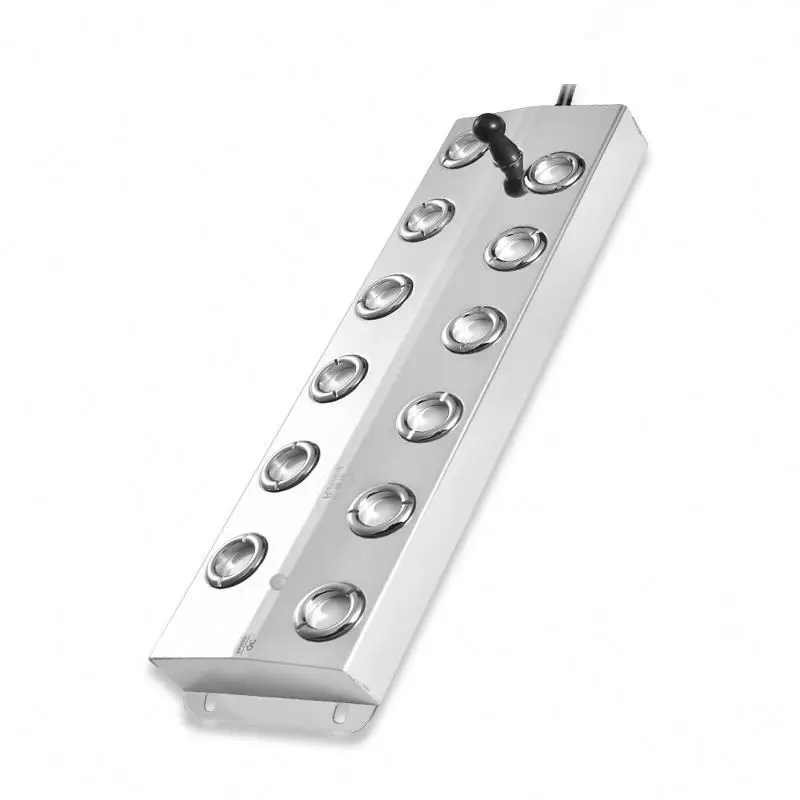
Source-controlled product identity
The Hoting queue identifies Product ID 1601250409535 as a TEBAK 12-head ultrasonic humidifier module. The source wording also calls it a mushroom greenhouse humidifier, a Model 12 ultrasonic mist sprayer and a humidifier module.
The record is title-level and contains no structured technical parameters. It does not establish mist output, power, voltage, water consumption, coverage area, control method, droplet size, interface, tank arrangement or compliance status. Those items must be confirmed before purchase and tested in the intended growing environment.
This guide is for B2B buyers evaluating modular ultrasonic humidification for mushroom rooms, greenhouses, propagation spaces, plant rooms and other controlled environments. It focuses on humidity demand, water quality, distribution, controls, sanitation, electrical safety and acceptance testing without inventing performance data.
Recorded information and procurement status
| Field | Recorded source information | Procurement status |
|---|---|---|
| Product ID | 1601250409535 | Keep this ID on the quotation, sample request, inspection report and shipping documents. |
| Brand | TEBAK | Confirm exact model, head count, revision and included accessories. |
| Head count | 12-head | Confirm whether twelve transducers are included, installed and independently replaceable. |
| Technology | Ultrasonic humidifier / ultrasonic mist sprayer | Request operating principle, mist transport method and control architecture. |
| Application wording | Mushroom greenhouse humidifier | Validate the actual room volume, crop stage, temperature, airflow and sanitation program. |
| Configuration wording | Humidifier module / Model 12 | Confirm whether the product is a module only or a complete ready-to-run system. |
| Output | Not supplied | Request mist output per hour, test conditions, droplet data and acceptable tolerance. |
| Electrical data | Not supplied | Confirm voltage, frequency, phase, current, power, plug and protection. |
| Water and controls | Not supplied | Confirm water quality, tank or inlet arrangement, level control, humidity sensor and interface. |
| Compliance | Not supplied | Request electrical, EMC, material, sanitation and destination-market documents. |
Start with a humidity load calculation
Do not select a 12-head module by head count alone. Define room length, width, height, air exchange, infiltration, insulation, crop or substrate moisture, temperature, target relative humidity and the rate at which doors are opened.
For mushroom production, record the room stage and process. Fruiting, incubation, pinning and post-harvest areas may have different humidity, airflow and sanitation requirements. A humidifier that works in one stage may be oversized, undersized or difficult to clean in another.
For a greenhouse or propagation room, record solar load, ventilation, fan operation, plant density, irrigation schedule and nighttime conditions. Humidity demand can change sharply as outside air and ventilation change.
Ask the supplier to calculate or test the required mist output for the buyer's room. Require the test volume, starting relative humidity, temperature, air movement, water quality and time to reach the target.
Use the output result as a system value, not a marketing description. A 12-head label does not reveal transducer capacity, output per head, duty cycle or the actual humidity rise in a ventilated room.
What “12-head” must mean in the quotation
Confirm whether “12-head” means twelve ultrasonic transducers, twelve mist outlets, twelve nozzles or a product family name. Ask for a drawing or photograph that identifies each head and its electrical connection.
Request the rated output per head, total output, maximum continuous duty, control range, startup behavior and expected replacement interval. Confirm whether all heads can operate simultaneously.
Ask whether heads are independently monitored or whether one failed transducer reduces output without an alarm. Define the acceptable output loss and the fault indication.
Confirm transducer mounting, water depth, cooling, scale tolerance and replacement method. Ultrasonic elements may require a specific water level and installation orientation.
Request the Model 12 manual, wiring diagram, spare-parts list and revision number. The product title alone is not enough to establish interchangeability with another Model 12 unit.
Water quality and sanitation
Water quality is a central procurement variable for ultrasonic humidification. Ask for limits on hardness, dissolved solids, mineral content, iron, microbial load, temperature and treatment chemicals.
Confirm whether tap water, filtered water, softened water, reverse-osmosis water or another source is required. Do not infer that “humidifier” means any water can be used without scale or sanitation consequences.
Ask how the system handles minerals carried into the mist. For mushroom and greenhouse environments, define whether mineral deposition on plants, substrate, walls, sensors, fans or filters is acceptable.
Request a cleaning and disinfection procedure for the water chamber, heads, pipes, nozzles, tank, drain and contact surfaces. Confirm which chemicals are compatible with transducers, seals, plastics and metals.
Define drain, flush and dry-out requirements. Standing water can create odor, biofilm and microbial risks if the module is stopped for a period.
Test water at startup, steady operation and after the planned cleaning interval. Record output change, residue, smell, visible deposits and sensor stability.
Mist distribution and airflow
Ultrasonic mist must be distributed through the room without creating wet zones. Request a layout showing mist outlets, fan location, ducting, filters, obstacles, sensors and access points.
Confirm whether the module discharges directly into the room or connects to a duct or fan-assisted distribution system. Ask for maximum duct length, bends, static pressure and outlet arrangement if applicable.
Place humidity sensors where they represent the crop or substrate, not directly in the mist plume. Test sensor response at several room locations and heights.
Look for condensation on walls, ceilings, doors, lighting, electrical equipment, racks and leaves. A high local humidity reading near an outlet may hide dry conditions elsewhere.
Run smoke or safe airflow visualization during commissioning if permitted by the site procedure. Record whether mist settles, short-circuits to an exhaust, or accumulates near cold surfaces.
Define acceptable humidity variation across the room. A supplier should explain how the 12-head arrangement supports uniformity under the buyer's airflow pattern.
Humidity control and sensors
No controller, sensor, setpoint, accuracy or control range is supplied. Request the complete control architecture: built-in controller, external humidistat, PLC input, analog signal, relay, Modbus or another interface.
Confirm whether the module supports proportional control, staged head control, on/off operation or only manual switching. A twelve-head system may need staged output to avoid overshoot.
Ask for sensor type, range, accuracy, response time, calibration method, placement guidance and replacement process. Verify that the control sensor is not affected by direct mist.
Define high-humidity alarm, low-water alarm, overflow alarm, fan interlock, door interlock and communication-loss behavior. The source record does not list any of these features.
Test the complete control loop from dry room to target humidity, steady hold, door opening, fan change and power recovery. Record overshoot, recovery time and sensor agreement.
Do not claim a humidity percentage, accuracy or energy consumption without a measured test using the actual installation.
Electrical, water and installation safety
Voltage, frequency, power and current are not supplied. Request the electrical specification for the destination, including grounding, breaker, residual-current protection, cable, plug and enclosure protection.
Confirm separation between water and electrical sections. Ask for leak detection, overflow protection, low-water shutdown, dry-run behavior and restart prevention after power interruption.
Define the required floor, wall, rack or ceiling support. Request operating weight when filled, vibration guidance, service clearance and safe lifting points.
Ask whether a fan or pump is required and whether those components are included. A humidifier module may not be a complete system without water feed, drain, distribution and controls.
Test a blocked outlet, disconnected sensor, low-water condition, overflowing chamber, fan failure and power interruption. Record the alarm and shutdown sequence.
Confirm ventilation and electrical safety requirements for wet rooms and greenhouse environments. Stainless or plastic exterior surfaces do not prove washdown or ingress protection.
Crop, product and room validation
For mushroom rooms, record substrate type, rack arrangement, crop stage, target humidity, air speed and fresh-air exchange. Check whether the mist wets caps, bags, shelves or floor surfaces.
For greenhouse use, record crop type, leaf sensitivity, nutrient program, irrigation and ventilation. Confirm whether minerals or treatment residues in mist can damage plants or interfere with downstream systems.
For propagation or storage rooms, define the acceptable condensation and surface moisture limits. The same relative humidity can create different outcomes at different temperatures.
Run a commissioning trial at low, medium and high output. Measure humidity at multiple locations and log temperature, fan state, water quality and door state.
Record time to target, overshoot, recovery, uniformity, visible wetting, noise, vibration, residue and water consumption. Keep the raw logs with the purchase record.
Maintenance and replacement planning
Request transducer life, replacement procedure, scale inspection interval, filter schedule, drain cleaning, sensor calibration and controller backup guidance.
Ask whether the twelve heads can be replaced individually and whether one failed head allows safe operation of the remaining heads. Define the minimum acceptable output and alarm behavior.
Confirm availability and lead time for transducers, seals, valves, level sensors, control boards, fans, nozzles and water-treatment components.
Build maintenance around the water source and room sanitation program. A maintenance interval stated without water hardness, duty cycle and cleaning chemistry is not a complete plan.
Record output before and after cleaning. A gradual reduction may indicate scale, clogged outlets, sensor drift, water-level problems or transducer wear.
Factory acceptance test
- Verify Product ID 1601250409535, TEBAK brand, Model 12 wording and exact 12-head configuration.
- Count installed transducers, mist outlets, connectors and included spare parts; attach photos and a drawing.
- Verify voltage, frequency, phase, current, rated power, plug, grounding and enclosure protection.
- Measure output per head and total output under stated water quality, temperature and duty conditions.
- Test continuous operation, staged operation, one-head failure and total-output alarm behavior.
- Test water inlet, tank, drain, overflow, low-water shutdown, dry-run protection and restart prevention.
- Run the actual room layout or a documented test chamber with the buyer's fans and distribution path.
- Measure humidity at multiple locations and heights; record time to target, overshoot and recovery.
- Inspect condensation, wet zones, mineral deposition, residue, odor, noise and vibration.
- Test control setpoints, sensor accuracy, calibration, external signals and alarm outputs.
- Run startup, stop, fan failure, blocked outlet, disconnected sensor and power-interruption tests.
- Verify water-quality limits, cleaning chemicals, sanitation procedure and dry-out requirements.
- Inspect service access, transducer replacement, seals, pipes, connectors and electrical isolation.
- Confirm manuals, wiring, control drawings, spare-parts list, safety documents and certificates.
- Attach output logs, humidity maps, water tests, photographs, serial number and deviations to the order.
RFQ checklist
- Product ID 1601250409535, exact Model 12 configuration and twelve-head count.
- Transducer type, output per head, total mist output, droplet data and continuous duty cycle.
- Voltage, frequency, phase, current, power, plug, grounding, breaker and enclosure protection.
- Water source, hardness, dissolved-solids limits, filtration, treatment and temperature.
- Tank, inlet, drain, overflow, low-water sensor, dry-run protection and water-level range.
- Direct room discharge or duct/fan connection, outlets, static pressure and distribution limits.
- Controller type, setpoint range, sensor accuracy, calibration and external control interface.
- High/low humidity alarms, fan interlock, sensor failure, communication loss and restart behavior.
- Room volume, airflow, temperature, crop stage, substrate or plant sensitivity and humidity target.
- Condensation, mineral deposition, microbial control, cleaning chemicals and sanitation schedule.
- Operating weight when filled, mounting, service clearance, lifting and vibration requirements.
- Transducer, seal, valve, sensor, controller, fan and nozzle replacement intervals.
- Spare parts, warranty, training, commissioning, service response and lead time.
- Factory test conditions and buyer-witnessed room or chamber validation procedure.
- Electrical, EMC, material, sanitation and destination-market compliance documents.
Buyer decision framework
This source identifies a TEBAK 12-head ultrasonic humidifier module for mushroom and greenhouse misting, but it provides no numeric performance specification. The correct purchasing sequence is therefore to define the humidity load, water quality, room airflow, distribution method and controls before comparing quotations.
Approve the unit only after the supplier demonstrates total output, uniformity, water-level protection, control response, sanitation access and safe operation under the buyer's room conditions.
Compare suppliers using measured humidity maps, output stability, mineral management, transducer replacement, alarm behavior, energy data, service support and documentation. Do not rank offers by head count alone.
Frequently asked questions
What is the product called in the source?
It is described as a TEBAK 12-head ultrasonic humidifier module, mushroom greenhouse humidifier, Model 12 ultrasonic mist sprayer and humidifier module.
How much mist does it produce?
The source provides no mist-output value. Request output per head and total output under stated water and operating conditions.
What voltage and power does it use?
The source record does not provide voltage, frequency, current or power. Confirm the complete electrical specification for the destination.
Does it include a tank, fan and controller?
The source does not define the system boundary. Confirm whether the offer is a module only or a complete system with water, distribution and controls.
Can it be used in a mushroom room or greenhouse?
The title names those applications, but suitability requires validation of room volume, airflow, water quality, crop stage, sanitation and humidity control.
What certifications are included?
No certifications or compliance documents are listed. Request the documents required for the destination market and wet-room installation.
Source and contact
This guide is based on the Hoting queue record for Product ID 1601250409535. The source confirms the TEBAK 12-head ultrasonic humidifier and its mushroom/greenhouse application wording, but no structured performance values. Before purchase, request output tests, room validation, water-quality guidance, control drawings, safety documents, spare-parts terms, acceptance testing and warranty through the TEBAK sales inquiry channel.