
Three size designations in the title, one in the parameters
The Hoting queue carries Product ID 1601250864304 as a fridge magnet material listing. Its title names four size designations in a row: 2inch, 80 by 53 millimetres, 63.5 by 63.5 millimetres and 50 by 50 millimetres. Its parameter block names exactly one: 80 by 53 millimetres, with the product name repeated as 80 by 53 millimetre fridge magnet and the shape given as rectangular.
That leaves a buyer with an unanswerable first question. Ordering 100 pieces of this material requires knowing which of the four pieces in the title will arrive, and the record does not say. Two readings are possible. Either the same material is stocked in four sizes and the parameters were filled in for one of them, or the title was assembled from the search terms buyers use and only one size is really offered. The 27 kilogram figure makes the difference between the two readings measurable, because it can be checked against each size.
The designations themselves also have to be reconciled, because the title mixes inch and millimetre units for what may be the same piece:
| Title designation | Converted | Face area | Note |
|---|---|---|---|
| 2inch | 50.8 mm | 2,580 sq mm if square | 2 inch is exactly 50.8 millimetres, so this and the 50 by 50 designation are nominally the same size but differ by 0.8 millimetres |
| 50 by 50 mm | 50 mm | 2,500 sq mm | The rounded metric form of the 2 inch piece, and the piece in the record's image with the thicker body |
| 63.5 by 63.5 mm | exactly 2.5 inch | 4,032 sq mm | 63.5 millimetres is exactly two and a half inches, so this designation is an inch size written in millimetres with no rounding |
| 80 by 53 mm | 3.15 by 2.09 inch | 4,240 sq mm | The only size in the parameter block, and not a round number in either unit |
The third row is the useful one, because 63.5 millimetres is exactly 2.5 inch and not a conversion: the size was designed in inches and restated in millimetres at full precision. The second row is the opposite case: 50 by 50 is a rounded metric restatement of a 2 inch piece that is really 50.8 millimetres. A supplier who stocks the metric size and a supplier who stocks the inch size will both call it the same thing on a quotation. Ask for the measured face of a sample piece in millimetres to two places rather than asking for the nominal size, because nominal size is the one field where this record gives four different answers.
Auditing the 27 kilogram figure, and the three other quantities
Four quantities in this record describe the same product at four wildly different scales, and lining them up is how a buyer finds out which of them are real.
| Field as recorded | Value | What scale it describes |
|---|---|---|
| MOQ | 100 pcs | The smallest order the supplier will accept |
| Kw | 27kg/1000pcs | A mass for one thousand pieces, and therefore an implied 27 grams each |
| Weight | 27KG | The same 27 with no unit denominator, and with a carton dimension recorded beside it |
| Output | 10000000pcs/day | Ten million pieces in a single day, which is ten thousand thousand-piece lots |
The first two are consistent with each other and with a real product. At 27 grams per piece an 80 by 53 millimetre blank has an areal mass of about 0.64 grams per square centimetre, which is the right order of magnitude for a flexible magnetic sheet laminated to a printable face, and a minimum order of 100 pieces is 2.7 kilograms of material, about a tenth of one carton. That is a sensible sample-scale minimum for a material sold by the thousands.
The fourth quantity is where the record stops being self-consistent. Ten million pieces a day at 27 grams each is 270,000 kilograms, or 270 tonnes of magnet material per day. That is 10,000 lots of a thousand pieces, and it is a figure that describes a large plant running flat out on nothing else, not a listing whose minimum order is 100 pieces. The gap between the two is seven orders of magnitude. The output figure is therefore almost certainly one of three things, and the supplier has to say which: the plant's total capacity across all products rather than this one, a theoretical figure from a production line specification, or a template field left at a default. Ask what the daily capacity is for this specific size, and ask for the last three months of actual, not rated, output. A rated figure and a shipped figure for the same line are routinely different by a factor of several.
The third quantity, the bare 27 kilograms, cannot be read on its own. It appears twice in the same parameter block with two different labels, once as Weight and once as Kw with a denominator of a thousand pieces, which strongly suggests both lines were copied from the same source figure and one of them lost its denominator in the process. If the 27 kilograms is a carton weight, then it belongs with the 47 by 35 by 28 centimetre dimension recorded directly above it, and those two numbers can be checked against each other:
| Carton calculation | Value |
|---|---|
| Outside dimensions recorded | 47 by 35 by 28 centimetres |
| Outside volume | 46,060 cubic centimetres, or 46.06 litres |
| Mass recorded | 27 kilograms |
| Bulk density this implies | 27 divided by 0.04606 cubic metres, which is 586 kilograms per cubic metre |
| Pieces this carton would hold, at 27 grams each | 1,000 pieces, which is the denominator in the Kw field |
Those figures agree with each other, and that agreement is the most useful thing in the parameter block, because it confirms that the 27 kilogram and the 27 kilograms per thousand pieces describe the same carton of the same piece: one thousand 80 by 53 millimetre blanks, 27 grams each, in a 46 litre carton weighing 27 kilograms gross. A bulk density of 586 kilograms per cubic metre for a carton of flat packed sheet material is plausible, since loose flat pieces do not fill a carton's volume the way a liquid does, and it is the number to use when working out how many cartons fit in a container.
One consequence follows directly, and it is the one to raise with the supplier. If the 27 kilograms per thousand pieces is the mass of a thousand 80 by 53 millimetre blanks, it cannot also be the mass of a thousand blanks in the other two sizes, because the face areas differ. A thousand pieces with a face of 4,240 square millimetres each is 4.24 square metres of material; the same thousand pieces at 63.5 millimetres square is 4.03 square metres, and at 50 millimetres square it is 2.50 square metres. If the material is the same, a thousand of the smaller pieces weighs about 59 per cent of what a thousand of the larger ones weighs, so the carton the supplier quotes for the 50 millimetre size should hold roughly 1,700 pieces to reach the same 27 kilograms. Ask for the pieces per carton and the gross carton weight for each size separately, and expect three different answers.
A forty-six litre carton or an export crate
The parameter block's 47 by 35 by 28 centimetre dimension describes a carton. The record's own images show something else entirely. One of the six detail images is a packing page, and it contains three photographs of plywood export crates: flat cases stacked on a warehouse floor, vertical cases with steel strapping and handling marks on the side, and a long row of cases carrying stencilled shipping marks with destination addresses and the words MADE IN CHINA.
Those crates are the packing used for the supplier's machines, not for 27 kilograms of flat magnet material, and the difference matters to the buyer in three ways. A plywood case has a volume and a tare weight of its own, and it is not the 46 litre carton the parameter block describes, so which one a shipment will use decides both the freight class and the shipping cost. A case is export packing with a cost attached, so a quote that silently includes it looks more expensive than one that excludes it, and the two quotes are not comparable. And a case has to be opened with tools at the destination, which matters if a buyer is ordering sample quantities rather than pallets.
Ask for the packing to be named per shipment: carton or plywood case, the outside dimensions of the unit actually used, the gross weight, the pieces per unit, and whether the case is included in the quoted price or billed separately. If the answer is a carton, ask whether the cartons are palletised and whether the pallet's height fits the container intended, because a 46 litre carton on a standard pallet reaches a height that decides whether the load goes in a 20 foot or a 40 foot container.
There is also a detail visible in the crate image worth copying rather than questioning. The cases carry stencilled marks including the destination, the case number and the country of origin. Whether the supplier's default packing includes those marks is worth confirming, because the cost of having them added after the goods reach a forwarder is usually higher than having them printed at the factory. Ask for the shipping mark layout in advance and confirm that the country of origin marking will be present on each case or carton rather than only on the master carton.
The commercial terms the record states, and the one it omits
Two of the six detail images carry commercial information rather than product information, and since a magnet material listing usually shows none, it is worth taking them at face value and then asking the questions they leave open. One is an FAQ page; the other is a sales card.
| Item | As stated in the record's own images | What a buyer should pin down before ordering |
|---|---|---|
| Quotation time | Within 24 hours of the inquiry, and inquiries marked urgent are given priority | Whether the 24 hours applies to a priced quotation or to an acknowledgement, and whether the price is held open for any period |
| Samples | Samples can be offered for reference | Whether the sample is free and whether freight is paid by the buyer, what the sample piece will be, and whether sample cost is credited against the order |
| Design service | A design team is offered to help carry out the buyer's idea | Whether artwork is supplied as a print ready file, who owns it, and whether a proof is approved in writing before production |
| Payment terms | 30 per cent deposit and 70 per cent balance before shipping, by T/T, PayPal or Western Union | The terms for a first order against a repeat order, whether a letter of credit is acceptable, whose bank charges apply, and whether the balance is due against a copy of the shipping document or before it |
| Lead time | About 15 working days for mass production, varying with quantity | Whether 15 working days is measured from deposit or from artwork approval, which certificate of origin or inspection step sits inside that window, and what the lead time is for the quantity actually being ordered |
| Delivery terms | EXW, FOB and CIF are all offered | Which of the three the quoted price uses, which port and which named place, and whether insurance is included in the CIF figure |
| Currency | Not stated | The currency of the quotation and of the payment, and who carries the conversion and bank charges |
The last row is the omission, and it is the one that changes the number. A price quoted in one currency and paid in another is not the same price, and with three payment routes named in the FAQ page, T/T, PayPal and Western Union, the routes themselves carry different costs: a bank transfer carries a fixed fee and a conversion spread, a card based transfer carries a percentage, and a cash transfer route carries a fee that depends on where it is sent from. Ask for the quotation to name the currency and the payment method it assumes, and ask for the all in amount that leaves the buyer's account rather than the invoice figure, because on a small order the difference between the three routes can be larger than the negotiating margin on the goods.
Three company names, and one watermark from a different storefront
A procurement guide on a raw material has to say who is selling it, and this record gives three different answers inside its own six images.
The factory photograph carries a sign in Chinese characters reading Hengshui Mengshang Trading Co., Ltd. The FAQ page in the same record is headed HENGSHUI SANRENXING TRADING CO.,LTD. And the magnet blank photograph carries a watermark reading hotstamping.en.alibaba.com, which is the storefront address of a different supplier rather than a product or company name at all.
| Evidence in the record | What it identifies | Reading |
|---|---|---|
| Building sign, Chinese characters | Hengshui Mengshang Trading Co., Ltd. | A trading company in Hengshui, which is not named anywhere else in the record |
| FAQ page header | HENGSHUI SANRENXING TRADING CO.,LTD | The company that appears on the FAQ and shipping pages of the same listing |
| Watermark on the blank photograph | hotstamping.en.alibaba.com | A third party's storefront address, placed on the image by whoever produced the photograph |
Two of these are explainable and one is not. A supplier legitimately holds a catalogue of factory photographs taken at partner plants, so a building sign showing a different trading company can simply mean the photograph was taken at a plant that is not the seller. And a photograph reused from a public listing, watermark included, is extremely common in this category, because the same sheet magnet material is cut by dozens of converters and photographed by one of them. What is not explainable is why a listing that names one company on its FAQ page uses a building photograph naming a second and a blank photograph watermarked by a third, and a buyer cannot resolve it from the record.
The resolution is procedural rather than investigative. Ask the supplier to state, in writing and on the invoice, which legal entity is selling, which plant will produce, and whether the goods will be manufactured or traded, and check that the name on the invoice matches the name on the bank account the deposit is paid into. Paying a deposit to an account in a name other than the seller's is the specific risk this record's inconsistency points at, and it is a one line check that closes it. If the goods are traded rather than manufactured, ask who the producer is, and expect a straight answer: a converter who buys sheet magnet and dies it out is a perfectly normal supplier for this product, but the buyer should know which of the two is being dealt with, because it decides who can answer a question about magnetic grade.
The sales card in the same record supplies the third set of details, and they are worth comparing against whatever address the buyer is already using. It names the TEBAK brand with a descriptor reading PTFE and technopolymers manufacturing, gives a sales manager's name and a mobile number, and gives a website and an email address:
| Detail on the record's card | Value as printed |
|---|---|
| Brand and descriptor | TEBAK, described as PTFE and technopolymers manufacturing |
| Role | Sales manager |
| Mobile, WhatsApp and Skype | +86 18831861916 |
| Website | www.cntebak.com |
| Address | Hengshui City, Hebei Province, China, 718, 720-722 Rongchuang Building, 053000 |
| info@hssanrenxing.cn |
Two observations follow. The brand descriptor on the card describes a manufacturer of PTFE and engineering polymers, while the product is a laminated sheet magnet, so the card belongs to a wider catalogue than this listing does; a buyer should not read it as a statement of what the supplier makes, only of how the supplier brands itself. And the email and website on the card are not the addresses used elsewhere in this supplier's material, so a buyer who writes to the address on the card should confirm that the reply comes from the same entity that issues the invoice. None of this is a reason to avoid the supplier; it is the standard reason to keep the correspondence, the invoice and the payment account in one chain.
What the product actually is, and the two fields that disagree
The parameter block answers the question what is this in two places, and the two answers are not the same. One field gives the usage as Diy Badge. Another gives the application as fridge. A badge and a refrigerator magnet are finished goods in different markets, made from the same raw material by different finishing steps: a magnet blank cut to shape serves a fridge door, and a badge generally has a pin, a clip or a magnetic back and is worn.
Since the product name is fridge magnet and the shape is rectangular and the material is sold as raw material, the listing is almost certainly offering a blank sheet magnet that a buyer can finish either way. That reading makes the two fields compatible rather than contradictory, and it also explains the title's four sizes: a converter who dies out fridge magnets and badges stocks several dies. It does not, however, tell a buyer what the blank is made of, which is the one thing a raw material listing is expected to state.
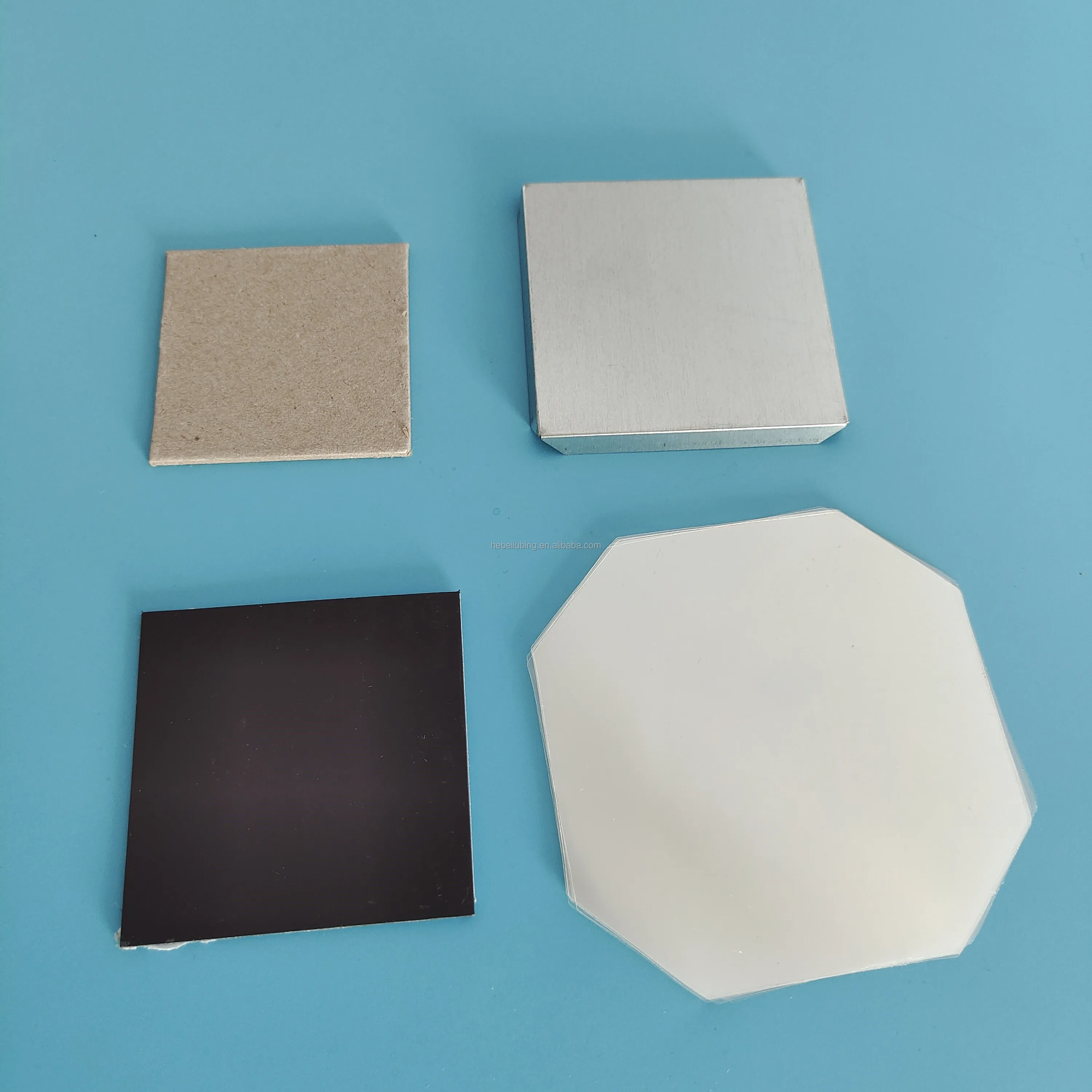
The blank photograph is the only evidence about construction in the whole record, and it shows four pieces on a plain background rather than one: a square with a plain paper or board face, a noticeably thicker square with a brushed metal face, a black square whose edge shows a white layer beneath the black face, and a large octagonal piece with a bright white reflective face. Four different constructions in one photograph, and no caption naming any of them.
| Piece visible in the record's image | What it appears to be | What the record does not state |
|---|---|---|
| Square with a plain board face | A magnet blank with an unprinted paper or board face, ready to be printed | Whether the face is coated for printing, and what the board weighs |
| Thicker square with a metal face | A blank with a metal or metallised face, visibly the thickest of the four | The thickness, and whether the face is steel, aluminium or a film |
| Black square with a white edge layer | A piece carrying a black face over a lighter body, with the layer boundary visible at the die cut edge | How many layers there are, and what each one is |
| Octagonal piece with a bright face | A larger piece with a reflective or mirror finish, cut to eight sides rather than four | Whether the finish is a film, a coating or a polished plate, and whether the piece is a magnet at all |
The reason to press on this is that the unnamed parts decide how the product performs and how it is used. A laminated blank has three components, a magnetic layer, an adhesive or bonding layer and a printable face, and the thickness and grade of each one determine how well the piece holds on a steel door, how flat it stays after printing and cutting, and whether it can be written on with a marker and wiped clean. The record states none of the three. The four pieces in the photograph are the supplier's range rather than the product being sold, and a buyer who assumes the quoted size is the piece shown in the thicker square may receive the thin one.
The parameter block's industry list adds a second kind of noise. It names fifteen industries, from hotels and garment shops through food and beverage factories to farms and energy and mining, plus construction works and an advertising company. A fridge magnet raw material is sold to printers, promotional product distributors and stationery converters, and could reasonably be bought by a hotel or a restaurant for a branded giveaway. It is not used by farms, machinery repair shops or a mining operation, so those fields describe a template rather than this product. They are worth ignoring when reading the record, and worth remembering when comparing this listing against another: a parameter block whose industry list is longer than its specification list is a parameter block that was filled in for something else.
The warranty field, and why a magnet has no core components
The record states a warranty of six months, and states it twice: once as the warranty on core components and once as the warranty. Both fields belong to the machine template this listing was built on. A magnet blank has no core components, no wearing parts and no power supply, so the only things a warranty could cover are dimensional and magnetic conformity at delivery, which is an inspection matter rather than a warranty matter.
The practical question is what the buyer can claim if the material arrives wrong, and the answer sits outside the warranty field. It sits in the agreed specification. If the order is placed on the basis of a face dimension, a thickness, a magnetic grade and a face finish, then a delivery that misses any of those is a non conforming delivery and the remedy follows from the purchase order. If the order is placed on the basis of a listing whose size field says 80 by 53 millimetres and whose title says four sizes and whose warranty says six months, then there is nothing specific to measure against, and a dispute becomes an argument about names. Ask for the specification to be written into the order as numbers with tolerances, and treat the six month warranty as a marketing field rather than as cover.
Two questions make the point concretely. Ask what the permissible tolerance is on the cut dimension, because a magnet blank is die cut and the cut edge of a flexible magnet is never exactly nominal, and ask what the permissible tolerance is on the thickness where the material is laminated, because an uneven laminate shows through a printed face. Neither tolerance appears in the record, and a supplier who cannot state them cannot accept a return against them either.
Questions to put to the supplier before ordering
- Which of the four sizes in the title are actually stocked for this listing, and is the quoted price for the 80 by 53 millimetre piece?
- Is the 2 inch piece 50.8 millimetres or a rounded 50 millimetres, and what is the measured face of a sample to two decimal places?
- Is the 63.5 millimetre piece exactly 63.5 millimetres, and are the 50 millimetre pieces square to within the cut tolerance?
- What are the pieces per carton and the gross carton weight for each size separately, and are they all 27 kilograms?
- What is the thickness of the magnetic layer, of the bonding layer and of the printable face, and what is the total thickness?
- What is the magnetic grade or holding force, and what does the material weigh per square metre?
- What is the face material, and is it coated for printing, writable with a marker, or wipeable?
- What is the colour of the magnetic layer and of the reverse face, and can the reverse be left uncoated?
- Is the material isotropic or anisotropic, and does the answer differ between the sizes?
- What are the cut tolerances on the face dimensions and on squareness, and what is the maximum length of a cut run before the die is replaced?
- Does the listing offer the blank alone, or printed, and if printed, what printing methods are available?
- Which of the two usages named in the record, the fridge magnet and the DIY badge, does this material serve, and does a badge version require a different blank?
- Is the material supplied flat or on a roll, and what is the largest single piece available?
- What is the packing: a 47 by 35 by 28 centimetre carton as the parameters state, or a plywood export case as the images show?
- Is the packing cost included in the quoted price, and what are the pieces per pallet and the pallet height?
- Will the country of origin and the shipping marks be applied to each unit or only to the master carton?
- Which legal entity will issue the invoice, and is the bank account for the deposit in the same name?
- Is the goods manufactured or traded, and if traded, who produces it?
- What is the currency of the quotation, and which payment route does the quoted price assume?
- Is the 15 working day lead time measured from the deposit or from artwork approval, and does the lead time change if artwork is supplied later?
- What is the daily capacity for this specific size, and what was the actual shipped output in the last three months?
- Will the price be held open for a stated period, and what does the sample cost with freight?
Questions one, four, five and seventeen are the ones that decide whether a quotation can be used at all. Without the real size the material cannot be specified; without the pieces per carton the freight cannot be priced; without the layer thicknesses the material cannot be compared with a competitor's; and without matching the invoice to the payment account the deposit is exposed.
Incoming inspection when the material arrives
- Count the pieces against the packing list rather than against the carton label, and record the count for the carton actually opened rather than extrapolating from one.
- Weigh one carton gross, subtract the carton's own mass, and compare the net figure with the 27 kilograms per thousand pieces in the record for the size actually ordered.
- Weigh ten pieces on a balance and divide, because a single blank at around 27 grams is close to the resolution of a kitchen scale and the ten piece average removes most of the error.
- Measure the face of at least ten pieces in both directions with a caliper, and check the spread as well as the average, because a die that is wearing produces pieces that drift in one direction.
- Check squareness by measuring both diagonals of a square piece; on the rectangular 80 by 53 piece measure both diagonals and compare them.
- Measure total thickness at the centre and at the four corners of several pieces, and compare the difference against the tolerance the supplier stated.
- Check the cut edge with a magnifier for burrs, for a ragged magnetic layer and for face material lifting away from the body.
- Lay the pieces on a flat steel plate and check for curl at the corners, then leave a stack loaded overnight and check whether the curl returns.
- Test the holding force on a painted steel surface of the kind the finished magnet will be used on, not on bare steel, because a painted or coated door holds a magnet differently.
- Test the holding force at the working temperature the finished product will see, and note whether the material is specified for freezer or ambient use.
- Print a test piece on the actual press the buyer will use, at the actual ink and cure settings, and check that the face accepts ink without mottling and without the coating lifting.
- Cut a test run of pieces with the buyer's own die and check that the cut is clean and that the dimensions hold across a full sheet.
- Write on a piece with a marker and wipe it, and check whether the face survives wiping, if the finished product is intended to be written on.
- Check the colour of the magnetic layer at the cut edge for consistency across the shipment, since a change of supplier of the base sheet shows there first.
- Confirm that the country of origin marking and the shipping marks were applied where the order specified, and photograph the marks before the carton is broken down.
- Keep one unopened carton, one sample piece of each size and the signed specification sheet as the reference for any later claim.
The third, fourth and sixth checks together turn the record's single weight figure into a usable specification, since mass per piece, face dimension and thickness are the three numbers that decide whether a delivery matches the order. All three can be measured in under an hour with a caliper and a balance.
Answers to the questions this record raises most often
How many sizes is this listing selling?
The title names four designations, 2 inch, 80 by 53 millimetres, 63.5 by 63.5 millimetres and 50 by 50 millimetres, and the parameter block names one, 80 by 53 millimetres. The record does not settle it, so ask which sizes are stocked and which one the quoted price covers.
Is the 2 inch piece the same as the 50 by 50 piece?
Nominally, and not exactly. Two inches is 50.8 millimetres, so a piece designed in inches and a piece designed in millimetres differ by 0.8 millimetres across the face. Ask for the measured dimension rather than the nominal one.
What does the 27 kilogram figure mean?
It appears twice, once as Weight and once as Kw with the denominator 27 kilograms per thousand pieces. With the 47 by 35 by 28 centimetre carton beside it, the reading that fits both lines is one thousand pieces at 27 grams each in a 46 litre carton. Confirm it, and confirm it for each size separately.
Can the plant really make ten million pieces a day?
For this size alone, ten million pieces at 27 grams each is 270 tonnes a day, which is unlikely for a listing whose minimum order is 100 pieces. The figure probably describes total plant capacity, a rated line specification or a template default. Ask for actual shipped output rather than a rated figure.
How many pieces will fit in the carton and how many cartons in a container?
At 27 grams per piece and 27 kilograms per carton, one carton holds about a thousand 80 by 53 millimetre pieces, and a 46 litre carton on a pallet determines the container load. Confirm the pieces per carton for the size actually ordered, because a thousand of the smaller pieces weighs considerably less than a thousand of the larger ones.
Will the goods arrive in a carton or a crate?
The parameters describe a carton and the images show plywood export cases with shipping marks. Ask which is used for the ordered quantity, whether the case is included in the price, and what the outside dimensions and gross weight of the unit are.
What are the payment and delivery terms?
The record's own FAQ image states a 30 per cent deposit with the 70 per cent balance before shipping, payable by T/T, PayPal or Western Union, a lead time of about 15 working days, and a choice of EXW, FOB or CIF. The currency is not stated and should be confirmed, along with which term and which port the quoted price uses.
Which company is the seller?
The record shows two company names in its images, one on a building sign and one on the FAQ header, and the blank photograph carries a watermark from a different supplier's storefront. Ask which legal entity issues the invoice and confirm the deposit account is in the same name.
What is the material made of?
The record states the size, the shape, the colour treatment and the packing, and it does not state the magnetic grade, the layer thicknesses, the face material, the printing method or the magnetic polarity. Those are the fields to request before comparing this listing with another.
What is not in this record at all?
The magnetic grade or holding force, the layer thicknesses, the face material and finish, the printing method, the cut tolerances, the colour of the reverse, whether the material is supplied flat or on a roll, the price, the currency, the sample cost, the pieces per pallet, the warranty terms in detail, the certificates, and the identity of the producing plant.
Source, scope and what this guide does not claim
This guide is based on the Hoting queue record for Product ID 1601250864304, a fridge magnet material listing whose parameter block contains fourteen lines. Everything quoted as a specification above is from that parameter block or from the record's own six detail images, and all six images were examined.
The parameter block supplies the product name as 80 by 53 millimetre fridge magnet, the size as 80 by 53 millimetres, the shape as rectangular, the usage as DIY badge, the application as fridge, the colour as custom requirement, the minimum order as 100 pieces, the output as ten million pieces a day, the weight as 27 kilograms, the field labelled Kw as 27 kilograms per thousand pieces, the carton dimension as 47 by 35 by 28 centimetres, a six month warranty stated twice, and an industry list naming fifteen industries. The title supplies the four size designations 2 inch, 80 by 53 millimetres, 63.5 by 63.5 millimetres and 50 by 50 millimetres.
Four figures are taken from the record's own images rather than from its parameters, and are identified as such in the text. The FAQ image states a quotation within 24 hours, samples available for reference, a design service, a 30 per cent deposit with a 70 per cent balance before shipping by T/T, PayPal or Western Union, a lead time of about 15 working days, and a choice of EXW, FOB or CIF. The sales card gives the TEBAK brand with a descriptor reading PTFE and technopolymers manufacturing, a sales manager's title, the mobile number +86 18831861916, the website www.cntebak.com, the address Hengshui City, Hebei Province, China, 718, 720-722 Rongchuang Building, 053000, and the email info@hssanrenxing.cn. The factory photograph carries a sign in Chinese characters reading Hengshui Mengshang Trading Co., Ltd. The blank photograph carries a watermark reading hotstamping.en.alibaba.com. The packing image shows plywood export cases with stencilled shipping marks including the words MADE IN CHINA.
Several passages are the author's arithmetic or reading rather than published data, and are set out here so they are not mistaken for specifications. The millimetre equivalents of 2 inch and 2.5 inch are exact conversions. The face areas are the product of the two stated dimensions for each size. The figure of 27 grams per piece is 27,000 grams divided by 1,000 pieces. The areal mass of about 0.64 grams per square centimetre is 27 grams divided by the 42.4 square centimetres of the 80 by 53 millimetre face. The carton volume of 46.06 litres is the product of the three stated dimensions, and the bulk density of 586 kilograms per cubic metre is 27 kilograms divided by that volume expressed in cubic metres. The 270 tonnes per day figure is ten million pieces multiplied by 27 grams. The comparison of surface areas between the thousand piece lots in the three graphic sizes uses the three face areas above, and the 59 per cent figure is 2,500 square millimetres divided by 4,240. The statement that the smaller size would need about 1,700 pieces in a carton to reach 27 kilograms follows from the same areal mass.
Unless a figure appears in the lists above, it is not in this article because it is not in the record. This record states no magnetic grade or holding force, no magnetic layer or face thickness, no total thickness, no face material or coating, no printing method, no cut tolerance, no squareness tolerance, no colour of the reverse face, no magnetic orientation, no sheet or roll form, no price, no currency, no sample cost, no pieces per pallet or pallet height, no shipping mark content, no certificate, no inspection arrangement, and no statement of which plant produces the material.
A buyer can close the whole specification with five requests and one measurement: which sizes are genuinely stocked and at what price, the mass per piece for the size ordered, the three layer thicknesses, the pieces and gross weight per carton, and confirmation of which legal entity invoices and receives payment. The measurement is ten pieces on a balance and a caliper across the face, which takes minutes and settles the rest, through the TEBAK sales inquiry channel.
Key specifications
- Product name on the record
- 80*53MM Fridge Magnet
- Size on the record
- 80*53mm
- Shape on the record
- Rectangular
- Usage on the record
- Diy Badge
- Application on the record
- fridge
- Colour on the record
- Custom Requirement
- MOQ on the record
- 100pcs
- Output on the record
- 10000000pcs/day
- Weight on the record
- 27KG
- Kw on the record
- 27kg/1000pcs
- Dimension (L*W*H) on the record
- 47*35*28cm
- Warranty on the record
- 6 Months, stated twice
- Sizes named in the record title
- 2inch, 80*53mm, 63.5*63.5mm, 50*50mm
- Quote turnaround stated on the record's FAQ image
- within 24 hours of the inquiry
- Payment terms stated on the record's FAQ image
- 30 percent deposit, 70 percent balance before shipping, by T/T, PayPal or Western Union
- Lead time stated on the record's FAQ image
- about 15 working days for mass production, depending on quantity
- Delivery terms stated on the record's FAQ image
- EXW, FOB and CIF offered
- Material of the blanks
- not stated in the record or in any of its six images
- Magnetic grade
- not stated in the record or in any of its six images
- Printing method
- not stated in the record or in any of its six images
- Packing method
- the parameter block implies a 47x35x28cm carton; the record's own images show plywood export crates with shipping marks