
What the source record confirms
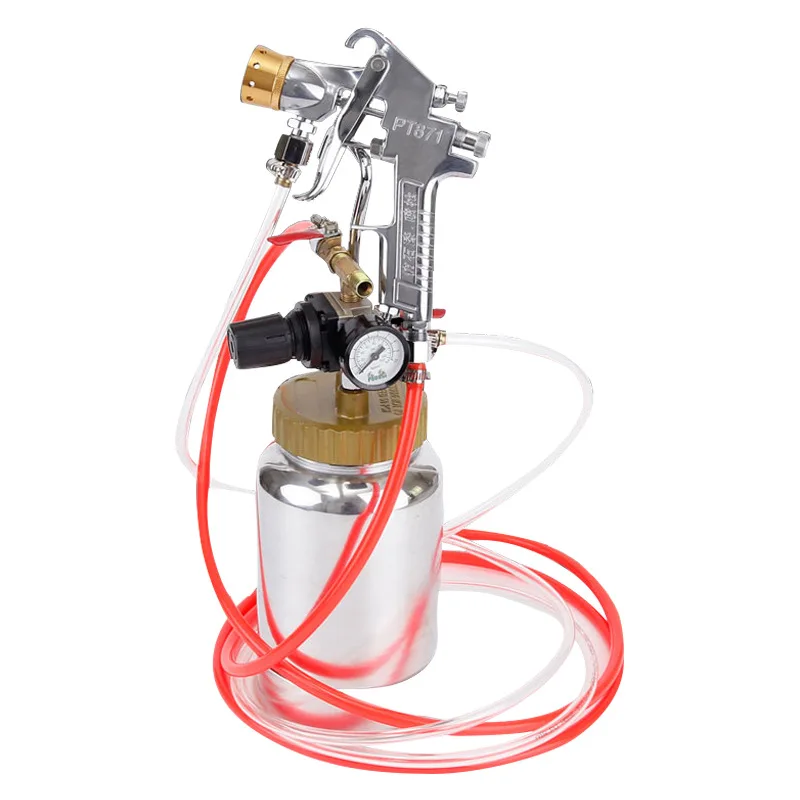
The TEBAK product record identifies a 2L pressure tank package with an air spray gun and regulator. Its title also says it is suitable for shoe factories. The available parameter block lists optimal working air pressure of 30-45psi, cup paint volume of 2Quart, a 3/8" hose size, material output of 11 FM, and a 1/4" NPT or BSP air inlet.
This guide treats those entries as source-listed procurement fields. It does not convert 2Quart into a metric volume, reinterpret “11 FM” as a different flow unit, or infer spray pattern, nozzle size, tank material, coating compatibility, electrical requirements, certification or production capacity. Those points require written supplier confirmation for the exact configuration.
The record contains repeated wording for “air Spray Gun Spray Gun.” This guide uses “air spray gun” for readability while keeping the product identity tied to product ID 1601273280307 and the supplied title.
1. Product identity and procurement boundary
Keep the RFQ tied to TEBAK 2L pressure tank with air spray gun and regulator, product ID 1601273280307. Ask the supplier to place the product ID, model or configuration reference on the quotation, packing list, instruction material and pre-shipment test record.
The source title mentions shoe factories, but it does not specify a particular shoe component, adhesive, leather coating, primer, dye, finish or production step. Ask the supplier to confirm the intended coating process and to test a representative material before purchase.
Do not assume that a pressure tank package is suitable for every coating or solvent. Request the tank, hose, gun, regulator and seal compatibility information for the actual material used at the buyer's site.
Request a configuration list that identifies the pressure tank, air spray gun, regulator, hose, fittings, gauges, valves, seals, tools and spare parts. If different gun, nozzle, hose or fitting options are available, record the selected option in the purchase order.
The source record names TEBAK and includes company-level promotional wording. Company or brand wording does not establish model-specific certification, pressure-vessel approval, warranty scope, chemical compatibility or destination-market compliance. Request evidence for the exact delivered package.
2. Confirmed source specifications
| Field | Source value | Procurement treatment |
|---|---|---|
| Product ID | 1601273280307 | Match the quotation, packing list, photographs and shipment documents. |
| Product identity | 2L pressure tank with air spray gun and regulator | Confirm the exact tank, gun, regulator and accessory set. |
| Application wording | Suitable for shoe factories | Confirm the shoe-production material and operation with a sample test. |
| Working air pressure | Optimal 30-45psi | Confirm whether this is tank pressure, spray pressure or a recommended operating window. |
| Cup paint volume | 2Quart | Confirm whether this is tank capacity, paint cup capacity or another source label; do not silently convert the unit. |
| Hose size | 3/8" | Confirm inside or outside diameter, length, material, end fittings and pressure rating. |
| Material output | 11 FM | Preserve the source wording and ask the supplier to define the unit and test condition. |
| Air inlet | 1/4" NPT or BSP | Confirm the supplied thread standard and do not assume NPT and BSP are interchangeable. |
“Optimal 30-45psi” is a recommended source field, not a verified pressure-vessel rating. Ask for the maximum allowable working pressure, test pressure, regulator range and relief-device setting before commissioning.
3. Pressure system definition
Ask the supplier to provide a pressure-flow diagram showing the air inlet, regulator, pressure tank, outlet, spray gun and any relief or shutoff components. The queue does not describe the internal arrangement, so the buyer should not design a connection layout from the title alone.
Confirm whether 30-45psi is measured at the tank, at the regulator outlet, at the gun inlet or under a spraying load. A gauge reading at one point is not automatically equivalent to pressure at another point.
Request the minimum and maximum adjustment ranges for the regulator. Confirm how the operator reads the gauge, locks the setting and releases pressure after use.
Ask for the maximum allowable working pressure of the tank and every connected component. Confirm the pressure rating of the hose, fittings, valves, gun, regulator and seals as a matched system.
Request details of the pressure-relief arrangement, including setting, inspection method and replacement procedure. Do not claim that a relief valve is included unless the supplier identifies it in the configuration and documentation.
Define a safe depressurization sequence before opening the tank, changing material, cleaning the gun or disconnecting the hose. The written procedure should identify all valves and confirm how trapped pressure is released.
Ask whether the tank requires periodic pressure testing, inspection or replacement under the destination market's rules. This product record does not provide a pressure-vessel standard or compliance document.
4. Material volume and the 2Quart field
The source lists “Cup Paint Volume 2Quart.” Preserve this wording in the RFQ and ask the supplier to define what component the field describes. It may refer to a paint cup, a tank volume or another catalog label, but the supplied record does not establish that meaning.
Request a dimensioned drawing of the pressure tank, lid, opening, internal vessel and material container. Ask for nominal volume, usable fill volume, maximum fill line, residual volume and the recommended headspace.
Confirm whether the package is intended to hold one material batch or to feed continuously from an external container. Ask how the operator loads, closes, mixes, drains and cleans the material side.
For shoe-factory use, identify the material by name and type before testing. Confirm whether the supplied wetted parts are compatible with water-based coating, solvent-based coating, adhesive, primer, dye or finishing material. Do not infer compatibility from the phrase “paint volume.”
Ask whether the tank, lid, tube, gun passage, hose and seals can be cleaned without hidden material pockets. Request a cleaning drawing and a list of approved cleaning agents.
Define the material viscosity, solids content, particle size and temperature at the test. The queue does not provide any of these values, so they belong in the buyer's sample-test specification rather than in the product description.
Confirm the filter or strainer arrangement, if any. Ask for mesh size, location, cleaning method and replacement part number. Do not assume a filter is supplied.
5. Air spray gun procurement checks
Request the spray gun model and a complete nozzle-and-needle specification. The product record does not list nozzle diameter, air cap, fan pattern, fluid tip, trigger type, material passage or adjustment controls.
Confirm whether the gun is supplied with the pressure tank package or is an optional component. Match the gun model to the regulator, hose and fittings in the quotation.
Ask for a spray pattern diagram and test video using the buyer's material. Record spray distance, pressure reading, material setting, fan setting, overlap and surface result.
Confirm the gun's operating pressure range and the maximum permitted pressure. Do not treat the tank's 30-45psi source field as the gun's complete specification.
Request details of the fluid passage material, seals, air cap, nozzle, needle, cup or inlet connection and replacement parts. Chemical resistance must be confirmed against the actual coating or adhesive.
Ask whether the gun supports only a fixed pattern or whether the operator can adjust fluid, air and fan controls. If adjustments exist, request the adjustment range and lock method.
For shoe components, define the target surface and acceptable finish. A sample should cover the actual leather, synthetic material, sole, edge, upper or other component that will be sprayed.
6. Hose and connection standards
The queue lists a 3/8" hose size. Ask whether this is the hose internal diameter, external diameter or a nominal connection size. Request the hose drawing and end-fitting specification before ordering.
Confirm hose length, material, temperature range, pressure rating, bend radius and compatibility with the planned material. The source does not provide these values.
The air inlet is listed as 1/4" NPT or BSP. These are alternative thread standards in the source wording, not a permission to mix fittings. Confirm whether the delivered inlet is NPT or BSP and specify the destination-side adapter if needed.
Ask for thread gender, sealing method, fitting material, wrench size and replacement part number. Confirm whether thread sealant, a gasket, an O-ring or a tapered thread is required.
Do not force an NPT fitting into a BSP port. Request a photograph or drawing of the actual port and check the connection with the buyer's maintenance team before shipment.
Define the air-source connection separately from the material-side connection. Confirm the compressor interface, filter, dryer, water separator and drain arrangement required by the buyer's installation.
Ask whether the hose supplied is dedicated to clean air, material delivery or both. Do not interchange components until the supplier confirms the intended flow path.
7. Air supply and installation planning
Request the air consumption of the tank, regulator and spray gun under the intended test condition. The source lists “11 FM” as material output, but it does not provide compressor capacity or air consumption.
Preserve “11 FM” exactly in the procurement file and ask the supplier to define the unit, whether it means material or air output, and whether the value is measured at 30psi, 45psi or another condition.
Confirm the required compressor pressure and free-air delivery. The buyer should size the air source from a model-specific test, not from the title or the nominal hose size.
Ask for the recommended air filtration, water separation and oil control. Contaminated air can affect spray consistency, but the source does not state what filtration package is included.
Provide the supplier with the destination electrical and compressed-air conditions, even though the queue does not list electrical requirements. If the package has no electrical component, record that as a supplier-confirmed boundary rather than assuming it.
Request the footprint, mounting or support arrangement, operator clearance and service access. The source record provides no dimensions or weight, so these must be confirmed before workstation planning.
Ask whether the tank is portable, fixed, trolley-mounted or intended for another support arrangement. Do not infer mobility from the product title.
8. Shoe-factory application validation
The title states suitability for shoe factories, but it does not identify the validated process. Ask the supplier to name the shoe component, coating or adhesive used in the demonstration and to provide a sample result.
Send representative substrates and define the target finish. Include the material type, surface preparation, masking, spray distance, number of coats, drying method and acceptable appearance.
Test both small and large workpieces if the factory has more than one shoe line. Record whether the spray gun can maintain the required pattern and whether the operator can reach edges, seams or curved areas.
Confirm whether the package is for decorative coating, adhesive application, edge finishing, primer, dye or another operation. Do not use the phrase “suitable for shoe factories” as a substitute for a process-specific qualification.
Ask for cleaning and changeover instructions when two materials are used in the same work area. Record the purge, disassembly, solvent or cleaning-agent requirements for the exact fluid path.
Define acceptance criteria for coverage, overspray, runs, dry spray, orange peel, edge build-up and color consistency as applicable to the buyer's material. These are buyer test requirements, not claims about the source product.
Request a sample video that shows the pressure reading, gun settings, material, substrate and final result. Match the video components to the quoted tank, regulator, hose and gun.
9. Regulator and operator controls
Confirm the regulator model, adjustment range, gauge scale, inlet, outlet and locking method. The queue confirms that a regulator is named in the title but does not provide its technical values.
Ask whether the regulator controls tank pressure, gun pressure or another downstream pressure. Request a clear labeled diagram to prevent incorrect installation.
Confirm whether the gauge is included, readable at the 30-45psi source range and protected during transport. Ask for accuracy, calibration information and replacement availability if the gauge is used for acceptance testing.
Define the operator start-up sequence: inspect the tank, close the lid, connect air, set pressure, verify leaks, open the fluid path and test the spray. The supplier should provide this sequence for the exact configuration.
Define the shutdown sequence: stop spraying, isolate air, depressurize the tank, drain or recover material, clean the fluid path and store the gun. A buyer should not open a pressurized tank.
Ask whether the pressure setting can drift during operation and how the operator checks it. Record the inspection frequency in the work instruction if pressure stability is important to the process.
10. Safety, maintenance and documentation
Request the safety manual, pressure-system warnings, hose inspection guidance, gun cleaning instructions and regulator maintenance schedule. The queue does not provide safety documents.
Confirm the tank's pressure rating, test record, relief arrangement, lid locking method, gasket replacement method and safe opening procedure. Do not claim pressure-vessel certification without model-specific evidence.
Ask for leak-test and pressure-test procedures. Define who performs the test, what pressure and duration are used, what constitutes a pass and how the result is recorded.
Request the list of wear parts: seals, hose, gun nozzle, needle, air cap, regulator, gauge, valves and fittings. Confirm part numbers and lead time for replacement components.
Ask how the operator cleans the pressure tank and spray gun without damaging seals or contaminating the next material. Confirm approved cleaning agents and prohibited methods.
Request the manual language, labels, spare-parts list, exploded drawing and troubleshooting table. Match the documentation to product ID 1601273280307 and the selected configuration.
Do not claim CE, ISO9001, warranty, food-contact compliance, explosion protection or solvent resistance unless the supplier provides current documents for the exact delivered package.
11. Packaging and export checks
Request packing photographs showing the pressure tank, spray gun, regulator, hose, fittings, gauges, valves, tools and manuals. The buyer should be able to compare the packed contents with the quotation.
Ask how the gun, gauge, hose and fittings are protected from impact, contamination and thread damage. Confirm whether the tank is secured against movement during transport.
Request package dimensions, gross weight, net weight, carton or pallet details and shipping marks. The source queue provides no logistics values.
Confirm whether the air inlet is shipped as NPT or BSP and whether any adapter is included. Record the actual thread standard on the packing list.
For the destination market, request the required pressure-system documentation, labels, manual language and inspection records. A source title alone does not establish import or workplace compliance.
Ask for a pre-shipment video showing the nameplate or product identification, regulator setting, tank connection, gun spray and included accessories. The video should use the same configuration that will be packed.
12. Pre-shipment acceptance test
Confirm product ID 1601273280307 and the exact pressure tank, air spray gun, regulator, hose and fittings supplied.
Verify the source-listed working pressure field of optimal 30-45psi and record where the pressure is measured. Also record the regulator setting, gauge reading and test duration.
Verify the delivered volume label and clarify the “2Quart” field before acceptance. Do not approve a substituted volume or converted unit without written agreement.
Verify the 3/8" hose size, hose length, end fittings, material and pressure rating. Confirm that all connection points match the selected 1/4" NPT or BSP inlet standard.
Ask the supplier to define and demonstrate the “11 FM” material-output field. Record the unit, material, pressure, nozzle and test method on the acceptance sheet.
Run the air system for leaks at the agreed pressure. Test the regulator, gauge, shutoff and pressure-release sequence before connecting the material.
Run a sample spray using the buyer's representative shoe-factory material and substrate. Record the material, spray setting, distance, pattern, number of coats, cleaning procedure and result.
Photograph the product identification, fittings, gauge, hose, gun, regulator and packed accessories. Resolve any mismatch before shipment.
13. RFQ checklist
- Confirm product ID 1601273280307 and the exact pressure-tank, spray-gun and regulator configuration.
- Define the shoe-factory process, material, substrate and target finish for the sample test.
- Confirm whether 30-45psi is tank pressure, regulator outlet pressure or gun inlet pressure.
- Provide maximum allowable working pressure, test pressure, relief setting and inspection requirements.
- Define the “2Quart” field and identify whether it describes tank capacity, usable volume or paint-cup volume.
- Confirm the 3/8" hose measurement basis, length, material, fittings and pressure rating.
- Clarify the “11 FM” unit, whether it is material or air output, and the test condition.
- Confirm whether the air inlet is 1/4" NPT or 1/4" BSP and provide any adapter required.
- Provide spray-gun model, nozzle, air cap, needle, fluid passage and adjustment specifications.
- Provide regulator model, gauge range, adjustment range, lock and replacement details.
- Provide air-consumption data, compressor requirements, filtration and water-separation recommendations.
- Provide wetted-part materials, seal materials and chemical-compatibility information for the buyer's fluid.
- Provide pressure, leak, spray and sample-acceptance test procedures.
- Provide dimensions, weight, support arrangement, package data and installation clearance.
- Provide safety documents, maintenance intervals, spare-parts list, warranty and destination-market compliance records.
14. Questions for the supplier
Where is the 30-45psi pressure measured, and what are the maximum allowable working and test pressures of the tank and complete system?
What does “2Quart” describe? Please provide the tank drawing, nominal volume, usable volume, maximum fill line and residual volume.
What does “11 FM” mean, and what are the unit, material, pressure, nozzle and test conditions? Please provide the original test record.
Is the delivered air inlet 1/4" NPT or 1/4" BSP? Please send a fitting drawing and identify the included adapter, if any.
What is the 3/8" hose measurement, and what hose length, material, fitting type and pressure rating are included?
Which spray-gun model, nozzle, air cap, needle and fluid passage are supplied? Which adjustment controls are included?
Which shoe-factory material and substrate were used to support the application wording? Can you test the buyer's representative sample?
Which parts contact the material, and which coatings, adhesives, solvents or cleaning agents are excluded?
What pressure relief, leak-test, safe-opening, cleaning and maintenance instructions apply to the exact configuration?
What are the package dimensions, net weight, gross weight, shipping marks, manuals, spare parts and destination-market documents?
15. What not to assume
Do not convert “2Quart” into a metric volume without supplier confirmation. Preserve the source unit and define the component it describes.
Do not rewrite “11 FM” as CFM, L/min or another flow unit. The source does not define the unit.
Do not treat 30-45psi as the maximum pressure rating. It is listed as an optimal working-pressure field and requires system-level confirmation.
Do not assume NPT and BSP fittings are interchangeable. Confirm the actual inlet standard and adapter.
Do not assume that “suitable for shoe factories” validates every shoe material or application. Test the buyer's material and substrate.
Do not claim nozzle size, spray pattern, tank material, seal material, chemical compatibility, air consumption, certification, warranty or production output without model-specific evidence.
16. Final procurement decision
The TEBAK 2L pressure-tank package has a source-defined procurement baseline: an air spray gun and regulator, optimal working air pressure of 30-45psi, a source-listed 2Quart paint-volume field, a 3/8" hose-size field, material output written as 11 FM, and a 1/4" NPT or BSP air inlet. The application wording refers to shoe factories, but the exact process and material remain to be qualified.
Proceed only after the supplier defines the pressure measurement point, pressure rating, volume field, “11 FM” unit, hose specification, thread standard, spray-gun configuration and material compatibility. A buyer-specific leak test and sample spray should be completed before shipment.
Editor's note: This guide uses the supplied Hoting queue fields only. It preserves the original units and ambiguous labels and does not add unsupported pressure-vessel, coating, performance, certification, warranty or shoe-production claims.
Key specifications
- Working air pressure
- Optimal 30-45psi
- Cup paint volume
- 2Quart
- Hose size
- 3/8"
- Material output
- 11 FM
- Air inlet
- 1/4" NPT or BSP
Frequently asked questions
- What working pressure is listed for the pressure tank package?
- The source lists optimal working air pressure of 30-45psi. Confirm the measurement point and the maximum allowable working pressure before ordering.
- What does the 2Quart field mean?
- The source labels it Cup Paint Volume 2Quart but does not define the component or usable volume. Ask the supplier for a drawing and volume definition.
- What does 11 FM mean?
- The source lists Material Output 11 FM without defining the unit or test condition. Preserve the wording and request the original test record.
- What air inlet is listed?
- The source lists 1/4-inch NPT or BSP. Confirm which thread standard is supplied; do not assume the two standards are interchangeable.
- Is the package suitable for shoe factories?
- The title uses that application wording. Confirm the exact shoe-factory process, material and substrate with a buyer-specific sample test.