
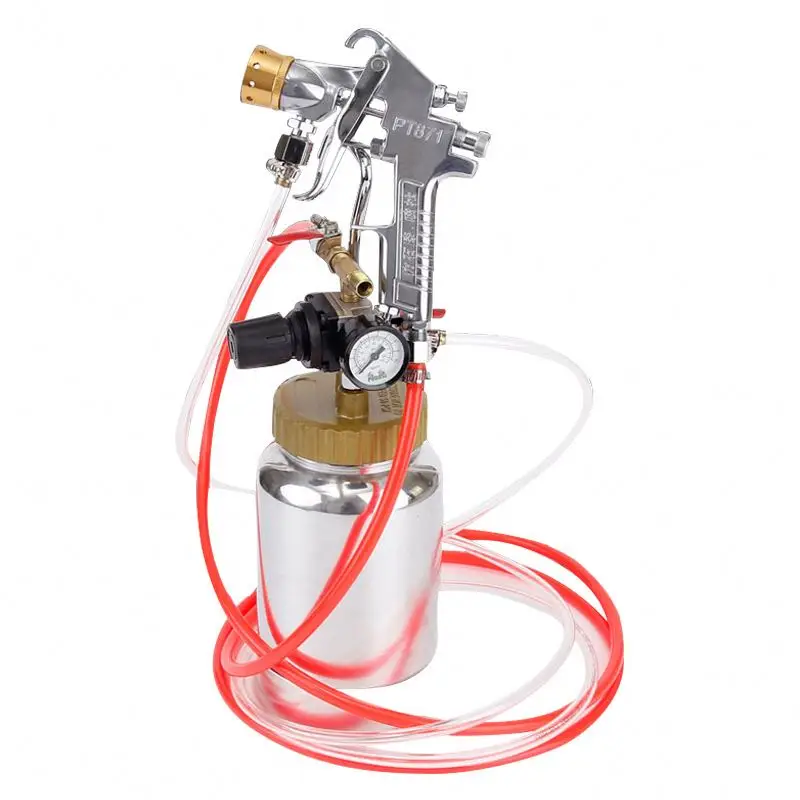
The kit, and the two things its own documents disagree about
The Hoting queue carries Product ID 1601276327550 as a TEBAK two metre hose gun assembly kit, a two litre pressure tank with an air spray gun and a regulator, described in the title as suitable for shoe factories. The listing publishes five parameters. The record's fourth image publishes a six row specification table of its own, for a product it calls the two litre blister water gun 871. Between those two sets of figures there are two direct disagreements and one scope note that changes what the numbers mean, and a buyer who reads only one of the two documents will order the wrong kit or the wrong compressor.
The first disagreement is pressure. The listing gives the working air pressure as an optimal range of 30 to 45 psi. The record's own specification image gives the working pressure as 0.8 to 2.1 bar. Those two ranges are not the same range expressed twice, and the conversion shows how little they have in common.
| Pressure | In bars | In megapascals | Where the figure appears |
|---|---|---|---|
| 11.6 psi | 0.80 | 0.080 | The lower limit on the record's own specification image |
| 30 psi | 2.07 | 0.207 | The lower limit in the listing, and just inside the image's upper limit |
| 30.5 psi | 2.10 | 0.210 | The upper limit on the record's own specification image |
| 36 psi | 2.48 | 0.248 | The middle of the listing's range, above the image's upper limit |
| 45 psi | 3.10 | 0.310 | The upper limit in the listing, half again above the image's upper limit |
So the listing's range and the image's range meet only in a narrow band around 2.1 bar, which is the image's ceiling and almost the listing's floor. Taken at face value, the listing asks for a pressure that the record's own specification table does not permit, and its 45 psi limit is about half again the maximum on that table.
Two pressure ranges, and two components that nobody separates
The disagreement resolves itself once the machine is understood, and the record contains the clue: its sixth image shows a valve block with a knob and the caption regulating valve, described as adjusting the pressure in the barrel. This kit therefore has two separate pressure domains. One is the pressure inside the pot, which pushes the fluid down the hose to the gun. The other is the pressure at the gun's air inlet, which atomises the fluid at the nozzle and is set by the small regulator knob described in the third image as the inlet air pressure regulating button. A pressure pot system always has both, and they are set independently, because pot pressure controls how much fluid arrives and gun pressure controls how finely it is broken up.
That explains why the record can carry two ranges that do not match: 0.8 to 2.1 bar is a plausible pot pressure, and 30 to 45 psi is a plausible gun atomisation pressure. The record, however, never says which range belongs to which component. Both appear under headings that could be read as covering the whole kit, the listing's field is simply called working air pressure, and the image's table carries the innocent looking note that the parameters do not include the spray gun while still printing a figure a buyer will naturally apply to the gun.
The reason to insist on the separation before ordering is practical rather than pedantic. Applying pot pressure to a gun atomises badly, and the operating instruction in the third image tells the operator to judge atomisation by feel, so a poorly atomised fluid is easy to mistake for a badly adjusted gun. Applying gun pressure to a pot is the more serious error, because it loads the pot's body, its lid and its lid gasket above the figure in the record's own table.
So the question is not what the kit's working pressure is, but four separate questions. What is the maximum pressure the pot body and its lid are rated for. What is the relief valve set at, and is a relief valve fitted at all. What is the gun's recommended atomisation pressure at its inlet. And is the regulator supplied a pot regulator, a gun regulator, or two regulators. The title says spray gun and regulator in the singular, which on a pressure pot system is one regulator short of a complete kit unless the pot and the gun are fed from a common regulated line, and the buyer should assume nothing until the packing list says otherwise.
Two litres against two quarts, and a table that excludes the gun
The second disagreement is capacity. The title states a two litre pressure tank. The listing's parameter table states a cup paint volume of two quarts. Two units are in play and neither reading matches two litres exactly.
| Statement | In litres | Difference from the stated two litres |
|---|---|---|
| Two litres, as in the title and in the record's specification image | 2.000 L | Reference figure |
| Two United States quarts | 1.893 L | About 5 per cent less |
| Two Imperial quarts | 2.273 L | About 14 per cent more |
There is a second problem in the same field, and it is the more useful one. The field is named cup paint volume. A cup is the reservoir that mounts on a suction or gravity gun. This kit's reservoir is a pressure tank that sits on the floor or on a bench and feeds the gun through a hose, which is why the record shows a pot, a regulator, a gauge and a hose in the same photograph. A cup volume and a pot volume are different quantities, and the field name suggests the parameter table was assembled from a cup gun template and applied to a pressure pot.
The specification image closes the question for the pot and then opens a new one. It states a capacity of two litres, a mass of about 2.35 kilograms and dimensions of about 12.6 by 12.6 by 39.5 centimetres, and then prints the note that the parameter information does not include the spray gun. Three consequences follow. The two litre capacity, the 2.35 kilograms and the 39.5 centimetres describe the pot assembly alone, so the kit's total mass and its packed size are unstated. The kit's mass matters for freight and for whoever carries it to the bench. And the packed size matters because the pot assembly is nearly forty centimetres tall, which usually means a carton rather than a mailer and a different freight tier.
The pot's geometry, checked against its own dimensions
The three figures in the specification image can be checked against each other, and doing so tells a buyer something about the shape of the pot that the photograph alone does not. Two litres is two thousand cubic centimetres. If the pot's body is a cylinder about 12.6 centimetres across, as the stated footprint suggests, its cross sectional area is about 124.7 square centimetres, and two litres therefore occupy about 16 centimetres of height. The assembly is stated as 39.5 centimetres tall, so roughly 23 centimetres of that height is the valve block, the regulator, the gauge and the handle that are stacked above the pot's lid.
The arithmetic matters because of what it says about stability. A pot holding two litres of fluid in a body about 16 centimetres tall, standing on a footprint 12.6 centimetres square and carrying a further 23 centimetres of hardware on top, is a tall and narrow object with a high centre of mass, and a two litre charge of adhesive or textured paint weighs a little over two kilograms on its own. A tall pot on a small footprint is easily pulled over by its own hose, and a full pot that goes over spills its entire charge. So the questions to ask about the pot are structural: does it have a weighted base or a foot, is there a hook or a bracket to hang it from a bench or a trolley, what is the burst pressure of the body and the lid, and does the lid have a safety relief valve in addition to the regulator.
Eleven FM, and whether the buyer's compressor can drive the kit
The listing's fifth parameter reads material output 11 FM. The abbreviation is truncated, and the field name and the unit do not agree with each other. A material output would be a fluid volume per unit time, in millilitres or litres per minute. An air consumption figure would be in cubic feet per minute. Eleven of something is most plausibly 11 CFM, which is an air consumption figure for the gun and not a material output at all, and that reading is worth taking seriously because it is the number that decides whether the buyer's compressor can run the kit.
If the figure is 11 CFM, the conversion is straightforward and the consequence is not. One cubic foot per minute is about 28.3 litres per minute, so 11 CFM is about 311 litres per minute, or about 18.7 cubic metres per hour of free air delivery. A pressure pot system sprays continuously, unlike a cup gun that is refilled between passes, so the compressor has to sustain that flow rather than peak at it.
| If the kit consumes | Litres per minute | Cubic metres per hour | Compressor free air delivery needed |
|---|---|---|---|
| 7 CFM | 198 | 11.9 | At least 198 L per minute at the working pressure |
| 9 CFM | 255 | 15.3 | At least 255 L per minute at the working pressure |
| 11 CFM | 311 | 18.7 | At least 311 L per minute at the working pressure |
| 13 CFM | 368 | 22.1 | At least 368 L per minute at the working pressure |
The practical instruction is to read the compressor's own plate rather than its tank size, because tank litres say how much air is stored and free air delivery says how much the pump can add, and it is the second figure that limits spraying. A compressor whose free air delivery is below the kit's consumption will spray well for a short burst and then lose pressure as the tank empties, which the operator experiences as a pattern that fades and recovers, and which is easy to blame on the gun. So the question to the supplier is the kit's air consumption in CFM or in litres per minute at a stated inlet pressure, and the question to the compressor supplier is free air delivery at the same pressure.
The gun is labelled for a different trade than the listing names
The first three images in the record are about the gun, and they carry three different descriptions of what the gun is for. The gun's marketing headline reads automotive primer, with the model number PT871. The body of the gun, photographed from both sides, carries an inscription in Chinese characters that names imitation stone paint, which is a thick decorative exterior coating rather than a primer. The fifth image, headed applicable to most paints on the market, lists four fluids with photographs: latex paint, texture paint, imitation stone paint and multicoloured paint. Three of those four are decorative architectural coatings, and the fourth, latex paint, is a wall paint.
The listing's title names a different trade again: suitable for shoe factories. In a shoe factory the sprayed fluid is normally an adhesive, a contact cement or a solvent borne cement applied to sole and upper before assembly, and that fluid behaves nothing like a decorative wall coating. It is often more viscous, it contains solvents that attack elastomers, and it must not be sprayed with a fine finishing pattern but laid down as a wet, tacky film.
So the same hardware is presented under three trades in one record, and none of the record's own images shows an adhesive. A buyer in the shoe trade should therefore not read the applicability image as evidence that the kit suits their fluid, and should ask the question directly, in writing and with the fluid named: which parts of the pot, the hose, the gun body, the needle packing, the fluid nozzle and the lid gasket are compatible with the specific adhesive the buyer uses, and what is the seal material in each case. The reason to be specific is that a solvent borne contact cement will swell or dissolve common rubber packings, and a swollen needle packing leaks fluid past the trigger, which is a fault the buyer discovers at the bench and the supplier can dispute.
What the model name says the gun was built for
The specification image names the product a two litre blister water gun 871, and the first and seventh images both refer to water in water, with one bullet reading that water in water can be sprayed and a caption describing a water in water airflow. The phrase is a translation of a trade name for a water in water multicolour decorative coating, in which coloured droplets are suspended in a water based carrier and stay distinct after application. The fifth image supports that reading, since one of its four fluids is multicoloured paint.
If that is the fluid the gun was designed around, the rest of the gun's specification stops being arbitrary. A water in water multicolour coating is thick and shear sensitive, because the coloured droplets must survive the pump, the hose and the nozzle without being broken up; a gun for it therefore needs a large fluid passage and a high flow, low shear air cap rather than a fine finishing cap. That is exactly what the record shows: an air cap described as a four hole upgraded to six hole, bullets claiming a high flow gas path, and a caption saying the cap can be used as a common primer by changing the air cap, which is an admission that the cap fitted is not the primer cap that the gun's own headline advertises. So the fitted configuration is a high flow decorative coating configuration, and it is the configuration the buyer receives unless the order says otherwise.
For an adhesive job the requirement inverts. Adhesive wants a large fluid nozzle and a modest, wet pattern rather than a finely atomised cloud, and it wants a fluid passage that will not clog and a cap that will not over-atomise the cement into a dry mist. Since no nozzle or needle diameter is stated anywhere in the record, the buyer cannot tell from the documents whether the fitted nozzle suits their fluid at all. That single missing figure is the most important number in the kit.
What the kit contains, and the hose that is stated once
The title is a two metre hose gun assembly kit, and the listing states a hose size of three eighths of an inch. On a pressure pot system there are two hoses to think about, and the record describes one. Fluid leaves the pot through a fluid hose and reaches the gun at the fluid inlet, which the specification image gives as a quarter inch by one. Air reaches the pot's regulator and the gun's air inlet through an air hose, and the listing's air inlet figure, quarter inch NPT or BSP, describes the thread rather than the hose. Three eighths of an inch is a normal air hose bore for a gun at this consumption, and a quarter inch is a normal fluid line on a two litre pot, so the single stated hose size almost certainly describes the air line while the fluid line goes unmentioned.
That produces four questions that decide whether the kit is usable on arrival. Is the stated two metres the air hose, the fluid hose, or the sum of both. How many hoses are in the box. What is the fluid hose's bore, and does it match the quarter inch fluid outlet on the gun. And is the air hose fitted with the correct end fittings and couplers for the buyer's compressor, which is a question about threads as much as about bore, since the record offers quarter inch NPT or BSP and the two are not interchangeable without adaptors.
Two metres deserves its own comment, because it is short in service. The pot stands on the floor or hangs from a bench, the gun has to reach the work, and on a shoe line the operator may have to move along the bench between stations. Two metres of hose minus the route up and over a hook leaves little slack. So the buyer should measure the working distance from the pot's position to the furthest point of the work, add the height of the run, and order a longer hose if the answer exceeds what two metres allows, rather than discovering the constraint with a sprayed workpiece in front of them.
The title also repeats the words spray gun twice in succession, which suggests the title was assembled from keyword fields rather than written. Taken with the specification image's note that the parameters exclude the gun, and with the fact that only the pot assembly's mass and size are stated, the practical conclusion is that the record does not contain a packing list. Ask for one in the form of a numbered list of items with quantities and masses, and treat the kit as complete only when the list names the pot, the lid and its gasket, the regulator, the gauge if fitted, the relief valve if fitted, the two hoses with their bores and lengths, the gun, the air cap or caps, the fluid nozzle and needle fitted, the wrench the record advertises, and the container.
Settings without graduations, and why repeatability lives in the pot
The third and eighth images between them describe the gun's adjustments, and neither describes a scale. The third image names an atomisation adjusting knob, a coating amount adjusting knob and an inlet air pressure regulating button, and the eighth image, under the heading paint adjustment button, explains the fluid control in the language of craft rather than of measurement: if the flow control valve is loose the quantity of paint will be more and more, tighten it and the paint becomes thinner, and the operator is to judge by the feel of the valve to reach a good atomisation effect. On the first image, one of the selling bullets is a soft trigger pull.
Judging by feel is normal on a general purpose spray gun, and it is the correct method for a decorator repainting a wall. It is the wrong method for a production line that has to apply the same quantity of adhesive to every shoe, because two operators will set two different flows and the same operator will drift over a shift. So a buyer in a production setting should know where repeatability can actually come from on this kit. It does not come from the gun's knobs, which have no graduations. It comes from three places: the pot's regulator, which sets the feed pressure and can be fitted with a gauge so the setting is a number; the fluid nozzle diameter, which fixes the maximum flow independently of the knobs; and a fixed, recorded setting of the gun's knobs marked with a paint pen or a stop collar on the day the line is set up.
The gauge question follows directly. The record's own image shows a gauge on the regulator in the kit photograph, and the specification table gives a pressure range, but no parameter states that a gauge is included. A regulator without a gauge cannot be set to a number, only to a feel, so the buyer should require the gauge in the order and require the relief valve at the same time.
Adhesive in a pressurised pot, and the questions that come with it
The listing names shoe factories, and the relevant fluid is therefore likely to be a solvent borne adhesive. A pressurised pot containing two litres of solvent borne cement concentrates several questions into one small piece of equipment, and the record answers none of them.
The first is earthing. A pressurised pot and a hose carrying solvent produce static as the fluid moves, and the standard precaution is to bond the pot to earth and to ground the workpiece, and to avoid plastic components that isolate the pot from the bench. Ask whether the pot is fitted with an earthing lug or a bonding strap, whether the fluid hose is conductive or antistatic, and whether the manufacturer requires the workpiece to be earthed. A kit supplied for adhesive work without an earthing provision is a kit the buyer must complete before use.
The second is the pot's own pressure rating and its relief valve, which is the same question raised by the conflicting pressure ranges earlier in this guide. The figure that matters is the pot's maximum working pressure and its burst pressure, printed in the documentation rather than inferred from a regulator setting.
The third is gasket and seal compatibility, because the lid gasket seals two litres of solvent and the needle packing seals the fluid at the trigger. Ask for the material of each and for its resistance to the buyer's specific solvent.
The fourth is the gauge and the fittings. Solvent carried in a pot under pressure will find a leaking joint, and the standard quarter inch NPT or BSP threads on a cheap fitting will weep if they are assembled without a suitable sealant that is itself solvent resistant. Ask which fittings are taper thread and which are parallel, and which sealant the supplier recommends, because a white plastic tape meant for water lines is not the right answer for a solvent line.
The fifth is ventilation and personal protection, which is an operational rather than a purchasing matter and is raised here only to note that the record makes no claim about it at all. A two litre pressurised pot sprays a large volume of solvent into the air of a workshop in a short time, and the buyer's own risk assessment has to cover it.
The documentation, and the images that carry a repeated keyword list
Five of the eight images carry a block of small pale text below their headings, in which the same phrases repeat over and over in a continuous string without punctuation: car spray, home spray, woodworking spray, and further repetitions of the same words running together. That is a keyword list inserted into the artwork rather than a description, it carries no information, and on a supplier's own product page it is a signal about how the page was built. The record's other documentation defects point the same way. The parameter heading is spelled Paramenters and appears twice in succession. The heading company profile appears twice as well. A heading reading product packaging is present with nothing under it, which is why the packing of this kit is unstated. The company profile text is the same paragraph that appears in other records for unrelated products, and it ends mid sentence with the words our customers are from all over the world followed by a comma and nothing more.
None of that is a defect in the kit itself, and it matters for one practical reason. The gun in the photographs is a branded and model marked product carrying another company's marketing text, printed with the words automotive primer and an inscription in Chinese characters naming imitation stone paint, and illustrated with a keyword list. A buyer therefore cannot tell from the record whether the gun supplied in the box is the gun photographed, whether the branding is reproduced for this order, or whether a functionally equivalent gun is substituted. So the order should name the gun by model and require the model to be stated on the packing list and cast or engraved on the delivered gun, which converts a marketing photograph into a checkable line item.
The specification and packing list to send
| Item | Answer required as |
|---|---|
| Pot capacity | Litres, and the equivalent in quarts with the quart named as United States or Imperial |
| Pot maximum working pressure and burst pressure | Bar and psi, for the body and for the lid separately |
| Relief valve | Fitted yes or no, and the set pressure |
| Regulators supplied | One or two, and which of the pot and the gun each serves |
| Gauge | Included yes or no, range in bar and psi, and whether it reads the pot or the gun |
| Gun atomisation pressure | Recommended inlet pressure in psi and bar |
| Air consumption | CFM and litres per minute, at a stated inlet pressure |
| Fluid nozzle and needle | Diameter in millimetres, and the sizes available |
| Air cap | Number of holes, and which additional caps are supplied or available |
| Fluid outlet and air inlet | Thread type and size, with a note on whether each is taper or parallel |
| Hoses | Number of hoses, which is air and which is fluid, each bore and each length, and the end fittings |
| Wetted materials | Pot, lid gasket, fluid hose, gun body, needle packing, nozzle, and compatibility with the named adhesive |
| Earthing provision | Lug or strap on the pot yes or no, and whether the fluid hose is conductive or antistatic |
| Gun identification | Model marked on the delivered gun, and whether it matches the photographed gun |
| Kit mass and packed size | Kilograms for the complete kit including the gun, and carton dimensions in centimetres |
| Packing list | A numbered list of every item with quantity and mass |
| Documentation | Operating instructions and a parts diagram with part numbers, in English |
| Commercial terms | Price, minimum order quantity, trade term, lead time, warranty, and spare part prices for the nozzle, needle, packing and lid gasket |
The last line is worth keeping. On a spray kit the consumable is not the pot or the gun but the nozzle, the needle, the needle packing and the lid gasket, and a buyer who cannot price those will discover the kit's true cost per year only after the first failure.
Incoming inspection when the kit arrives
- Count the items against the packing list rather than against the photograph, and record any item the list names that is absent and any item present that the list does not name.
- Fill the pot with two litres of water and check the level against the pot's own mark, then weigh the pot empty and full to establish the usable charge in kilograms for the buyer's fluid.
- Read the pot's pressure rating and the relief valve's set pressure from the body and the documentation, and confirm both are at or above the pressure the buyer intends to use.
- Pressurise the pot slowly to the intended working pressure with the lid on and the outlet closed, and watch the gauge and the lid joint for drift or weeping over several minutes.
- Operate the relief valve deliberately and confirm it releases at its stated pressure and reseats without leaking.
- Measure the gun's atomisation pressure at the gun's inlet with a gauge at the inlet, not at the compressor, and record the reading against the supplier's recommended figure.
- Measure the fluid nozzle and the needle with a caliper or a pin gauge and compare with the order, since no diameter is stated in the record.
- Count the holes in the air cap and record the number, then check whether any second cap was supplied and whether its hole pattern differs.
- Identify the fluid hose and the air hose by tracing them, measure each bore and each length separately, and confirm the stated two metres belongs to the hose the supplier says it does.
- Check every thread for type and fit, test the couplings against the buyer's compressor and gun, and record any adaptor that was needed.
- Spray the buyer's own fluid, not water, and time how long the pot holds working pressure with the gun open, which establishes whether the buyer's compressor is adequate in service rather than on paper.
- Spray a test panel and record the pattern width, the wet film appearance and whether the fluid arrives as a wet film or as a dry mist, because a dry mist means the atomisation pressure is too high for the fluid.
- Check the needle packing for leakage while the trigger is held with the pot pressurised, and note any fluid at the packing nut.
- Clean the gun and the pot with the supplier's recommended solvent and note which parts retain fluid or are difficult to reach, since those are the parts that will cause trouble in daily use.
- Check the earthing provision if the fluid is solvent borne, and confirm the pot can be bonded to earth before the kit is used on a production line.
- Record the mass and dimensions of the complete kit as delivered and keep them with the photographs, so the next order can be checked against this one.
The second, fourth, sixth and eleventh checks are the four that turn this record into a specification, because usable charge, pot pressure behaviour, the pressure at the gun's inlet and the compressor's real capacity are the four figures the listing states ambiguously or not at all.
Answers to the questions this record raises most often
What is the kit's working pressure?
The record gives two answers and they are not the same range. The listing says an optimal 30 to 45 psi, which is about 2.07 to 3.10 bar. The record's own specification image says 0.8 to 2.1 bar, which is about 11.6 to 30.5 psi. The two ranges meet only just above 2.1 bar. Treat 0.8 to 2.1 bar as the pot figure, since the record's regulator image describes adjusting the pressure in the barrel, and require a separate figure for the gun's inlet before ordering.
Is the reservoir two litres or two quarts?
The title and the specification image say two litres. The listing's parameter table says two quarts. Two United States quarts is about 1.89 litres and two Imperial quarts is about 2.27 litres, so neither reading is exactly two litres. Require the capacity in litres and the quart named as United States or Imperial, and note that the parameter field calls the reservoir a cup although the kit has a pressure tank.
What does material output of eleven FM mean?
The abbreviation is truncated and the field name does not match the unit. Eleven of something is most plausibly 11 CFM, which is an air consumption rate rather than a material output; a true material output would be quoted in millilitres or litres per minute. If it is 11 CFM, the kit consumes about 311 litres per minute, which sets the compressor's minimum free air delivery.
How large a compressor is needed?
One whose free air delivery is at least equal to the kit's consumption at the working pressure, which is about 311 litres per minute if the figure is 11 CFM. Tank volume is not the measure; a compressor with a large tank and a small pump will still lose pressure while the gun is held open. Check the compressor's plate rather than its tank size.
Does the kit include the spray gun?
The title says so and repeats the words spray gun twice, and the photographs show a gun. The record's specification image, however, prints a note that the parameters do not include the spray gun, and every figure in that table, the 2.35 kilograms and the 12.6 by 12.6 by 39.5 centimetres, therefore describes the pot assembly alone. Require an explicit packing list rather than inferring the contents.
What nozzle size does the gun have?
Not stated in the listing or in any of the eight images. This is the single most important missing figure for a buyer with a specific fluid, because the nozzle diameter sets the maximum flow and the viscosity the gun can handle, and a decorative coating gun and an adhesive gun will not share one.
Can the kit spray shoe adhesive?
The listing says it is suitable for shoe factories, and none of the record's own images shows an adhesive. The gun's headline reads automotive primer, its body names imitation stone paint, and the applicability image lists latex, texture, imitation stone and multicoloured paints, all decorative coatings. The model name refers to water in water multicolour paint, which is a thick shear sensitive coating needing a high flow cap, and the fitted cap is described as a six hole high flow cap that must be changed to serve as a primer cap. Compatibility with a specific adhesive must therefore be confirmed in writing, part by part.
How is the fluid quantity set?
By feel. The record's own text says the flow control valve is loosened and tightened and the operator judges by the feel of the valve to reach a good atomisation effect, and no knob carries a graduation. For repeatable output, set and record the pot pressure on a gauge, fix the nozzle size, and mark the gun's knobs physically.
How long are the hoses and how many are there?
The title states one hose of two metres and the listing states a hose size of three eighths of an inch. A pressure pot system needs both a fluid hose and an air hose, and the record describes one, so the buyer should require the number of hoses, the bore and length of each, and the end fittings. Three eighths of an inch is a normal air hose bore and a quarter inch is a normal fluid bore on a pot of this size.
Is the pot earthed?
Not stated. If the fluid is a solvent borne adhesive, the pot should be bonded to earth and the workpiece grounded, and the record makes no provision visible. Ask whether the pot has an earthing lug or strap and whether the fluid hose is conductive or antistatic.
Source, scope and what this guide does not claim
This guide is based on the Hoting queue record for Product ID 1601276327550, titled as a TEBAK two metre hose gun assembly kit with a two litre pressure tank, an air spray gun and a regulator, described as suitable for shoe factories, and on the eight detail images that accompany it. All eight images were examined.
The listing's five published parameters are quoted as they appear: working air pressure, optimal 30 to 45 psi; cup paint volume, two quarts; hose size, three eighths of an inch; material output, 11 FM; and air inlet, quarter inch NPT or BSP. The record's own specification image supplies a further set: product model, two litre blister water gun 871; working pressure, 0.8 to 2.1 bar; paint export, quarter inch by one; capacity, two litres; air inlet, quarter inch; mass, about 2.35 kilograms; dimensions, about 12.6 by 12.6 by 39.5 centimetres; and a printed note that the parameters do not include the spray gun.
Everything else attributed to the record's images is taken from those images and named where it appears: the six hole air cap and the statement that a four hole was upgraded to six and that the cap can serve as a common primer cap when changed, on the seventh image; the three fluid and three pressure controls and the instruction to judge atomisation by feel, on the third and eighth images; the regulating valve described as adjusting the pressure in the barrel, on the sixth image; the applicable fluids, latex, texture, imitation stone and multicoloured paint, on the fifth image; the gun's headline reading automotive primer with the model PT871 and the Chinese inscription naming imitation stone paint, on the first image; and the repeated keyword list that appears in the artwork of five of the eight images.
Several figures in this guide are the author's arithmetic rather than published data, and are identified here so that they are not mistaken for specifications. The pressure conversions between psi, bar and megapascals use the standard factor of about 0.0689 bar per psi. The pot height of about 16 centimetres and the resulting 23 centimetres of hardware above the lid are calculated from the stated two litre capacity and the stated 12.6 centimetre footprint, treating the body as a cylinder, and they are an estimate rather than a measurement of the kit. The compressor figures are conversions of the assumed 11 CFM reading at about 28.3 litres per minute per cubic foot, and the row values of 7, 9 and 13 CFM are illustrative rather than quoted limits. The reading of the model name as referring to a water in water multicolour coating is an interpretation of a translated trade term, offered because the record's own list of applicable fluids includes multicoloured paint, and it should be confirmed with the supplier rather than assumed.
A buyer can close this specification with five questions and two measurements. The questions are the pot's maximum working pressure and relief setting, the gun's recommended inlet pressure, the kit's air consumption in litres per minute, the fluid nozzle diameter, and compatibility of every wetted part with the buyer's own fluid. The measurements are the pot's usable charge in kilograms and the buyer's compressor output at the working pressure, both taken on arrival. Everything else in this guide is a consequence of those seven answers, and none of them is in the record as it stands.
Key specifications
- Working Air Pressure
- Optimal 30-45psi
- Cup Paint Volume
- 2Quart
- Hose Size
- 3/8"
- Material Output
- 11 FM
- Air Inlet
- 1/4" NPT or BSP
- Product model on the record's own specification image
- 2L blister water gun 871
- Working pressure on the record's own specification image
- 0.8-2.1 BAR
- Paint export on the record's own specification image
- 1/4"*1
- Capacity on the record's own specification image
- 2L
- Air inlet on the record's own specification image
- 1/4
- Mass on the record's own specification image
- about 2.35 kg
- Dimensions on the record's own specification image
- about 12.6 x 12.6 x 39.5 cm
- Scope note printed on the record's own specification image
- the parameter information does not include the spray gun
- Spray gun model marked on the gun itself
- PT871, with the words automotive primer on the gun image and an inscription in Chinese characters on the body that names imitation stone paint
- Air cap
- six hole design, described as a four hole upgraded to six hole, and described as usable as a common primer by changing the air cap
- Fluids shown as applicable
- latex paint, texture paint, imitation stone paint, multicoloured paint
- Application named in the listing title
- suitable for shoe factories
- Nozzle or needle diameter
- not stated in the listing or in any of the eight images
- Pot pressure rating and relief valve
- not stated anywhere
- Kit contents as a packing list
- not stated; the title repeats the words spray gun twice and the only stated mass excludes the gun