
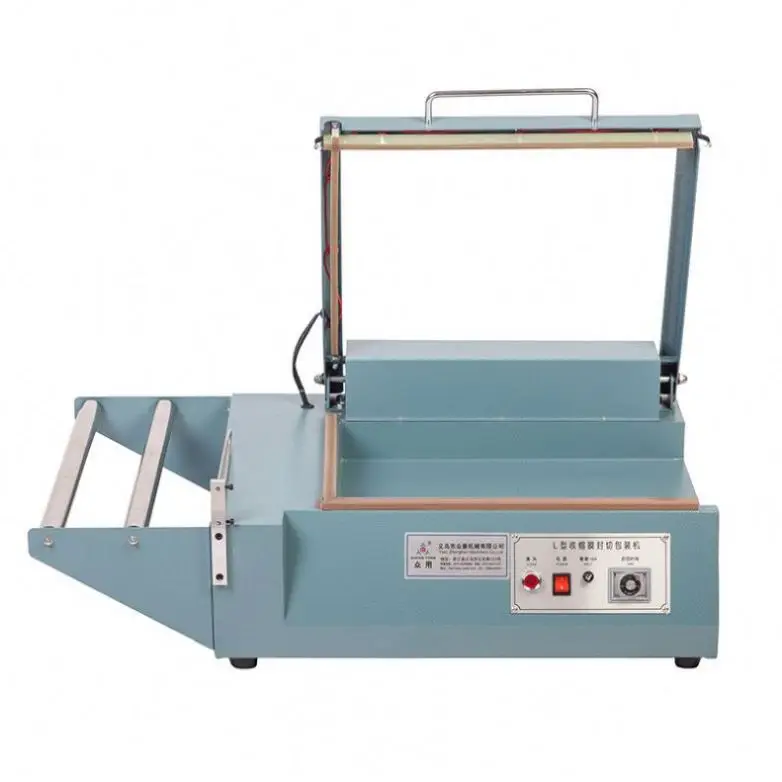
What the source record confirms
The TEBAK source record identifies a high-temperature PVC/POF plastic 380MM L-type manual packing heat-shrink cutting and sealing machine. The structured fields confirm a maximum sealing section of 490*340mm, machine size of 950*550*370mm, sealing and cutting time of 0-3s, weight of 22KG, and a field labeled Voltage with the value 1000W.
The last field is reproduced exactly as supplied: Voltage: 1000W. Because W is a power unit rather than a voltage unit, it must not be silently corrected to a guessed voltage. Ask the supplier for the actual electrical voltage, frequency, phase, current and nameplate before purchase.
The title and description mention 380MM, L-type manual sealing and cutting, high-temperature operation, PVC, POF and heat shrink. These are source descriptions and procurement scope. They do not by themselves establish film width, film thickness, sealing temperature, shrink tunnel configuration, throughput, certification or warranty.
This guide is for buyers evaluating the exact product ID 1601252387344. Keep the product ID on the quotation, nameplate photograph, inspection record, packing list and manual.
1. Procurement identity and scope
Use the full source title when requesting a quotation: TEBAK Easy To Operate High Temperature PVC POF Plastic 380MM L-type Manual Packing Heat Shrink Cutting Sealing Machine. Ask the supplier to confirm whether the offered configuration is the same machine represented by product ID 1601252387344.
Clarify whether 380MM identifies the sealing length, film width, usable package width, model family or another product attribute. The structured maximum sealing section is 490*340mm, so the two size references should not be merged into one specification without written confirmation.
Confirm whether the machine performs only L-type sealing and cutting or whether a separate shrink tunnel is included. The source names a heat-shrink packing machine, but the queue does not list tunnel dimensions, heating zones, fan, temperature controls or conveyor data.
Request a complete configuration list covering the L-sealing frame, cutting wire or blade, sealing surface, film holder, support table, control panel, transformer or electrical parts, spare parts, tools, manual and packaging. Record included and optional items separately.
Do not describe the machine as an automatic packer. The source explicitly says manual L-type sealing and cutting. Any operator assistance, pedal, pneumatic action or automatic film feed must be confirmed for the offered configuration.
Company or certification wording in a listing does not prove model-specific electrical, thermal, food-contact or destination-market compliance. Request documents for the exact product ID.
2. Confirmed source specifications
| Field | Source value | Procurement treatment |
|---|---|---|
| Product ID | 1601252387344 | Match the quotation, nameplate, inspection record and shipping documents. |
| Product identity | High temperature PVC POF plastic 380MM L-type manual packing heat shrink cutting sealing machine | Confirm the exact model, film path, L-sealing format and whether a shrink tunnel is included. |
| Maximum sealing section | 490*340mm | Confirm whether this is effective seal length and width, frame opening or another measurement. |
| Size | 950*550*370mm | Confirm dimension order, external footprint, working clearance and packed dimensions. |
| Sealing and cutting time | 0-3s | Confirm test conditions, film, package size, operator steps and whether this is one cycle or only heating time. |
| Weight | 22KG | Confirm net or gross weight and include packaging weight separately. |
| Voltage | 1000W | Preserve the source wording. Request the actual voltage; 1000W is a power-style unit and requires clarification. |
| Film wording | PVC / POF in title and description | Confirm supported film width, thickness, roll core, shrink ratio and sample performance. |
The row labeled Voltage is intentionally not normalized. A buyer should request a corrected electrical data sheet instead of relying on the listing field.
3. Maximum sealing section and package envelope
Ask the supplier to define exactly what 490*340mm means. It may refer to the maximum sealing section, but the source does not state whether the first value is the horizontal seal, the vertical seal, the frame opening or the usable package dimension.
Request a dimensioned drawing with sealing bar length, sealing bar width, film path, product clearance, frame opening, working height and edge margins.
Confirm the maximum package dimensions for a real product, not only the empty film envelope. Product shape, height, corners, overhang, product supports and film folding can reduce the usable working area.
Test the buyer's largest planned package. Record package length, width, height, film width, film overlap, seal position, trimming result and shrink result.
Clarify whether 380MM refers to a model designation or a film/sealing dimension. It should remain a separate RFQ question until the supplier provides a drawing.
Ask for minimum package dimensions as well as maximum dimensions. Small articles can need different film handling, seal placement and operator technique.
Confirm whether the sealing section is suitable for a continuous range of package sizes or only for a fixed frame format.
Do not claim that a 490*340mm sealing section equals 490*340mm package capacity. Seal geometry and package envelope are different procurement values.
4. PVC and POF film compatibility
The source names PVC and POF plastic. Request the supported film width, thickness, roll diameter, core diameter, shrink ratio, sealing temperature and recommended film grades.
Ask for sample tests with the buyer's actual PVC and POF film. Record film supplier, thickness, roll size, package material, temperature setting, sealing time, shrink result, seal strength and visual defects.
Confirm whether PVC and POF require different settings or different consumable handling. Do not assume one setting is suitable for both materials.
Request the permitted film overlap and film loading path. Confirm whether the operator must center the film manually and how misalignment is corrected.
Inspect seal clarity, wrinkles, holes, burn marks, incomplete seals, excessive shrink, loose film and corner tearing. Define acceptance criteria before the sample test.
Ask whether the machine can process printed film, perforated film, anti-static film or food-contact film if relevant to the buyer's application. These capabilities require confirmation.
Do not infer film thickness, shrink ratio, material grade or food-contact compliance from the words PVC and POF.
Confirm whether the film holder, cutting wire, sealing tape, blade or other wear parts are included and whether replacements are stocked.
5. L-type manual sealing and cutting workflow
Ask the supplier to demonstrate the complete manual sequence: position film, place product, lower the L-frame, complete sealing and cutting, open the frame, remove the pack and prepare the next cycle.
Confirm whether the machine uses a hand lever, hinged frame, magnetic latch, pedal or another manual control. The source does not specify the actuation method.
Measure operator reach, handle force, hand clearance, frame movement and hot-surface exposure during the cycle.
Define whether one manual closure produces both the L seal and the cut. Confirm whether the operator must perform a separate trimming or film adjustment step.
Test film alignment and product positioning with different package sizes. Record operator training points and common failure modes.
Confirm whether the machine includes a work table and film support. The listed external size does not prove the working surface arrangement.
Ask for a video or sample record using the buyer's product and film. A demonstration with an unrelated small package should not be treated as a capacity proof.
Do not describe a 0-3s value as guaranteed total cycle time until loading, positioning, opening and product removal are included in the test.
6. Sealing and cutting time
The source lists sealing and cutting time as 0-3s. Preserve this range, but ask the supplier to explain whether it is heating time, sealing dwell time, blade action time or the full operator cycle.
Request the test conditions for the 0-3s value: film type, film thickness, package size, temperature, ambient conditions, operator steps and acceptance standard.
Test at several film thicknesses and package sizes. Record the time from frame closure to release, and separately record the complete handling cycle.
Check whether the time range is adjustable by a timer or controlled by operator pressure and release. The source does not list a timer or controller.
Define acceptable seal strength and cut quality at the buyer's chosen cycle. A short time is not useful if it creates weak seals or burned film.
Record start-up and recovery behavior after repeated cycles. The queue does not provide heating recovery time or continuous duty information.
Do not convert 0-3s into a guaranteed pieces-per-minute figure. Practical output also depends on loading, film alignment, product handling and shrink steps.
7. Heating and temperature controls
The title says high temperature, but the source does not provide a temperature range, setpoint, controller type, heating element, surface temperature or temperature accuracy.
Request the actual sealing temperature range and identify where it is measured. Confirm whether the machine has an adjustable thermostat, timer, fixed setting or manual control.
Ask for temperature uniformity across the sealing section. Test the center, corners and both sealing bars using a documented measurement method.
Confirm thermal protection, overload protection, fuse, insulation, grounding and cool-down instructions. None of these details is present in the queue.
Test PVC and POF samples at the supplier-recommended conditions. Record burn marks, incomplete seals, film shrink, odor, smoke, sticking and seal strength.
Ask how the operator recognizes readiness. Confirm indicator lights, audible signals, warm-up indication and emergency shutdown.
Do not infer a high temperature value or thermal performance from the title. Require a model-specific electrical and thermal data sheet.
8. Electrical clarification: source field labeled Voltage: 1000W
The queue presents a field named Voltage with value 1000W. Because W normally denotes power, this is an internal data ambiguity that must remain visible in procurement documentation.
Ask the supplier to provide a corrected nameplate showing voltage in V, frequency in Hz, phase, current in A and rated power in W. Do not substitute a guessed voltage.
Confirm whether 1000W is rated input, maximum input, heating power or total connected load. Ask whether the machine uses a single heating circuit or multiple circuits.
Verify the destination electrical supply before ordering. A listing field with a unit mismatch is not evidence that the machine is compatible with the buyer's site.
Request wiring diagram, plug type, cable length, grounding method, fuse specification and protection details.
Match the nameplate photograph to product ID 1601252387344, quotation, inspection record and packing list.
Record the discrepancy in the RFQ and purchase order as an open item. Close it only when the supplier provides the corrected electrical data.
Do not change the article's source value to 1000V or another guessed voltage. The source-backed value remains exactly `1000W` under the field label `Voltage`.
9. Machine size, layout and logistics
The source lists size as 950*550*370mm. Confirm the dimension order and whether the value means length by width by height.
Request a drawing identifying external body dimensions, sealing frame projection, handle swing, film roll area, worktable area, cable outlet and service access.
Plan clearance around hot surfaces and moving parts. The external footprint alone does not define a safe workstation.
Confirm whether 950*550*370mm is the working machine or packed carton. Request carton dimensions and packing photographs separately.
The source lists 22KG. Ask whether this is net machine weight or gross shipping weight, and request a packing list with both values.
Confirm lifting points, pallet requirements, carton orientation, moisture protection and impact protection for the sealing frame and heating components.
Use the verified dimensions to plan table strength, operator access, ventilation and maintenance access. Do not assume the machine is suitable for a particular kiosk or line without a layout check.
Ask for the center of gravity or lifting guidance if the machine will be moved frequently.
10. Commercial duty cycle and output planning
The source describes the machine as easy to operate and manual, but it does not define duty cycle, operating hours, rest intervals, service interval or output.
Define the buyer's required workload by package size, film, sealing cycles per hour, operating hours per day and number of operators.
Run an acceptance test that includes product placement, film handling, sealing, cutting, shrink and pack removal. Record the complete cycle rather than only the 0-3s field.
Measure seal defects, film waste, rework, operator fatigue, heating recovery and wear during a representative run.
Ask whether the machine is suitable for occasional packing, a shop counter, a small workshop or a continuous packing station. Obtain the supplier's written duty recommendation.
Do not calculate capacity from 0-3s alone. A manual L-sealer's practical rate depends on product handling and film preparation.
Confirm service parts and maintenance intervals for the expected workload. Request replacement procedures for cutting and sealing components.
Do not use “commercial” or “easy to operate” as proof of high throughput, continuous use or low labor cost.
11. Safety, operator protection and maintenance
Request the safety instructions for hot sealing bars, cutting edges, moving frame, electrical isolation and film handling.
Confirm hand clearance and whether guards, handles, latches or interlocks are included. The source does not list a safety system.
Ask whether the sealing bar remains hot after release and how long cool-down takes. Define the safe cleaning and maintenance condition.
Request instructions for clearing a misaligned film, a failed seal, a stuck frame or a damaged cutting wire. Do not allow improvised access to hot or energized parts.
Define daily inspection points for cable, plug, grounding, sealing tape, wire or blade, frame alignment, hinge, handle and insulation.
Ask for the approved cleaning method and whether film residue can be removed without damaging the sealing surface.
Confirm lubrication points and maintenance intervals for hinges and moving components. Do not assume that the 22KG machine is maintenance-free.
Request spare-part numbers, prices and lead times for wear parts, heating elements, thermostats, switches, fuses, sealing tape, cutting wire or blade and handles.
12. Packaging and sample acceptance
Request a pre-shipment video showing product ID, nameplate, size reference, maximum sealing test, PVC sample, POF sample, 0-3s setting and completed package.
Confirm that the sample uses the buyer's intended film and package dimensions. A small sample cannot prove maximum performance.
Inspect seal continuity, cut edge, film alignment, shrink behavior, wrinkles, burn marks, holes and package presentation.
Record the settings and operator steps used for the accepted sample. Attach photographs or video to the inspection record.
Request packing photographs showing frame protection, heating parts, controls, cable, manual, tools, spare parts and film support.
Match carton markings, product ID, net weight, gross weight and destination information to the shipping documents.
Confirm whether the manual includes electrical information, film instructions, safety warnings, maintenance and troubleshooting.
Do not accept a substituted model based only on similar appearance. Match the nameplate and configuration to product ID 1601252387344.
13. Quality and compliance documents
Request model-specific electrical documents if required by the destination market. The listing field labeled Voltage: 1000W is not sufficient electrical evidence.
Ask for current nameplate photographs, wiring information, grounding details and any applicable test records.
For food or pharmaceutical packaging, ask whether the film and completed package require food-contact or hygiene documentation. The machine title alone does not establish such compliance.
Confirm whether PVC/POF film recommendations are compatible with the buyer's regulatory and environmental requirements.
Do not claim CE, ETL, UL, ISO, food-contact approval, fire safety or another certification unless a current document covers the exact machine and its scope is clear.
Company certificates, generic factory claims or unrelated product documents should not be treated as model-specific compliance evidence.
Record document numbers, issue dates, model scope and issuing organization in the purchase file.
14. Payment and commercial confirmation
The queue does not provide price, MOQ, lead time, shipping term or warranty. Request these items in a formal quotation for product ID 1601252387344.
Ask the supplier to list the exact machine, maximum sealing section, machine size, sealing and cutting time, weight and corrected electrical data.
Confirm whether spare parts, film support, worktable, tools, manual and packaging are included or optional.
Define inspection conditions before any balance payment. Use the buyer's sample, film and package when practical.
Confirm currency, payment channel, beneficiary, taxes, freight, insurance, duties and local charges. Do not infer landed cost from the product record.
Put the electrical field discrepancy in the quotation clarification list and close it before approval.
Record cancellation, delay, damage, shortage, replacement and warranty terms. These are commercial terms requiring written agreement.
15. RFQ checklist
- Confirm product ID 1601252387344 and the exact TEBAK L-type manual configuration.
- Confirm what 380MM identifies and reconcile it with the 490*340mm maximum sealing section.
- Confirm whether 490*340mm is effective seal size, frame opening or package envelope.
- Confirm machine size 950*550*370mm, dimension order and working clearances.
- Confirm whether 0-3s is heating time, dwell time, cutting time or complete operator cycle.
- Confirm 22KG as net or gross weight and provide packing dimensions.
- Resolve the source field labeled Voltage with value 1000W; provide corrected V, Hz, phase, A and W data.
- Confirm PVC and POF film width, thickness, roll core, shrink ratio and sample performance.
- Provide sealing temperature range, control method, recovery, protection and uniformity data.
- Define manual workflow, frame actuation, film loading, product clearance and operator safety.
- Provide duty cycle, recommended hours, service interval, output test and spare-parts list.
- Provide model-specific electrical, safety, food-contact and destination-market documents where required.
- Confirm packaging, nameplate, manual, tools, accessories, inspection and warranty terms.
16. Questions for the supplier
What exactly does 380MM refer to, and how does it relate to the 490*340mm maximum sealing section?
Is 490*340mm the effective seal size, frame opening or maximum package envelope? Please provide a dimensioned drawing.
Does 0-3s describe heating, sealing dwell, cutting or the complete manual cycle? Please provide test conditions.
The source field says Voltage: 1000W. What are the actual voltage, frequency, phase, current and rated power on the nameplate?
Which PVC and POF film widths, thicknesses, roll cores and shrink ratios are approved?
What sealing temperature range and control method are supplied? How is temperature uniformity tested?
Is a shrink tunnel included? If yes, please provide tunnel dimensions, heating data, fan, conveyor and controls.
What are the recommended operating hours, rest intervals, duty cycle and tested output for the buyer's package?
What is included in the 22KG machine package, and what are the net, gross and carton dimensions?
Which wear parts are included, and what are their replacement prices and lead times?
17. What not to assume
Do not correct the source field `Voltage: 1000W` to a guessed voltage.
Do not treat 380MM and 490*340mm as interchangeable dimensions.
Do not treat 0-3s as guaranteed complete cycle time or use it alone to calculate output.
Do not assume a shrink tunnel, conveyor, thermostat, timer, guard, pedal or automatic film feed is included.
Do not infer supported film thickness, shrink ratio, temperature, sealing strength or package capacity from PVC, POF or heat-shrink wording.
Do not claim CE, UL, ETL, food-contact approval, warranty, continuous duty or production capacity without model-specific evidence.
18. Final procurement decision
The source-confirmed baseline for this TEBAK L-type manual packing heat-shrink cutting and sealing machine is a maximum sealing section of 490*340mm, size 950*550*370mm, sealing and cutting time 0-3s and weight 22KG. The source also lists a field labeled Voltage with value 1000W, which requires electrical clarification before purchase.
Proceed only after the supplier reconciles the 380MM title wording with the maximum sealing section, confirms PVC/POF film compatibility, provides the actual electrical nameplate, explains the 0-3s test condition, confirms whether a shrink tunnel is included and completes a buyer-specific sample test.
Editor's note: This guide uses the supplied Hoting queue fields only. It preserves the source unit mismatch rather than inventing a voltage and labels unsupported thermal, film, output, safety, certification and warranty details as RFQ items.
Key specifications
- Maximum sealing section
- 490*340mm
- Size
- 950*550*370mm
- Sealing and cutting time
- 0-3s
- Weight
- 22KG
- Voltage
- 1000W
Frequently asked questions
- What sealing section is listed?
- The source lists a maximum sealing section of 490*340mm. Confirm whether this is effective seal size, frame opening or package envelope.
- What is the listed machine size and weight?
- The source lists 950*550*370mm and 22KG. Confirm dimension order and whether the weight is net or gross.
- What does the 0-3s value mean?
- It is labeled sealing and cutting time. Ask whether it means heating, dwell, cutting or complete operator cycle and request test conditions.
- Is the electrical specification complete?
- No. The source field is labeled Voltage but carries 1000W. Preserve it as supplied and request actual voltage, frequency, phase, current and power.
- Which films should be tested?
- The title mentions PVC and POF. Confirm supported width, thickness, roll core, shrink ratio and test both buyer-selected films.