
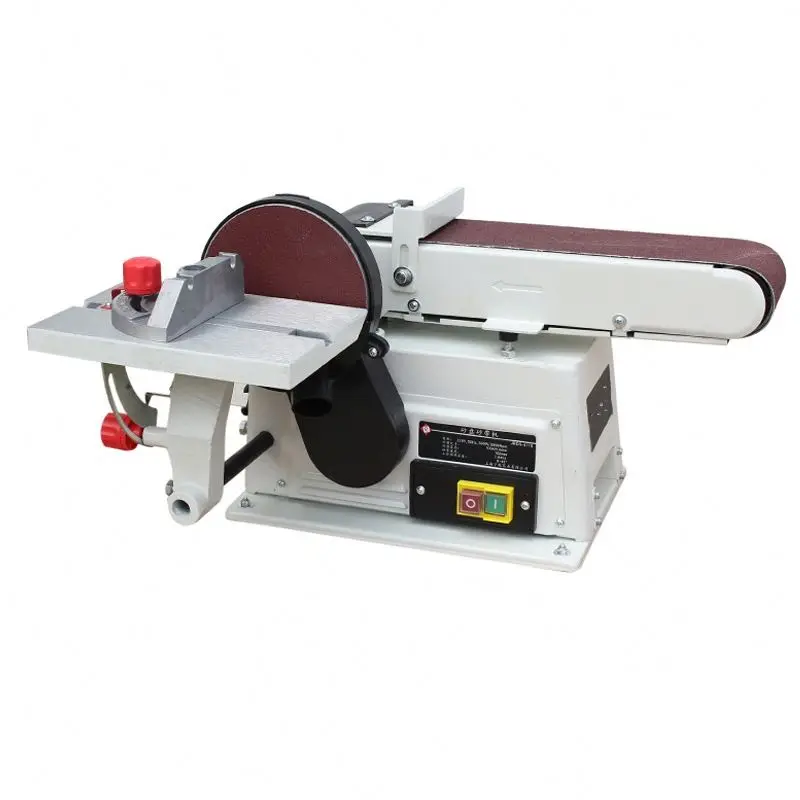
Source-controlled product identity
The Hoting queue identifies Product ID 1601276259295 as a TEBAK 500W vertical sand belt machine for woodworking. The source specification combines a vertical sanding belt with a 150mm sanding disc and a tilting workbench.
The recorded electrical field is 220V/50HZ, power is 500W, rotating speed is 2950 RPM and sand belt speed is 7.6m/s. The belt size is 100*914mm and the sand disc is 150mm in diameter.
The workbench is listed as 158*225mm with a tilt angle of 0-45 Degree. Package dimensions are 620*325*380mm and gross weight is 27kg. The source title uses “all copper motor”; this guide treats that as a supplier claim to verify against the nameplate and quotation, not as an independent motor construction certification.
This B2B buying guide is designed for woodworking shops, furniture component production, cabinet and joinery workshops, prototyping rooms, maker spaces and maintenance teams. It focuses on abrasive selection, belt tracking, disc and table setup, dust management, operator safety and measurable acceptance testing.
Recorded specifications
| Field | Source value | Procurement meaning |
|---|---|---|
| Product ID | 1601276259295 | Use this ID on the quotation, purchase order, packing list and acceptance report. |
| Brand | TEBAK | Verify the nameplate and delivered brand marking. |
| Voltage / frequency | 220V/50HZ | Confirm the exact electrical rating, plug, wiring and local installation requirements. |
| Power | 500W | Confirm whether this is rated input power, motor output or another supplier field. |
| Rotating speed | 2950 RPM | Confirm which shaft or abrasive assembly the value describes. |
| Sand belt speed | 7.6m/s | Verify measurement method, tolerance and behavior under load. |
| Sand belt size | 100*914mm | Buy compatible belts and confirm joint direction, grit range and tracking width. |
| Sand disc size | 150mm in diameter | Confirm abrasive disc attachment, backing method and usable sanding area. |
| Workbench size | 158*225mm | Check workpiece support, fence position and usable clearance. |
| Workbench tilt angle | 0-45 Degree | Verify the scale, locking method, repeatability and actual angle range. |
| Package dimensions | 620*325*380mm | Plan freight, storage and receiving space using the packed dimensions. |
| Gross weight | 27kg | Plan handling and verify the packed weight on the shipping documents. |
Choose the machine for the work, not the title
A vertical belt and disc sander can handle different edge, face and end-grain tasks, but the source record does not define production capacity, maximum workpiece dimensions or supported materials. Ask the supplier to confirm the intended duty cycle before comparing the machine with heavier industrial sanders.
Map every planned operation to one abrasive surface. Use the belt for long edges, faces or controlled bevel work only after confirming the available table and fence arrangement. Use the 150mm disc for smaller edge or end-grain operations only after checking the disc guard and work support.
Confirm whether the 158*225mm workbench is the main table, disc table, belt table or a shared measurement. Request a dimensional drawing showing the belt, disc, table, fence and guard locations.
Define the largest workpiece the buyer expects to process. The listed table size is not a maximum workpiece size, and the source does not state belt clearance, throat, working height or contact-wheel dimensions.
Confirm whether the machine is intended for intermittent workshop use or continuous production. No duty-cycle or thermal rating is provided.
Ask the supplier to identify the motor, belt drive, disc drive, bearings, switchgear and overload protection. The listing does not provide a service diagram or motor model.
Electrical and motor verification
The source lists 220V/50HZ and 500W. Confirm the nameplate, wiring diagram, rated current, phase, plug type, grounding method and permissible voltage tolerance before shipment.
Clarify the meaning of “500W.” It may represent input power, motor rating or a catalog field. The quotation should state the exact rated electrical value and test condition.
Verify which rotating assembly is associated with 2950 RPM. A belt or disc speed claim must be tied to a shaft, pulley ratio or measured abrasive speed.
Request no-load current, loaded current, startup behavior and overload response. These data help the buyer size the circuit and identify abnormal loading during acceptance.
Confirm that the motor and switchgear are suitable for the buyer's environment. Wood dust, humidity, extension cables and workshop temperature can affect safe operation.
Inspect the power cable, plug, strain relief, switch, earth connection and motor enclosure before energizing the machine.
Run a no-load test and listen for bearing noise, belt slap, vibration, rubbing, switch arcing or unusual heating. Record voltage and current if the buyer's procedure requires it.
Run a loaded sample test using an approved wood species and grit. Record whether the motor stalls, slows materially, trips protection or overheats.
Sand belt specification and tracking
The stated belt size is 100*914mm. Ask the supplier to confirm width, circumference, joint direction, backing type, recommended grit range and belt installation orientation.
Confirm whether 100*914mm refers to a nominal belt size or the actual delivered abrasive. Different suppliers may use similar dimensions with different joint tolerances.
Request a starter abrasive list for hardwood, softwood, plywood, painted surfaces and finish preparation only if those materials are actually within the supplier's instructions.
Inspect the belt tracking mechanism, tension adjustment, tracking knob, rollers and guards. The source does not provide tracking tolerance or adjustment range.
Run the belt at no load and observe whether it stays centered. Stop before making adjustments and follow the supplier's safe procedure.
Check the belt joint for lifting, exposed edges, cracking or uneven tracking. A defective joint can damage the workpiece or the operator.
Confirm the abrasive backing direction and storage conditions. Store belts flat, dry and protected from crushing.
Define acceptable belt drift under no load and under a representative load. Use a simple record rather than relying on a visual claim that the belt is stable.
Ask whether replacement belts, compatible grits and private-label abrasives can be sourced at the required MOQ and lead time.
150mm sanding disc verification
The source lists a 150mm diameter sand disc. Ask for the disc mounting drawing, backing pad specification, attachment method, maximum abrasive speed and guard coverage.
Confirm whether 150mm is the abrasive diameter, backing plate diameter or the maximum permitted disc. Do not substitute a different diameter without supplier approval.
Check disc runout, flatness and balance during no-load operation. Stop immediately if the disc oscillates, rubs the guard or produces unusual vibration.
Inspect the work support at the disc. The source gives the workbench size but does not state fence, miter guide, table gap or adjustment details.
Confirm the relationship between the disc and the 158*225mm workbench. A small table may require careful workpiece handling and additional shop fixtures.
Define the approved abrasive face and the prohibited contact zones. The machine manual should state how to avoid trapping a workpiece between the disc and table.
Request replacement disc availability, grit range, backing type and installation instructions. Consumable continuity is part of the machine's total cost.
Workbench and 0-45 Degree tilt
The workbench is listed as 158*225mm with a tilt angle of 0-45 Degree. Confirm the direction of tilt, pivot location, scale markings, lock and repeatability.
Test the table at 0, 15, 30 and 45 degrees using a calibrated angle tool. Record the actual angle and the difference from the scale.
Check whether the table can be locked without moving as the handle is tightened. A table that shifts during locking can create inconsistent bevels.
Inspect the table surface for flatness, burrs, coating damage and fastener interference. The workpiece must contact a stable surface.
Ask for the maximum supported load and workpiece envelope. Neither is provided in the source record.
Confirm fence compatibility, stop blocks and safe workpiece support for small or irregular parts. Do not assume accessories are included.
Check the table gap near the belt or disc. The manual should specify the safe maximum gap and adjustment procedure.
Mark approved reference angles for repeat jobs only after verifying them with a physical angle check.
Dust, abrasive debris and workshop layout
Wood sanding creates dust and abrasive debris. The source does not state whether dust extraction, a dust port, collection bags or filtration are included.
Ask for dust-port diameter, extraction airflow requirements and a diagram of the collection path. Do not infer these values from the 500W motor rating.
Plan the machine near suitable extraction and away from ignition sources. Follow local requirements for combustible dust and electrical equipment.
Inspect guards, covers and access panels before use. Do not operate with dust shields removed unless the supplier's maintenance procedure specifically requires it and the machine is isolated.
Clean the belt path, disc area, table and motor vents at defined intervals. Dust accumulation can affect tracking, cooling and switch operation.
Keep abrasive grit separated by work stage. Cross-contamination between coarse shaping and fine finishing can reduce surface consistency.
Use the buyer's PPE and risk assessment. Eye, respiratory, hearing and hand protection requirements depend on the material, abrasive and extraction system.
Record the cleaning method and prohibited actions. Compressed air can redistribute dust and may not be appropriate for every electrical enclosure.
Application testing by material
Do not describe the machine as suitable for every wood or board simply because it is listed for woodworking. Test actual materials and thicknesses planned by the buyer.
Start with a stable softwood sample, then test the actual hardwood, plywood, MDF or coated board. Record grit, feed method, contact area and result.
Inspect edge burning, tear-out, chatter, gouging, flatness, bevel consistency and surface scratches. Separate machine behavior from abrasive choice.
For small workpieces, define a safe holding method. Do not hold a small part close to a moving belt or disc without a suitable fixture.
For end-grain work, verify table support and feed direction. The correct direction depends on the machine geometry and abrasive movement.
For finish preparation, use a clean fine-grit belt or disc. Do not use a worn or contaminated abrasive to judge machine quality.
Record the material, moisture condition, dimensions, abrasive grit, operator and pass count. This makes supplier comparisons repeatable.
Ask the supplier for examples of materials tested during factory inspection, but keep the buyer's own sample test as the acceptance basis.
Quality and acceptance criteria
The listing provides dimensions and speed-related fields but no tolerance, surface-finish guarantee, vibration limit or production rate. Convert the buyer's application into measurable acceptance criteria.
Define no-load runout, belt tracking, disc vibration, table-angle accuracy, switch function, motor current and abnormal-temperature limits according to the buyer's safety and engineering procedures.
Use a controlled sample with a known material, thickness, abrasive grit and feed method. Record the finished surface and geometry.
Inspect the first, middle and last sample to detect heating, belt drift, abrasive loading or operator fatigue.
Check 0 and 45 Degree table positions, then test intermediate angles. Record actual measured values instead of accepting the scale alone.
Verify 220V/50HZ operation with the delivered plug, cable and protective earth. Confirm the nameplate and quotation match.
Measure the machine and packed carton separately. The source package dimensions and gross weight should not be confused with working dimensions or net weight.
Inspect all guards, switches, fasteners, belt tension parts, table locks and accessories against the packing list.
Classify defects as electrical, structural, abrasive, alignment, dimensional, packaging or documentation issues. Require corrective action before final acceptance.
Packaging, service and spare parts
Package dimensions are listed as 620*325*380mm and gross weight as 27kg. Confirm whether these values include the complete packed shipment, protective materials and accessories.
Request net weight, carton material, inner protection, moisture control, shock indicators and lifting instructions. These are not supplied in the source record.
Ask for a complete packing list: machine, belt, disc, tables, guards, tools, manual, cable, spare parts and any dust accessories.
Request the motor model, belt rollers, tension parts, table fasteners, switches, bearings, guards and other normal replacement items.
Confirm replacement belts of 100*914mm, 150mm discs and available grit grades. Ask for MOQ, lead time and storage instructions.
Define warranty scope for motor, switch, frame, table mechanism, belt tracking parts, disc mount and normal wear items.
Request setup instructions for belt installation, tracking, table angle, disc mounting, cleaning and lubrication.
Ask for technical support response time and the process for reporting a failed sample, damaged shipment or missing accessory.
Safety checklist for operators
Read the supplier manual before operating. The source record does not provide a complete risk assessment or safety manual.
Keep guards installed and keep hands, clothing, hair and loose materials away from the belt, disc, rollers and rotating shafts.
Use eye and respiratory protection appropriate to the dust and abrasive process. Confirm hearing and hand-protection requirements through the site's safety assessment.
Do not force the workpiece into the abrasive. Excessive pressure can cause kickback, belt damage, motor overload or loss of control.
Stop and isolate power before changing belts, discs, guards, tables, fixtures or dust connections.
Do not adjust the tracking mechanism while the belt is moving unless the supplier's manual explicitly permits a controlled adjustment and the operator is trained.
Keep the table, floor and switch area clean and free of dust buildup. Never bypass overload, grounding or protective devices.
Inspect the power cable, plug, switch, frame, table locks, guard and abrasive before every shift or production batch.
Use a push block, fixture or approved workholding method for small, narrow or irregular parts. Do not improvise hand positions near the abrasive.
Factory acceptance test
- Verify Product ID 1601276259295, TEBAK brand and the delivered vertical belt/disc configuration.
- Verify the nameplate: 220V/50HZ and the quoted 500W field.
- Clarify whether 500W is input power, motor output or another rated value.
- Run the motor at no load and check switch, grounding, vibration, noise and abnormal heating.
- Verify the meaning and measurement method for 2950 RPM and 7.6m/s.
- Measure the 100*914mm belt and inspect joint, grit, tracking and tension adjustment.
- Inspect the 150mm disc, mount, backing, guard, runout and usable sanding area.
- Measure the 158*225mm workbench and verify fence, table gap, lock and support.
- Test 0, 15, 30 and 45 Degree workbench positions with an angle tool.
- Run controlled samples on the buyer's actual wood or board materials.
- Record feed method, abrasive grit, surface result, edge quality, burning, chatter and tear-out.
- Check the belt and disc under representative load for drift, stall, overload or abnormal heat.
- Verify dust port, extraction requirements, guards, covers and cleaning instructions.
- Measure working dimensions, packed dimensions 620*325*380mm and gross weight 27kg against documents.
- Verify packing list, manuals, spare parts, warranty and replacement abrasive supply.
- Sign acceptance only after electrical, mechanical, abrasive, angle and sample criteria are met.
RFQ checklist
- Product ID 1601276259295, TEBAK brand, model and exact vertical belt/disc configuration.
- Nameplate, wiring diagram, 220V/50HZ rating, plug, phase, grounding and rated current.
- Meaning of 500W and the test condition for the quoted power.
- Meaning of 2950 RPM and 7.6m/s, including tolerance and measurement method.
- 100*914mm belt details: joint, backing, grit range, tracking width and replacement supply.
- 150mm disc details: abrasive diameter, backing plate, mount, speed limit and guard.
- 158*225mm workbench drawing, table gap, fence, support, scale and lock.
- 0-45 Degree tilt direction, pivot, repeatability, locking method and measured accuracy.
- Maximum workpiece envelope, supported material thickness, duty cycle and load limit.
- Dust port diameter, extraction airflow, collection system and cleaning procedure.
- Working dimensions, packed dimensions 620*325*380mm, net weight and gross weight 27kg.
- Motor model, bearings, rollers, switches, overload protection and normal wear parts.
- Factory sample test using the buyer's material, abrasive and measurable acceptance criteria.
- MOQ, sample, lead time, package protection, warranty and technical support.
- Replacement belts, 150mm discs, grit grades, pricing and replenishment lead time.
Buyer decision framework
This source confirms a TEBAK 500W vertical sand belt machine with 220V/50HZ electrical field, 2950 RPM rotating speed, 7.6m/s belt speed, 100*914mm belt, 150mm disc, 158*225mm workbench, 0-45 Degree tilt, 620*325*380mm package dimensions and 27kg gross weight.
It does not confirm production capacity, motor construction beyond the title claim, dust collection, maximum workpiece size, vibration, surface-finish tolerance, net weight, duty cycle or certification. Approve the purchase only after the quotation, nameplate, drawings, sample test and safety documentation agree.
Compare suppliers by actual sanding result, belt tracking, table repeatability, electrical safety, abrasive replenishment, service and total cost of ownership rather than by the “all copper motor” wording alone.
Frequently asked questions
What voltage and power are listed?
The source lists 220V/50HZ and 500W. Confirm the nameplate, rated current, plug, grounding and whether 500W means input power or motor output.
What belt does the machine use?
The recorded belt size is 100*914mm and the listed belt speed is 7.6m/s. Confirm joint direction, grit range, tracking and replacement availability.
How large is the sanding disc?
The source lists a 150mm diameter sand disc. Confirm whether this is the abrasive or backing diameter and verify the mount, guard and speed limit.
Can the workbench tilt?
The source lists 0-45 Degree. Verify tilt direction, scale accuracy, lock, repeatability and actual measured angles before production use.
What is the package size and weight?
The listed package dimensions are 620*325*380mm and gross weight is 27kg. Confirm net weight and whether all accessories are included in those shipping values.
Is dust extraction included?
The source does not specify dust extraction or a dust port. Request the extraction design, airflow requirement and included accessories before ordering.
Source and contact
This guide is based on the Hoting queue record for Product ID 1601276259295. It preserves the TEBAK identity and the supplied electrical, speed, abrasive, table, angle, package and weight fields. Request the final nameplate, drawings, safety manual, sample test and spare-part quotation through the TEBAK sales inquiry channel.
Key specifications
- Source Product ID
- 1601276259295
- Brand
- TEBAK
- Voltage / frequency
- 220V/50HZ
- Power
- 500W
- Rotating speed
- 2950 RPM
- Sand belt speed
- 7.6m/s
- Sand belt size
- 100*914mm
- Sand disc size
- 150mm in diameter
- Workbench size
- 158*225mm
- Workbench tilt angle
- 0-45 Degree
- Package dimensions
- 620*325*380mm
- Gross weight
- 27kg