
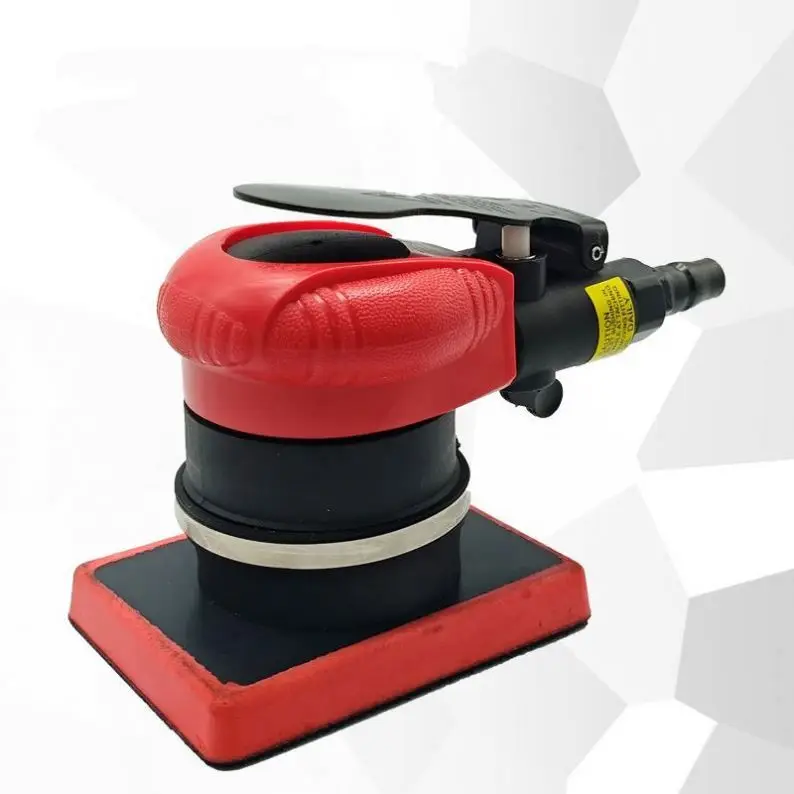
Eight rows, six of them measurements, and five names for one machine
This is the best specified record in the recent run of items, and it is worth saying so before describing what is wrong with it. Eight parameter rows, of which six carry a quantity with a unit: twelve cubic feet per minute of air, a classic size of one hundred and two by seventy millimetres, twelve thousand revolutions per minute, a three millimetre eccentric distance, a one hundred millimetre orbital diameter and a two kilogram weight. The other two rows are the brand and a product name. Compare that with the items before it, where the parameter blocks held three and four rows of which none was a measurement.
What the eight rows do not do is agree on what the machine is. Five names appear in one record.
| Where the name appears | Name as written |
|---|---|
| The record's title | TEBAK 75*100MM Pneumatic Square Sandpaper Machine Air Sander for Grinding Sanding Polishing |
| The product name parameter row | Air triangular sander |
| The caption of the first image | Pneumatic Small Square Dry Grinder |
| The table inside the fourth image | Pneumatic Square Grinder |
| The first content line of the description | TEBAK Pneumatic Leather Cleaning Machine Triangle Waxing Machine Polishing Car Interior Cleaning Machine |
Four of the five say square, one says triangular, and one of them is not a sander at all but a leather cleaning, waxing and car interior machine. The most consequential of the disagreements is the first pair, because the shape of the pad is not decoration: a square pad takes a rectangular sheet of abrasive and reaches into corners, a triangular pad takes a delta sheet and reaches into tighter corners while cutting less per pass, and the two do not accept each other's consumables. A buyer who orders from the title and a buyer who orders from the parameter row can reasonably expect two different tools.
The description field makes the disagreement worse rather than settling it. Its first content line names a pneumatic leather cleaning machine with a triangular waxing head for car interiors, and then, immediately below that name, the field reproduces all eight of this record's parameter rows label by label and value by value. So the field carries one machine's name and another machine's numbers, and a reader who trusts the first line will think they are buying a car interior polishing tool rather than a sanding tool.
That is not a one-off in this catalogue. Comparing each record's description against its own title, two hundred and sixty of the five hundred and twelve descriptions open with a first content line that is not the record's title, which is just over half. Fifty-four of the two hundred and sixty open with a bare section heading rather than a product at all, lines reading product parameter, related recommendations, related products or product introduction. Others open with the name of a genuinely different machine, as this one does. A few open with a sentence about price, such as the price on the page is for another model, not the number that follows, or the price on the web page is a volume in millilitres. The description field is therefore not a reliable statement of what the record sells, in half the catalogue, and this record is an instance rather than an outlier.
The first photograph shows both tools, and no row says which one ships
The disagreement is not a typist's error, because the photographs advertise both variants. The first image carries a red badge reading 75X100MM and a heading reading Pneumatic Small Square Dry Grinder, and beneath that heading it shows two complete machines side by side. The machine on the left has a triangular pad. The machine on the right has a rectangular pad. The bodies are the same red and black castings with the same lever, the same air inlet and the same yellow warning label; only the pad differs.
The fourth image repeats the pattern inside a single panel. Its third section, headed multifunctional use, photographs the triangular version. Its fourth section, headed product parameters, prints a table whose name row reads Pneumatic Square Grinder, whose material row reads plastic steel core, whose size row reads 75*100mm and whose scope row reads removes paint and rust, etc. So one panel shows a triangle and the table beside it says square.
The last two images make the split explicit by giving each variant its own caption. The seventh reads red durable model 75x100 small square machine without glue pillars and aluminum plates, double shaft for increased durability. The eighth reads triangle grinder, small triangle machine, without glue column and aluminum plate, dual shaft for greater durability. The two captions describe the same two construction claims in different words, a glue pillar against a glue column and a double shaft against a dual shaft, which is what happens when two variants are written up separately and then placed in one listing. The two captions also carry a negative claim that is unusual in this catalogue: that the machine has no glued pillars and no aluminium plates, which is a statement about how the body is assembled rather than about what it does.
Nowhere in the record is there a row for pad shape. The parameter block has eight rows and none of them is a shape, a pad type or a model code distinct enough to identify the variant. So the listing presents two tools, names five things, and provides no field in which a buyer can say which tool they are buying.
The consumable settles what the pictures will not. The second image states that the machine is used with 75x100 size sponge sandpaper or dry sandpaper, and a 75 by 100 sheet is a rectangle. A delta pad does not take a rectangular sheet. So the consumable named in the second image belongs to the square variant, and the phrase sponge sandpaper appears in no record's text in this catalogue, nor does dry sandpaper, so neither phrase can be found by searching. A buyer looking for the triangular tool's consumable will find nothing on the page.
Three size statements that do not agree
The record gives the size of the same part three times, and the three do not agree.
| Where | Figure | Area |
|---|---|---|
| The title | 75*100MM | 7,500 square millimetres |
| The classic size parameter row and the fourth image's table | 102mm*70mm | 7,140 square millimetres |
| The orbital diameter parameter row | 100mm | a diameter, so a different kind of statement |
The first two differ by three hundred and sixty square millimetres, which is five per cent of the smaller figure. Five per cent is close enough to look like rounding and far enough apart to matter: a hundred and two by seventy and seventy-five by one hundred are different backing plates and take different sheets, and the difference is not something a buyer can attribute to measurement tolerance without being told to. The third row, the hundred millimetre orbital diameter, is the one that reads as a mistranslation. An orbital sander's orbit is produced by the eccentric, which the record separately gives as three millimetres, so the orbit is a six millimetre circle and not a hundred millimetre one. A hundred millimetres is the size of the abrasive disc for a hundred millimetre tool, so the row appears to describe the consumable while the label describes the orbit. The catalogue uses the label orbital diameter in exactly one record, which is this one, as it does the labels classic size and eccentric distance, so there is no second example to check the intention against.
Three statements about the size of a part whose shape is also disputed is enough to make the pad, rather than the motor or the air supply, the thing a buyer must settle before ordering. No dimension of the pad is given in the record's own data, so all three figures come from the title or from a picture.
The figure that decides whether the tool runs at all is missing
Twelve cubic feet a minute is three hundred and thirty-nine point eight litres a minute, or five point six six litres a second, measured as free air at atmospheric pressure. That is a substantial appetite. Expanding that much air from seven bar absolute down to atmosphere releases about one point one kilowatts of pneumatic power, and a vane motor converts only a fraction of that into shaft power, so the tool's output is a few hundred watts. That is the right order of magnitude for a two kilogram hand sander, comparable to a small electric one, so the consumption figure is credible and the arithmetic supports it rather than contradicting it.
What the record omits is the pressure at which that twelve cubic feet was measured. This matters more for an air tool than for almost any other class of machine, because a compressor's free air delivery is quoted at a stated pressure, and the same compressor will deliver noticeably less air at a higher pressure. Without the tool's working pressure, a buyer cannot compare the twelve cubic feet a minute against a compressor's rating on equal terms, and cannot tell whether the figure was taken at five bar, at six point three bar where most such tools are rated, or at seven bar. The result is a compressor bought too small, a tool that stalls under load, and a finish that suffers because the pad slows down when it is pressed against the work.
Two practical points follow from the number. The first is that twelve cubic feet a minute is a workshop compressor's job rather than a hobby one: a small single phase machine sold for tyres and blow guns will not sustain it, and its label will usually print two figures, a displacement and a free air delivery, of which only the second is comparable to the tool's consumption. The second is that the tool's own inlet thread, its recommended hose bore and its air inlet size are all absent, so the plumbing that carries the air has to be guessed as well.
The catalogue shows how rarely the full picture is offered. Twenty-six records mention a pneumatic or air tool. Ten state an air consumption in cubic feet a minute or litres a minute. Eight state a pressure in bar, megapascals or pounds per square inch. Exactly one record in five hundred and twelve states both, and it is not this one. So in this catalogue an air tool's appetite and the pressure it is hungry at are, with a single exception, never printed on the same page, and this record is one of the twenty-five where the buyer has half the information.
Sixty-two metres a second, and a daily oiling
If the twelve thousand revolutions a minute is the rotation of the pad and the hundred millimetres is the pad diameter, then the abrasive at the pad's rim is travelling at sixty-two point eight metres a second. That is grinding-wheel territory rather than hand-tool territory, and it means the abrasive grade, the backing and the pressure are all being asked to work hard: a cheap sheet will load up and shed grit, and a pad pressed too hard will slow the rotation and burnish the work instead of cutting it. The record's labels do not say whether the twelve thousand is the rotation or the orbit, which changes the figure, so the number is quoted here with its assumption attached rather than as a settled fact.
The photographs carry two pieces of maintenance information that the record's text does not. The pad faces shown in the third and fifth images are perforated with extraction holes, and no parameter row mentions dust extraction, a vacuum port or a dust bag. Searching this catalogue for dust or extraction returns seven records and this is not one of them. For a dry sander working on paint and filler, where the dust is the hazard as much as the nuisance, whether the perforations lead to a collection point or merely to the housing's exhaust is a question the page does not answer.
The yellow warning label visible in the sixth, seventh and eighth images reads caution, disconnect air supply before servicing or dismantling, and oil daily. Neither instruction appears in the record's text. Searching for oil daily or the word lubricate returns nine records in this catalogue, none of them this one, and searching for disconnect air returns nothing at all. A tool that expects to be oiled every working day is a tool with a maintenance routine, and a buyer running several of them needs the oil specification, the quantity per application and whether the shop air needs a lubricator fitted in line, none of which is present.
The parameter block's own labels repay a reading. The air consumption row is spelled with the letter n missing, air comsumption, and that misspelling appears in exactly one record in this catalogue while the correct spelling appears in exactly one other, so there is one right and one wrong and no way to tell which page a buyer will land on. The weight row reads asterisk weight, with a stray asterisk in front of the label and no footnote anywhere to attach it to. Thirteen parameter rows in this catalogue begin with an asterisk, spread across three records, and the family's schema also contains a voltage row spelled volatge, so the asterisk convention travels with a template that carries its own typographical errors.
Every photograph carries another storefront's watermark
All nine of this listing's images are unique within the catalogue: searching all five hundred and twelve records, the main image and each of the eight gallery images is used by this record alone and by no other. That is the third time in the recent run of items that a gallery has been wholly its own, and taken on its own it would look like a sign of original artwork. It is not, and the reason is visible in the pictures.
A watermark is legible across the gallery's product photographs, reading hebingtechnology.en.alibaba.com. It is the address of an Alibaba storefront belonging to a different business from the seller named in this record's description, which is Hengshui Mengshang Trading, and different again from the brand in the title, which is TEBAK. The watermark sits over the machines, over the parameter panels and over the two variant photographs with their separate captions, so the artwork that carries the listing's only pictures of the two pad shapes belongs to somebody else's shop front.
The catalogue cannot find it, because it is a picture and not text. Searching all five hundred and twelve records for the word hebing returns nothing, so the watermark is invisible to every search, including the seller's own if they were to look. The gallery's nine files weigh one million eight hundred and thirty-nine thousand four hundred and ninety-two bytes, and all nine are served over secure transport, so the listing gets that detail right; what it does not get right is whose photographs they are.
For a buyer this changes what the pictures are evidence of. They are evidence that some supplier's machine looks like this and that two pad variants exist, and they are not evidence about the unit that will arrive. The seven images are also the only place where the pad shape, the extraction holes and the maintenance label can be seen at all, which makes the borrowed artwork load-bearing for exactly the questions the record leaves open.
What the description field contains
The description is eight hundred characters, one of the four hundred and ten records in this catalogue that stop at exactly that length. It opens with the heading product description, then the name of the car interior machine described above, then the eight parameter rows restated label by label and value by value, then the supplier's company paragraph, then it stops mid-list at the words North America, Eu.
So the field is a faithful copy of the parameter block, which means it adds nothing that the parameter block did not already say, and it is prefaced by the name of a different machine, which means it also subtracts. The company paragraph takes four hundred and seventy-three of the eight hundred characters, which is fifty-nine per cent. It describes a business selling CNC carbide inserts, turning tools and milling tools, and it contains the four phrases that travel together through most of this catalogue: the misspelling of OEM and ODM as OED and ODM, the phrase this filed for this field, the claim that products are seventy per cent for experts, and the list of customer regions.
The field carries no packing heading of either of the two kinds this catalogue uses. Two hundred and ninety-five records, which is fifty-eight per cent of the catalogue, are in the same position, so a description that never mentions packing is the majority case rather than a gap in this one listing. Between that and the company paragraph, the description field of this record contains no information about the product beyond what the eight parameter rows already gave, and one name that belongs to something else.
What the listing does not state
The shape of the pad, in any field, despite the record's title, its product name row and its own photographs disagreeing about it and despite two variants being photographed. Which of the two variants is priced and shipped. The working air pressure at which the twelve cubic feet a minute was measured. The air inlet thread, the hose bore and the recommended hose size. Whether the perforations in the pad lead to dust collection or to the housing. The abrasive grade, the sheet size in the consumable the pictures name, and the attachment method, whether hook and loop or adhesive. The spindle or pad fixing, and whether pads can be changed between the square and the triangle. The orbit rate as distinct from the rotation. The sound level and the vibration level, which are the two figures a buyer running several tools in one room needs. The net weight of the body as distinct from the two kilogram figure, which carries a stray asterisk and no footnote. The pad's own dimensions in the record's data. Any certification. Any warranty and who honours it. Any oil specification, despite a label requiring daily oiling. And the price.
Incoming inspection on arrival
- Identify the pad before anything else: measure it, decide whether it is the seventy-five by one hundred or the hundred and two by seventy variant, and confirm that the shape is the one the order was placed for.
- Buy one sheet of the consumable named in the second image and check that it fits the pad's face and its extraction holes without trimming.
- Measure the pad's face against the figure in the record's data, of which there is none, so measure and record it for the next order.
- Find the tool's working pressure: read the rating plate and the yellow label, and compare whatever the seller states in writing against the pressure at which the compressor can actually deliver twelve cubic feet a minute.
- Check the compressor's free air delivery figure rather than its displacement figure, and confirm that the tool does not slow down when the pad is pressed against the work, which is the symptom of a supply that is too small.
- Press the pad against a painted panel for a full minute and watch the rotation speed, the heat in the pad and the finish, because the rim speed derived from the record's own figures is high and the tool's reputation will be made or lost on the abrasive and the pressure.
- Establish whether the extraction holes lead anywhere, and if not, plan dust control around the tool rather than through it.
- Oil it on the day it arrives, since a label on the machine requires daily oiling and the record's text does not mention lubrication at all.
- Photograph the machine and the pad and keep the pictures, because the gallery that arrived with the order belongs to another shop front and cannot be used to resolve a dispute about what was ordered.
Questions buyers ask about this class of listing
Is it a square sander or a triangular one?
Both are photographed and the record's own fields disagree: the title says square, the product name row says triangular, the first image's caption says square while showing both, and the last two images carry one caption for each. No parameter row states the pad shape. Ask the seller to name the pad in writing, and ask for a photograph of the pad attached to the unit being quoted, because the consumable differs between the two and the record's own second image names a rectangular sheet.
Why are there two sizes, 75 by 100 and 102 by 70?
Nobody says. The title and the fourth image's table give seventy-five by one hundred; the classic size row gives one hundred and two by seventy. The two areas are seven thousand five hundred and seven thousand one hundred and forty square millimetres, a five per cent difference, which is too small to notice in a picture and too large to be rounding. Measure the pad on arrival rather than ordering consumables in advance.
What is the hundred millimetre orbital diameter?
It cannot be the orbit, because the record separately gives a three millimetre eccentric distance, which makes the orbit a six millimetre circle. A hundred millimetres is the size of a consumable disc for a hundred millimetre tool, so the row appears to describe the abrasive while the label describes the path. Ask which, because if a hundred millimetre disc is the consumable then the pad and the sheet must match it.
Can my compressor run it?
Only if it can deliver twelve cubic feet a minute of free air, which is three hundred and forty litres a minute, and the record does not say at what pressure. Compare the tool's figure against the compressor's free air delivery, not its displacement, and remember that a compressor delivers less air at a higher pressure. A small single phase compressor sold for inflating tyres will not sustain this tool.
Is the two kilogram weight the whole tool?
The row reads asterisk weight two KG, with an asterisk and no footnote, and there is no separate figure for the body, the pad or the carton. Two kilograms is the right order for a tool of this size with a plastic body over a metal core, so the figure is plausible; what is missing is whether it is the bare tool or the tool in its box.
Why does the picture say hebingtechnology?
Because the watermark on the photographs belongs to a different storefront's address. It is not text in the record, so no search finds it, and it is legible across the machine photographs. Treat the pictures as an illustration of the model rather than as evidence about the unit, and ask for photographs of the actual machine and pad before paying.
Scope, sources and method
Every figure attributed to the machine comes from the product record for ID 1601646106845 in the catalogue file and from the nine images listed in that record, one main image and eight gallery images. The eight parameter rows are quoted as printed, including the misspelling in the air consumption row and the stray asterisk in the weight row, and neither is corrected here. The names in the five-name table are quoted verbatim from the title, the parameter row, two image captions and the description's first content line.
The arithmetic uses this record's own figures. Twelve cubic feet a minute is converted at twenty-eight point three one six eight litres per cubic foot to give three hundred and thirty-nine point eight litres a minute. The pneumatic power of about one point one kilowatts is the isothermal expansion of that free air from seven bar absolute to atmosphere, and it is stated as an upper bound on what the air carries rather than as the motor's output, which is a fraction of it. The rim speed of sixty-two point eight metres a second assumes that the twelve thousand revolutions a minute is the pad's rotation and that the hundred millimetre figure is the pad's diameter, and it is stated with that assumption because the record does not distinguish rotation from orbit. The pad areas are calculated from the two size statements as rectangles.
The reading of two pad variants in the photographs is a reading of pictures and is stated as such; the two captions in the last two images, one reading square machine and one reading triangle grinder, are the record's own words and are quoted verbatim. The watermark is reported as read from the images and no claim is made about whether its use was authorised. All counts are searches of the five hundred and twelve records taken as text, case-insensitively, with the search term stated beside each figure. The description-versus-title comparison normalises both strings to letters and digits, takes the description's first content line after stripping a product description heading, and counts a match when the first twenty-four normalised characters of that line appear in the record's normalised title; that test is deliberately narrow and undercounts rather than overcounts matches.
No machine was unboxed, weighed, assembled, run, pressurised, oiled or used on any work. No air compressor was selected or sized for the buyer, and nothing here is a substitute for the tool's own working pressure, which the record does not give. No food-contact, electrical or import statement is made, and no freight or duty figure is offered, because none of those figures appears in the record.
Appendix: the two hundred and sixty descriptions that do not name their own product
The comparison described above found that two hundred and thirty-nine of the five hundred and twelve descriptions open with a first content line that matches the record's own title, and two hundred and sixty do not. The mismatches fall into recognisable classes.
The largest class is a rewording: the same machine named with the words in a different order, or with a model number brought forward, so that a reader recognises the product even though the strings differ. The second class opens with a section heading instead of a product, and there are fifty-four of these, lines reading products description, product parameter, machine parameter, product introduction, related recommendations or related products. A description whose first content line is the word specification or the phrase related products has had a template's navigation copied into the body of the text.
The third class, of which this record is a member, opens with the name of a genuinely different machine. The examples include a description opening with a battery powered hand held marking machine under a title selling a metal engraving machine, a description opening with a lawn mower under a title about a mower's parts, a description opening with a chisel mortiser under a title for a single spindle slot mortiser, and a description opening with a hydraulic pipe crimping machine under a title about a hose crimping tool. A fourth small class opens with a sentence about price, including one that reads the price on the page is for another model, not the number that follows, and another that reads the price on the web page is a volume in millilitres.
The practical consequence is that the description field cannot be used as a check on what a record sells, in just over half the catalogue. For a buyer assembling a shortlist from several listings, the title is the only field that reliably names the product, and where the title and the description disagree, the disagreement is not evidence that the buyer has made a mistake; it is a property of the catalogue. Where the title is also disputed internally, as it is here, the only remaining evidence about what will arrive is the pictures, and in this record the pictures belong to somebody else.
Key specifications
- Brand
- TEBAK
- Air comsumption
- 12CFM
- Classic Size
- 102mm*70mm
- Speed
- 12000rpm
- Eccentric Distance
- 3mm
- Product name
- Air triangular sander
- orbital diameter
- 100mm
- *Weight
- 2KG