
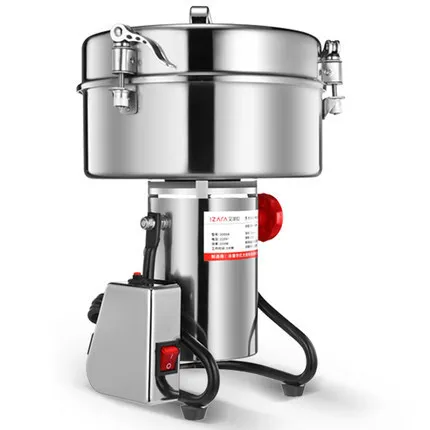
Why an 800G flour mill needs a controlled procurement specification
The TEBAK New 800G Small Home Use Flour Mill is listed as a mini rice, corn, walnut, coffee, cocoa, soybean and peanut powder grinding machine. The queue record identifies it as Grain Processing Equipment with an 800g capacity, 2200W power and 9KG weight. It lists Motor and Gear as core components, a one-year warranty, a machinery test report as provided and online after-sales support.
Those fields establish a useful starting point, but they do not establish grinding fineness, throughput, permitted duty cycle, motor speed, voltage, frequency, chamber dimensions, screen configuration or food-contact compliance. A buyer should confirm those items using the exact machine configuration and the intended ingredient. An 800g field is a nominal capacity statement; it should not automatically be treated as usable batch weight or hourly output.
This guide is written for importers, distributors, restaurant suppliers, small food workshops, farms, retail channels and home-use appliance buyers. It separates source-confirmed values from RFQ questions so the buyer can evaluate whether a compact 2200W grinder fits the required grain, nut, cocoa, coffee or seasoning workflow.
1. Controlled identity from the source record
The source product ID is 1601277172126. The title describes a new 800G small home-use flour mill and names rice, corn, walnut, coffee, cocoa, soybean and peanut powder grinding. The product type is Grain Processing Equipment, and the application is described as Food Industry Equipment. The record also lists a broad set of applicable industries, including home use, restaurants, farms, food and beverage factories, retail and food shops.
The parameter list contains an “item” field with the value “value.” This is a placeholder-like source field, so it is retained as an unresolved source record rather than interpreted as a specification. The machinery-function field says “304 Stainless clap, 403 Stainless clap, 304 Stainless button.” Because “clap” and “button” are the exact source words, the buyer should ask the supplier to identify the intended parts, material grades and configuration before using those terms in a purchase order.
2. Source-confirmed specification table
The table below repeats the available queue fields. It does not add estimated output, speed, fineness or electrical details that are absent from the source.
| Field | Source value or procurement control |
|---|---|
| Product ID | 1601277172126 |
| Product type | Grain Processing Equipment |
| Product positioning | 800G small home-use flour mill and mini rice, corn, walnut, coffee, cocoa, soybean and peanut powder grinding machine |
| Capacity | 800g / 800G; confirm usable batch capacity and measurement method |
| Power | 2200W |
| Weight | 9KG |
| Core components | Motor, Gear |
| Machinery function field | 304 Stainless clap, 403 Stainless clap, 304 Stainless button; clarify source wording and parts |
| Test report | Machinery test report: Provided; request the report for the exact model and configuration |
| Warranty | 1 Year; core components warranty also listed as 1 Year |
| After-sales | Online Suport |
| Showroom | None |
| Marketing type | High quality; marketing wording, not a measured performance claim |
| Unprovided performance fields | RFQ required: fineness, speed, throughput, duty cycle, noise, voltage, frequency and ingredient limits |
3. Define what 800G means
The source lists both “Machinery Capacity 800g” and “Capacity 800G.” Ask the supplier whether the value is the maximum loading weight, usable grinding batch, chamber volume converted to an equivalent weight, or a marketing model designation. Confirm the allowed fill line and the amount of free space needed for the ingredient to circulate.
Test capacity with each target ingredient. Rice, corn, walnut, coffee, cocoa, soybean and peanut have different bulk densities, oil content and grinding behavior. A chamber that accepts 800g of one ingredient may not accept 800g of another without overheating, bridging or reduced fineness. Record ingredient mass, moisture condition, preparation, grinding time and final result.
Do not convert 800g into kilograms per hour. Request a throughput test with a defined ingredient and target particle size. Ask whether the stated capacity includes a single uninterrupted batch or a series of smaller loads with cooling intervals.
4. Ingredient compatibility and preparation
The title names rice, corn, walnut, coffee, cocoa, soybean and peanut powder grinding. Treat these as listed application examples, not as proof that every ingredient can be processed under one setting. Request a written compatibility matrix covering moisture, hardness, oil content, particle size, shells, skins, stones and foreign material.
Ask whether ingredients must be cleaned, dried, dehulled, cut or pre-crushed. Confirm the maximum input size and whether whole walnuts, coffee beans, cocoa pieces or corn kernels are allowed. The supplier should state whether frozen, hot, wet, sticky or high-oil ingredients are prohibited.
For allergen-sensitive facilities, define cleaning and changeover requirements between peanut, soybean, cocoa, coffee and other products. Request instructions for disassembly, residue removal and inspection of hidden areas. An online support statement does not replace a validated cleaning procedure.
5. 2200W power and electrical confirmation
The source lists Power as 2200W but does not provide voltage, frequency, phase, current, plug type, cable specification, grounding method or protection requirements. Request a nameplate photograph and electrical schematic for the exact 800G machine. Confirm that the destination-market electrical version matches the quotation.
Power rating alone does not establish grinding speed or output. Ask for startup current, overload protection, thermal protection, recommended rest time and motor duty. Confirm whether the motor and gear assembly are designed for repeated home-use batches or a defined commercial schedule.
The installation plan should identify the socket, breaker, earth connection, cable route, ventilation clearance and emergency isolation method. If the machine is intended for a restaurant, farm or food shop, test the electrical setup under the buyer's actual load rather than relying only on an empty-running demonstration.
6. Motor, gear and transmission review
Motor and Gear are listed as core components. Request the motor model, gear material, transmission ratio, lubrication method, service access and replacement part numbers. The source does not provide motor speed, gear ratio, shaft speed or bearing information.
Inspect the machine for abnormal vibration, gear noise, heat, oil leakage and looseness during empty and loaded tests. Record the ingredient, load, operating time and rest interval. Ask whether the gear assembly is sealed, whether it requires scheduled lubrication and whether operators may open the drive housing.
For maintenance planning, obtain an exploded diagram and a list of consumable or wear parts. Clarify whether the warranty covers the motor and gear together or only the core components described in the listing. The one-year warranty is a source field, but its exclusions, response time and parts terms still need to be written into the quotation.
7. Grinding chamber and material wording
The machinery-function field reads “304 Stainless clap, 403 Stainless clap, 304 Stainless button.” The wording is not sufficiently clear to identify a chamber, blade, button, cover or other component. Ask the supplier to mark each term on an exploded drawing and provide the exact material grade for every food-contact and wear surface.
Do not rewrite the source wording as a confirmed 304 stainless steel chamber or 403 stainless steel blade without documentation. Request thickness, hardness, surface finish, corrosion resistance, cleaning method and replacement procedure. Confirm whether the material is the same across standard and customized versions.
Inspect the chamber, lid, seals, fasteners and outlet for sharp edges, residue traps and access limitations. Ask whether the grinding mechanism uses a screen, blade, plate, hammer, cutter or another arrangement. The source does not supply this mechanism detail, so the purchase order should refer to the approved drawing and sample.
8. Fineness and powder quality
No particle-size range, screen mesh, fineness setting or powder uniformity result is provided. Ask the supplier to identify the available adjustment method and the measured output range for rice, corn, coffee, cocoa, soybean, peanut and walnut. Define the test sieve, sampling method and percentage retained.
Run a sample test using the buyer's actual raw material. Record initial particle condition, moisture, load, power version, operating time, screen or setting, temperature and final particle distribution. Repeat the test after cleaning and after a defined number of batches to check whether residue or heat changes the result.
Do not describe the machine as producing a specific flour grade or powder fineness until the supplier provides measured data for the selected configuration. “High quality” is listed as the marketing type, not a substitute for a particle-size test.
9. Heat, noise and duty cycle
The record does not provide noise, temperature rise, cooling method or continuous-duty data. Ask for empty and loaded noise measurements, motor housing temperature, chamber temperature and recommended rest intervals. Oil-rich ingredients such as walnuts, cocoa and peanuts may behave differently from dry rice or corn.
Define the intended workflow: batch size, batches per hour, operator changeover, cleaning interval and daily operating time. Compare it with the supplier's written duty-cycle limit. A 2200W rating does not prove that the machine can run continuously in a shop or factory.
Check whether the 9KG body remains stable during loaded grinding. Measure vibration at the work surface and inspect feet, fasteners and cover locking. If the supplier recommends a fixed bench or additional restraint, include that requirement in the installation plan.
10. Test report and acceptance protocol
The source says “Machinery Test Report: Provided.” Request the actual report before approval and verify that it identifies the same product ID, capacity, power, motor, gear configuration and intended ingredient. Check the test date, method, load, duration, output, fineness and acceptance criteria. A generic factory report should not be treated as a product-specific result.
Pre-shipment acceptance should include nameplate verification, empty running, loaded running, capacity check, fineness check, cover and guard inspection, leakage check, noise observation, temperature observation and cleaning review. Record the sample ingredient and the final powder condition.
For a distributor, keep the report, video, drawing, manual and packing list together. For a food workshop, use the buyer's own raw material in the final acceptance test. Do not sign off on a claimed 800g capacity when the supplier has not defined the fill level or batch method.
11. Warranty and online after-sales service
The queue lists a one-year warranty and a one-year warranty for core components. It also lists “Online Suport.” Ask whether the warranty starts at shipment, delivery or commissioning, and identify the covered motor, gear, housing, grinding components and electrical parts.
Request response time, diagnostic procedure, replacement-part process, remote-video support and language coverage. Confirm whether online support can provide wiring guidance, cleaning instructions, gear maintenance and fault diagnosis without requiring the operator to open hazardous parts.
Clarify exclusions for wet ingredients, overload, unauthorized disassembly, voltage mismatch, wear components and improper cleaning. Record the serial number, model, nameplate and installation evidence at receipt so a warranty claim can be matched to the shipped configuration.
12. Applicable industries and realistic positioning
The source lists hotels, garment shops, building material shops, machinery repair shops, manufacturing plants, food and beverage factories, farms, restaurants, home use, retail, food shops, printing shops, construction works, energy and mining, food and beverage shops, other businesses and advertising companies as applicable industries. It also lists vegetable processing, canneries, wineries, meat processing, commercial catering, snack food, dairy, beverage, flour milling, seasoning, bakery, fruit processing, cooking oil and frozen food factories.
This broad list is a sourcing field rather than proof that every application is suitable. Match the machine to the actual ingredient, hygiene regime, operating time, electrical system and required powder quality. In particular, a home-use positioning should not be treated as a commercial-duty guarantee without a written duty-cycle test.
For retail or home-use channels, confirm noise, cleaning effort, accessories and instructions. For food factories and commercial catering, confirm throughput, sanitation, spare parts, electrical protection and acceptance testing. For farms, confirm raw-material preparation and dust control.
13. Packaging, spare parts and handling
Packaging details are not provided. Request packed dimensions, gross weight, carton or crate construction, moisture protection, internal restraints and lifting instructions. The listed machine weight is 9KG, but packed weight and shipping dimensions still need confirmation.
Protect the grinding chamber, cover, controls, motor, gear housing and stainless-related parts from impact and moisture. Ask whether the machine is shipped assembled and whether any tools, screens, seals or spare parts are included. The packing list should identify the 800G model and 2200W version.
Request spare part numbers for motor, gear, seals, grinding components, cover, switches, bearings and fasteners. Confirm expected availability and replacement instructions. Do not assume that “304 Stainless” wording means every wetted or wear part is interchangeable.
14. RFQ checklist
- Confirm product ID 1601277172126, exact model and 800G configuration.
- Define the 800g capacity as maximum load, usable batch or another measurement.
- Confirm 2200W electrical details: voltage, frequency, phase, current, plug and grounding.
- Provide motor model, gear model, transmission ratio, duty cycle and overload protection.
- Explain the source “304 Stainless clap, 403 Stainless clap, 304 Stainless button” field on a marked drawing.
- Provide chamber, screen, blade, plate or other grinding-mechanism details and material grades.
- Provide fineness range, test sieve, throughput, noise, temperature and ingredient compatibility data.
- Provide the actual machinery test report for the exact model and configuration.
- Confirm one-year warranty scope, core-component coverage, exclusions and online support response.
- Confirm packed dimensions, 9KG net weight, accessories, spare parts and inspection requirements.
15. Questions for the supplier
Ask the supplier to answer these questions in the quotation: What does 800G measure? Can the 2200W machine process rice, corn, walnut, coffee, cocoa, soybean and peanut under one configuration? What preparation is required? What is the motor speed and gear ratio? What is the grinding mechanism? What do “304 Stainless clap,” “403 Stainless clap” and “304 Stainless button” identify? What fineness and throughput were measured in the provided test report? What are the noise, temperature and rest limits? Which parts contact the ingredient? What does the one-year warranty cover?
If these questions cannot be answered with a drawing, test report or written specification, keep the purchase at RFQ or sample-review stage. Capacity, power and broad industry labels alone do not prove output, powder quality or commercial duty.
16. Final procurement decision
This TEBAK 800G machine is a candidate for buyers seeking a compact grain and food-ingredient grinder. The source-confirmed anchors are product ID 1601277172126, Grain Processing Equipment type, 800g/800G capacity, 2200W power, 9KG weight, Motor and Gear core components, one-year warranty, provided machinery test report and online support.
Approve the order only after the supplier defines the 800G capacity, electrical package, grinding mechanism, material wording, fineness result, duty cycle, hygiene method, warranty and spare parts. Keep the approved drawing, test report, nameplate image, sample record and packing list together for traceability. This prevents a different capacity, power version or grinding configuration from being shipped under a broad flour-mill title.
Editor's note: Product facts in this guide are limited to the supplied Hoting queue record. Company-level statements are not treated as product-specific certification, performance evidence or customer proof.
Key specifications
- Product type
- Grain Processing Equipment; small home-use flour mill
- Source product ID
- 1601277172126
- Source item field
- item / value (placeholder retained from source record)
- Machinery capacity
- 800g
- Capacity
- 800G
- Power
- 2200W
- Weight
- 9KG
- Core components
- Motor, Gear
- Machinery function field
- 304 Stainless clap, 403 Stainless clap, 304 Stainless button; source wording retained for confirmation
- Machinery test report
- Provided
- Warranty
- 1 Year; core components warranty also listed as 1 Year
- After-sales service
- Online Suport
- Showroom location
- None
- Marketing type
- High quality
- Applicable industries
- Source lists hotels, food and beverage operations, farms, restaurants, home use, retail and other industries
Frequently asked questions
- What capacity and power are listed?
- The source lists 800g and 800G capacity fields plus 2200W power. Confirm usable batch weight, fill line and electrical details.
- What are the listed core components?
- The source lists Motor and Gear. It does not provide motor model, gear ratio, speed or duty cycle, so request those details.
- What does the stainless function field mean?
- The source says “304 Stainless clap, 403 Stainless clap, 304 Stainless button.” Preserve this wording and ask the supplier to identify the parts and material grades on a drawing.
- Is the machine suitable for commercial production?
- The source lists home use and many industries, but does not provide commercial throughput or continuous-duty data. Confirm the duty cycle with a model-specific test.
- What warranty and support are listed?
- The source lists one year for the product and core components, plus online support. Confirm coverage, exclusions, response time and spare-part terms.