
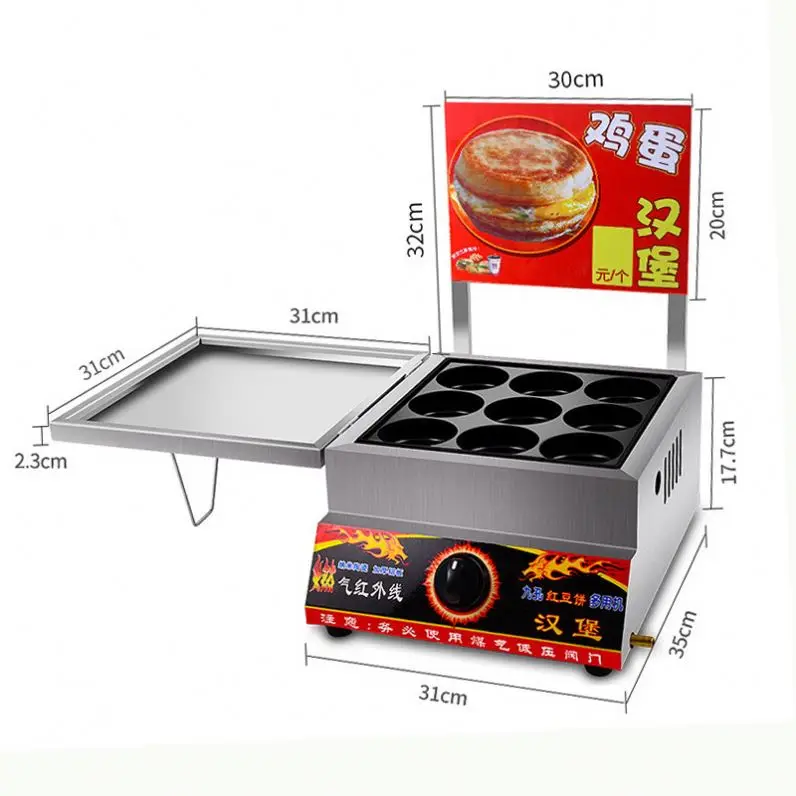
What this TEBAK 9-hole gas machine is specified to do
The TEBAK commercial food machine in queue item 116 is described as a 9-hole egg hamburger gas type machine, egg hamburger pot stall machine, red bean cake machine and meat-and-egg hamburger machine. The source record supplies three procurement fields: dimensions of 355*270*185 (mm), net weight of 8kg and carton packing.
This guide treats the equipment as a gas-heated multi-cavity food cooking machine. It does not invent gas pressure, fuel type, burner rating, cavity diameter, heating time, temperature control, output per hour or material grade. Those fields must be confirmed against the exact configuration before a buyer places an order.
The application wording contains several product names. A quotation should state which mold and recipe are included: egg hamburger, red bean cake, or meat-and-egg hamburger. Do not assume that every named food is supplied with one universal plate. Ask for photographs, a cavity drawing and the accessory list for the ordered unit.
The dimensions and net weight are useful for bench planning. They are not a shipping-carton size, working clearance, gas-consumption figure or safe operating-load specification. The source says packing is carton, but no carton dimensions or gross weight are supplied.
1. Source identity and procurement boundary
The source product ID is 1601276373589. The title identifies TEBAK, commercial food use, nine holes, gas type and several application names. Preserve this wording in the inquiry, but separate confirmed values from marketing descriptors.
Confirm whether “9-hole” means nine simultaneously heated cavities, nine openings in one mold, or a nine-cavity plate supplied as an accessory. The queue does not provide a cavity diameter, depth, spacing, shape or mold material. A dimensioned drawing is required for menu and portion planning.
Confirm whether the machine is a complete gas appliance or a body and mold assembly that requires a separate burner, regulator, hose or valve. No fuel specification is present. Do not connect the machine to a gas supply until the supplier has provided the correct fuel, pressure, connector and safety instructions for the destination market.
The source company description mentions Hengshui Mengshang Trading Co., Ltd. and the TEBAK brand, together with design, sales and OEM/ODM language. Those statements identify the source seller context; they do not prove a specific certification, factory audit, service level or export approval for this model.
2. Confirmed specification table
| Field | Source value | RFQ treatment |
|---|---|---|
| Source product ID | 1601276373589 | Match the ID to the quotation, photos and pre-shipment record. |
| Brand | TEBAK | Confirm the nameplate and branding on the supplied unit. |
| Cooking format | Gas type | Confirm fuel type, gas pressure, regulator, connector and burner arrangement. |
| Cavity description | 9-hole | Confirm cavity count, diameter, depth, shape and usable cooking area. |
| Machine dimensions | 355*270*185 (mm) | Confirm dimension order, measurement points and whether handles or valves are included. |
| Net weight | 8kg | Confirm what is included and request gross packed weight separately. |
| Packing | Carton | Request carton dimensions, protection, markings and export packing details. |
| Listed applications | Egg hamburger, red bean cake, meat-and-egg hamburger | Confirm the mold and accessories for each intended recipe. |
The table intentionally does not convert the source into an output capacity. Nine cavities alone cannot establish cycles per hour, because cycle time, recipe, operator loading and gas heating conditions are not provided.
3. Mold and menu compatibility
For a buyer selling egg hamburgers, red bean cakes or meat-and-egg hamburgers, the mold is the central commercial decision. Request a cavity drawing with diameter, depth, edge profile, spacing and plate thickness. Confirm whether all nine cavities are identical.
Ask whether the same plate supports all listed foods or whether separate plates are required. “Egg hamburger pot stall” and “red bean cake machine” may describe different recipes or interchangeable mold options. Put every included mold and every optional mold on the quotation rather than relying on the title.
Request a sample-cooking test using the buyer's batter, egg size, filling and portion weight. The source does not give a recipe or cavity volume, so the buyer should not assume that a standard portion will fit.
Confirm whether the mold surface is removable. Ask how the mold is cleaned, whether it can be replaced and whether the supplier offers spare plates. If the buyer needs a different shape for a local menu, request a drawing and tooling price.
Check the interface between mold and heat source. A removable plate can affect flame distance and heat distribution. Ask whether the supplied mold is the tested configuration and whether changing it changes the burner setting or operating procedure.
4. Gas system and safety confirmation
The source only says gas type. It does not identify LPG, natural gas, gas pressure, burner count, nozzle size, consumption or thermal input. These are required before installation.
Ask for the exact fuel specification and destination-market compatibility. Request the regulator type, inlet connector, hose requirement, shut-off valve, ignition method and flame-failure protection. Do not infer these details from photographs or from the phrase “gas type.”
Confirm whether ignition is manual or automatic and whether a flame must be monitored during operation. Ask for the supplier's leak-test procedure and ventilation requirements. Gas appliances should be installed and tested by a qualified local professional according to applicable local rules.
Request a layout showing burner, valve, hose and hot surfaces. Confirm the required clearance from walls, combustible material and overhead surfaces. The 355*270*185mm product dimensions do not define safe operating clearance.
Ask for an operating instruction covering start-up, preheating, cooking, shutdown, leak response and cleaning. If a gas regulator or hose is not included, state this clearly in the purchase order and source compatible components locally or through the supplier.
5. Heating and process validation
No heating time or temperature range is supplied. Validate the complete cooking cycle with the buyer's recipe. Record ignition time, preheat time, batter loading time, filling method, turning or closing method, cooking time and cooling or release time.
Measure temperature at multiple cavities during a controlled test. Look for differences between center and edge positions, front and rear positions and repeated cycles. Do not describe the machine as evenly heated until a test establishes the buyer's acceptance range.
Confirm whether the operator must turn the product, close a lid, rotate a plate or use a separate utensil. The listing does not provide a working sequence. Request a demonstration with the exact supplied configuration.
Define a sample size for acceptance. Check shape, browning, filling position, release, surface tearing and internal doneness. A visually cooked surface is not enough for an egg or meat-containing product; the buyer must set a safe food process with local food-safety advice.
Ask how the machine behaves after repeated cycles. The source gives net weight but no duty cycle, thermal recovery, burner life or maintenance interval. Request a recommended operating pattern and spare-part list.
6. Commercial applications and recipe controls
The title lists egg hamburger, red bean cake and meat-and-egg hamburger applications. These recipes can differ in batter viscosity, filling weight, moisture and cooking time. Keep separate test records for each product rather than assuming one setting fits all.
For egg hamburger production, confirm cavity size, egg loading method, shell-free preparation, filling placement and release method. The supplier has not provided an egg size or portion specification.
For red bean cake, confirm whether the batter and filling are loaded together or in stages. Request the recommended fill weight and a demonstration using the buyer's filling. Do not invent a recipe ratio.
For meat-and-egg hamburger, confirm whether the product is cooked in the same cavity and with the same mold. Ask for food-contact surface details and the cleaning changeover procedure between meat and other recipes.
Ask whether the machine is intended for a stall, shop counter, test kitchen or another environment. The source says commercial food and pot stall, but it does not specify ventilation, throughput, staffing or regulatory requirements for the buyer's location.
7. Dimensions, bench layout and handling
The confirmed machine dimensions are 355*270*185mm. Verify whether these are length, width and height in that order. Ask whether knobs, gas valves, handles, legs, removable plates and hose connections are excluded from the measurement.
Plan working clearance around the unit for batter, filling, utensils, product transfer, gas controls and cleaning. The machine's footprint is not the same as the operator's workspace. Request a top and side installation drawing.
The net weight is listed as 8kg. Confirm whether this includes the mold, burner, valves and removable accessories. Ask for the center of gravity and safe lifting points if the machine will be moved between a kitchen and a stall.
Carton packing is the only packing field provided. Request carton length, width, height, gross weight, internal protection and whether the gas parts are packed separately. Do not use the machine dimensions as carton dimensions.
Before shipment, photograph the machine on a measuring surface and photograph the nameplate, mold, burner, valve and accessories. Match the photos to the quotation and packing list.
8. Surface materials and cleaning
The queue does not provide a material grade for the body, mold, handles, burner support or fasteners. Do not describe the machine as stainless steel or non-stick unless the supplier provides documentation for the exact unit.
Ask for the mold surface treatment and whether it is food-contact suitable for the intended recipes. Confirm whether the surface is removable, whether it can be scrubbed, and which cleaners and temperatures are permitted.
Define a changeover procedure for egg, bean and meat products. Record disassembly steps, cleaning time, inspection points and drying requirements. Meat-and-egg use may require a stricter process than a dry red-bean product.
Inspect cavities, corners, hinges, seams and burner areas for residue accumulation. Request a cleaning diagram if the operator cannot access a surface safely.
Ask for replacement plates, handles, valves, burners, ignition parts and gaskets. The source does not provide a warranty or service interval, so these are commercial confirmation items.
9. Pre-shipment acceptance test
Require the exact 9-hole gas configuration shown in the quotation. Confirm dimensions of 355*270*185mm, net weight of 8kg and carton packing records. Photograph the unit and nameplate before packing.
Run separate tests for each intended recipe. Use the buyer's batter, egg, filling and portion weight. Record fuel type and pressure, preheat time, cycle time, cavity temperature observations, release quality and food result.
Check all nine cavities rather than sampling only the center. Look for heating differences, shape variation, leakage, sticking and incomplete cooking. The acceptance criteria should be agreed before the test.
Verify the gas connector, valve, ignition and flame-failure features against the quotation. If a safety feature is not supplied or is not documented, stop installation and request clarification.
Check the supplied accessories and spare parts. Confirm whether the mold, burner, regulator, hose, tools and instruction sheet are included or optional.
Do not use a successful sample to claim a fixed capacity. A sample demonstrates compatibility with one recipe and one process; it does not establish production rate without a defined cycle test.
10. RFQ checklist
- Confirm product ID 1601276373589 and the exact TEBAK 9-hole configuration.
- Confirm whether nine holes means nine heated cavities and provide a dimensioned mold drawing.
- Confirm fuel type, gas pressure, regulator, inlet connector, hose and burner specification.
- Confirm ignition method, flame-failure protection, valve type and leak-test procedure.
- Confirm dimensions 355*270*185mm and measurement order.
- Confirm net weight 8kg and provide gross packed weight.
- Confirm carton dimensions, internal protection and export markings.
- Confirm mold material, coating or surface treatment and food-contact documentation.
- Confirm whether one mold supports egg hamburger, red bean cake and meat-and-egg hamburger.
- List every included and optional mold, plate, burner and accessory.
- Provide preheat time, cycle time, thermal recovery and recommended duty cycle.
- Run sample tests using the buyer's batter, filling and portion weight.
- Provide cleaning, changeover, maintenance and spare-part instructions.
- Confirm local installation and ventilation requirements for the destination market.
11. Questions for the supplier
What is the exact gas fuel and operating pressure? Is the unit supplied with a regulator, hose, ignition system, flame-failure protection and compatible connector? Please provide a gas-system drawing and installation instructions.
Does the quoted unit include the nine-hole mold shown in the product images? What are the cavity diameter, depth, spacing and usable portion volume? Are egg hamburger, red bean cake and meat-and-egg hamburger molds interchangeable?
What are the material and surface treatment of the mold and food-contact areas? Can the plate be removed for cleaning? Which cleaners and temperatures are allowed?
What are the preheat and cycle times for each recipe? Please test the buyer's actual batter and filling, measure all nine cavities and provide an acceptance report rather than a general capacity claim.
Does 355*270*185mm include the valves, handles, legs and hose connection? Does the 8kg net weight include the mold and burner? What are the carton dimensions and gross weight?
12. What not to assume
Do not assume the machine is electric, LPG-ready, natural-gas-ready or compliant with a destination country's gas standard. The source only says gas type.
Do not assume nine holes means a particular cavity size, output capacity or cooking time. Request drawings and a controlled sample test.
Do not assume the named recipes use one universal mold. Confirm tooling, included plates and changeover steps.
Do not assume carton packing protects gas parts or that the machine dimensions describe the carton. Request the packing specification.
Do not assume the supplier's general company description proves a model-specific certification, inspection or warranty. Request evidence for the exact item.
13. Final procurement decision
The TEBAK item 116 is a compact commercial gas-type, nine-hole food machine listed for egg hamburger, red bean cake and meat-and-egg hamburger applications. The source-confirmed dimensional and logistics baseline is 355*270*185mm, 8kg net weight and carton packing.
Proceed to purchase only after the supplier confirms the gas system, mold geometry, included accessories, food-contact surfaces, cleaning process and destination-market installation requirements. A pre-shipment test with the buyer's recipe should verify all nine cavities and the actual operating sequence.
Editor's note: This guide uses the supplied Hoting queue fields only. It does not add gas pressure, fuel consumption, cavity size, output rate, temperature, certification, coating, warranty, safety feature or recipe performance. Missing information remains supplier-confirmation content.
Key specifications
- Source product ID
- 1601276373589
- Cavity description
- 9-hole
- Heating type
- Gas type (source wording)
- Machine dimensions
- 355*270*185 (mm)
- Net weight
- 8kg
- Packing
- Carton
- Listed applications
- Egg hamburger; red bean cake; meat-and-egg hamburger
Frequently asked questions
- What are the confirmed dimensions and weight?
- The source lists 355*270*185 (mm) and a net weight of 8kg. Confirm the dimension order and what is included in the net weight.
- What does the source say about heating?
- It describes the machine as gas type. Fuel, pressure, regulator, connector, burner and safety features must be confirmed with the supplier.
- Are all listed recipes included with one mold?
- The source lists egg hamburger, red bean cake and meat-and-egg hamburger applications, but it does not state the mold configuration. Request a drawing and accessory list.
- What is the confirmed packing method?
- Packing is listed as carton. Carton dimensions and gross packed weight are not supplied and should be requested.
- What should be tested before purchase?
- Test the exact gas and mold configuration with the buyer's recipes, checking all nine cavities, heat consistency, release, cleaning and installation safety.