
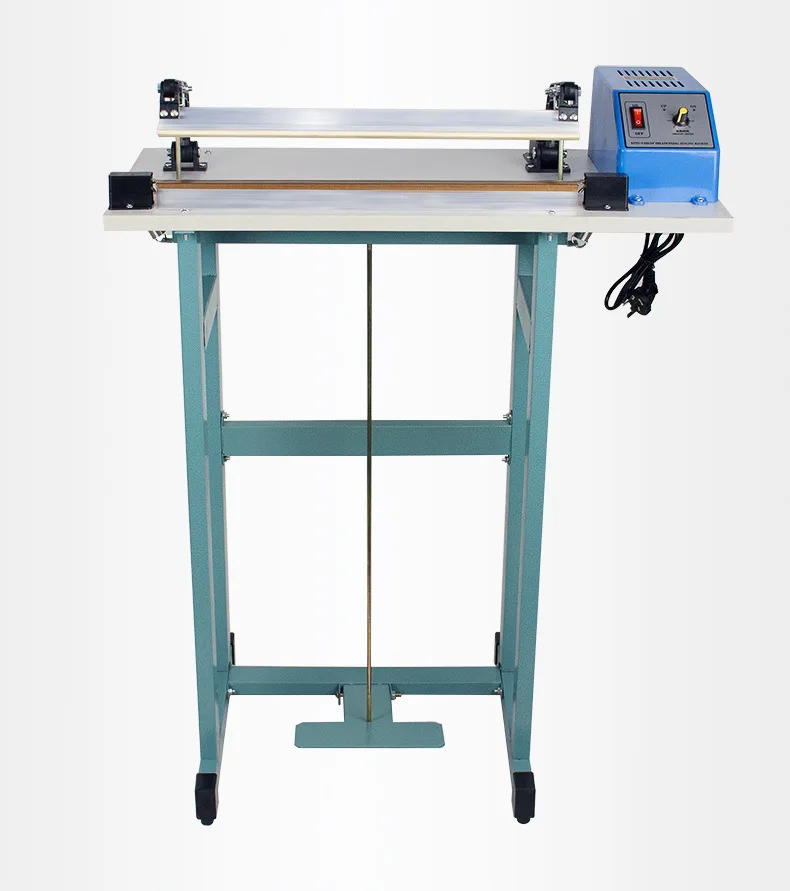
Six parameters, and the best-organised ones so far
Product ID 1601436864211 sells a pedal-operated impulse sealer in five lengths, and its parameter block has six rows. Each row is named after the property it describes, and the five values that belong to that row are kept together inside it, separated by a bar. Model holds the five designations from F300 to F700; impulse power holds five wattages from three hundred and fifty to eight hundred; sealing length holds five lengths from three hundred to seven hundred millimetres; heat time holds the range nought point two to two seconds repeated five times; and weight holds five figures from seven point two to eleven kilograms.
That is the arrangement a capacity table ought to end up in when it is put into fields, and it is worth saying so, because the previous record in this series had the same kind of table flattened a different way, with the row headings in the label column, the column headings in the first value, and the model code used as a parameter's name. Here the five-model matrix survived the move into fields intact, and anyone reading the fields can reconstruct the table. Across the catalogue five hundred and twelve records, fifty-seven carry a cell separator inside a parameter's value, which is the signature of a flattened table, and this record is one of the fifty-seven; but the separator here is doing its intended job of keeping a row together, which is the benign case.
The description field is where the table comes apart instead. There the same matrix is written as a single column, one token per line: the word Model, then F300, then F400, and so on down through every value, so that the whole specification becomes a list of disconnected words with nothing attaching a value to the property it belongs to. A reader can still recover it, but only by counting, and a machine reading the field cannot recover it at all. So this record is the mirror image of the previous one: there the fields were broken and the text held a legible table, here the fields hold a legible table and the text is a column of loose tokens. Both come from the same pipeline, and it is worth knowing which way round a given record has gone before trusting either copy.
The description's first line names a different company's brand
The listing's title calls this a Tebak sealer. The description field's company paragraph says in so many words that our brand is TEBAK. And the description field's first line, which is where a description normally opens with the product's own name, reads: HZPK Aluminum Plastic Bag Impulse Sealer Manual Heat Pedal Type Sealing Machine.
HZPK is not a spelling of the supplier's brand and it is not a model code for any of the five models in the table. Searching the whole catalogue of five hundred and twelve records for that string returns exactly one hit, and the hit is this record: the same three or four letters appear nowhere else, in no title, in no parameter and in no other description. So the description of this machine opens with a brand that belongs to nobody in this catalogue, while the title and the profile disagree with it.
The most likely explanation is the ordinary one, and the guide does not assert more than the record shows: this description was assembled from material written for a machine sold under another name, and the first line was not changed when it was reused. The record's own images support the same reading. One panel is headed Why choose it and carries, underneath the heading, the line: ONE SHOE ONE STORY. That is a slogan from footwear marketing and it has nothing to do with sealing bags, which means the panel was made for a different product and reused here. The catalogue does contain footwear material, with seventeen of its records mentioning shoes, so material of that kind exists in this supplier's library and something of it has ended up attached to a bag sealer.
What a buyer should take from all this is narrow and practical. The description field of this record is not a description of this machine, so nothing in it should be relied on as a statement about what is being bought, and the same reservation applies to the panels, which are marketing graphics with rings, badges and icon strips rather than specifications. The parameters and the one panel that carries figures, which is discussed below, are the only product-specific evidence in the record, and the questions to put to the supplier follow from that: whether the machine is sold under the supplier's own brand or as a plain machine, whether the delivered machine and its labels carry the supplier's name or another's, whether the manual is written for this machine, and whether the supplier can state, in writing, the manufacturer of the model it is actually shipping.
A figure called thickness that is really a width, and the figure it hides
The fourth row of the parameter block is labelled Sealing thickness, and it carries the same value on all five models: three millimetres. Read as a material dimension that is nonsense, because no bag film a sealer can handle is three millimetres thick, and a machine that claimed to seal three millimetres of anything would be a different class of equipment. Read as a serviceable figure it starts to make sense once the record's own panels are consulted.
The last image in the gallery is a parameter table for the four-hundred model, headed in Chinese and English, and among its rows is one labelled Sealing size whose value is written as four hundred by three millimetres. That resolves the ambiguity: the three millimetres is the width of the sealed seam, not a thickness, and the row in the parameter block is mislabelled. The same panel supplies two other facts the parameters omit, the supply voltage of two hundred and twenty volts at fifty hertz and a model designation of KF-400, and it disagrees with the parameters on two figures that are repeated: its sealing time reads nought point two to three seconds against the block's nought point two to two, and its equipment weight reads eight kilograms against the block's seven point five for that model.
Resolving the label matters because it exposes a real gap. If three millimetres is the seam's width, then the machine's capacity is not stated anywhere at all in the way a buyer needs it. An impulse sealer's capacity is the thickness of film it will seal through, usually expressed as a total laminate thickness or as a pair of film thicknesses, and it depends on the impulse energy available per unit length of bar and on the pressure. This machine's parameters give the power in watts and the bar's length, and never the film. So a buyer cannot tell from the record whether it will seal a hundred and fifty micron laminate, or two hundred, or whether the largest model with its eight hundred watts will seal the same film as the smallest. The answer is a function of watts per millimetre of bar, which is the one thing the record does let a buyer calculate, and that calculation is set out further down.
Two further questions follow from the seam's width. Three millimetres is a narrow seam for a bag that has to hold powder or liquid, and the seam's width is what a leak test actually measures, so the question of whether a wider bar of five or eight millimetres is available belongs in the enquiry, together with whether the bar can be changed and what a spare bar costs. And since the figure is the same on all five models, it says the bar's cross-section is the same across the range, which is consistent and worth confirming.
Two parts that wear out are named in a diagram and absent from the specification
The seventh image is the most informative in the record and it is not a specification at all. It is a photograph of the machine with vertical callout lines and labels, seven of them: bracket, heating wire, pedals, high temperature cloth, power cord, control panel, anti-slip mat. Three of those name parts the buyer needs to know about.
The heating wire is the element that heats when the impulse fires, and the high temperature cloth is the tape that covers it and separates it from the bag, protecting both the bag from direct contact with the hot wire and the wire from the bag's residue. Both are consumables. The cloth in particular is the part that fails first in normal use, because it takes the heat and the pressure of every seal, and it also takes any contamination from the product being packed. Neither appears in any of the six parameters. There is no wire gauge, no wire length per model, no cloth width, no cloth material, no statement of how many of each are supplied with the machine, no price for a replacement set, no replacement interval, and no note about what shortens their life.
For a buyer this is the wrong way round. The machine's purchase price is paid once, and these two parts are bought for as long as the machine is used; a workshop that seals a few hundred bags a week will go through them, and a packing line that seals thousands will go through them quickly. The number of seals a cloth survives depends on the film, the heat setting and the duty cycle, and the duty cycle is also absent from the record, so a buyer cannot even estimate it. The questions are therefore specific. What is the wire's specification and its length for each of the five models. What is the cloth's width, and is it a glass cloth or a polytetrafluoroethylene tape. How many of each come with the machine. What is the price of a set, and is it priced by model. What lifetime in seals should be expected, and under what film and heat setting. And, since the callouts show the wire and cloth as separate from the bar, whether they can be replaced with ordinary hand tools, which determines whether a stop on the line costs a minute or a day.
The machine is advertised as cutting, and there is no cutter in the specification
Two of the record's own panels claim a cutting function. The first, headed Convenient pedal sealing machine, lists among its three selling points the phrase: Can be cut and sealed. The second, headed Various shrink film sealing and cutting, says the machine does both for a list of films. The title of the listing, and every one of the six parameters, describes only sealing.
A cutter is not a trivial feature to leave out of a specification. In these machines it is either a separate bar carrying a blade that comes down with the sealing bar, or a second stage, and either way it is a part that has to be specified, worn, replaced and sometimes adjusted. The record's own diagram names seven parts, and a cutter is not among them. So a buyer cannot tell whether the machine comes with a cutter, whether the cutter is fitted to all five models, what length of cut each model gives, whether the blade is a standard consumable, what it costs and whether it can be changed without tools.
The safest reading is that the two panels were carried over from a sibling listing rather than written for this machine, in the same way that the description's opening line and the footwear slogan were, and that the cutting claim may or may not apply. But it cannot be resolved from the record, and the buyer should not assume either way: ask directly whether this machine cuts, and if it does, whether the cut is on the same bar as the seal, whether it is fitted on all five lengths, and what the blade's part number and price are.
Films the record names, and a control that cannot be set to a temperature
The listing's title describes the machine as being for an aluminium plastic bag, which is a literal rendering of the Chinese term for a foil laminate bag and reads in English as though the machine were made of aluminium and plastic. The record's own panels name quite different materials. One shows three rolls of film labelled POF, PVC and PP and calls the machine's job sealing and cutting various shrink films. Another, headed Sealing effect, illustrates three bag types: a transparent bag, an aluminium foil bag, and fruit, which is a use rather than a material.
These are not interchangeable. An impulse sealer works by passing a current through a resistance element for a controlled time, and what it actually welds is the thermoplastic layer of whatever is between the bars. An aluminium foil laminate bag seals because it has a plastic sealing layer inside, and a pure foil structure would not seal at all; so the first thing a buyer should establish, and the first thing the record does not say, is the bag's own structure, which layer is heat sealable, and how thick the whole laminate is. The panel's three films behave differently again: their sealing windows sit at different temperatures, and one of them, PVC, is the film most likely to give trouble on a time-controlled machine, because its useful range is narrow and it is the one that most needs attention to the setting.
The reason the setting matters so much is that this machine is controlled by time and not by temperature. The parameter block gives a heat time range, nought point two to two seconds, repeated identically on all five models, and it gives no sealing temperature at all, no temperature display and no thermostat. So the operator's control is how long the impulse lasts, and the same dial position produces different results as the ambient temperature changes, as the machine warms up through a shift, and as the bar gets longer. On a short bar in a warm room the setting that works at nine in the morning is not the setting that works at four in the afternoon, and the compensation is made by hand. A temperature-controlled machine removes that variability at a price, and whether it is worth the price depends on how consistent the seal has to be, which is a question about the buyer's product rather than about the machine.
So the enquiry should state the bag: its structure, the inner sealing layer, the total laminate thickness, the bag's dimensions and the product inside. And it should ask for the recommended time setting for that bag on the model intended, whether a temperature-controlled version exists for the same bar lengths, and what happens to the seal when the same setting is used on POF, PVC and PP, since the panels promise all three.
How the five models scale, and where they do not
Because the block gives both power and length for every model, the range can be checked for internal consistency, which is a useful thing to do before trusting a table.
| Model | Impulse power | Sealing length | Watts per millimetre | Weight |
|---|---|---|---|---|
| F300 | 350 W | 300 mm | 1.167 | 7.2 kg |
| F400 | 450 W | 400 mm | 1.125 | 7.5 kg |
| F500 | 600 W | 500 mm | 1.200 | 8.8 kg |
| F600 | 750 W | 600 mm | 1.250 | 10.0 kg |
| F700 | 800 W | 700 mm | 1.143 | 11.0 kg |
The power figure passes the check, and the numbers above are this guide's own division of the record's own figures. Watts per millimetre of bar run between one point one two five and one point two five across the whole range, a spread of about five per cent around one point one seven, which is what a family of machines of the same design with longer bars should look like. Since the impulse energy per unit length is what determines whether a given film seals, that consistency is a real point in the range's favour, and it also supports the reading that the bar is the same section on all five models, as the constant three millimetre width suggested.
The weight does not scale that way, and neither do the power steps. Going up a hundred millimetres of length adds one hundred watts between the three hundred and the four hundred, then a hundred and fifty, then a hundred and fifty, then only fifty to reach the seven hundred. The weight steps are stranger still: nought point three kilograms for the first hundred millimetres, then one point three, then one point two, then one. A step of nought point three kilograms for a hundred extra millimetres of bar and frame, followed by a step four times larger for the next hundred, does not look like a range that is simply scaled in one dimension. Something changes in the construction between the four-hundred and the five-hundred model, and possibly again between the six-hundred and the seven-hundred, where the power barely rises while the weight rises by a kilogram.
That deserves a question rather than a conclusion. What changes at five hundred millimetres: a heavier frame, a different transformer, a different bar section, or nothing but the weight figure. Why does the seven-hundred model need only fifty watts more than the six-hundred when the previous steps needed a hundred and fifty. And since the heat time range is the same nought point two to two seconds on all five models, does two seconds actually seal the seven-hundred millimetre bar with the film intended, or does the longest model need the top of the range for every seal, leaving no margin for a thicker bag or a colder workshop.
Throughput cannot be worked out from this record
The cycle of a pedal impulse sealer is not the heat time. It is the heat time plus the cooling time, during which the bars stay closed so the seam sets, plus the time to place the bag and remove it. The record gives the first of those three and neither of the others.
That is enough to rule out any throughput calculation. One bag at nought point two seconds and another at two seconds are the extremes of the same dial, and the time a seal needs in order to set is a property of the film and the ambient temperature rather than of the machine, and is frequently longer than the impulse itself. Nor is there any statement of the maximum number of seals per hour or of a duty cycle. That matters twice over on this machine. First, it is what a buyer needs in order to know how many machines or operators a packing line requires. Second, the duty cycle is exactly what sets the life of the two consumables named in the diagram: a high temperature cloth that seals ten times a minute will fail far sooner than one that seals twice a minute, and there is no figure for either.
There is also no statement of whether the machine has an interlock that prevents the next impulse until the previous seal has cooled. On machines without one, an operator working to a bonus will simply seal faster, and the visible symptom is a cloth that fails early and seams that are weak or wrinkled. Whether the interlock exists, and whether it is adjustable, is a question worth putting in writing, together with the recommended seals per minute, the minimum cooling interval for the films intended, and the maximum continuous running time before the machine should be allowed to rest.
Eight images, and not one of them shared with another record
Every other record examined in this series has carried shared furniture: a payment and courier panel, a gate photograph, a frequently asked questions panel, or a packing panel, some of them appearing in dozens or scores of other listings. This record carries none. Comparing its eight image addresses against every image address in the catalogue, with the address scheme normalised so that the same file reached over http and https counts once, every one of the eight is used by this record alone, and the eight files were downloaded and digested to confirm they are eight distinct files, from about sixty kilobytes to six hundred.
Two things follow. The first is that the shared panels seen elsewhere are a choice rather than a necessity: when a supplier supplies its own photography through the whole gallery, the gallery can be its own. The second is a caution about the method used throughout these guides. Address-based reuse counting can only find what repeats, so a record like this one reads as entirely original even though two of its panels are demonstrably not original to this machine, as the footwear slogan shows. Reuse counting finds repetition; it cannot find a panel that was copied once and never used again.
The eight pictures themselves are, in order: a marketing panel showing the machine on a stylised background with three selling points; a strip of four generic icons labelled practical, energy saving, environmental friendly and safety, with no figure of any kind; a panel showing the pressing direction and the pedal linkage; a panel headed why choose it with the footwear slogan and three more claims; three photographs of sealed bags; a panel showing rolls of POF, PVC and PP film; the labelled diagram naming the seven parts; and the parameter table for the four-hundred model. Five of the eight are graphics rather than photographs, and only two of them contain any figure at all: the parameter table, and the three millimetre seal width printed on it.
What the record does not state at all
- The maximum film thickness the machine will seal, which is the machine's capacity and the number a buyer needs first.
- The seal width as a parameter, and whether any wider bar than three millimetres is available.
- The supply voltage and frequency, which appear only inside one gallery panel for the four-hundred model and in no parameter for any model.
- The heating wire's gauge, length and spare, and the high temperature cloth's width, material and spare, although both are named in the machine's own diagram.
- The number of wires and cloths supplied with the machine, their prices by model, and their expected life in seals.
- Whether the machine cuts as well as seals, on which models, with what cut length, and with what blade.
- Cooling time, seals per minute, duty cycle, and whether a cooling interlock exists.
- Any sealing temperature, and whether a temperature-controlled model exists.
- The films the machine is set up for in practice, and the recommended heat time for each film and thickness.
- The bag structures the machine suits, the inner sealing layer's material, and the maximum bag width and length.
- The machine's own dimensions, for all five models: only weights are given.
- The pedal's cable or linkage length, whether the pedal is supplied, and whether the machine can be operated without it.
- The control panel's functions in detail: what the dial adjusts, what the switch does, and whether there is a fuse or a circuit breaker.
- The working height of the bar, which decides the operator's posture over a shift.
- Case dimensions, case weight, gross weight, and the number of units per container.
- Country of origin, warranty period and scope, spare parts availability, and who services the machine.
- Minimum order quantity, price breaks by model, delivery term, port pair, production lead time and transit time.
- Which brand the delivered machine carries, given that the description's opening line names one that appears nowhere else in the catalogue.
Incoming inspection when the machine arrives
- Photograph the machine and everything in the case before assembly, and compare the contents against the quotation, since the record never enumerates what is included.
- Check the model designation on the machine's own plate and compare it with the quotation, given that the parameter block calls the four-hundred model F400 while the panel in the same record calls it KF-400.
- Read the voltage and frequency from the machine's plate and from its manual, and compare them with the destination's supply, since no parameter states either.
- Weigh the machine and compare it with the parameter block's figure and with the panel's, which differ by half a kilogram on the four-hundred model.
- Measure the sealing length and the seal width produced, and confirm the width against the three millimetres the panel prints, since the parameter block mislabels it as a thickness.
- Measure the bar's working height from the floor and check it against the operator's comfortable working height.
- Identify the heating wire and the high temperature cloth, measure both, and record their specifications, since neither appears in the parameters and both will have to be ordered again.
- Seal a test bag of the intended film and structure at three settings, the lowest heat time, a middle one and the highest, and open the seams to see where the seal is sound and where it burns through or pulls apart.
- Repeat the middle setting after the machine has run for an hour, and compare the seam with the one made when the machine was cold, which is where a time-controlled machine shows its variability.
- Seal the intended film at the maximum thickness the bag will ever reach, and record the highest heat time that still gives a clean seam; if that figure is at the top of the range, the machine has no margin for a thicker bag.
- Time a full cycle by hand, from placing the bag to removing the sealed one, at a comfortable pace, and compare it with the throughput the line requires; the record gives no figure for this.
- Run the machine continuously for an hour at production pace and watch the high temperature cloth and the heating wire for discolouration, tracking and slackening, and watch whether the machine has any cooling interlock.
- Confirm whether the machine cuts, and if it does, measure the cut length and identify the blade and its part number.
- Check the pedal's linkage or cable for length, for smoothness, and for any tendency to bind, and check the return of the bar.
- Test the three films the panels name, POF, PVC and PP, with the machine's own recommended settings, and record the setting that gives a sound seal on each, since the panels promise all three.
- Check the anti-slip mats under the feet, the frame's rigidity when the pedal is pressed hard, and whether the machine walks on the floor in use.
- Ask for the price and the lead time of a spare set of wire and cloth before accepting the machine, since the answer determines the cost of ownership.
What the catalogue says, counted
The counts below come from scanning all five hundred and twelve records, and they place this record's defects in proportion. They are this guide's own measurements of the feed, not supplier statements.
| Observation | Records | Share |
|---|---|---|
| Records with a cell separator inside a parameter value, the signature of a table flattened into a field | 57 | 11.1% |
| Records giving a power rating but no voltage anywhere in their parameters | 45 | 8.8% |
| Records with seal, sealer or sealing in the title | 24 | 4.7% |
| Records mentioning shoes in the title or description, the material the reused slogan belongs to | 17 | 3.3% |
| Records containing the phrase aluminium plastic | 2 | 0.4% |
| Records containing the string HZPK, the brand in this record's description. The one occurrence is this record | 1 | 0.2% |
The two rows that matter most are the second and the last. Forty-five records, about nine per cent of the catalogue, give a power rating without ever stating the voltage, which is the same gap this record has and which is a straightforward problem for anyone buying for a country that does not use two hundred and twenty volts. And a brand string that occurs once in five hundred and twelve records is either a genuine second brand belonging to this listing alone or, as the rest of the evidence suggests, a leftover from material written for a different machine; either way the buyer should ask which brand the delivered machine carries.
The specification to send before ordering
| Item | What to require in writing |
|---|---|
| Model | The model designation as it will appear on the machine's plate, the quotation and the packing list, given that the parameters call it F400 and the record's own panel calls it KF-400. |
| Capacity | The maximum total film thickness the machine will seal, in microns, with the film and the pressure the figure applies to, and the same figure for the longest model if that is the one intended. |
| Seal width | The seal width the bar produces, stated as a width and not as a thickness, and whether a wider bar is available. |
| Supply | Voltage, frequency, current, plug type and the fuse rating, for the destination country. |
| Consumables | The heating wire's specification and length per model, the high temperature cloth's width and material, how many of each are supplied, the price of a replacement set by model, and the expected life in seals. |
| Cutter | Whether the machine cuts as well as seals, on which models, the cut length, and the blade's part number and price. |
| Control | What the dial adjusts, whether a sealing temperature is displayed or settable, and whether a temperature-controlled version exists. |
| Timing | The heat time range, the minimum cooling time for the films intended, the recommended seals per minute, whether a cooling interlock is fitted and whether it is adjustable. |
| Films | The recommended heat time for each film and thickness intended, including the bag's structure and inner sealing layer, and whether the machine is suitable for the three films the panels name. |
| Geometry | The machine's length, width and height for the chosen model, the bar's working height from the floor, and the pedal's linkage length. |
| Construction | The bar's cross-section, the frame's material, the plate's thickness, and the anti-slip feet's specification. |
| Packing and freight | Case dimensions and weight, gross weight, the number of units per container, and the net and volumetric weights used for the freight quotation. |
| Documents | A manual written for this model in a language the operators read, a wiring diagram, a spare parts list with prices, and any certification needed at the destination. |
| Commercial | Unit price for the chosen model and configuration, what is excluded, price breaks, minimum order, delivery term and port pair, production lead time, transit time, warranty and who services the machine. |
| Brand | Which brand the delivered machine, its plate and its manual carry, given that this record's description opens with one brand, its title uses another, and its profile paragraph names a third. |
Frequently asked questions
Is the three millimetre figure a thickness?
No. The parameter block labels it Sealing thickness, but the record's own last gallery image gives the same figure under the label Sealing size, written as four hundred by three millimetres for the four-hundred model. So it is the width of the sealed seam. That means the machine's real capacity, the maximum film thickness it will seal, is not stated anywhere in the record, and it is the first thing to ask for.
Why does the description name a brand that is not in the title?
The description field's first line reads HZPK with the rest of the product's name, while the listing's title says Tebak and the description's own profile paragraph says our brand is TEBAK. The string HZPK occurs once in the whole five hundred and twelve record catalogue and that one occurrence is this record. The likely explanation is that the description was assembled from material written for a machine sold under another name, and the record's panels support that: one of them carries the line ONE SHOE ONE STORY, a footwear slogan, on a bag sealer. Treat the description and the graphic panels as supplier furniture rather than product information, and ask which brand the delivered machine carries.
Which parts have to be bought again?
Two, and the record names them only inside a diagram. The labelled photograph of the machine calls out a heating wire and a high temperature cloth, which are the two consumables of an impulse sealer: the wire is the element that heats when the impulse fires and the cloth is the tape that separates the hot wire from the bag. Neither appears in any parameter. There is no width, no gauge, no length, no spare, no price and no expected life, so a buyer should ask for all of those together with the machine, because they are what will be bought for as long as it is used.
Does it cut the bag as well as seal it?
Two panels say it does, with the phrases can be cut and sealed and sealing and cutting, and the title and every parameter say only sealing. The diagram that names seven parts does not name a cutter. So it cannot be resolved from the record; ask directly, and if the answer is yes, ask which models have it, what the cut length is, and what the blade costs.
Can it seal the bags I use?
That depends on the bag rather than the machine, and the record does not help. The title describes an aluminium plastic bag, which is a literal translation of foil laminate and reads as a material rather than as a bag; one panel names a transparent bag, a foil bag and fruit; another shows rolls of POF, PVC and PP film. An impulse sealer welds the thermoplastic layer of whatever sits between the bars, so a foil laminate bag seals through its plastic inner layer and a pure foil structure would not seal at all. Establish the bag's structure and its inner sealing layer, then ask for the recommended heat time for that exact bag and thickness.
Can I set a temperature?
Not from anything the record shows. Control is by heat time, with a range of nought point two to two seconds repeated on all five models, and no temperature is stated, displayed or settable. That means the same dial position gives different results as the workshop warms up and as the bar gets longer, and the compensation is manual. If seal consistency matters, ask whether a temperature-controlled version exists in the same bar lengths.
How fast can it seal?
The record does not say, and the heat time is only one third of the answer. A cycle is the heat time plus the time the seal needs to cool under pressure plus the time to handle the bag, and the record gives neither of the last two, nor a seals-per-minute figure, nor a duty cycle, nor a statement of whether the machine has a cooling interlock. Time the cycle by hand on arrival at a comfortable pace before planning a line around it, and note that the duty cycle is also what determines the life of the cloth and the wire.
Which of the five models should I buy?
The one whose sealing length matches the longest bag seal you will make, and then check the capacity rather than assuming it scales. The record's own figures show the power rising in proportion to length, about one point one seven watts per millimetre across the range, which is a good sign; but the weight steps are not proportionate, with a nought point three kilogram step from the three hundred to the four hundred model against one point three to reach the five hundred, and the power step falls to fifty watts to reach the seven hundred, so the models are not simply scaled versions of one another. Ask what changes at five hundred millimetres, and whether the longest model still seals the intended film at a setting with margin left.
Source, scope and what this guide does not claim
Everything about the machine comes from the record for Product ID 1601436864211 as it stands: six parameter rows, a description field containing the same matrix as a single column followed by the supplier's profile, and eight gallery images. The parameter labels and values are quoted as stored, including the row that is labelled as a thickness and is shown by the record's own panel to be a width. The five model designations, the five wattages, the five lengths, the repeated three millimetres, the repeated heat time range and the five weights are the record's own figures, and the figures that differ between the parameter block and the panel are reported rather than resolved: the heat time's upper bound, two seconds against three, and the weight of the four-hundred model, seven point five kilograms against eight.
The labelled diagram is read as printed, and the seven callouts it carries are bracket, heating wire, pedals, high temperature cloth, power cord, control panel and anti-slip mat. The slogan and the claims quoted from the panels are transcribed from the images. The watts per millimetre column, the power and weight steps between models, the count of eight distinct image files and its meaning are this guide's own work, and the two figures whose disagreement is unresolved are flagged as such wherever they appear.
The counts in the table are this guide's own scans of all five hundred and twelve records: fifty-seven with a cell separator inside a parameter value, forty-five giving power without voltage, twenty-four with a sealing term in the title, seventeen mentioning shoes, two containing the phrase aluminium plastic, and one, this record, containing the string HZPK. The address comparison for shared panels was done with the http and https forms normalised so that one file counts once, and all eight of this record's images were downloaded and digested, from about sixty kilobytes to six hundred, and each is used by this record alone.
Nothing here asserts that the supplier has misrepresented the machine. A row mislabelled as a thickness, a description left with another brand's name at the top and another product's slogan on a panel, consumables named in a diagram but left out of the specification, a cutting feature claimed in advertising and absent from the data, and a weight and a time range that differ between two panels of the same record are the ordinary consequences of a listing assembled quickly from material at hand, and the counts above show how common each pattern is. A seal's strength depends on the film, the temperature, the pressure and the dwell, and a workshop's choice of machine depends on its bag, its pace and its power supply. Nothing in this guide is engineering approval or purchase advice for a particular application, and anything sealed for food, medical or hazardous contents needs its own validation of the seal, by whoever is qualified to perform it.
Key specifications
- Model
- F300 | F400 | F500 | F600 | F700
- Impulse power
- 350w | 450w | 600w | 750w | 800w
- Sealing length
- 300mm | 400mm | 500mm | 600mm | 700mm
- Sealing thickness
- 3mm | 3mm | 3mm | 3mm | 3mm — the record's own panel shows this is the seal width, written as Sealing size 400*3 MM, not a material thickness
- Heat time
- 0.2-2s | 0.2-2s | 0.2-2s | 0.2-2s | 0.2-2s — the record's own panel gives 0.2-3 seconds for the 400 model
- Weight
- 7.2KG | 7.5KG | 8.8KG | 10KG | 11KG — the record's own panel gives 8 kg for the 400 model
- Brand in the title
- Tebak, and the description's profile field says our brand is TEBAK
- Brand in the description's first line
- HZPK. The string HZPK occurs once in the entire 512-record catalogue, and that one occurrence is this record
- Supply voltage
- not stated in any parameter. It appears only inside the record's own panel, as 220V/50HZ for the 400 model
- Maximum film thickness
- not stated anywhere: the figure a buyer needs in order to know whether the machine will seal a given laminate
- Seal width
- 3 mm implied by the panel's Sealing size 400*3 MM, but no parameter states a width and no wider bar option is offered
- Consumables
- not stated: no heating wire specification, length, gauge or spare; no high temperature cloth width, material or spare; neither appears in any parameter, although both are named in the callouts of the machine's own diagram
- Cutter
- not stated: two panels claim the machine cuts as well as seals, and no parameter, and none of the seven diagram callouts, identifies a cutter or a blade
- Cooling and duty cycle
- not stated: no cooling time, no seals per minute, no duty cycle, no cooling interlock
- Temperature control
- not stated: control is by heat time only, so no sealing temperature is given or settable
- Films covered
- not stated in the parameters. One panel shows rolls labelled POF film, PVC film and PP film; another names a transparent bag, a foil bag and fruit
- Machine dimensions
- not stated: no length, width or height for any of the five models, only a weight
- Packing
- not stated: no case, no gross weight, no number of units per container
- Product slug
- 80 characters, ending cleanly in the word machine, the first in this series not to be cut mid-word