
Two parameter rows, and neither is a measurement
Product ID 1601253021491 carries two parameter rows. The first is Brand and its value is TEBAK. The second is Product and its value is Wax Injection Machine. That is the entire parameter block. One row states who makes the machine and the other restates what the machine is, and a buyer who has read only those two rows knows nothing about the machine that the title had not already said.
Seriousness of the omission is best shown by placing the block against the rest of the catalogue, because a block of two rows turns out to be close to the floor. Of the five hundred and twelve records, three hundred and sixty-one carry at least one parameter row; the largest block in the catalogue carries twenty; forty-nine records carry exactly two; and exactly one record carries fewer than this one, a record whose single row reads item equals value, with the field's own label sitting in the field as its content. So this record is the second-thinnest parameter block in the catalogue, and the only record thinner than it is thinner because of a defect rather than because of brevity.
Thinness alone would be unremarkable if the two rows had been chosen for what a buyer needs. They were not, and the more useful measurement is the one that ignores row count entirely. Of the forty-nine records that carry exactly two rows, twenty-two have no numeral in either row, this record among them. A two-row block that contains a numeral is at least an attempt at a specification: a voltage and a frequency, or a capacity and a weight. A two-row block with no numeral in it anywhere cannot be a specification at all, and twenty-two records in this catalogue are in that position.
The consequence is practical rather than rhetorical. This listing cannot be compared with any other wax injection machine on price, because price comparison requires comparing what is being sold, and what is being sold here is a category name. It cannot be quoted into a tender, because a tender needs figures. It cannot be used to check a delivery, because there is nothing to check the delivery against. All of those things are possible on this record, and all of them require reading the gallery rather than the parameters, because that is where the numbers are.
The specification is printed inside the photographs
The eight images are the product's documentation. Reading them in order: a specification panel over a photograph of the machine, a four-panel display of finished patterns, a marketing panel captioned for high-pressure infiltration, a labelled diagram of the machine with dimensions in a box beneath it, a cutaway of the open barrel showing the liner and the heating band, a four-step illustrated procedure, a three-part detail panel showing the gauge, the controller and the wax port, and a photograph of the packed carton.
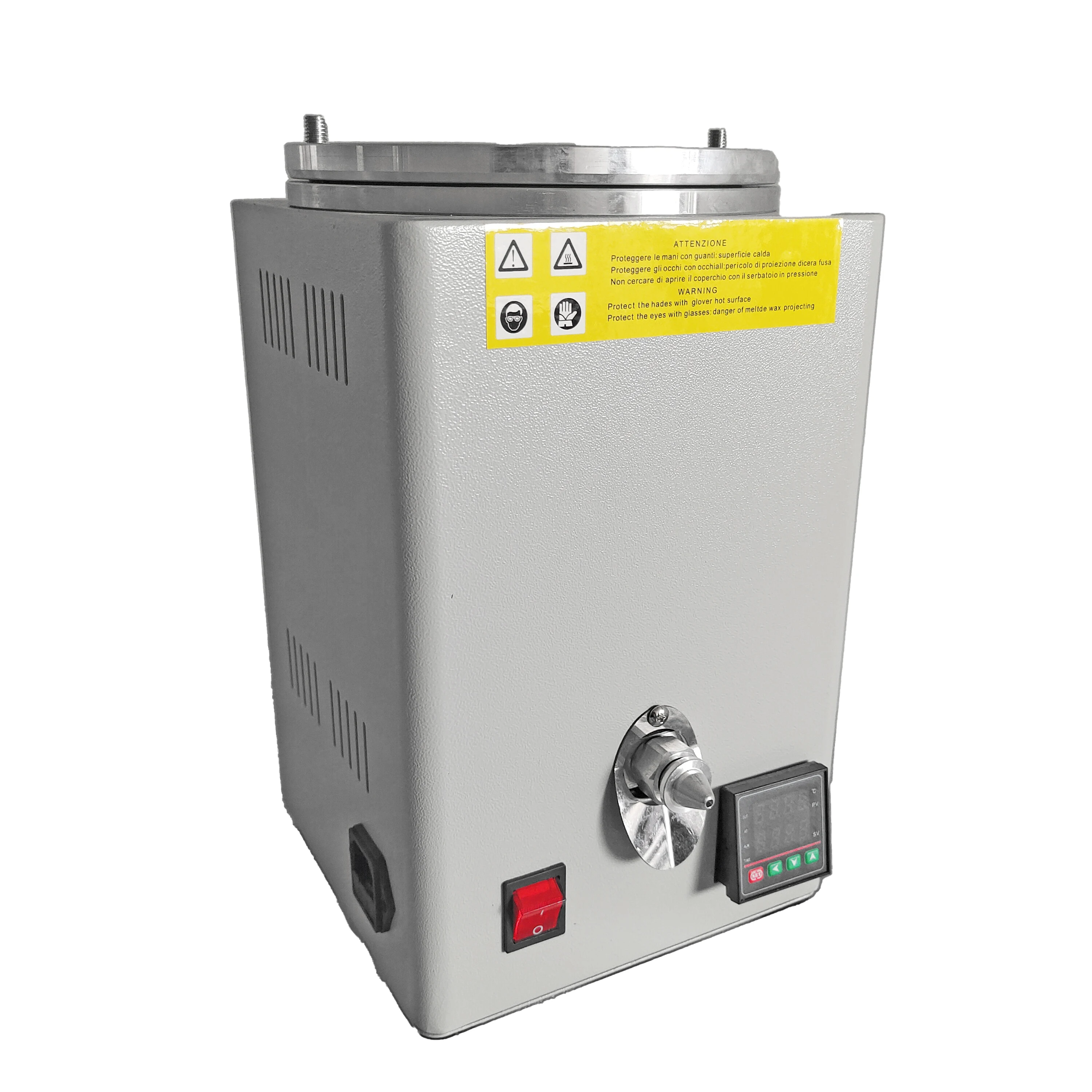
From those images the machine can be described fully enough to be ordered, which is exactly what cannot be done from the parameters. It is a box 400 millimetres tall with a 195 millimetre square footprint, weighing 6.65 kilograms. Its barrel is a cylinder with a thickened liner, heated and controlled by a closed-loop controller marked REX-C100 with a two-line display showing a process value and a set value and a row of setting keys. Its lid is a plate held down by two knurled nuts, and on that lid sit a pressure gauge with a megapascal and bar scale, a pressure regulating valve with a push-fit air inlet, a small red safety valve, and a fitting for a tube. On the front face there is a single chrome wax outlet with a lever, and lower down a combined switch and temperature display. The carton measures 480 by 280 by 320 millimetres, and the packing photograph shows the machine wrapped in film and held by moulded polystyrene corner blocks with foam sheeting over the top and a blue instruction booklet.
Three of those figures deserve to be read carefully, because each of them means something different from what it appears to mean at first glance.
The temperature is given twice and its unit is never named
Two photographs state a temperature range of zero to one hundred and ten degrees. Neither states degrees Celsius, degrees Fahrenheit or degrees of anything else, and the record states no temperature at all. If the figures are Celsius and they describe the barrel's limit, then a hundred and ten degrees is a plausible ceiling for a wax pot, though a range whose lower bound is the freezing point of water is an odd window for a machine whose job is to keep wax liquid, and the useful number, which is the working temperature the wax should be held at, is not given. If the figures are Fahrenheit, the range is meaningless for this machine. The published range is therefore not usable as a setting, and the safe working temperature has to come from the wax supplier rather than from this listing.
The pressure gauge has a full scale and the procedure has no target
The gauge fitted to the lid is scaled in megapascals and in bar, and its full scale reads 0.25 megapascals, which is 2.5 bar, which is about 36 pounds per square inch. A gauge's full scale is not a working pressure, and the record does not give a working pressure: the illustrated procedure's third step says to use an air pump to inflate until the air pressure reaches the appropriate value, and the appropriate value is never stated anywhere in the record, in the parameters, in the description or in the pictures.
That is the most consequential gap in this listing. The operator's job in step three is to pump by hand until a gauge that goes to 2.5 bar shows an unspecified figure, with a pressure regulating valve available and a safety valve fitted, and with the warning sticker on the machine's own face warning about exactly the failure that over-pressure produces. A pressure setting that is described as appropriate and never quantified cannot be handed to an operator, cannot be written into a work instruction, and cannot be audited. The questions that fix it are the working pressure the manufacturer intends, the cracking pressure of the safety valve, whether the valve is certified and to what standard, what test pressure the barrel is designed for, and what the regulator's outlet range is. All five are absent.
The dimensional weight exceeds the actual weight
The machine's own envelope is 400 by 195 by 195 millimetres, which is 15,210 cubic centimetres, and the carton is 480 by 280 by 320 millimetres, which is 43,008 cubic centimetres. The carton is therefore 2.83 times the volume of the machine, which is what a 6.65 kilogram machine packed in a box of those proportions looks like: a box 80 millimetres longer, 85 millimetres wider and 125 millimetres deeper than the object inside it.
That ratio has a cost consequence worth stating plainly. At the common air-freight divisor of 6,000, a carton of 43,008 cubic centimetres has a dimensional weight of 7.17 kilograms, and at the divisor of 5,000 it has a dimensional weight of 8.60 kilograms. The actual weight is 6.65 kilograms. Both dimensional figures are higher than the actual weight, so a courier billing on the greater of the two will bill this shipment on volume, at 0.52 kilograms above the real mass at the 6,000 divisor and 1.95 kilograms above it at the 5,000 divisor. The buyer's first question about freight should therefore not be what the machine weighs, which the pictures answer, but what the carton's dimensions are and which divisor the forwarder applies, which the record does not answer at all. For reference, another way of seeing the same thing: 6.65 kilograms in 15,210 cubic centimetres is a bulk density of 437 kilograms per cubic metre, which is roughly a third that of water, and normal for a machine that is mostly an insulated empty vessel.
The machine's own picture says manual while the title says automatic
The title calls this an automatic hand pump wax injection machine, which is already two descriptions in one phrase. The pictures resolve the ambiguity in a way the title does not: the marketing panel captioned for high-pressure infiltration carries the label Manual air pump over the black hand-held pump, the specification panel lists an air pump among the three accessories, and the procedure's third step says to use an air pump to inflate the barrel until the pressure is right. There is no motor, no compressor, no timer, no programmable cycle, no foot switch and no automatic cycle in any of the eight photographs. The machine is pressurised by hand, the wax is released through a port on the front, and the mould is held against that port by the operator.
The word automatic therefore does not describe a function that exists. It is worth saying why this matters beyond a spelling complaint, because the two machine classes are different products. An automatic wax injector has a cylinder, a stated ejector force, a stated shot volume and a stated stroke; it makes the same shot repeatably and its specification is a set of forces and volumes. A hand-pumped pressure pot has a vessel, a heating band, a thermostat and an outlet; it makes whatever shot the operator's hand and the vessel's pressure happen to make, and its specification is a set of pressures and temperatures. The four sibling listings in this catalogue, discussed below, give the figures for the first kind of machine. This listing is the second kind, and it gives neither kind of figure.
Four sibling listings carry an identical seven-row block that this listing lacks
Five records in this catalogue contain the word wax, and this record is one of them. Four of the others are also wax injection machines, and each of those four carries the same seven parameter rows, byte for byte the same, which I confirmed by serialising each record's parameter list and comparing: an ejector force of ten kilonewtons, a theoretical shot volume of twenty cubic centimetres, an injection rate of ten grams per second, an injection weight of one hundred grams, a weight of five and a half kilograms, an open stroke of one hundred millimetres, and power of half a kilowatt.
That block is a real specification, and its existence changes what can be said about this listing. This record states none of those seven figures. It states a different weight, because its own picture says 6.65 kilograms while the block says 5.5 kilograms, and it states no power at all while the block says 0.5 kilowatts. So a buyer comparing this listing against any of its four siblings is not comparing two presentations of one product: they are comparing a listing with no data against a listing with seven rows, and the rows that exist describe a machine that is 1.15 kilograms lighter than the one in this record's photograph, with half a kilowatt of power and an ejector force of ten kilonewtons that a hand pump cannot develop.
The block is also worth reading for its own defects, because it is the same three-line pattern that has now appeared in this series on two different product families. The labels and values contain the unescaped HTML entity for a superscript three, in the label as well as in the value, so the row that should read cubic centimetres reads as an entity in both places; the label carries a unit as well as the value, which means the unit is written twice; and the block is pasted onto listings whose titles describe different machines, one of them a wax sprayer, one of them a two and a half litre five hundred watt injector, and one of them a double-nozzle machine. Two of those titles claim a capacity in litres or kilograms, two and a half litres and two and two and a half kilograms, and the parameter block that accompanies them contains no capacity row at all. That is the same pattern recorded for the melting furnace family in the previous item of this series: capacity written in titles, absent from the data.
One more comparison is available and it is precise. Two of those four sibling records share exactly one image with this record, and that image is the packing photograph, so three records in this family publish the same carton picture while giving different weights for its contents. Seven of this record's eight images are used by no other record in the catalogue.
The warning label is headed in Italian
The machine carries a yellow warning sticker on its front face. It has two triangular hazard pictograms and two circular pictograms in the international style, an Italian heading, and English warning text, and its visible words refer to protecting the pump and to the danger of hot wax. It is a generic label for this class of machine rather than a document about this machine, and it is the only safety information supplied: this record states no certification, no test report, no conformity marking, no vessel approval, no electrical approval and no statement of which market any approval applies to.
There is a legitimate reading of that, and it should be given. A small workshop machine sold to a global market often arrives with a generic label and a generic leaflet, and the buyer is expected to satisfy their own market's rules. That expectation is reasonable, and it is also unstated here. What a buyer therefore has to establish is which standard the pressure vessel was designed and tested to, what the electrical safety approval is and for which markets, whether a test certificate for the safety valve is available, and what documentation the supplier can actually produce rather than describe.
Two smaller observations belong with the label. The first is the instruction sequence: step one is to connect the power cord and unscrew the nuts on both sides to open the lid, and step two is to pour in the wax block, set the temperature, cover the barrel and heat it. Pouring solid wax into an unheated pot and then closing a lid held by two knurled nuts is a normal procedure for this class of machine, and it now puts the operator in the position described above, holding a pump and looking for an appropriate pressure that no document defines. The second is step four, which says to use insulation bricks to clamp the film and align it with the wax outlet, and to push forward to inject wax. Insulation bricks are therefore part of the supplied method of operation, are used to hold a mould against a hot port, and appear in no accessory list: the three accessories the specification panel names are the tube, the air pump and the power cable.
The instruction that decides the shot is not in the kit
Step four is where the machine's output is decided, and it is the step the record documents least. The operator holds the mould against the wax outlet, spaced and clamped by a piece of insulation brick, and pushes forward to release wax. Everything that governs whether that produces a good casting is absent: the pressure to hold it at, which is the unspecified value from step three; the temperature at the moment of injection, which the controller displays but which nothing tells the operator to record; how long to hold the mould against the port; whether to release the pressure before or after withdrawing the mould; how many shots the pot will yield at a given pressure and temperature; and what to do when a mould is short-filled, which is the characteristic failure of this method and the one the marketing panel's claim about corners without dead ends is aimed at.
An operator can establish all of that empirically, and most workshops do, which is why it is worth describing rather than dismissing. The point is that the machine is delivered without it, so the first days of production are spent discovering it, and the discovery is not recorded anywhere the record has provided. The two practical things a buyer should require are a written starting procedure giving pressure and temperature for at least one named wax, and a batch of sample casts from the supplier made with that procedure, photographed, so that there is a known-good result to compare with. Neither is in this record.
What the record does not state at all
- The working pressure, the design pressure and the test pressure of the barrel, and the cracking pressure of the safety valve.
- The electrical rating, the voltage, the frequency, the plug type and the rated current, though the machine has a cord and a controller.
- The barrel's capacity in kilograms or in litres, though two sibling listings in the same family claim two and two and a half litres.
- The temperature unit, whether the figure describes the barrel or the wax, the control accuracy and the warm-up time.
- The controller's sensor type, its calibration method and its set-point limits.
- The wax outlet's diameter and the pressure regulating valve's outlet range and adjustment behaviour.
- The tube's material, bore, working pressure and length, and the air inlet's fitting size and thread.
- The shot volume, the injection rate, the cycle time and the yield per fill, all of which the four sibling listings state for a different machine.
- Which waxes the machine is intended for, and the melting point and shrinkage of any of them.
- How a mould is held against the hot port, what the insulation bricks must be and where they are obtained, since they are required by the procedure and supplied by nobody.
- The seals, gaskets, heating element, controller and valve part numbers and prices as consumables.
- The duty cycle and the maximum continuous operating time.
- The cleaning procedure for the barrel between waxes.
- Ventilation and siting requirements, and any requirement about working posture, since the machine is 400 millimetres tall and its outlet is low on the front face.
- The material and thickness of the barrel liner, and how the heating band is attached and replaced.
- Any certification, test report or conformity marking for the vessel or the electrical parts, and for which markets.
- The number of cartons, though a packing photograph exists, and a packing list in any form.
- Price, minimum order quantity, price breaks, delivery term, lead time and warranty.
Incoming inspection when the unit arrives
- Photograph the carton as received and the open carton before unpacking, and compare the contents with the packing photograph, since the record supplies no packing list and that photograph is the only statement of contents.
- Inventory against the three named accessories, the tube, the air pump and the power cable, and note that the procedure's insulation bricks are not among them, so they must be sourced separately before the machine can be used as documented.
- Weigh the machine and measure it, and record the figures, because its own picture says 6.65 kilograms and 400 by 195 by 195 millimetres while its four sibling listings say 5.5 kilograms, so the delivered figure is the only reliable one.
- Measure the carton and record the three dimensions, then calculate the dimensional weight at the divisor the forwarder uses, so the freight basis is known before the next shipment.
- Inspect the barrel's liner for damage and measure the internal diameter and depth, since no capacity figure exists anywhere in the record.
- Inspect the lid, the two knurled nuts, the sealing face and the gasket, and record the condition, because the lid is the pressure boundary and closes on a seal that no parameter describes.
- Identify the safety valve, read every marking on it and record them, and obtain its cracking pressure and any certificate, because the valve is the only over-pressure protection on a vessel whose working pressure is unspecified.
- Identify the pressure regulating valve, the gauge and the air inlet, and record their markings and ranges, then confirm that the gauge's indicated pressure matches a reference before the machine is used, since the gauge is the only pressure feedback the operator has.
- Read the controller's model marking, the REX-C100 shown in the pictures, and record it, along with any nameplate on the machine and on the heating band, since the record states no electrical rating.
- Carry out an electrical safety check on the delivered machine before first power-up, and record the results, because the record states no approval for any market.
- Perform a leak and pressure test at the pressure the supplier specifies, obtained in writing before the test, and record the pressure held and the time held, never exceeding what the supplier states.
- Pour wax, set the temperature the wax supplier specifies rather than the temperature the pictures imply, and bring the barrel to temperature, recording the actual time taken since no warm-up figure exists.
- Measure the actual temperature of the wax at the outlet with an independent probe rather than trusting the controller's displayed value, and record the difference.
- Pressurise to the pressure the supplier specified, hold the pressure for the whole of a production run and record whether it holds or decays, since a decaying pressure at an unspecified working pressure is the failure mode that cannot be detected from the documentation.
- Cast a known mould repeatedly and record the number of good casts, the pressure and the temperature used, establishing a baseline that the record does not provide.
- Keep the whole record as the machine's own specification file, because on this listing the buyer's measurements, the supplier's written answers and these test results will together be a fuller specification than anything the supplier published.
What the catalogue says, counted
The counts below are this guide's own scans of all five hundred and twelve records, with the search terms named so that they can be reproduced.
| Observation | Records | Share |
|---|---|---|
| Records that carry at least one parameter row | 361 | 70.5% |
| Records carrying exactly two parameter rows, this record among them | 49 | 9.6% |
| Two-row records with no numeral in either row, this record among them | 22 | 4.3% |
| Records carrying exactly one parameter row, whose single row is the literal placeholder word, making it the only block in the catalogue thinner than this one | 1 | 0.2% |
| Records whose description text is exactly 800 characters, against none longer and a shortest of 144 | 410 | 80.1% |
| Records whose description contains the supplier's profile sentence with the misspelling productc | 251 | 49.0% |
| Records containing the supplier's sentence about customers around the world | 252 | 49.2% |
| Records containing the supplier's sentence that ends in the quality control standards are based on | 138 | 27.0% |
| Records containing the word wax, of which this record and four others are wax injection machines and a looser match adds a fertiliser dosing injector and a magnet kit | 5 | 1.0% |
| Records containing a word for injection on the looser match, which is why counts need reading rather than trusting | 7 | 1.4% |
| Records containing a word for jewellery, unchanged from the previous item's measurement of the same field | 15 | 2.9% |
| Records containing the word pump | 21 | 4.1% |
| Records containing the word pressure, and those giving a megapascal or bar unit | 31 and 11 | 6.1% and 2.1% |
| Records containing the word temperature | 19 | 3.7% |
| Records containing the words trachea, PID or the controller model REX-C100, all three of which appear in this record's pictures and in no record's text | 0 each | 0% |
| Records that use any of this record's first seven images, which is none: seven of its eight pictures are used by this record alone, and only the packing photograph is shared, with two siblings | 0 | 0% |
| Records whose description the supplier's company-name sentence appears in | 384 | 75.0% |
| Records referring to the ISO 9001 standard in that paragraph | 136 | 26.6% |
| Records containing the string OED&ODM, the misspelling used here and elsewhere | 329 | 64.3% |
| Records containing the string this filed, the misspelling used here and elsewhere | 319 | 62.3% |
| Records containing the phrase 70% for expert, as used here | 265 | 51.8% |
Three rows carry the argument. The first is the pair of two-row counts: forty-nine records carry exactly two parameters and twenty-two of those have no numeral in either, which places this record in a group that is small in the catalogue and, in practice, unquotable. The second is the eight-hundred-character row, which is the structural finding of this item: four hundred and ten of five hundred and twelve records have a description of exactly eight hundred characters and not one is longer, which means the description is not written but truncated, a fixed window over a longer document, and what a buyer sees of the supplier's profile depends on how long the title and the parameter block in front of it happen to be. The third is the group of rows counting the supplier's own sentences, which appear in half to three quarters of the catalogue and in this record, and which confirm that the text a buyer is reading is shared boilerplate rather than a description of this machine.
The three zeros are also worth a line. The words trachea, PID and the controller model REX-C100 appear in no record's text and all three appear in this record's pictures, which is the cleanest illustration in this series so far that on this catalogue the specification can live in pixels while the words live in a template.
The house-style counts are unchanged once more: the company-name sentence in three quarters of the catalogue, the ISO 9001 reference in just over a quarter, the misspelled abbreviation in about two thirds, the phrase this filed in about five eighths, and the claim that seventy per cent of products are for experts in about half.
The specification to send before ordering
| Item | What to require in writing |
|---|---|
| Pressure | The working pressure, the design pressure and the test pressure of the barrel; the cracking pressure of the safety valve and any certificate for it; the outlet range of the pressure regulating valve; and the figure that should replace the phrase the appropriate value in the illustrated procedure. |
| Electrical | The voltage, frequency, rated current, rated power, plug type and any electrical approval, with the markets each applies to, since the record states none of them and the four sibling listings in this family state 0.5 kilowatts. |
| Temperature | The unit of the stated range, whether zero to one hundred and ten degrees describes the barrel or the wax, the control accuracy, the sensor type, the calibration method and the warm-up time. |
| Capacity | The barrel's capacity in kilograms and in litres, and the wax consumption per shot, resolving the two and two and a half litre figures that appear in sibling titles and in no parameter block. |
| Identity | Whether the quoted machine is the hand-pumped pressure pot shown in these photographs or the machine described by the seven-row block that four sibling listings carry, since that block gives an ejector force of ten kilonewtons and an open stroke of one hundred millimetres that this machine's pictures do not show. |
| Weight and size | Confirmation of the net and gross weight and of the machine and carton dimensions, because this record's picture says 6.65 kilograms and its siblings' data says 5.5 kilograms. |
| Wax | Which waxes the machine is intended for, their melting temperatures and shrinkage figures, the working temperature and pressure for at least one named wax, and the cleaning procedure between waxes. |
| Output | The shot volume, the injection rate and the cycle time, or a written statement that the machine does not have them and that the shot is set by the operator's hand, which is what the photographs indicate. |
| Consumables | The part numbers and prices of the seals, gaskets, heating element, controller, pressure regulating valve and safety valve, and the recommended spares for a first year. |
| Method | What is to be used to hold the mould against the wax outlet, since the procedure calls for insulation bricks and the accessory list does not include them. |
| Safety and compliance | The standard the vessel was designed and tested to, the test certificate, the conformity markings and the markets they apply to, and the correct pressures for commissioning and for routine checking. |
| Documentation | A furnace-specific instruction leaflet in a language the operators read, replacing a multi-language sticker, and a packing list rather than a photograph of a carton. |
| Packing and freight | The carton count and each carton's dimensions and gross weight, the packing material specification, and the dimensional weight basis so that the freight charge can be predicted rather than discovered. |
| Inspection | A pre-shipment test record showing the machine run at the supplier's stated working pressure and temperature with a named wax, photographs of the nameplate and of the safety valve markings, and a sample cast kept for comparison. |
| Commercial | Unit price, minimum order quantity, price breaks, delivery term, lead time, warranty period and scope, spare parts availability, and who services the machine in the buyer's country. |
Frequently asked questions
How much specification does this listing actually contain?
Two parameter rows, one giving the brand as TEBAK and one giving the product as Wax Injection Machine, with no measurement in either. Everything measurable is inside the eight photographs: 400 by 195 by 195 millimetres, 6.65 kilograms, a carton of 480 by 280 by 320 millimetres, a temperature setting of zero to one hundred and ten degrees with no unit named, a gauge with a 0.25 megapascal or 2.5 bar full scale, a REX-C100 controller, a lid held by two knurled nuts and a small red safety valve, and three accessories named as trachea, air pump and power cable. Of the forty-nine records in this catalogue with exactly two parameters, twenty-two have no numeral in either row, and only one record in the catalogue has fewer rows than this one.
Is it automatic or manual?
The pictures answer and the title does not. The marketing panel is captioned Manual air pump over the black hand pump, the specification panel lists the air pump as an accessory, and the illustrated procedure says to use an air pump to inflate the barrel. No motor, compressor, timer, programmable cycle or foot switch appears in any of the eight photographs. The title's word automatic therefore does not describe a function that exists on this machine, and the distinction matters because an automatic injector is specified by an ejector force, a shot volume and a stroke, while a hand-pumped pot is specified by a pressure and a temperature, and this listing gives neither.
What pressure should the barrel be pumped to?
The record never says. The illustrated procedure says to inflate until the air pressure reaches the appropriate value and stops there, while the gauge on the lid has a full scale of 0.25 megapascals, or 2.5 bar, and a pressure regulating valve and a safety valve are fitted. That is a machine which asks an operator to pressurise a heated vessel by hand to a figure no document defines, and it is the first question to put to the supplier, along with the safety valve's cracking pressure and the barrel's design and test pressures.
What do the four sibling listings tell me that this one does not?
They carry a seven-row parameter block that is byte-identical across all four: an ejector force of ten kilonewtons, a theoretical shot volume of twenty cubic centimetres, an injection rate of ten grams per second, an injection weight of one hundred grams, a weight of five and a half kilograms, an open stroke of one hundred millimetres and power of half a kilowatt. This listing states none of those seven figures and gives a different weight, 6.65 kilograms in its own photograph against the block's 5.5. The block also describes a machine with an ejector and a stroke, which is not what the photographs here show, so the block should be treated as data about a different machine until the supplier confirms otherwise.
Why does the description talk about the company and not the machine?
Because the description is a fixed window. Four hundred and ten of the five hundred and twelve records have a description of exactly eight hundred characters, none is longer, and the shortest is one hundred and forty-four. This record's eight hundred characters end mid-sentence at the words the quality control standards are based on, and in other records in this catalogue the same window ends mid-word at different points depending on how long the title and the parameter block in front of it were. So the description is a truncated view of a longer shared document, the supplier's profile sentences appear in half to three quarters of the catalogue, and the words productc, this filed and the phrase about seventy per cent being for experts are shared boilerplate rather than anything about wax injection.
What will the freight cost be based on?
Probably on volume rather than on weight. The machine's envelope is 15,210 cubic centimetres and the carton is 43,008, so the box is 2.83 times the machine. At a divisor of 6,000 the carton's dimensional weight is 7.17 kilograms and at 5,000 it is 8.60, both above the 6.65 kilogram actual weight, so a courier billing on the greater figure will bill this shipment on volume. Ask for the carton dimensions and gross weight and ask the forwarder which divisor applies before comparing freight quotes.
Is anything in the kit consumable or missing?
The three accessories named are the tube, the air pump and the power cable. The illustrated procedure additionally requires insulation bricks to hold the mould against the wax outlet, and insulation bricks are in no accessory list, so the machine cannot be operated exactly as documented with the kit alone. The parts that wear are the seals and gasket in the lid, the heating band, the controller and the valves, and none of them has a stated part number, life or price.
What safety documentation comes with it?
What the photographs show is a yellow multi-language warning sticker with international hazard pictograms, an Italian heading and English warning text referring to protecting the pump and to hot wax. It is generic for this class of machine. The record states no certification, no test report, no vessel approval and no conformity marking, and no statement of which market anything applies to. Establish your own market's requirements and ask the supplier which documents exist in fact, and require the pressure figures before anyone pressurises the vessel.
Is this machine related to the melting furnace in the previous item of this series?
Only by the pattern rather than by the product. It is the same catalogue and the same supplier's profile text, and it repeats the structural habits recorded earlier: capacity and size appearing in titles or in photographs rather than in the data, a shared boilerplate description truncated at a fixed length, records carrying no measurement at all, and a parameter block pasted onto listings whose titles describe different machines. In the melting furnace family the block was empty and the capacity lived in the titles; here the sibling block is full and describes a different machine class, while this record's own figures live only in the pictures. The repetition is the finding, and it is what makes a buyer's habit of reading the gallery before the table worth forming.
Source, scope and what this guide does not claim
Everything about the product comes from the record for Product ID 1601253021491 as it stands: a two-row parameter block, an eight-hundred-character description that ends mid-sentence at the words the quality control standards are based on, and eight gallery images. The two parameter values are quoted verbatim. The specification attributed to the machine is read from the photographs and attributed to them at every point where it appears, because none of it is in the record's own fields: the size, the weight, the carton dimensions, the temperature range, the gauge's full scale, the controller model and the accessory list are all image content. The gauge's full scale is read from the scale markings in the detail panel, and I state it as a full scale rather than as a working pressure, because the record supplies no working pressure. The figure for the temperature range is quoted with the explicit observation that no unit is named. The instruction that says to inflate to the appropriate value is quoted because that is what the procedure says.
The arithmetic is this guide's own. The machine's envelope volume of 15,210 cubic centimetres and the carton's 43,008 cubic centimetres come from multiplying the stated dimensions, and the ratio of 2.83 follows from them. The dimensional weights of 7.17 kilograms at a divisor of 6,000 and 8.60 kilograms at 5,000 come from dividing the carton's volume by each divisor, and the comparison against the 6.65 kilogram actual weight is arithmetic, not a quotation from any tariff. The bulk density of 437 kilograms per cubic metre follows from the stated weight and the stated envelope. The conversion of 0.25 megapascals to 2.5 bar and to about 36 pounds per square inch is a unit conversion. All eight images were downloaded and individually digested to confirm that they are eight distinct files, totalling 3,748,674 bytes or about 3.75 megabytes, an average of about 468 kilobytes each, which is a far lighter gallery than the previous item's and worth noting because on this record the images carry the whole specification. No pressure, no temperature, no capacity, no shot volume, no power and no tolerance is estimated anywhere in this guide, because the record and its pictures do not supply them and an estimate of a pressure vessel's working limit would be a fabrication and a hazard rather than a specification.
The catalogue counts are this guide's own scans of all five hundred and twelve records with the search terms named so that they can be reproduced. Three hundred and sixty-one records carry at least one parameter row; forty-nine carry exactly two and twenty-two of those have no numeral in either row; one record carries exactly one, and that row is the literal placeholder word; four hundred and ten records have a description of exactly eight hundred characters with none longer than that and the shortest at one hundred and forty-four; the supplier's profile sentences appear in two hundred and fifty-one, two hundred and fifty-two and one hundred and thirty-eight records depending on which sentence is searched; the word wax appears in five records and a looser match on injection adds two records that are not wax machines; jewellery appears in fifteen; pump in twenty-one; pressure in thirty-one and a megapascal or bar unit in eleven; temperature in nineteen; and trachea, PID and the controller marking REX-C100 appear in none. The byte-identity of the four sibling parameter blocks was confirmed by serialising each record's parameter list and comparing, and the image-sharing counts were established by normalising every image address in the catalogue to one scheme and counting the records that use each of this record's eight pictures. The house-style counts of three hundred and eighty-four, three hundred and twenty-nine, three hundred and nineteen and two hundred and sixty-five, and the ISO 9001 count of one hundred and thirty-six, are unchanged from the previous rounds' measurements, and the jewellery count of fifteen matches the previous item's measurement of the same field.
Nothing here asserts that the supplier has misrepresented anything, and nothing here should be read as an assessment of the machine's quality or safety. A two-row parameter block, a specification carried inside photographs, a shared boilerplate description truncated at a fixed length, a marketing caption that says manual where the title says automatic, a procedure that refers to an appropriate pressure it never defines, a required item that the accessory list omits, and a warning sticker headed in one language with its text in another, are all ordinary consequences of listings assembled by hand at speed, and the counts above show how common each pattern is across this catalogue. Above all, nothing here is engineering approval, a pressure-vessel assessment or purchase advice. A machine that heats wax and pressurises a closed vessel to melt and inject it is a safety-critical appliance: its working pressure, its relief arrangement, its electrical safety and its operating procedure are matters for the manufacturer's own data, for the buyer's market rules and for a qualified person on site, and not for anything in a supplier listing or in this guide.
Key specifications
- Brand
- TEBAK, the only row of the two that is a statement at all
- Product
- Wax Injection Machine, which restates the product's category and is the second of the two rows
- Rows in total
- two, against a catalogue in which three hundred and sixty-one records carry at least one parameter row and the largest block carries twenty; only one record in the catalogue has fewer rows than this one, and that record's solitary row is the literal placeholder word
- Measurement rows
- none. Neither of the two values is a dimension, a mass, a pressure, a temperature, a volume, a rate, a power or a tolerance
- Machine size
- 400 by 195 by 195 millimetres, stated only inside a photograph, never in a parameter
- Packing size
- 480 by 280 by 320 millimetres, stated only inside a photograph
- Net weight
- 6.65 kilograms, stated only inside a photograph and repeated in a second one; the four sibling listings for this family state 5.5 kilograms in their parameter blocks and this listing states neither
- Volume and dimensional weight
- the machine's own envelope is 15,210 cubic centimetres and the packing carton is 43,008 cubic centimetres, which is 2.83 times the machine; at a divisor of 6,000 the carton's dimensional weight is 7.17 kilograms and at 5,000 it is 8.60 kilograms, both above the 6.65 kilogram actual weight, so freight will be charged on volume rather than on mass
- Temperature
- zero to one hundred and ten degrees, printed twice inside the photographs, with the unit never named; whether it is the pot's limit or the wax's working window is not stated
- Temperature control
- a closed-loop controller shown in two photographs with the model marking REX-C100, a dual PV and SV display and a set button; no accuracy, no stability, no sensor type and no warm-up time is given
- Pressure gauge
- fitted to the lid, with a scale marked in megapascals and bar; the full scale reads 0.25 megapascals, which is 2.5 bar or about 36 pounds per square inch
- Working pressure
- not stated anywhere, although the machine is pressurised by hand and the instruction that covers it says only to inflate until the air pressure reaches the appropriate value
- Relief pressure of the safety valve
- not stated; a safety valve is labelled on the lid and its cracking pressure, its certification and its test history are all absent
- Barrel capacity
- not stated in kilograms or litres, although the machine is a vessel that is filled with wax and closed, and two sibling titles in the same family claim two and two and a half litres
- Power and voltage
- not stated, although the machine has a cord and a controller; the four sibling listings in the same family state 0.5 kilowatts and this listing states nothing
- Wax path and nozzle
- the wax outlet is a single port on the front face, against which the mould is held by hand; no port diameter, no nozzle, no shot volume, no injection rate and no cycle time is given
- Air connection
- a push-fit air inlet and a pressure regulating valve are labelled on the lid, and the tube is listed as an accessory under the word trachea, which is the anatomical term for a windpipe rather than the word for a hose
- Accessories listed
- three, named in a photograph as trachea, air pump and power cable. The usage steps also call for insulation bricks to hold the mould against the wax outlet, and insulation bricks appear in no accessory list
- Safety label
- a yellow multi-language warning sticker headed in Italian and carrying an English warning line and international hazard pictograms; the record itself states no certification, no test report, no vessel approval and no conformity marking
- Wax types
- not stated: no wax grade, no recommended injection wax, no melting point and no shrinkage figure
- Mould and clamping
- not stated: nothing about mould thickness, about how a mould is held against a port that is hot, or about what may be used instead of the insulation bricks the procedure assumes
- Consumables and spares
- not stated: no seals, no gaskets, no heating element, no controller, no valve and no price for any of them
- Service and warranty
- not stated: no warranty period, no scope, no spare parts list and no service arrangement in the buyer's country
- Commercial terms
- not stated: no price, no minimum order quantity, no delivery term, no lead time and no packing list