
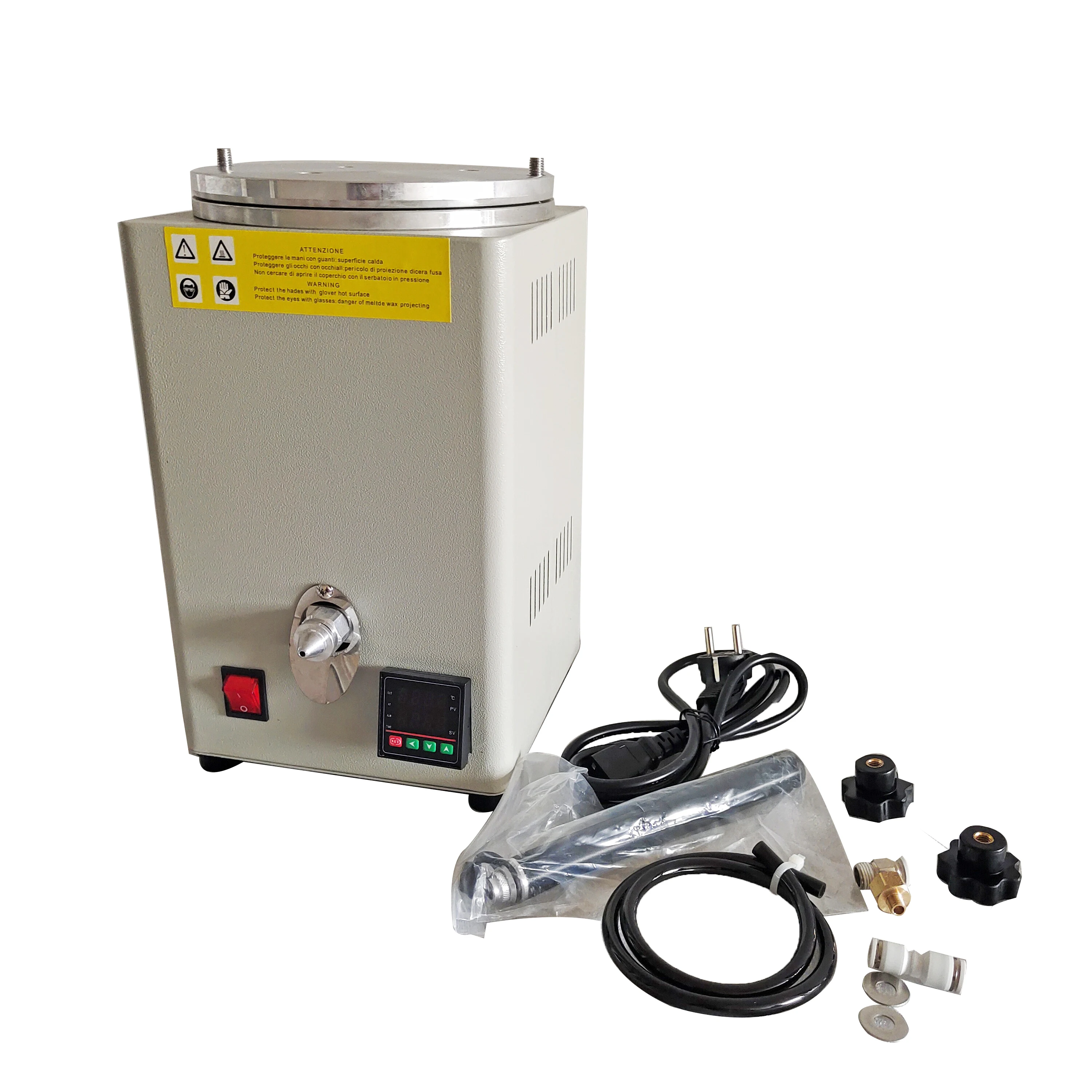
What the source record confirms
The TEBAK source record describes an automatic wax injection machine for jewelry casting, also referred to as a digital vacuum wax sprayer or small wax sprayer in the supplied description. The product ID is 1601252550162. The structured record provides seven confirmed fields. This guide keeps those fields separate from engineering information that must be confirmed by the supplier before an RFQ becomes a purchase order.
| Source field | Confirmed value | Procurement meaning |
|---|---|---|
| Ejector Force(kN) | 10kN | Declared ejector-force value; confirm the measurement point, actuator condition and whether it is maximum or working force. |
| Theoretical Shot Volume(cm³) | 20cm³ | Declared theoretical shot-volume value; confirm whether it refers to the injection chamber, one shot or a maximum setting. |
| Injection Rate (g/s) | 10g/s | Declared injection-rate value; confirm wax temperature, pressure, nozzle and measurement method. |
| Injection Weight (g) | 100g | Declared injection-weight value; confirm wax type, density, shot condition and whether it is maximum or nominal. |
| Weight (KG) | 5.5kg | Declared machine weight; confirm net or gross status and whether tooling, hopper, accessories or packing are included. |
| Open Stroke(mm) | 100mm | Declared opening stroke; confirm the moving component, usable mold clearance and end-stop reference. |
| Power (kW) | 0.5kW | Declared power value; confirm voltage, frequency, phase, current, plug and whether this is rated input or heater-only power. |
The queue does not provide a model number, wax-reservoir capacity, wax temperature range, pressure range, vacuum level, nozzle size, mold interface, cycle time, dimensions, control system, air supply, electrical voltage or frequency, material specification, certification, warranty or spare-parts list. These are RFQ confirmation items. Do not convert a title, product photograph or company profile into a complete machine datasheet.
Use product ID 1601252550162 on the quotation, nameplate photograph, technical drawing, sample test, inspection report, packing list and manual. The description contains several translated product names, so the supplier should confirm the exact machine identity and intended jewelry-wax workflow in writing.
1. Procurement identity and application scope
Use the exact procurement identity: TEBAK Automatic Wax Injection Machine Equipment for Jewelry Casting Making Pressure Wax Injector Vacuum Wax Casting Machine. Ask the supplier to confirm that the quoted unit corresponds to product ID 1601252550162 and to provide a model number or nameplate photo.
Clarify the intended process. Jewelry wax injection may involve wax preparation, heating, pressure or vacuum assistance, mold filling, cooling and demolding. The queue does not say whether this unit heats wax, injects preheated wax, creates vacuum, or combines several functions.
Ask the supplier to provide a labelled diagram showing wax chamber, heater, pressure chamber, nozzle, mold interface, controls, vacuum path, vents and moving parts.
Confirm the target jewelry applications: rings, pendants, earrings, chains, small ornaments, filigree work or other patterns. Different cavities and wax volumes can require different injection behavior.
Keep the product identity consistent across all documents. A “wax sprayer”, “wax injector” and “vacuum wax casting machine” may describe different configurations; do not approve a substituted device until the supplier explains the functional equivalence.
Ask whether the machine is intended for one mold at a time or a mold tree, whether the mold is clamped manually, and whether the buyer supplies a separate pressure vessel, compressor, vacuum pump or wax melter.
Request a complete list of included equipment. The source fields do not establish that a mold, nozzle set, wax tank, heater, vacuum pump, air regulator, hose, tooling or spare seal is included.
2. Ejector force and mold opening
The source lists an ejector force of 10kN. Ask the supplier to define whether this is injection ejector force, mold-ejection force, clamp force or another force value. The field label alone does not define the motion or acceptance test.
Request the force diagram, actuator type, stroke reference and operating condition. Confirm whether 10kN is maximum force, nominal working force, peak force or a force measured at a particular pressure.
Ask how force is limited to protect delicate rubber, silicone, metal or plaster tooling. The source does not identify the mold material or the force-control method.
The record lists a 100mm open stroke. Confirm whether this is the opening of a mold platen, an injector cylinder, a nozzle carriage or another moving element.
Request the usable mold clearance, maximum mold height, maximum mold width, alignment features and access area when the machine is open. Do not derive these values from the 100mm stroke.
Test the smallest and largest intended tooling. Record opening, closing, alignment, release, wax flash, mold damage and operator access.
Confirm end stops, interlocks, guarding and emergency stop behavior during opening and injection. A force value without a safety and control description is not enough for purchase approval.
Ask for repeatability of the open position and mold alignment after repeated cycles. Record the test method, number of cycles and acceptable variation.
3. Shot volume and injection weight
The structured record lists a theoretical shot volume of 20cm³ and an injection weight of 100g. These values need reconciliation because volume and mass depend on wax density, temperature, voids and the definition of one shot.
Ask whether 20cm³ is chamber volume, usable shot volume, maximum displacement or a theoretical calculation. Request the formula and measurement method.
Ask how the 100g injection weight was measured: wax type, density, temperature, pressure, nozzle, mold, shot condition, number of samples and whether the value is maximum, nominal or repeatable.
Do not assume 20cm³ of wax equals 100g for every wax formulation. Require the supplier to state the wax material and density used for the quoted value.
Provide the buyer's actual wax type and target shot weights. Test a low, medium and high shot within the planned production range.
Record fill completeness, short shots, flash, air marks, shrinkage, seam lines, surface detail and demolding quality. A larger shot weight does not automatically mean suitable filling of a complex jewelry cavity.
Confirm residual wax volume, dead volume, purge procedure and changeover loss. These affect material consumption and color or formulation changes.
Ask whether the machine supports programmable shot weight, manual adjustment, pressure adjustment or time-based injection. The queue does not provide a control method.
4. Injection rate and pressure behavior
The source lists an injection rate of 10g/s. Request the test conditions behind this figure, including wax temperature, wax formulation, pressure, nozzle, mold restriction and measurement location.
Clarify whether 10g/s is average rate, peak rate, free-flow rate, mold-filling rate or a controller setting. A rate measured without a mold may not represent production filling.
Ask for injection-pressure range, pressure accuracy, pressure ramp, hold stage, relief setting and response to a blocked nozzle or closed mold vent.
Test slow, normal and fast injection where the machine permits adjustment. Record surface detail, air entrapment, flash, turbulence, mold movement and wax temperature change.
For small jewelry cavities, a high rate may increase flash or air entrapment while a low rate may produce incomplete fill. Define the target result with a real buyer mold.
Confirm whether the supplier's 10g/s value is available at the stated 100g injection weight or only under a different shot condition.
Request a pressure and rate data sheet or test video tied to product ID 1601252550162. Do not use a generic injector test as evidence for this machine.
Define acceptance using completed wax patterns, not only a control-panel number. Record the actual weight, fill quality, cycle time and reject reason.
5. Wax heating and temperature control
The queue provides no wax temperature range, heater power allocation, sensor type, controller accuracy, warm-up time or heat-recovery data. Request these values before comparing suppliers.
Ask whether the machine has an integrated wax reservoir or requires an external melter. Confirm reservoir capacity, usable fill level, drain method, insulation and compatible wax forms.
Request heating method, heater location, over-temperature protection, sensor location, temperature display resolution and setpoint stability.
Define the wax temperature test with a calibrated instrument and a specified measurement location. The controller display may not equal the wax temperature at the nozzle.
Measure warm-up time, temperature recovery after repeated shots, top-to-bottom variation, nozzle temperature and behavior during idle periods.
Test the buyer's wax formulation at the supplier-recommended temperature. Record viscosity, fill, surface detail, flash, shrinkage and release.
Ask how the machine handles wax changeover, residue, color change, cleaning and solidification. Request a purge procedure and safe drain method.
Do not assume the machine can process every jewelry wax, paraffin blend, injection wax or recycled wax. Request a material compatibility statement.
6. Vacuum and air-system clarification
The title and description use “vacuum wax” wording, but the queue does not provide vacuum level, flow, pump type, air pressure or connection data. Ask the supplier to define whether vacuum is integrated, optional or not part of the quoted machine.
Request vacuum pump model, ultimate vacuum, operating vacuum, flow, connection size, cycle sequence and maintenance requirements if a pump is included.
If compressed air is required, request pressure range, consumption, inlet size, filtration, regulator, moisture separation and compressor requirements.
Clarify whether air or vacuum acts on the wax chamber, mold, pressure vessel or another path. Request a process diagram and valve sequence.
Test the effect of vacuum on air bubbles, fine detail, surface quality and fill completeness using a buyer mold. Record vacuum level at the mold, not only at the pump.
Ask about vacuum leaks, seal replacement, hose compatibility and safe venting. Do not assume a vacuum label proves the machine can achieve a particular vacuum.
Confirm whether the buyer must purchase a separate vacuum pump, compressor, regulator, hose and filter. List these separately in the quotation.
Do not specify a vacuum casting workflow in the purchase order until the supplier confirms the actual included configuration.
7. Nozzle, mold interface and pattern quality
Request nozzle diameter, nozzle material, heating or insulation, replacement method, alignment, sealing surface and compatibility with the buyer's sprue or gate design.
Confirm whether the nozzle is fixed, adjustable or interchangeable. Ask for the available nozzle set and the price and lead time of replacements.
Provide mold interface drawings: gate location, sprue dimensions, mold support, clamping arrangement, alignment pins, sealing surface and maximum mold envelope.
Test fine details, thin sections, sharp corners and long flow paths. Record incomplete fill, weld lines, flash, distortion, surface marks and trapped air.
Check wax pattern dimensions against the buyer's master or CAD reference. Measure shrinkage after cooling and document the measurement timing.
Confirm whether the machine supports mold preheating, mold cooling, release agent use or a specific mold orientation. The source does not provide these functions.
Ask for pattern-quality criteria and a sample set. A product image is not evidence of repeatable jewelry pattern quality.
Define the acceptance sample as the buyer's actual mold and wax. Include photos, weights, dimensions and defect limits in the purchase record.
8. Power, controls and electrical safety
The source lists power of 0.5kW but provides no voltage, frequency, phase, current, plug or cable information. Request a complete nameplate and wiring specification.
Ask whether 0.5kW is total rated input, heater power, motor power, pump power or a nominal consumption value. Confirm the power required by any external pump or compressor separately.
Request rated current, circuit protection, fuse, grounding, leakage protection, plug type, cable length, switch rating and voltage tolerance.
Confirm the control interface: digital display, pressure adjustment, temperature setting, shot timer, manual trigger, foot pedal, emergency stop and alarm functions.
Ask whether settings are saved, whether the machine has password or recipe control, and whether the operator can accidentally exceed safe pressure or temperature.
Request wiring diagrams and model-specific electrical documentation. Do not infer compliance from the supplier's general ISO9001 statement in the description.
Verify the destination-market plug and local electrical requirements with the buyer's electrician. Do not assume 0.5kW identifies the installation circuit.
Test power-on, heating, injection, vacuum, emergency stop, restart and fault behavior during acceptance.
9. Weight, footprint and workshop planning
The source lists machine weight of 5.5kg. Confirm whether this is net machine weight, whether it includes wax chamber, nozzle and controls, and whether it excludes packing and accessories.
The queue does not provide machine dimensions, working height, open clearance, mold clearance or bench requirements. Request a dimensioned drawing before planning the workstation.
Confirm center of gravity, lifting points, bench stability, vibration, fixing feet and the space required for mold loading and wax cleaning.
Plan safe access to hot surfaces, moving parts, pressure lines, vacuum lines and electrical controls. A light machine may still need secure mounting if injection force or hose movement is present.
Request packed dimensions and gross weight for shipping and site access. Do not use 5.5kg as a transport-package weight.
Check door, lift, bench and storage access. Include space for wax, molds, cleaning tools, spare seals and personal protective equipment.
Ask whether the machine can be operated on a standard bench or requires a dedicated frame. The product image does not establish the support requirement.
10. Jewelry production and process validation
Define the production process around actual wax patterns. Record wax formulation, mold material, mold temperature, wax temperature, pressure, vacuum, shot weight, injection rate, cooling time and demolding method.
Test repeatability across the first shot, steady-state shots, a new wax fill, a mold change and a shift change. Record all adjustments.
Use a sample set that includes thin walls, heavy sections, fine details, textured surfaces and the largest planned shot. Measure fill completeness and pattern integrity.
Record scrap causes: short shot, flash, air bubble, deformation, crack, shrinkage, contamination, incorrect weight, wrong dimension or difficult release.
Calculate accepted patterns per hour only after including loading, mold change, purge, cleaning and rejected pieces. Do not infer output from 10g/s or 100g alone.
Ask the supplier to repeat the test with the buyer's master mold or an agreed equivalent. Generic sample jewelry does not prove compatibility with the buyer's design.
Keep a process sheet that identifies product ID 1601252550162, machine model, wax batch, mold ID and operator. This supports traceability during production.
Define a change-control procedure for wax type, nozzle, pressure, temperature, mold, vacuum and shot weight.
11. Maintenance and consumables
Request a maintenance schedule for seals, hoses, nozzle, heater, temperature sensor, pressure components, vacuum components, filters, switches and moving parts.
Ask for spare-part numbers, prices and lead times. Identify which parts are consumables and which require trained service.
Confirm cleaning steps for the wax chamber, nozzle, mold interface, pressure path, vacuum path and work surface.
Ask how to remove solidified wax without damaging the nozzle, sensor, seal or coating. Define safe isolation before cleaning.
Request troubleshooting for slow injection, unstable temperature, low pressure, vacuum loss, leakage, incomplete fill, flash and abnormal noise.
Confirm whether seals, hoses and nozzles are standard sizes or proprietary parts. Keep a minimum spare stock for production-critical components.
Record machine hours, wax batches, maintenance, part replacement and quality results. Link every service record to the machine model and product ID.
Confirm remote support, service response time, warranty coverage and exclusions for wax residue, overheating, incorrect material or unauthorized modification.
12. Safety and compliance
Request model-specific safety documents for hot wax, pressure, vacuum, electrical power, moving parts and mold handling.
Identify burn risks at the wax chamber, nozzle, heater, mold and hot surfaces. Define protective equipment, warning labels and safe cooling time.
Identify pressure hazards and request pressure relief, rated components, hose protection and inspection requirements.
Identify vacuum implosion or hose-collapse risks where applicable. Request safe venting and pump isolation procedures.
Use appropriate eye, hand and clothing protection for hot wax and jewelry mold handling. The exact PPE should follow the supplier's safety data and the buyer's workplace assessment.
Ask for electrical grounding, insulation, over-temperature protection, emergency stop and restart behavior.
Request destination-market certification and declarations only for the quoted model. Do not reuse a certificate for another machine or a general company certificate as product evidence.
Keep safety data sheets for the wax and cleaning materials separate from the machine documentation.
13. Acceptance test before shipment
Write an acceptance test around product ID 1601252550162 and the supplier-confirmed model. Include the seven source fields as declared baseline values, not as a substitute for test conditions.
Verify the nameplate, power statement of 0.5kW, declared 10kN ejector force, 20cm³ theoretical shot volume, 10g/s injection rate, 100g injection weight, 5.5kg weight and 100mm open stroke.
Request the supplier to explain how each value was measured and record the measuring instrument, test wax, temperature, pressure, mold and sample size.
Run the buyer's wax and mold. Record shot weight, injection rate, fill quality, pattern dimensions, flash, air marks, shrinkage and release.
Check temperature, pressure, vacuum, controls, emergency stop, guarding, seals, hose connections, nozzle alignment and electrical safety.
Test the largest and smallest planned mold configurations within the supplier-confirmed clearance.
Photograph the machine, nameplate, wax chamber, nozzle, mold interface, controls, test patterns and packing. Attach the signed report to the purchase order.
Define remedies for wrong model, missing accessories, failed injection weight, unstable rate, inadequate fill, unsafe temperature, leakage or missing documents.
14. Packing, delivery and commercial terms
Request packed dimensions and gross weight. The declared 5.5kg machine weight is not sufficient for transport planning.
Ask for moisture protection, impact protection, nozzle protection, seal protection, lifting instructions and package markings.
Request a packing list naming machine body, wax chamber, nozzle, controls, hoses, molds or mold supports, tools, manual and spare parts.
Confirm whether the machine is assembled or requires installation of nozzle, hoses, controls, pump, regulator or support fixtures.
Match carton markings to product ID 1601252550162 and the supplier-confirmed model. Photograph the package before dispatch and on arrival.
Confirm price, MOQ, lead time, shipping term, insurance, duties, destination delivery, warranty, spare parts and service response in writing.
Keep title, product description, technical datasheet, drawing, sample test and commercial terms together. Resolve contradictions before payment or production scheduling.
15. Commercial comparison framework
Compare complete working systems rather than only the seven headline values. List wax heater, pressure source, vacuum source, nozzle, controls, mold interface, hoses, safety parts, tools, documents and service.
Ask every supplier to run the same wax, mold, shot weight, temperature, pressure and acceptance criteria. A generic wax pattern cannot support a fair comparison.
Separate declared values from verified performance. The current baseline includes 10kN, 20cm³, 10g/s, 100g, 5.5kg, 100mm and 0.5kW, but conditions and definitions are not supplied.
Review the cost and lead time of nozzles, seals, heaters, sensors, hoses and controllers. A low initial price can be offset by unavailable consumables.
Check warranty exclusions for wax contamination, blocked nozzle, overheating, incorrect voltage, unauthorized repair, unsuitable wax and mold damage.
Do not treat a general company profile, product image or ISO9001 statement as proof of this machine's shot performance, safety or certification.
16. RFQ checklist
- Confirm product ID 1601252550162 and exact model number.
- Explain how 10kN ejector force is defined and measured.
- Define 20cm³ theoretical shot volume and its calculation basis.
- Define 10g/s injection rate and provide wax, pressure, nozzle and mold conditions.
- Define 100g injection weight and provide wax density, temperature and test method.
- Confirm 100mm open stroke, moving component, mold clearance and end-stop reference.
- Confirm 5.5kg net or gross weight and provide assembled and packed dimensions.
- Confirm 0.5kW total input or component power and provide voltage, current, frequency, phase, plug and grounding.
- Provide wax temperature, pressure, vacuum, reservoir, nozzle and control specifications.
- Provide mold interface drawing and a test with the buyer's wax and mold.
- Provide food or workshop safety documents, certification, warranty and spare-parts list.
- Attach the signed acceptance test to the purchase order.
17. Questions for the supplier
What exact model corresponds to product ID 1601252550162, and can you provide a nameplate photograph?
Is the 10kN value ejector force, clamp force, injection force or another force? What are its test conditions?
Does 20cm³ mean usable shot volume or theoretical chamber volume? What wax density and calculation are used?
How is 10g/s measured, and does the value apply to the buyer's wax, nozzle, pressure and mold?
How is 100g injection weight measured? Is it maximum, nominal or repeatable, and under what wax condition?
What component has the 100mm open stroke, and what mold height and clearance are available?
Is 0.5kW total rated input, heater power or another value? What electrical supply and plug are required?
Is vacuum integrated? If so, what are vacuum level, flow, pump, connection and maintenance requirements?
What wax temperature range, pressure range, reservoir capacity, nozzle sizes and control functions are included?
Which surfaces, seals, hoses, heaters and sensors are included, and what are the spare-part prices and lead times?
18. What not to assume
Do not assume the machine has a particular model number because none is present in the structured queue fields.
Do not assume 10kN identifies a specific actuator, clamp system or working-force range.
Do not assume 20cm³ and 100g describe every wax formulation or every mold.
Do not assume 10g/s is a production filling rate without wax, pressure, nozzle and mold conditions.
Do not assume 100mm stroke proves a particular mold clearance or usable jewelry-tooling size.
Do not assume 0.5kW identifies voltage, current, frequency, phase, plug or total system consumption.
Do not assume “vacuum wax” proves an integrated vacuum pump or a defined vacuum level.
Do not assume the 5.5kg value is gross shipping weight or that the machine needs no secure mounting.
Do not approve the injector without testing the buyer's wax, mold, shot weight, temperature and quality criteria.
19. Final procurement decision
The source-confirmed baseline for this TEBAK automatic wax injection machine is product ID 1601252550162, with declared ejector force 10kN, theoretical shot volume 20cm³, injection rate 10g/s, injection weight 100g, machine weight 5.5kg, open stroke 100mm and power 0.5kW.
Proceed to purchase only after the supplier confirms model identity, the meaning and test conditions of each declared field, wax heating and pressure behavior, vacuum configuration, nozzle and mold interface, electrical requirements, safety documents, dimensions, packing, spare parts and commercial terms. The purchase order should identify product ID 1601252550162 and attach the signed buyer-mold test.
Editor's note: This guide uses the supplied Hoting queue fields and product image, preserves the stated units and HTML entities, and marks all unreturned engineering, safety and commercial information as supplier-confirmation items.
Key specifications
- Ejector Force(kN)
- 10kN
- Theoretical Shot Volume(cm³)
- 20cm³
- Injection Rate (g/s)
- 10g/s
- Injection Weight (g)
- 100g
- Weight (KG)
- 5.5kg
- Open Stroke(mm)
- 100mm
- Power (kW)
- 0.5kW
Frequently asked questions
- What specifications are confirmed for this wax injector?
- The source lists 10kN ejector force, 20cm³ theoretical shot volume, 10g/s injection rate, 100g injection weight, 5.5kg weight, 100mm open stroke and 0.5kW power.
- Does 0.5kW provide the complete electrical specification?
- No. Confirm voltage, current, frequency, phase, plug, grounding and whether 0.5kW is total input or a component rating.
- What does 20cm³ shot volume mean?
- The field is marked theoretical. Confirm whether it is chamber volume, usable shot volume or a maximum setting, and state the wax density used.
- Is vacuum equipment included?
- The title uses vacuum-wax wording, but the queue does not provide pump, vacuum level or connection data. Request an included-equipment list and process diagram.
- What should the RFQ include?
- Include model identity, force and shot tests, wax conditions, temperature, pressure, vacuum, nozzle, mold interface, electrical data, safety, spare parts and warranty.