
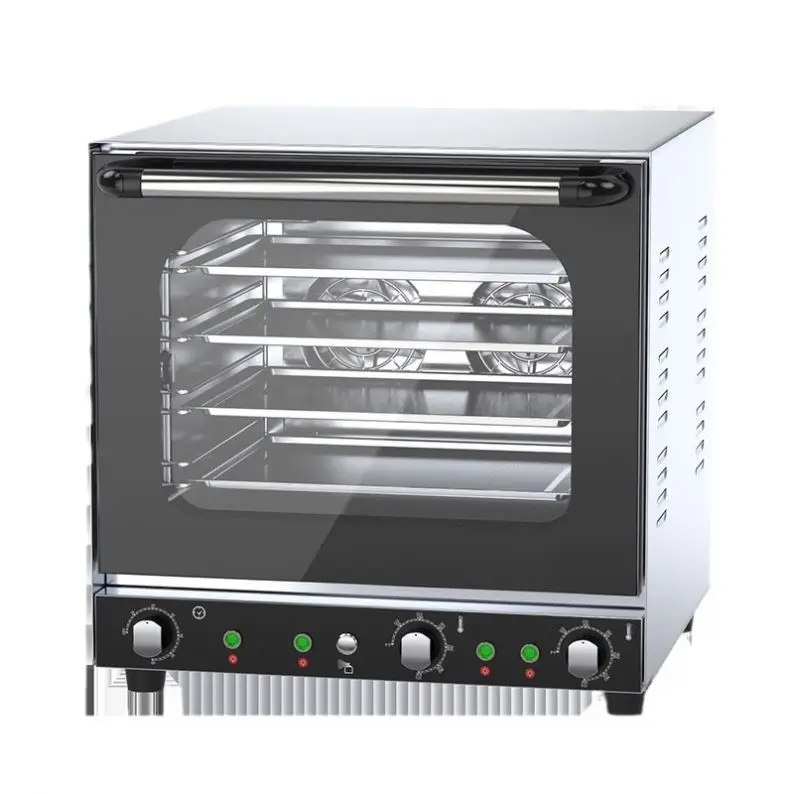
Source-controlled product identity
The Hoting queue record identifies a TEBAK bakery countertop bread and cake electric convection oven. Its structured fields record a 220V electrical version, 4.4KW power, 35KG net weight, 45kg gross weight, foam plus wooden-crate packing, a 73X77X70 cm single-package size, a single oven, 4400W power, temperature control, convection/turbo oven type, kitchen cooking and baking use, and Motor and Pump as core components. The record also lists Year 2023 and Automatic as a key selling point.
These fields are the starting point for an RFQ, not a complete commercial-oven datasheet. The source does not provide cavity dimensions, tray count, tray size, temperature range, temperature uniformity, heating-element layout, fan speed, steam function, timer range, insulation, door construction, phase, plug, current, certification, MOQ, lead time or warranty. Those items must be confirmed for the exact production configuration.
Product ID 1601276257926 should appear on the quotation, nameplate, controller, inspection report and packing list. This guide is intended for bakery distributors, cafés, restaurants, hotel kitchens, central kitchens, pastry classrooms and small food-production sites evaluating a compact single-deck electric convection oven.
Verified fields and open RFQ items
| Information | Recorded value or status | Buyer action |
|---|---|---|
| Product ID | 1601276257926 | Require the same ID on quotation, nameplate, inspection report and shipment documents. |
| Voltage | 220V | Confirm frequency, phase, current, plug, cable, breaker and destination electrical requirements. |
| Power | 4.4KW and Power (W) 4400 | Confirm rated input, measured current, tolerance, heating-element configuration and circuit requirement. |
| Net weight | 35KG | Confirm whether this includes trays, accessories, controller and removable parts. |
| Gross weight | 45kg | Confirm packing list, crate construction, lifting points and freight calculation. |
| Single package size | 73X77X70 cm | Use for logistics planning; separately request machine footprint and operating clearances. |
| Packing | Foam + wooden crate | Specify moisture protection, shock protection, markings, pallet and damage inspection procedure. |
| Number of ovens | Single | Confirm cavity count and whether the listing is a single deck, one chamber configuration. |
| Type | Convection Oven / Turbo Oven | Confirm fan arrangement, airflow direction, circulation mode and measured baking uniformity. |
| Function | Temperature control | Request temperature range, resolution, sensor, stability, alarm and calibration procedure. |
| Core components | Motor; Pump | Clarify each component's function; do not infer steam capability from the word pump. |
| Year | 2023 | Confirm current production revision, component changes, manual revision and spare-parts status. |
| Automatic | Key selling point | Define which functions are automatic: temperature, timer, fan, heating, steam or shutdown. |
Define the bakery process first
Select the oven from the products, batch size, tray format, target temperature, bake time, humidity requirement, daily cycles and available electrical service. Bread, cakes, cookies, pastries and roasted foods respond differently to airflow, heat recovery, humidity and loading pattern.
Write the requirement as a repeatable test: product formula, dough or batter mass, tray material, tray count, spacing, target temperature, preheat condition, bake time, color, internal temperature, moisture target and acceptable variation. Do not approve a commercial oven because its title contains both “bread” and “cake.”
For a café or restaurant, prioritize footprint, recovery after door opening, cleaning and operator training. For a bakery distributor, define the tray standard, electrical variant and service package as separate SKU options. For a classroom, prioritize guarding, clear controls, emergency isolation and documented operating limits.
Countertop size versus operating space
The recorded single-package size is 73X77X70 cm. This is a packing dimension, not necessarily the machine footprint or the minimum installation space. Request the unpacked width, depth, height, door swing, rear clearance, side clearance, top clearance, cable exit and service access.
Measure the receiving doorway, lift, stairway, counter, floor loading and final installation route. Confirm whether the 35KG net weight includes the trays, feet, handles, fan guard and controller. The 45kg gross weight should be matched to the actual crate and lifting plan.
Place the oven on a level, non-combustible support designed for its operating weight and heat. Do not cover ventilation openings or place combustible materials above the appliance. Ask the supplier for required clearances and surface-temperature data.
During incoming inspection, photograph the crate, product label, machine dimensions, feet, door and control panel. Record damage before removing the wooden crate and compare all accessories with the packing list.
220V and 4.4KW electrical verification
The source records 220V, 4.4KW and Power (W) 4400. It does not record frequency, phase, rated current, plug, cable, breaker or tolerance. Treat 4.4KW as the listed rated power, not as a guarantee of continuous measured consumption in every operating state.
Request the exact nameplate and electrical diagram. Confirm whether the 220V version is single-phase or another configuration, and verify the destination supply before ordering. Ask for current, recommended protection, earthing, insulation, cable cross-section, plug type and residual-current requirements.
Do not select an adapter or extension cable from the title. A qualified electrician should verify the circuit and protective devices. Record nameplate values, measured voltage and operating current during the factory or site acceptance test.
Test start-up, steady heating, fan operation, controller switching, door opening, recovery and shutdown. Check that abnormal temperature, sensor failure and power loss lead to the documented safe state and that restart follows the intended operator procedure.
Temperature control and baking uniformity
Temperature control is recorded, but no range, resolution, sensor type, stability, tolerance or calibration method is supplied. Request these values in the quotation and manual for the exact controller.
Clarify whether the displayed temperature represents the sensor location, chamber average, air temperature or an estimate. Ask where the sensor is mounted and how the supplier validates the displayed value.
Run a mapping test with calibrated probes at multiple cavity positions. Record preheat time, overshoot, recovery after door opening, corner-to-corner variation and temperature during a stable hold. Baking uniformity should be assessed with the intended tray and load, not only with an empty chamber.
Repeat the test at more than one setpoint and with the intended product. Record product color, internal temperature, moisture or texture criteria where applicable. Do not claim uniform baking without a defined test method.
Convection fan, motor and pump
The type is listed as Convection Oven / Turbo Oven and Motor and Pump appear as core components. The source does not identify fan diameter, speed, airflow, motor rating, pump purpose or whether the pump serves steam, drainage or another subsystem.
Ask the supplier to identify every core component and provide a functional diagram. Confirm whether the fan runs continuously, cycles with the heater, supports multiple speeds or changes direction. Request the motor model, service part, voltage, power, bearings and maintenance instructions.
Do not infer steam injection from the word “Pump.” Ask whether the oven has a water inlet, tank, drain, steam generator, humidity setting, water-quality requirement and cleaning procedure. If no steam function exists, document that clearly in the purchase specification.
Test airflow without and with the intended trays. Check fan noise, vibration, rotation, door-open interlock, heating recovery and cleaning access. Confirm that the fan guard and moving parts are protected during normal operation.
Automatic functions
Automatic is recorded as a key selling point, but it does not define the machine's actual automation. Ask whether automatic operation covers temperature regulation, timer, fan, heating stages, steam, alarm, preheat completion, shutdown or recipe memory.
Request a control-panel photograph, operating sequence and manual. Define the operator steps from cold start to preheat, loading, bake, hold, alarm, end-of-cycle and shutdown.
Test timer accuracy, end-of-cycle behavior, alarm audibility, door opening behavior, sensor failure, over-temperature protection and restart after power loss. Record whether the heater and fan stop in the expected sequence.
For a shared commercial kitchen, confirm whether controls can be locked, whether recipes are stored and whether the interface can be operated safely with heat-resistant gloves. Do not claim “fully automatic” unless the supplier defines the covered functions.
Cavity, trays and product fit
The source records a single oven but does not provide cavity dimensions, tray count, tray size, rail spacing, door opening or usable height. Request the internal drawing and tray specification.
Confirm the tray material, edge dimensions, rack positions, loading clearance and maximum product height. Test the buyer's actual trays rather than assuming a common bakery standard.
Ask whether trays are included, optional or customer-supplied. Record the part number, material, thickness, coating, cleaning method and replacement price. Include the required number of trays and racks in the RFQ.
Check door sealing, hinge alignment, handle temperature, viewing window if present and safe loading posture. Measure heat loss and recovery after a representative door opening.
Cleaning, maintenance and food-contact decisions
The source does not identify interior material, coating, gasket, drain, removable rack, cleaning chemicals or sanitation procedure. Request a complete cleaning and maintenance schedule.
Inspect the cavity for accessible corners, seams, fan guard, heater protection and removable parts. Ask how grease, flour, sugar, crumbs and condensation are removed without damaging sensors, heaters or the motor.
Clarify whether any pump or water circuit requires filtration, descaling, drainage or sanitation. Do not use a water or steam function until the supplier provides its operating and cleaning limits.
For commercial food operations, obtain the documents and declarations required in the destination market for the exact machine and food-contact accessories. Do not claim food-contact compliance, CE or other certification unless the supplier supplies and verifies the relevant documents.
Packaging, freight and incoming inspection
The recorded packing method is foam plus wooden crate, with a 45kg gross weight and 73X77X70 cm single-package size. Confirm whether the wood is treated and marked where required by the destination's import rules.
Request crate construction, moisture barrier, shock protection, corner protection, lifting points and carton or crate markings. Match the packing list to the order: oven body, trays, racks, power cable, controller parts, pump or water components, manuals and spare parts.
Inspect the crate before opening. Photograph impact damage and moisture. After unpacking, verify the nameplate, door, cavity, fan, controls, motor, pump, cable, feet, trays and accessories before energizing the oven.
Ask for replacement heaters, sensors, motors, fans, pumps, gaskets, controllers, trays and door parts as applicable. None of these service details is complete in the source record and should be specified before purchase.
Factory acceptance test proposal
- Verify product ID 1601276257926, exact model, nameplate and 220V configuration.
- Record unpacked dimensions, footprint, door swing, clearances, net weight and lifting points.
- Confirm 4.4KW and 4400W fields against measured nameplate power and operating current.
- Verify frequency, phase, cable, plug, breaker, earthing and destination electrical requirements.
- Inspect cavity, tray rails, door seal, hinge, handle, insulation, fan guard and heater layout.
- Identify motor and pump functions, models, ratings, maintenance and replacement parts.
- Verify controller range, sensor location, resolution, alarms, timer, automatic functions and calibration.
- Map temperature at multiple cavity positions during preheat, hold, loading and recovery.
- Run bread, cake or agreed product tests with defined tray, load, setpoint and acceptance criteria.
- Record bake time, color, internal temperature, moisture or texture, variation and recovery.
- Test door opening, fan behavior, over-temperature, sensor failure, power loss and end-of-cycle shutdown.
- Review cleaning, food-contact, electrical, EMC, warranty, spare parts and packing documents.
RFQ checklist
- Product ID 1601276257926 and exact production nameplate photograph.
- 220V version: frequency, phase, rated current, plug, cable, breaker, earthing and insulation.
- 4.4KW / 4400W: rated input, measured current, tolerance and heating-element layout.
- Unpacked footprint, cavity dimensions, tray count, tray size, rail spacing and clearances.
- Single-oven configuration, door, window, seal, hinge, handle and insulation specification.
- Convection airflow, fan speed, fan direction, motor model, noise, vibration and maintenance.
- Pump function: steam, water, drain or other; include inlet, tank, filtration and cleaning data.
- Temperature range, setpoint resolution, sensor, stability, uniformity, recovery and calibration.
- Automatic functions: preheat, timer, heating, fan, steam, alarm, recipes and shutdown.
- Product test: bread, cake or buyer-selected product with tray, load, time and acceptance criteria.
- Interior materials, cleaning method, removable parts, gasket, drain and sanitation instructions.
- Year 2023 revision, current production changes, manual revision and spare-parts availability.
- Foam plus wooden-crate packing, gross weight 45kg, package size 73X77X70 cm and wood treatment.
- MOQ, sample cost, lead time, warranty, service, inspection terms and destination-market documents.
Buyer decision framework
This is a single-oven TEBAK convection/turbo-oven listing with a useful set of recorded fields: 220V, 4.4KW, 4400W, 35KG net weight, 45kg gross weight, foam plus wooden-crate packing, 73X77X70 cm single-package size, temperature control, Motor and Pump core components, and kitchen cooking/baking use. Approve it only after the supplier resolves cavity and tray data, electrical phase/current, controller performance, airflow, pump function, automatic functions, cleaning and destination-market documentation.
For a bakery distributor, sell the electrical and tray configuration as a defined SKU. For a café, prioritize recovery, footprint, cleaning and operator workflow. For a pastry kitchen, use product-specific mapping tests rather than relying on an empty-chamber temperature. For a school or shared kitchen, prioritize guards, alarms, emergency isolation and clear operating instructions.
Frequently asked questions
Is the oven truly industrial?
“Industrial” appears in the listing title, but the source does not define duty cycle, production capacity, service interval or continuous-use rating. Request those values before positioning it for industrial production.
What does 4.4KW mean?
The source records both Power 4.4KW and Power (W) 4400. Confirm that these are the same rated input, then verify current, phase, cable, plug and protection requirements for the 220V version.
Does the pump provide steam?
Pump is listed as a core component, but its function is not stated. Confirm whether it supports steam, water, drainage or another subsystem before including steam baking in the specification.
How many trays fit?
The source records a single oven but no tray count, tray size or rail spacing. Request the cavity drawing and test the buyer's intended trays.
Is Automatic the same as fully automatic?
No. Automatic is a key selling point only. Confirm each automatic function, including temperature, timer, fan, steam, alarm, recipe and shutdown behavior.
Source and contact
This guide is based on the Hoting queue record for product ID 1601276257926. Its recorded fields include 220V, 4.4KW, 35KG net weight, 45kg gross weight, foam plus wooden-crate packing, 73X77X70 cm single-package size, temperature control, single oven, 4400W, convection/turbo oven type, kitchen cooking/baking use, Motor and Pump core components, Year 2023 and Automatic as a key selling point. Before purchase, request the current quotation, exact datasheet, cavity drawing, tray data, electrical diagram, controller manual, test report, cleaning instructions, compliance documents, packing list, spare-parts offer, warranty and final machine photographs. For sourcing questions, contact the TEBAK sales team through the site's current inquiry channel.
Key specifications
- Core Components
- Motor
- Voltage
- 220V
- Power
- 4.4KW
- Weight
- 35KG
- Year
- 2023
- Key Selling Points
- Automatic
- Gross weight
- 45kg
- Packing
- Foam +wooden crate
- Core Components
- Pump
- Single package size
- 73X77X70 cm
- Function
- temprature control
- Number of Ovens
- Single
- Power (W)
- 4400
- Type
- Convection Oven / Turbo Oven
- Usage
- Kitchen Cooking\Baking