
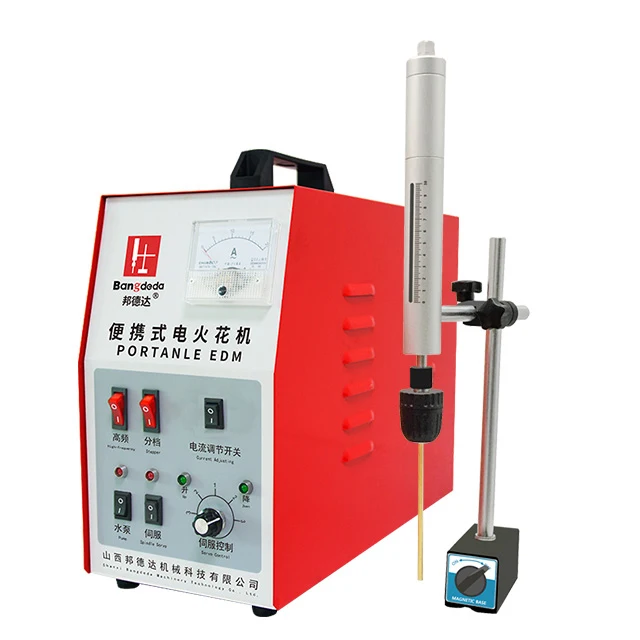
Source-controlled product identity
The Hoting queue identifies Product ID 1601247943879 as a TEBAK BD-500A small EDM erosion machine. The source title describes a portable broken-wire and broken-bolt removal machine, a small-hole EDM forming drilling machine and a portable mini automatic EDM wire-taking drilling machine.
The source record contains no structured technical parameters. It does not establish hole diameter, electrode size, stroke, workpiece envelope, discharge current, voltage, pulse settings, dielectric system, accuracy, removal rate, input power, weight or certification. These items are kept as supplier-confirmation and acceptance-test requirements.
This guide is for B2B buyers evaluating compact EDM equipment for broken-bolt removal, broken-wire extraction, small-hole drilling and repair work. It focuses on the actual repair workflow, access, workpiece protection, dielectric management, electrical safety, repeatability and serviceability without turning title wording into verified performance.
Recorded information and procurement status
| Field | Recorded source information | Procurement status |
|---|---|---|
| Product ID | 1601247943879 | Keep this ID on the quotation, sample request, inspection report and shipping documents. |
| Brand | TEBAK | Confirm exact model marking, revision and supplied configuration. |
| Model wording | BD-500A | Confirm whether the offer is BD-500A, BD-500C or another closely named revision. |
| Technology wording | EDM erosion / small-hole EDM drilling | Request the electrical operating principle, electrode system and parameter range. |
| Application wording | Broken wire and broken bolt removal | Validate with buyer-provided failed parts and define acceptable removal and surface results. |
| Portability wording | Portable / mini automatic | Confirm actual dimensions, mass, handles, mounting and whether a separate power unit is required. |
| Hole capability | Not supplied | Request minimum/maximum hole range, electrode sizes, depth, aspect ratio and tolerance. |
| Electrical data | Not supplied | Confirm input voltage, power, discharge current, pulse controls, grounding and protection. |
| Workpiece data | Not supplied | Confirm size, mass, material, access, clamping and allowable surface condition. |
| Compliance | Not supplied in the source record | Request electrical, EMC, safety, user manual and destination-market documents. |
Define the repair job before selecting the EDM
A broken-bolt or broken-wire removal job is not defined by the word “portable.” Record the failed part material, original fastener size, break location, exposed length, access direction, surrounding features, required removal depth and the result expected after extraction.
For a broken bolt, specify whether the goal is to remove the entire remaining shank, open a pilot hole, preserve the original thread, prepare for an extractor or repair a damaged hole. These outcomes require different electrode sizes and finishing steps.
For broken-wire extraction, record wire diameter, material, tension, break location, surrounding die or guide, allowable contact marks and whether the wire must be removed without disturbing the workpiece.
For small-hole drilling, specify hole diameter, depth, straightness, position tolerance, entry and exit condition, material hardness and the required hole finish. Do not use “small-hole EDM” as a substitute for a numeric specification.
Send representative failed parts or dimensioned drawings with the RFQ. A supplier's demonstration on a different metal, diameter or access condition does not validate the buyer's repair job.
Model identity and configuration control
The queue title uses BD-500A, while the description wording mentions BD-500C. Treat this as a configuration-control issue. Ask the supplier to confirm the exact model shown on the nameplate, quotation, manual, packing list and inspection report.
Request photographs of the nameplate, controller, spindle or electrode holder, workpiece fixture, cable set, dielectric system and accessories. Confirm whether the BD-500A and BD-500C names refer to different power units, automation levels or regional listings.
Keep the model, revision, serial number and software or controller version in the purchase record. Do not accept a substitute model based only on a similar title.
Ask which components are included: EDM power supply, electrode holder, guide, dielectric tank, pump, filter, work light, control panel, fixture, cables, spare electrodes, tools and manuals.
Confirm whether “automatic” means automatic feed, automatic depth stop, pulse control, servo control, or only an automated part of the drilling sequence. Request a functional description and test procedure.
Electrical and EDM process requirements
No input voltage, rated power, discharge current, pulse frequency, pulse duration or polarity is supplied. Request the full electrical specification for the destination site.
Ask for the available current and voltage ranges, pulse-on and pulse-off settings, polarity options, servo or feed control, short-circuit response, open-circuit behavior and overload protection.
Define the permitted material range. EDM depends on electrical conductivity and thermal behavior; do not assume that a machine described for bolts can process every alloy, coating or nonconductive material.
Request an explanation of the electrode system, including tubular or solid electrodes, electrode diameters, lengths, runout, chuck or collet, guide method and replacement procedure.
Confirm whether the unit requires a dedicated circuit, grounding, residual-current protection, ventilation or a separate cooling system. Test leakage, grounding and emergency stop behavior before production use.
Record the process settings and actual current during the acceptance test. A stable display value should be compared with measured electrical data where practical.
Workpiece access, clamping and preservation
Portable repair equipment must reach the failure without damaging adjacent features. Provide the smallest access opening, obstruction height, angle, clamping area and available clearance.
Ask for the working envelope, maximum workpiece height, maximum mass, fixture dimensions, electrode travel, guide clearance and usable stroke. None of these values are in the source record.
Confirm how a large die, mold, shaft, machine base or installed component is supported. If the unit is portable, define how it is positioned and held against vibration or movement.
Test the machine on a representative part while monitoring contact with threads, sealing surfaces, guideways, hardened inserts and nearby edges. Record any heat tint, pitting, recast layer or unintended marks.
Define the allowable surface condition after removal. The buyer may require thread preservation, minimal burr, controlled hole diameter or a defined post-EDM cleaning step.
Ask whether the machine can be used on an installed component or only on a removed workpiece. Confirm dielectric containment and chip or sludge collection in each situation.
Hole size, depth and accuracy confirmation
The source provides no hole diameter, depth or accuracy. Request a table linking electrode diameter, usable hole diameter, maximum depth, aspect ratio, material and expected tolerance.
Test at the buyer's target diameter and depth, not only at an easy demonstration setting. Measure entry diameter, exit diameter, taper, position, straightness and surface condition.
For broken-bolt removal, confirm the smallest pilot hole that can be made without touching the surrounding thread. Use a calibrated pin gauge, optical measurement or another agreed method.
For small-hole applications, specify whether the hole is through or blind, whether flushing is required and how the bottom is detected. Confirm automatic stop and overtravel protection.
Define electrode wear and compensation. A nominal electrode diameter does not automatically equal the final hole diameter after erosion.
Repeat the test on multiple parts to distinguish one successful result from repeatable capability. Attach measured data and process settings to the acceptance record.
Dielectric, flushing and waste management
Request the dielectric type, viscosity or conductivity limits, tank volume, filtration, pump, flow, flushing pressure, drain method and compatible seals or hoses.
Confirm whether the machine uses EDM oil, deionized water or another dielectric. Do not infer the medium from the word “EDM” or from the product image.
Ask how the dielectric is contained when the machine is used on a large or installed part. Define spill control, fire precautions, ventilation, storage and waste disposal.
Inspect flushing around the electrode and workpiece. Poor flushing can cause unstable discharge, slow removal, short circuits, debris retention and poor hole quality.
Record dielectric condition before and after the test. Request filter replacement intervals and a method to remove metal particles and sludge.
Confirm whether the system includes a leak tray, level sensor, pump protection, overflow control and safe shutdown when flow is lost.
Broken-bolt and broken-wire workflow
Document the part condition before setup: material, hardness, diameter, break depth, corrosion, surrounding threads, coatings and accessibility. Photograph the area and record the repair objective.
Center the electrode or guide using a documented method. Check alignment before energizing and confirm that the electrode will not contact the surrounding thread or guide surface.
Use a conservative pilot strategy agreed with the supplier. Monitor current stability, feed behavior, dielectric condition, sound, heat, visible marks and progress.
Stop at a defined depth or breakthrough condition. Confirm that automatic feed or depth control cannot continue into a critical surface.
After erosion, clean and inspect the hole. Measure remaining thread, diameter, depth, taper and surface condition. Document whether an extractor, tap, insert or additional machining is required.
For wire removal, define how the cut or eroded section is supported and how debris is collected. Confirm that the surrounding die, guide, insert or workholding is protected.
Safety and operator controls
Request guards, interlocks, emergency stop, door or cover switches, overcurrent protection, short-circuit response, low-flow protection and restart behavior.
Confirm operator exposure to electrical energy, dielectric, hot workpieces, sludge, sharp electrodes and moving feed components. Provide PPE and lockout procedures appropriate to the site.
Test a short circuit, electrode jam, loss of dielectric flow, open tank, disconnected sensor, power interruption and emergency stop. Record the machine's response and reset process.
Ask for warnings about dielectric flammability, fumes, skin contact, eye contact, spills and waste. Request the SDS or equivalent information for any supplied fluid.
Confirm grounding of the machine, workpiece, fixture and tank. A portable frame does not remove the need for a controlled electrical installation.
Define safe lifting and carrying. Request mass, handles, center of gravity and support requirements before moving the unit around a repair site.
Maintenance and serviceability
Ask for inspection and replacement intervals for electrodes, guides, collets, seals, pumps, filters, cables, switches, sensors and power electronics.
Confirm whether the power supply, feed mechanism and control board are modular and replaceable. Request spare-part numbers, lead times and service instructions.
Record calibration requirements for depth, feed, current, voltage and measurement tools. Define how calibration results are stored.
Ask for remote or on-site service coverage, training, troubleshooting codes and the expected response time for a failed power unit or feed system.
Include a sample repair video or documented process sheet in the handover. A buyer should be able to repeat the accepted process without relying on undocumented operator experience.
Factory acceptance test
- Verify Product ID 1601247943879, TEBAK brand and exact BD-500A nameplate configuration.
- Resolve the BD-500A versus BD-500C wording discrepancy in the quotation, manual and packing list.
- Verify input voltage, frequency, power, current, grounding, protection and emergency stop.
- Verify included power supply, electrode holder, guide, fixture, dielectric equipment, cables and manuals.
- Measure workpiece envelope, mass, clamping range, electrode travel, guide clearance and usable stroke.
- Test buyer-provided broken bolts, broken wires and small-hole workpieces in representative materials.
- Record electrode type, diameter, length, wear, feed, pulse settings, polarity and dielectric conditions.
- Measure hole diameter, depth, position, straightness, taper, surface condition and remaining thread.
- Test automatic feed, depth stop, servo response, short-circuit response and overtravel protection.
- Test dielectric tank, pump, filter, flushing, level, overflow, leak control and loss-of-flow shutdown.
- Inspect heat tint, pitting, recast layer, burr, sludge, debris and unintended adjacent-surface marks.
- Run emergency stop, power interruption, sensor disconnect, electrode jam and restart tests.
- Measure electrical leakage, grounding and protective-device operation with qualified personnel.
- Verify maintenance schedule, calibration procedure, spare parts, service terms and training.
- Attach drawings, measurements, photographs, process settings, repair results and deviations to the order.
RFQ checklist
- Product ID 1601247943879, BD-500A model confirmation and nameplate photograph.
- Resolution of BD-500A and BD-500C wording, including revision and included configuration.
- Input voltage, frequency, current, rated power, discharge current, pulse settings and polarity.
- Electrode type, diameter, length, guide, chuck, collet, runout and replacement method.
- Minimum/maximum hole diameter, depth, aspect ratio, tolerance, taper and surface condition.
- Workpiece size, mass, material, hardness, clamping, access and installed-part limits.
- Automatic feed, servo, depth stop, overtravel, short-circuit and overload behavior.
- Dielectric type, tank, pump, flow, flushing, filter, drain, containment and waste requirements.
- Broken-bolt extraction method and representative removal results preserving surrounding threads.
- Broken-wire removal method and protection for nearby dies, guides, inserts and fixtures.
- Noise, vibration, heat, fumes, dielectric safety, PPE, grounding and electrical protection.
- Guards, interlocks, emergency stop, low-flow alarm, sensor failure and restart prevention.
- Dimensions, weight, handles, center of gravity, mounting and portability conditions.
- Calibration, maintenance, spare parts, warranty, training and service response.
- Electrical, EMC, safety, user manual and destination-market compliance documents.
Buyer decision framework
This source identifies a TEBAK BD-500A portable small EDM machine for broken-wire, broken-bolt and small-hole repair, but it provides no numeric performance specification. The correct buying decision therefore depends on a representative workpiece trial and a clear configuration record.
Approve the unit only after the supplier demonstrates the required hole size and depth, removal result, thread preservation, surface condition, dielectric control, electrical safety, repeatability and service support.
Compare offers using measured repair outcomes, electrode consumption, process stability, setup time, portability, cleaning, safety controls, documentation and spare parts rather than the words “portable,” “automatic” or “small EDM” alone.
Frequently asked questions
What is the product model?
The queue title identifies TEBAK BD-500A. The description wording also mentions BD-500C, so the buyer should resolve the exact model and revision before ordering.
Can it remove broken bolts?
Broken-bolt removal is part of the source description. Actual capability depends on bolt material, diameter, depth, access, electrode and the required thread-preservation result.
What hole sizes and depths can it produce?
No hole range or depth is supplied. Request a tested capability table and validate it with the buyer's material and workpiece.
What power and voltage does it need?
The source provides no electrical values. Confirm input voltage, current, power, discharge settings, grounding and protective devices.
Is the machine fully automatic?
The description uses “automatic” in its product wording, but it does not define the automatic functions. Request a functional description and acceptance test.
What certifications are included?
No machine-specific certification is provided in the source record. Request the documents required for the destination market and installation.
Source and contact
This guide is based on the Hoting queue record for Product ID 1601247943879. The source confirms the TEBAK BD-500A/related BD-500 wording and EDM repair applications, but no structured performance values. Before purchase, request representative workpiece trials, electrical and dielectric specifications, safety documents, acceptance testing, spare-parts terms and warranty through the TEBAK sales inquiry channel.