
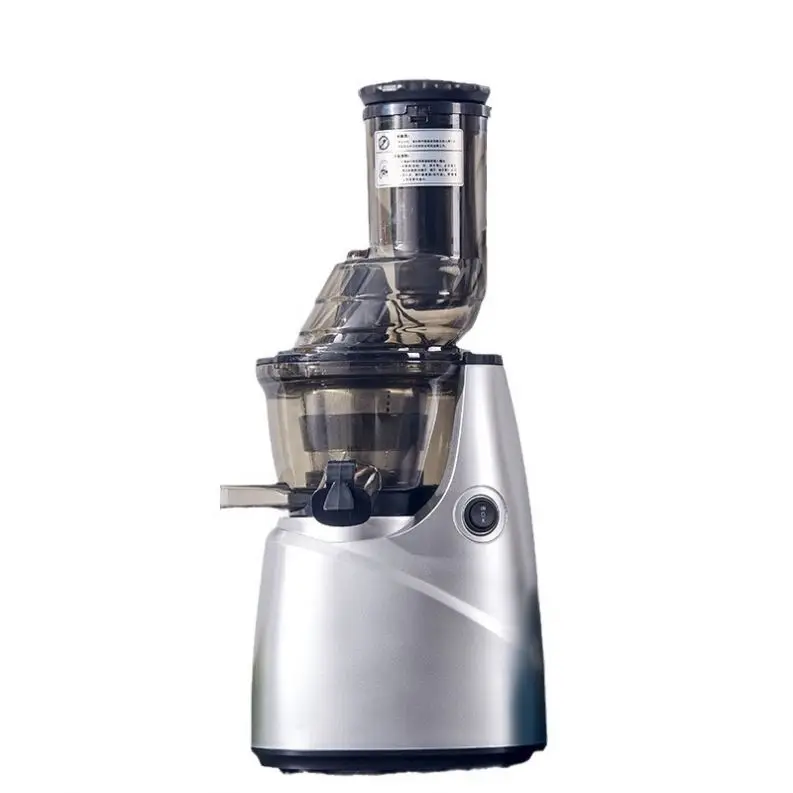
Why a specification-led purchase matters for a big-mouth cold-press juicer
The TEBAK Big Mouth Cold Press Electric Automatic Pulping Juicer is listed as a slow juicer and portable juicer for kitchen appliance juice extraction. The source parameters state a plastic housing, dimensions of 22.9*20.1*49.7cm, 45 RPM, 240W, 220V, 1.0L capacity, Space Silver color and China as the place of origin. Those values are the controlled starting point for a B2B quotation.
The word “big-mouth” describes the product positioning, but the source record does not provide the feed opening diameter, approved ingredient size, cutting arrangement, screen type, juice yield, noise level, duty cycle or food-contact material schedule. A buyer should not infer those values from the product photograph. They need to be confirmed with a drawing, nameplate image, sample test and supplier declaration.
This guide is for importers, distributors, kitchen-appliance brands, juice bars and hospitality buyers comparing a compact cold-press juicer. It separates the actual queue fields from the RFQ items needed to decide whether the 1.0L configuration and 220V electrical version fit the intended workflow.
1. Controlled identity from the source record
The source product ID is 1601277190068. The type field says “Slow Juicer, Portable Juicer,” and the usage field says “Kitchen Appliance Juicer Extractor Machine.” The housing material is listed as Plastic. The dimensions are written as 22.9*20.1*49.7cm; the record labels this field with an inches-related heading, so the buyer should preserve the original value and ask the supplier to confirm the measurement unit and length, width and height order.
The operating values listed are 45 RPM, 240W and 220V. The capacity field is 1.0L, the color is Space Silver and the place of origin is China; the description also contains the word hebei. These fields do not establish whether the capacity refers to a hopper, juice container, pulp container or marketing volume. Request a dimensioned drawing and a definition of every capacity claim before issuing a purchase order.
2. Source-confirmed specification table
This table repeats the available source parameters. Open fields are deliberately marked for confirmation rather than estimated.
| Field | Source value or procurement control |
|---|---|
| Product ID | 1601277190068 |
| Product type | Slow Juicer; Portable Juicer |
| Housing material | Plastic |
| Usage | Kitchen Appliance Juicer Extractor Machine |
| Dimensions | 22.9*20.1*49.7cm; confirm unit and L/W/H order |
| Speed | 45 RPM |
| Power | 240W |
| Voltage | 220V |
| Capacity | 1.0L; confirm the component and usable volume |
| Color | Space Silver |
| Place of origin | China; source text also contains hebei |
| Yield and duty cycle | RFQ required |
3. Confirm what “big mouth” means
Ask the supplier for the feed opening diameter, opening shape, maximum recommended ingredient size and whether whole or partially cut produce is allowed. “Big mouth” is not a dimensional specification. Confirm whether the opening uses a removable cover, safety interlock, pusher or splash guard. The quotation should include the approved opening drawing and any restriction on hard seeds, fibrous produce, frozen ingredients or hot liquids.
Run the sample test with the buyer's actual produce mix: leafy vegetables, citrus, apples, carrots, celery or other intended ingredients. Record whether preparation requires cutting, peeling, deseeding or pre-softening. The supplier should state the permitted ingredient temperature and whether the machine is intended for household batches, light commercial service or a defined continuous schedule.
Do not translate “automatic pulping” into an automatic feeding or automatic cleaning claim. Confirm which actions are automatic, which require the operator, and whether the machine separates juice and pulp continuously or only collects them in removable containers.
4. Speed, power and 220V electrical compatibility
The source states 45 RPM, 240W and 220V. It does not state frequency, phase, current, plug type, cable specification, grounding method or protection requirements. Request the rating-plate photograph and electrical schematic for the exact Space Silver configuration. Confirm whether 220V is single-phase and whether the quoted version is intended for the destination market.
Speed should be understood as the motor or auger speed, not automatically as the speed of juice production. Ask the supplier to identify the rotating component and the permitted speed tolerance under load. Request startup current, thermal protection, motor duty and recommended rest intervals. A 240W motor rating alone does not establish throughput or the ability to process dense produce continuously.
The buyer's installation plan should define socket, breaker, earth, cable route and splash protection. For a juice bar or hotel kitchen, verify that the appliance can be isolated quickly and cleaned without exposing the connector to water. For a distributor, include the regional plug and label version in the commercial specification rather than treating it as a post-order detail.
5. Capacity and container definition
The source lists 1.0L but does not identify whether this is the juice container, pulp container, hopper, working volume or nominal vessel size. Ask for a drawing with every container labeled. Confirm usable fill line, overflow clearance, minimum batch size, maximum batch size and the time needed to empty or clean each container.
For commercial buyers, measure the intended service pattern. Record the number of servings per hour, expected produce mass per batch, cleaning intervals and container turnover. Compare the measured workflow with the supplier's duty-cycle statement. Do not promote 1.0L as hourly output or assume it represents a continuous production rate.
If the buyer needs a larger queue of orders, ask whether extra containers, screens, augers, hoppers or seals are available. A compact portable unit may be useful as a counter appliance, but its practical capacity depends on preparation, screen cleaning and pulp removal time.
6. Juice yield, pulp separation and screen selection
No juice-yield percentage, pulp dryness, screen mesh, filter type or separation method is provided. Request a component list and exploded diagram showing auger, screen, end cap, scraper, seals, juice outlet and pulp outlet. Confirm which parts are included in the quoted machine and which are optional.
Run a controlled comparison with the buyer's recipe. Weigh the prepared produce, measure juice and pulp separately, record the 45 RPM setting, and document the screen and preparation method. Repeat the test with a defined sample size. Yield depends on produce variety, ripeness, temperature, cut size and screen condition, so one unqualified percentage should not be used as a universal performance claim.
Ask how quickly the screen can be removed and cleaned. For leafy or fibrous ingredients, confirm the recommended cleaning interval and whether a second screen permits continuous service while the first is washed. Request spare-screen part numbers and a replacement procedure.
7. Plastic housing and food-contact review
The source lists the housing material as Plastic. It does not state the plastic grade, wall thickness, heat resistance, UV resistance, food-contact status or which parts are made from other materials. Request a material schedule separating housing, hopper, pusher, auger, screen, seals, containers and outlet components.
Food-contact compliance must be assessed for the exact materials and destination market. Do not treat the housing field as a certification claim. Ask the supplier for product-specific declarations, test reports or other documents required by the buyer's market. Confirm whether the unit can process acidic juice, oily ingredients or hot liquids; do not infer hot-liquid suitability from the word electric.
Inspect the housing for seams, drainage paths and areas where pulp can accumulate. Confirm whether panels or covers can be removed without damaging clips or seals. The cleaning procedure should state water temperature, permitted detergent, drying method and which components must not be immersed.
8. Noise, vibration and countertop use
Noise and vibration data are not provided. Ask the supplier for a measured noise method and operating condition, or measure the sample at a defined distance and load. Check motor sound, auger contact, screen vibration, container resonance and movement of the appliance on the counter.
Request the base dimensions, foot material, center of gravity and recommended clearance around the appliance. The source dimensions are 22.9*20.1*49.7cm, but the measurement heading contains an inches-related label. Confirm the actual unit, orientation and whether the measurement includes the hopper, pusher, outlet or cable.
For a retail counter, test the machine during opening hours with normal staff movement and cleaning. A portable product still needs a stable, dry, level operating surface and a safe location for pulp and juice containers. Document the site conditions used in the acceptance test.
9. Safety and operator controls
Ask the supplier to describe the pusher, lid, interlock, overload protection, reset method and safe jam-clearing procedure. Confirm whether the motor stops when the cover or hopper is opened and whether the operator can reach the auger or screen while the appliance is energized.
The 45 RPM rating does not remove the need for guarding. Operators should never use fingers or an improvised tool to push ingredients. The manual should define the supplied pusher, approved ingredients, maximum loading behavior and the steps for isolating power before disassembly.
Acceptance should include empty running, loaded running, cover or interlock test where supplied, leakage check, container stability, jam-clearing instructions and post-cleaning restart. Record abnormal heat, smell, noise or vibration and require corrective action before the machine is accepted.
10. Sample and pre-shipment inspection
Use a sample with the exact 240W, 220V, 45 RPM and 1.0L configuration stated in the quotation. Photograph the nameplate, housing, hopper, pusher, auger, screen, containers, outlet, cable and accessories. Verify the Space Silver finish and the source product ID against the inspection record.
Run the machine empty, then with a controlled produce batch. Record ingredient mass, preparation, operating time, juice volume, pulp volume, screen, cleaning interval, noise observations and any blockage. Repeat with the buyer's main produce category. These results belong to the selected configuration; do not generalize them to other screens or motor versions.
Pre-shipment inspection should compare the machine with the signed drawing, parameter sheet, material declaration, wiring data and packing list. Check that the delivered motor, housing, container and accessories match the approved sample. A product photograph alone is not proof of output, food-contact compliance or electrical compatibility.
11. Packaging, spare parts and service
Packaging details are not supplied. Request packed dimensions, gross weight, moisture protection, shock protection, internal restraints and a packing list. Protect the screen, auger, containers, pusher, clips and plastic housing from impact and deformation during transport.
Ask for spare part numbers and lead times for screen, auger, end cap, seals, pusher, containers, switches, motor components and any control board. Confirm whether a second screen or container is included, optional or unavailable. A distributor should receive exploded diagrams and cleaning instructions that can be shared with end users.
Warranty and after-sales terms should cover motor failure, leakage, screen damage, broken clips, electrical faults and parts availability. Request a troubleshooting chart for no power, no rotation, low yield, excessive pulp, blockage, leakage, abnormal noise and overheating.
12. RFQ checklist
- Confirm product ID 1601277190068, model code and exact configuration.
- Confirm the meaning of “big mouth” with a feed-opening drawing and maximum ingredient size.
- Confirm 45 RPM, speed tolerance, rotating component and motor duty under load.
- Confirm 240W, 220V, frequency, phase, current, plug, cable and grounding method.
- Define the 1.0L capacity: component, usable fill line, batch size and overflow clearance.
- Confirm the 22.9*20.1*49.7cm dimensions, unit, L/W/H order and included parts.
- Provide screen, auger, pulp separation, juice outlet and cleaning details.
- Provide plastic grade, food-contact declarations and material schedule for all wetted parts.
- Provide yield, pulp, noise, vibration and continuous-duty test conditions if claimed.
- Agree sample testing, pre-shipment inspection, packaging, spares, warranty and service terms.
13. Questions for the supplier
Ask the supplier to answer these questions in the quotation: What is the actual feed-opening diameter? What ingredients can be loaded whole and which require cutting? Does 1.0L describe juice, pulp, hopper or container volume? What is the 45 RPM tolerance under load? What are the frequency, current and plug details for the 220V version? Which parts contact juice or pulp, and what materials are used? Which screens and containers are included? What yield and pulp results were measured with a defined recipe? What is the allowed continuous operating time? What are the noise, cleaning and jam-clearing procedures?
If the supplier cannot answer these questions, keep the order at RFQ or sample-review stage. A compact body and low nominal power do not by themselves prove juice yield, safe cleaning or commercial suitability.
14. Final procurement decision
This TEBAK product is a candidate for buyers seeking a compact slow juicer or portable kitchen appliance. The source-confirmed anchors are product ID 1601277190068, Plastic housing, 45 RPM, 240W, 220V, 1.0L, Space Silver, China and the dimensions written as 22.9*20.1*49.7cm. The commercial decision still depends on the supplier's confirmed drawing, electrical package, food-contact documentation, sample results and duty-cycle limits.
Approve the order only when the supplier identifies the exact machine configuration, screen, container definition, feed opening, electrical version and acceptance method in a signed quotation. Keep the product ID, nameplate photograph, inspection report and carton label together for traceability. This prevents a different juicer version or accessory set from being shipped under a broad big-mouth cold-press title.
Editor's note: Product facts in this guide are limited to the supplied Hoting queue record. Company-level statements are not treated as product-specific certification, performance evidence or customer proof.
Key specifications
- Product type
- Slow Juicer; Portable Juicer
- Source product ID
- 1601277190068
- Housing material
- Plastic
- Usage field
- Kitchen Appliance Juicer Extractor Machine
- Dimensions
- 22.9*20.1*49.7cm
- Speed
- 45 RPM
- Power
- 240W
- Voltage
- 220V
- Capacity
- 1.0L
- Color
- Space Silver
- Place of origin
- China; source text also includes hebei
- Juice yield, noise and continuous duty
- Not provided; request test data and operating limits
Frequently asked questions
- What speed, power and voltage are listed?
- The source lists 45 RPM, 240W and 220V. Confirm frequency, phase, current, plug, grounding and speed tolerance for the exact configuration.
- What does the 1.0L capacity refer to?
- The source does not identify the component. Ask whether it is the juice container, pulp container, hopper, working volume or another nominal capacity.
- What does big-mouth mean?
- It is product wording rather than a complete dimension. Require the feed-opening drawing, maximum ingredient size, pusher and safety details.
- Is the Plastic housing food-contact safe?
- The source lists Plastic for the housing but does not provide material grades or food-contact documents. Request a product-specific material schedule and declarations for wetted parts.
- Can this juicer run continuously in a juice bar?
- The source does not provide a duty cycle, yield or noise rating. Confirm operating limits through a sample test using the buyer's ingredients and workflow.