
No parameter rows at all, and the specification is a picture
Product ID 1601454877822 has an empty parameter block. Not a row, not a value, not a unit. One hundred and fifty-one of the five hundred and twelve records in this catalogue are in the same condition, so the record is unremarkable in that respect, and the reason to write about it is what it does instead.
Inside the last of its eight images there is a table. It is the only specification the listing contains, and it is a real one: five sizes, each with a model code, a diameter in millimetres, a magnetic pole size in millimetres and a number of magnetic poles. The table is reproduced below exactly as it appears, with the columns in the order the supplier set them out.
| Product name | Model specification | Diameter (mm) | Magnetic pole size (mm) | Number of magnetic poles |
|---|---|---|---|---|
| Five-axis permanent magnetic chuck | phi 200 | 200 | 50 by 50 | 4 |
| Five-axis permanent magnetic chuck | phi 300 | 300 | 50 by 50 | 12 |
| Five-axis permanent magnetic chuck | phi 400 | 400 | 50 by 50 | 21 |
| Five-axis permanent magnetic chuck | phi 500 | 500 | 50 by 50 | 32 |
| Five-axis permanent magnetic chuck | phi 500 | 600 | 50 by 50 | 52 |
Three things about this table are worth separating. The first is that it exists at all, and that it exists only as pixels: a search engine, a procurement system, a buyer's comparison sheet and a tender document cannot read it, and the record's own parameter block carries none of it. The second is that two of its five columns carry the same number four times out of five, since the model code and the diameter column agree exactly on the first four rows, and the fifth row is where they part company. The third is the footnotes.
Under the table, in the same image, four statements appear. Non-standard custom sizes are available on request. Customised products are not refundable or exchangeable unless there is a quality issue. The data above are all manually measured and there may be some errors, and the buyer should refer to the actual product. And the company is constantly developing and improving and reserves the right to change the design, the specifications and the structure at any time without prior notice, with the table given for reference only. So the only specification in the listing states, in its own text, that it may be wrong, that it may be changed without telling the buyer, and that it is not binding. That is a coherent position for a catalogue footnote to take, and it is also the reason the delivered machine's own nameplate, and the buyer's own measurements of it, are the only figures that will matter.
The same model code is used for two different diameters
Rows four and five both carry the model specification of a 500 millimetre chuck. Their diameter column reads 500 and 600. Their pole counts are 32 and 52. One of the two numbers in that pair of rows is wrong, and the pole arithmetic says which.
A circular face of diameter D has an area of pi times D squared over four. Dividing that area by the pole count gives the face area served by each pole, and dividing the pole count by the area gives the pole density. Both are calculated here from the table's own figures, on the assumption that the pole pitch is intended to be similar from size to size, which the constant 50 by 50 pole size supports.
| Diameter as printed | Poles | Face area | Area per pole | Poles per square centimetre |
|---|---|---|---|---|
| 200 mm | 4 | 31,416 sq mm | 7,854 sq mm | 0.0127 |
| 300 mm | 12 | 70,686 sq mm | 5,890 sq mm | 0.0170 |
| 400 mm | 21 | 125,664 sq mm | 5,984 sq mm | 0.0167 |
| 500 mm | 32 | 196,350 sq mm | 6,136 sq mm | 0.0163 |
| 600 mm | 52 | 282,743 sq mm | 5,437 sq mm | 0.0184 |
Read against the diameter column, four of the five rows sit in a band of 0.0163 to 0.0184 poles per square centimetre, which is a consistent design. Read against the model code column, the last row would be a 500 millimetre face carrying 52 poles, giving 0.0265 poles per square centimetre, which is far outside the band and is not physically consistent with the rest of the table. The diameter column is therefore the coherent one and the model code column is the one that was copied from the row above. This is the same diagnostic that settled the previous item's dimension contradiction, and it is worth stating plainly because it is the reason to trust a table's numbers over its labels when the two disagree.
The same arithmetic also isolates a smaller anomaly, and this one is worth raising with the supplier rather than treating as an error. The 200 millimetre row carries 4 poles, giving 0.0127 poles per square centimetre, which is about a quarter below the band the other four rows occupy. A consistent pitch across the range would suggest five or six poles at that diameter rather than four. It may simply be that the smallest chuck is designed with a coarser pole pattern to keep the poles a practical size, or it may be a transcription error, and the question to ask is which.
Everything in this section is arithmetic on the table's own figures. It rests on one assumption, that the pole pitch is intended to be similar across the range, and that assumption is stated rather than buried. What it establishes is not which number is right, since I cannot know that, but that the two rows cannot both be right and that the diameter column is the internally consistent one.
Not one magnetic record in the catalogue publishes a holding force
For a magnetic chuck, the specification that decides whether the workpiece stays on the table during a cut is the holding force per unit area. It is the first number a machinist asks for and the number that is compared between suppliers. This listing does not contain it, and neither does any other.
Scanning all five hundred and twelve records for the word magnet returns forty records, this one among them. Searching those forty for any figure or term expressing holding force, in newtons per square centimetre, in kilograms-force per square centimetre, or as phrases such as holding force, holding power, suction force or magnetic force, returns exactly one record, and that one match is the adjective in a title reading strong holding force. No record in the forty states a numeric holding force at all.
I published the count differently on first pass, as one record of forty carrying a holding-force term, and the correction matters enough to state: on inspection the single match is an adjective in a title rather than a figure, so the accurate statement is that zero of the forty records publish a holding force. The difference between those two statements is exactly the kind of error that a count can hide and that reading the match cannot, which is why the counts in this series are always followed by reading the items they return.
Two of the other magnetic records are worth naming because they are in the same family and they make the pattern sharper. One carries a single parameter row, and that row is the literal text item equals value, the empty template shipped as if it were data. The other carries two rows, reading products name and advantage, the second valued professional high quality. So the three chuck listings in this catalogue carry zero, one and two parameter rows respectively, and between them they publish no specification of any kind. The only figure in any of the three is inside a picture in this one. A buyer comparing magnetic chucks across this catalogue has nothing to compare.
The two feature slides contradict each other about the same face
One image is headed overall solid one-piece moulding and explains that the disk adopts an overall solid frame which is one-piece and does not deform, is more stable and durable, has excellent waterproof performance and improves the life of the disk. Another image is headed removable magnetic block and explains that the magnetic block can be removed and replaced, to avoid wear and tear on the surface, and that this also supports milling through to the bottom to meet various drilling needs.
A face whose magnetic blocks can be removed and replaced is not a one-piece frame. Both statements are on the same listing, both describe the same working face, and both carry the same nameplate in the photograph. The gallery also shows the face in two different states, with the pole blocks standing proud in one photograph and sitting flush in the others, so the two slides are not merely worded loosely; they describe two different configurations and present them as one product. For a buyer, the question is not which claim is more attractive but what is actually delivered: whether the pole blocks are integral to the body, and, if they are removable, whether spares are supplied, what they cost and how the face is re-dressed after replacement.
Related to this, the claim that no electricity is required during the processing, presented as a feature, is a property of every permanent magnetic chuck by construction rather than a difference between suppliers, and the same is true of the claim that the magnet does not fail on power failure. Both are descriptions of the class. The genuine question for an electro-permanent chuck is different and more specific, and it is the one the listing does not answer: how the coil is energised to switch the magnet on and off, how much energy that takes, and what the state is if the switching supply is interrupted mid-cycle.
A hand switch, no cable, and four different names
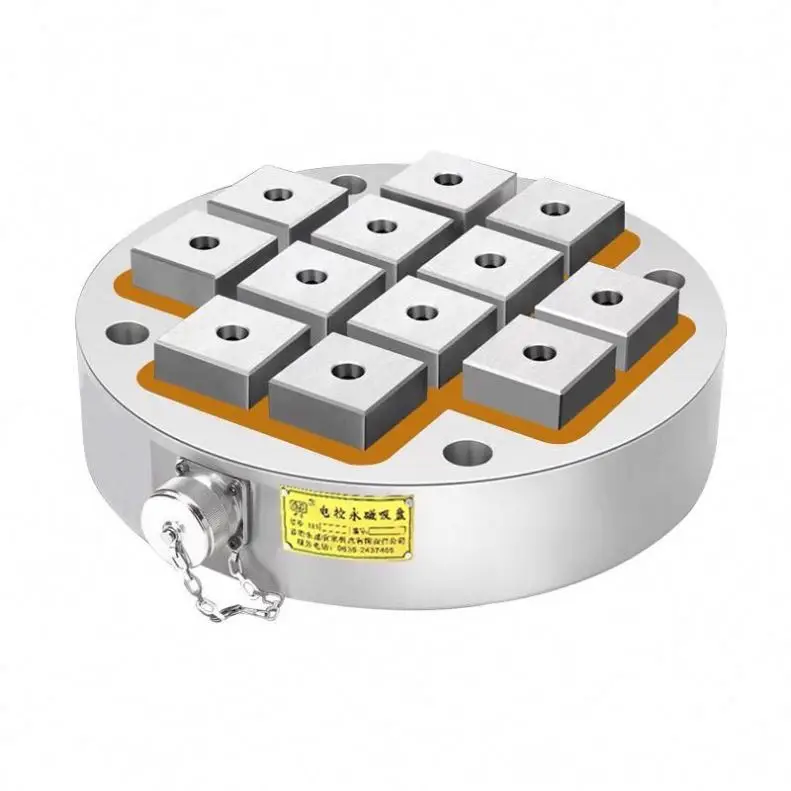
The chuck in all eight photographs is switched by a knurled knob on the side of the body, attached to the body by a short chain so that it is not lost. A hand knob of that kind is the arrangement of a mechanically switched permanent chuck. There is no cable in any of the eight images, no connector, no terminal box, no controller, no switch box and no cable gland.
Against that, the product carries four different names. The listing's title calls it both an electro-permanent magnetic chuck and an electro-controlled permanent magnetic chuck. The panels inside the gallery call it a five-axis permanent magnetic chuck and separately an electric permanent magnetic chuck. The specification table's own product-name column calls it a five-axis permanent magnetic chuck on all five rows. And the yellow nameplate fixed to the machine itself reads, in English, electric permanent magnetic chuck.
I am not asserting which of these the delivered device is, because the record does not establish it and the photographs cannot settle it: a permanent chuck that is switched by hand and a permanent chuck that is switched electrically can look similar from the outside. What the record does establish is that the buyer must ask, because the answer changes the price, the installation, the wiring, the control interface and the safety case. If the chuck is switched electrically it needs a supply, a controller and an interlock; if it is switched by hand, it needs none of those and the word electric in its name is a category description rather than a description of its operation. The question to put in writing is simple: how is the magnet switched, by the hand knob shown in your photographs or by an external controller, and if by controller, what is supplied with the chuck.
The nameplate is worth a further paragraph on its own, because it is the only place in the listing where a party is named other than the one named in the description. The yellow label carries an English line reading electric permanent magnetic chuck, a line of Chinese text identifying a manufacturer, and a service telephone number in the Hengshui area code 0318, reading 0318-2437365 in the clearest view available. The listing's own description names Hengshui Mengshang Trading Co., Ltd. as the supplier and TEBAK as its brand. The Chinese manufacturer line on the plate is partly below the resolution that the public image allows, so I do not reproduce it and I do not guess it. What is legible is enough to raise the ordinary question in this trade: whether the plate names the maker or another party, and which of them the buyer's warranty and spare-parts supply will run through. The plate is visible and the buyer can read it on the delivered machine, which is the reason it is worth photographing on arrival.
What the record states, and what it leaves to the supplier
Two statements in the gallery carry actual quantities, and they are the only ones outside the specification table. One says that the disk reaches the processing state within five seconds after magnetisation. The other says that five-sided processing can be achieved in one clamping, which is a statement about what the chuck allows the machine to do rather than a property of the chuck. Everything else is qualitative: strong suction, super strong magnetic force, long-lasting wear resistance, precision craftsmanship, easy to use, safe and reliable, excellent waterproof performance.
One of those qualitative claims contains a translation that removes its meaning. The text reads that the surface has a precision of up to one thread. There is no unit called a thread in metrology, and the phrase is almost certainly a literal rendering of the Chinese shop-floor word for one hundredth of a millimetre, a unit that machinists use constantly and that in Chinese is written with a character that also means a thread of silk. Read as the original unit, the claim is a flatness or parallelism figure of 0.01 millimetres, which would be a strong claim for a magnetic chuck face. Read as published, in English, it says nothing at all, and a buyer cannot tender against it. I state the reading as a reading rather than as a finding, and the question to ask is the face's flatness and parallelism tolerance in millimetres, together with how it is measured.
Alongside that, the table gives a diameter and a pole size but no height or thickness. For a machine tool the missing height matters as much as the diameter, because the chuck sits on the table and consumes Z travel, and because a change of chuck changes the machine's setup. The specification a buyer needs before ordering is short and none of it is in the record: the height, the holding force per unit area, the pole pitch and pole size confirmed for the size being ordered, the switched state under power failure, the mode of switching, the face tolerance in millimetres, the material and hardness of the top plate, the supply details if a controller is used, and the spare-parts position for the removable blocks if the blocks are in fact removable.
Incoming inspection when the chuck arrives
- Measure the diameter and the height of the delivered chuck and record both, because the record publishes no parameter row and the only table is a picture, and the table disclaims its own measurements.
- Count the magnetic poles on the face and record the pole size, then compare with the table row for the size ordered, since the table's last two rows carry the same model code for two different diameters.
- Establish from the nameplate which party made the chuck, photograph the plate including the telephone number, and confirm in writing which party the warranty and the spare-parts supply run through.
- Establish how the magnet is switched, by the hand knob or from a controller, and record what was supplied, because no cable, connector or controller appears in any of the eight photographs while the product name calls it electric.
- Verify the switched state with the power disconnected, and again after an interrupted switching cycle if a controller is used, and record the result, since the record does not state the state under interruption.
- Measure the flatness of the working face and its parallelism to the mounting face in millimetres with a suitable instrument, and record the figures, because the published accuracy claim is the phrase one thread and no tolerance in millimetres is stated anywhere.
- Determine whether the magnetic blocks are integral to the body or removable, and if removable record how they are retained and how the face is re-dressed after a replacement, since one slide describes a one-piece frame and another describes removable blocks.
- Check the mounting bolt pattern and the position of the fixing holes against the buyer's table, because the record gives a diameter but no hole layout and no bolt centres.
- Establish whether the chuck needs a supply at all, and if it does, the voltage, the current, the duty of the switching cycle and the connector type, since the record states electrical names and no electrical particulars.
- Ask for the holding force per unit area in newtons per square centimetre and, if the supplier cannot state it, measure the pull-off force of a representative workpiece on the delivered unit and keep the figure, because no record in this catalogue publishes that number.
- Test a cut at the buyer's normal depth of cut and feed with the largest workpiece the machine will hold, and record the result, since neither the holding force nor the recommended cutting envelope is published.
- Check whether any controller, cable, switch box or hand tool is included in the price, and reconcile the delivered items against the packing, since the scope of supply and the packing contents are never stated.
- Record the delivered weight and the carton's three dimensions, because the description has a packing and shipping heading with nothing beneath it and no packing data exists in the listing.
- Check the waterproofing claim in the ordinary way, since excellent waterproof performance is claimed qualitatively with no ingress protection rating stated.
- Keep the nameplate photographs, the measured diameter, height, pole count and face tolerances, the switching state records and the pull-off figures together as the chuck's specification file, because on this listing the buyer's own measurements will be more complete and more binding than anything the supplier published.
What the catalogue says, counted
The counts below are this guide's own scans of all five hundred and twelve records, with the search terms named so that they can be reproduced. One correction to a count taken on first pass is stated in the text and again in the methodology below.
| Observation | Records | Share |
|---|---|---|
| Records with no parameter rows at all, this record among them | 151 | 29.5% |
| Records whose description is exactly 800 characters, against 61 at exactly 799, none over 800 and a shortest of 144 | 410 and 61 | 80.1% and 11.9% |
| Records naming packing or shipping in the description, and of those the records whose parameter rows carry any weight or dimension | 275, of which 114 | 53.7% and 41.5% of those |
| Records whose company heading reads Company introduction, against those whose heading reads Company Profile, for the same paragraph | 71 and 161 | 13.9% and 31.4% |
| Records whose heading reads Product Description, and those whose heading reads Specification | 244 and 74 | 47.7% and 14.5% |
| Records mentioning magnets anywhere in the record, this record among them | 40 | 7.8% |
| Of those forty, records stating any holding-force figure in newtons or kilograms per square centimetre, or any holding-force term at all | 0 | 0% |
| The one record the first-pass count returned, on reading, was an adjective in a title rather than a figure | 1 title only | 0.2% |
| Records containing the word chuck | 14 | 2.7% |
| Records containing the phrase electro-permanent, this record and one other rectangular clamping plate | 2 | 0.4% |
| Records containing the word pole, which is not this record | 1 | 0.2% |
| Records containing the phrase one-piece, which appears in this record's pictures and in no record's text | 0 | 0% |
| Records containing the word suction, against this record's own image caption for the same feature reading suction cup | 2 | 0.4% |
| Records containing a word for thread, the term this record uses for its accuracy claim | 14 | 2.7% |
| Records containing an axis word | 36 | 7.0% |
| Records sharing any of this record's eight images, which is none | 0 | 0% |
| Records whose description the supplier's company-name sentence appears in | 384 | 75.0% |
| Records referring to the ISO 9001 standard in that paragraph | 136 | 26.6% |
| Records containing the string OED&ODM, the misspelling used here and elsewhere | 329 | 64.3% |
| Records containing the string this filed, the misspelling used here and elsewhere | 319 | 62.3% |
| Records containing the phrase 70% for expert, as used here | 265 | 51.8% |
Four of those rows carry the argument of this item. The first is the count of forty records that mention magnets against zero that publish a holding force, because a class of forty products in which not one member states its defining specification is not an omission, it is a convention, and a buyer who waits for that number to appear in a listing will wait indefinitely. The second is the state of the three chuck listings in the catalogue, which carry zero, one and two parameter rows respectively, three rows between them and not one of the three a measurement, so the entire family publishes nothing measurable and a comparison across it is impossible. The third is the pair of packing counts, two hundred and seventy-five records that name packing or shipping against one hundred and fourteen of those that carry any weight or dimension, which means that in this catalogue a heading about packing is about twice as likely to be empty of packing data as to contain it. The fourth is the heading split, seventy-one records introducing the same profile paragraph as a company introduction and one hundred and sixty-one introducing it as a company profile, which is another sign that these descriptions are assembled from a template with interchangeable parts rather than written for a product.
The house-style counts are unchanged once more: the company-name sentence in three quarters of the catalogue, the ISO 9001 reference in just over a quarter, the misspelled abbreviation in about two thirds, the phrase this filed in about five eighths and the claim about seventy per cent of products being for experts in about half. The description length distribution is likewise unchanged at four hundred and ten records of exactly eight hundred characters and sixty-one of exactly seven hundred and ninety-nine. All eight images were downloaded and individually digested to confirm that they are eight distinct files, totalling 1,130,970 bytes or about 1.13 megabytes, an average of about 141 kilobytes each, the lightest gallery in this series so far: these are studio renders and typeset slides rather than photographs, and the specification table is one of them, which is why the whole specification of this product weighs about 109 of those kilobytes and cannot be read by any machine.
The specification to send before ordering
| Item | What to require in writing |
|---|---|
| Which size, and which code | Confirmation of the diameter and the model code for the size being ordered, because the table's fourth and fifth rows carry the same model code for two different diameters, and the diameter column is the internally consistent one. |
| Holding force | The holding force per unit area in newtons per square centimetre, for the specific size ordered, since no record in this catalogue publishes it and it is the number the application depends on. |
| Height and mounting | The chuck's height or thickness, its mounting bolt pattern, the fixing-hole positions and the bolt centres, none of which appear in the table that carries the diameter. |
| Face accuracy | The flatness and parallelism of the working face in millimetres, and how it is measured, because the published claim is the phrase one thread and no tolerance in millimetres is stated anywhere. |
| Pole design | Confirmation of the pole size and the pole count for the size ordered, and an explanation of the 200 millimetre row, whose pole density is about a quarter below the band the other four rows occupy. |
| One-piece or removable | Whether the magnetic blocks are integral to the body or removable and replaceable, because one slide describes a solid one-piece frame and another describes removable blocks; if removable, the spare-block price, availability and the re-dressing procedure. |
| How it is switched | Whether the magnet is switched by the hand knob shown in the photographs or by an external controller, and if by controller, the supply details, the switching energy, the connector type and what is included in the price. |
| State under interruption | What the magnet does if the switching supply is interrupted mid-cycle, since a permanent chuck holds without power and the transition state is what matters. |
| Waterproofing | The ingress protection rating rather than the words excellent waterproof performance, since coolant and swarf are normal in this application. |
| Materials and hardness | The top plate material and its hardness, and the body material, because the record claims stainless and one-piece without stating grades. |
| Scope of supply | A packing list, because no controller, cable, switch box, hand tool or accessory is stated anywhere and the description's packing heading is empty. |
| Weight and carton | The net weight and the carton's three dimensions, since the description has a packing and shipping heading with nothing beneath it. |
| Nameplate and warranty | Which party the nameplate names, and which party the warranty, the spare parts and the technical support run through, given that the plate names a manufacturer and the listing's description names a trading company. |
| Documents | A machine-readable specification with the table supplied as data rather than only as a picture, an output or test record for the ordered size, and an instruction sheet covering mounting and switching. |
| Commercial | Unit price, minimum order quantity, price breaks by size, delivery term, lead time, warranty period and scope, and the position on custom sizes, given that the table states customised products are not refundable or exchangeable unless there is a quality issue. |
Frequently asked questions
Does this listing have a specification?
It has an empty parameter block, so as data the answer is no. The only specification is a table inside the last of the eight images, listing five sizes with their diameter, pole size and pole count. Because it is a picture, it cannot be read by a search engine, a procurement system or a buyer's comparison sheet, and it carries no machine-readable form anywhere in the listing.
What is wrong with the table?
Its fourth and fifth rows both carry the model code for a 500 millimetre chuck while their diameter column reads 500 and 600, so one of those two cells is wrong. The pole arithmetic says which: against the diameters the pole density runs from 0.0163 to 0.0184 poles per square centimetre on four of the five rows, which is a consistent design, whereas against the model codes the last row would be 0.0265, far outside that band. The diameter column is the coherent one and the model code was copied from the row above. The same arithmetic flags a smaller anomaly, that the 200 millimetre row carries 4 poles for about a quarter less pole density than the other four rows, which is worth a question rather than a conclusion.
Why does the table disclaim itself?
Because it does, in its own footnotes: the data are all manually measured and there may be some errors, the buyer should refer to the actual product, the company reserves the right to change the design, specifications and structure at any time without prior notice, and the table is for reference only. It also states that customised products are not refundable or exchangeable unless there is a quality issue. So the one place in this listing where a number appears is also the place where the listing says the numbers may be wrong and may change. The practical response is to make the ordered size, the diameter, the height, the pole count and the holding force part of the purchase contract, and to verify them on arrival.
Why is the holding force not given, and can I get it elsewhere?
It is not given here and it is not given anywhere in this catalogue: forty records mention magnets and none states a holding force in newtons per square centimetre, with the single near-match being the adjective strong in a title. That is a convention across this catalogue rather than a gap in one listing, so the number has to come from the supplier directly for the size you are buying, in writing. If it cannot be had, it can be measured on the delivered unit as a pull-off force and kept as the buyer's own figure.
Is this chuck electric or hand-switched?
The record does not settle it, and both readings have support. The title calls it electro-permanent and electro-controlled permanent; the panels and the nameplate call it an electric permanent magnetic chuck; the specification table's product-name column calls it a five-axis permanent magnetic chuck. In the photographs, the switch is a knurled hand knob on a chain on the side of the body, and there is no cable, no connector, no terminal box and no controller in any of the eight images. A hand-switched permanent chuck and an electrically switched one can look similar from outside, so the question has to be put in writing, because the answer decides whether you need a supply and a control interface as well as whether the price is comparable.
Whose name is on the machine?
The nameplate is a yellow label with an English line reading electric permanent magnetic chuck, a Chinese manufacturer line and a service telephone number in the Hengshui area code 0318, reading 0318-2437365 in the clearest view the public images allow. The listing's own description names Hengshui Mengshang Trading Co., Ltd. as the supplier and TEBAK as the brand. The rest of the Chinese line is below the resolution available in the published image, so I do not reproduce or guess it. Ask which party the nameplate names and which party the warranty and spare parts run through, and photograph the plate on the delivered machine.
Why does the listing say the blocks are removable if the frame is one-piece?
Because two of its slides say both. One is headed overall solid one-piece moulding and states that the disk adopts an overall solid frame which is one-piece and does not deform. Another is headed removable magnetic block and states that the magnetic block can be removed and replaced, to avoid wear and tear, and that this supports milling through to the bottom. A face with removable and replaceable blocks is not a one-piece frame, and the gallery shows the face in two different states, so the two slides describe two configurations and present them as one product. Ask which one is delivered, and if the blocks are removable, what the spares cost.
What does a precision of one thread mean?
There is no unit called a thread in metrology. The phrase is almost certainly a literal rendering of the Chinese shop-floor word for one hundredth of a millimetre, a unit machinists use constantly and whose character also means a thread of silk. Read as the original unit, the claim is a tolerance of 0.01 millimetres on the face; read as published in English it means nothing and cannot be tendered against. I give the reading as a reading, not as a finding. Ask for the flatness and parallelism in millimetres and for the method of measurement.
What does the record not state at all?
The holding force per unit area; the height or thickness; the mounting bolt pattern and hole centres; the face tolerance in millimetres; how the magnet is switched and what is supplied to switch it; the switched state under an interrupted cycle; the ingress protection rating behind the waterproofing claim; the top plate material and hardness; the scope of supply and the packing list; the net weight and the carton's three dimensions; any certification, standard, accuracy grade or test report; the recommended cutting envelope; and the position on spares for the pole blocks. Two statements in the whole gallery carry quantities, one of five seconds for reaching the processing state and one about five-sided machining in a single clamping.
How does this item sit in the series?
By pattern, consistently. The melting furnace deferred three of eight rows to the customer. The wax injection machine had two rows and neither was a measurement, while four siblings carried a block it lacked. The argon arc welder carried eleven rows and was contradicted on six of them by its own panel. This chuck carries no rows at all, and the one specification it has is a picture that reuses a model code for two diameters and then disclaims itself. Across all four, the description is a fixed eight-hundred-character window over shared boilerplate, capacity and size figures live in titles or images rather than in data, accessories exist only in pictures, and the words that describe the product's real features appear in no record's text. This item adds the cleanest example of the last habit: the phrase one-piece appears on a slide here and in zero of the five hundred and twelve records' text.
Source, scope and what this guide does not claim
Everything about the product comes from the record for Product ID 1601454877822 as it stands: an empty parameter block, an eight-hundred-character description, and eight gallery images. The description's structure is quoted from the record: it begins with the listing title, then a heading reading packing shipping under which nothing appears, then a heading reading company introduction, after which the shared profile paragraph begins and runs to the end of the window at character eight hundred.
All figures attributed to the specification table are read from the last image, including the five model codes in the form the supplier printed them, the five diameters, the constant 50 by 50 millimetre pole size and the pole counts of 4, 12, 21, 32 and 52, and the four footnotes beneath it are quoted from the same image. All claims attributed to the feature slides are read from those images and attributed to them: the one-piece moulding claim, the removable magnetic block claim, the five second magnetisation statement, the five-sided machining statement, the qualitative claims of strong suction and super strong magnetic force, and the accuracy phrase. The four product names are quoted from the places that carry them, and the parts of the machine's yellow nameplate that are reproduced are the English line, the fact that the Chinese text names a manufacturer, and the Hengshui area code and number; the remaining Chinese line is below the resolution the public image allows and I neither reproduce nor guess it. The absence of a cable, connector, terminal box or controller is a statement about what the eight published photographs show, which is all that can be established from them.
The arithmetic is this guide's own and its assumption is stated. Face areas are pi times the square of half the diameter, pole densities are the pole count divided by the area in square centimetres, and the reading that the diameter column is the coherent one rests on the assumption that the pole pitch is intended to be similar across the range, which the constant pole size supports but does not prove. No diameter, pole count, pole size or model code is corrected or estimated anywhere in this guide: the table is reproduced as printed and the arithmetic is used only to say which of two contradictory columns is internally consistent, not to supply a figure the supplier did not publish. No holding force, height, tolerance or material grade is estimated, because none is published and an estimate of a chuck's holding capacity would be a fabrication with a safety consequence. No chuck was measured, no machine was set up, no cut was taken, no magnet was switched and no controller was connected.
The catalogue counts are this guide's own scans of all five hundred and twelve records with the search terms named so that they can be reproduced: the absence of parameter rows, the description length distribution, the packing and shipping words, the four heading forms, the word magnet and the holding-force search over those records, the words chuck, electro-permanent, pole, one-piece, suction, thread and axis, the image-sharing count and the house-style counts. One correction to a first-pass count is stated in the text and here: the search for a holding-force figure returned one record of the forty that mention magnets, and on reading that record the match was the adjective strong in a title rather than a figure, so the accurate count of records publishing a holding force is zero. The image-sharing count was established by normalising every image address in the catalogue to one scheme and counting the records that use each of this record's eight pictures; all eight are used by this record alone, as in the previous item and unlike the item before it. The house-style counts of three hundred and eighty-four, three hundred and twenty-nine, three hundred and nineteen and two hundred and sixty-five, and the ISO 9001 count of one hundred and thirty-six, are unchanged from previous rounds.
Nothing here asserts that the supplier has misrepresented anything, and nothing here is an assessment of the chuck's quality, its safety or its suitability. Publishing a specification as a picture, reusing a model code across two sizes, presenting a hand-switched permanent chuck under electrical names, describing one face as both one-piece and removable, leaving a packing heading empty, naming a manufacturer on the plate and a trading company in the description, and stating an accuracy figure in a unit that does not exist in English are the ordinary consequences of listings assembled by hand from parts of other listings, and the counts above show how common each habit is across this catalogue. Above all, nothing here is machining advice, workholding advice or purchase advice. A magnetic chuck is the interface between a machine tool and a workpiece and it is the part that holds the work while it is cut: its holding force, its face accuracy, its height and its mounting are matters for the machine tool builder's own data, for the buyer's process requirements and for a qualified person in the workshop, and not for anything in a supplier listing or in this guide.
Key specifications
- Parameter rows
- none at all, which places the listing among the 151 of 512 records that publish no parameter row and means the record itself contains no specification whatever
- Where the specification is
- one table inside the last of eight images, listing five sizes with diameter in millimetres, magnetic pole size in millimetres and number of magnetic poles
- The five sizes as printed
- a 200 millimetre chuck with 4 poles, a 300 with 12, a 400 with 21, a 500 with 32, and a fifth row whose model code is the 500 code while its diameter column reads 600, with 52 poles
- Magnetic pole size
- 50 by 50 millimetres, identical on all five rows and therefore not a variable between them
- Holding force
- absent, as it is from every one of the forty records in this catalogue that mention magnets
- Chuck height or thickness
- absent, which matters because a chuck's height consumes the machine's Z travel
- Accuracy claim
- given as a precision of up to one thread, a phrase that is almost certainly a literal rendering of the Chinese shop-floor unit meaning one hundredth of a millimetre, and which as published conveys nothing to an English reader
- Magnetisation time
- the record states that the disk reaches the processing state within five seconds after magnetisation, with no figure for demagnetisation
- Switch
- a knurled hand knob with a retaining chain on the side of the body, in every photograph, with no cable, no connector and no controller visible anywhere in the eight images
- Names the product carries
- four, one in the title as a two-name phrase and two on the machine's own panels, and the specification table's product-name column uses a fifth form
- Materials claim
- stainless body with an overall solid one-piece frame in one slide, against removable and replaceable magnetic blocks in another, and both claims cannot describe the same face
- Nameplate
- a yellow label carrying an English line reading electric permanent magnetic chuck, a Chinese manufacturer line and a service telephone number in the Hengshui area code 0318
- Certification
- none stated, and no standard, no test report and no accuracy grade appear in the record or in any of the eight images
- Certification of packing
- the description contains a heading reading packing shipping with nothing at all beneath it, immediately followed by the company heading
- Accessories and scope of supply
- never stated; no controller, no cable, no switch box, no hand tools and no packing list appear anywhere