
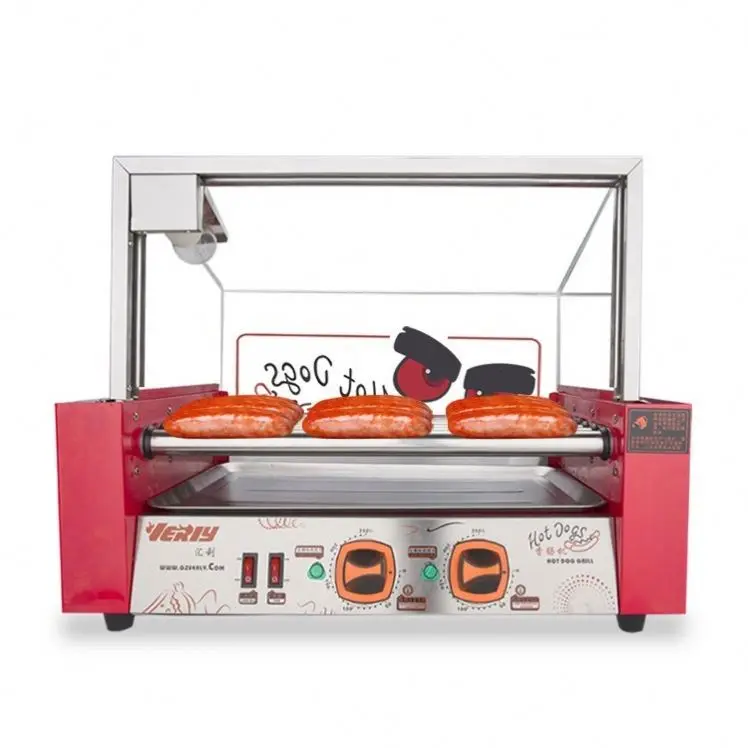
What this TEBAK 7-roller machine is specified to do
The TEBAK source listing describes a commercial seven-roller machine for French hot dogs and sausages. It is categorized as an other snack machine and identifies an electric tube as the heating method. The source also places the product in food industry equipment and snack applications.
The confirmed information is limited to the roller count, heating method, usage category and application wording. This guide does not invent wattage, voltage, frequency, roller dimensions, temperature range, speed, output, surface material, control method, safety certification or packaging data. Those fields must be confirmed for the exact configuration before procurement.
A seven-roller count is not an output specification. It does not establish the number of sausages that can be cooked per hour, the usable roller length or the number of products that fit in one batch. Request a dimensioned drawing and a controlled test using the buyer's sausage diameter and length.
The listing uses both “French hot dog” and “sausage roller” wording. Confirm whether the machine is intended for conventional sausages, French-style hot dogs, or both. Ask for the permitted food diameter, length, weight and loading arrangement rather than relying on the title.
1. Source identity and procurement boundary
The source product ID is 1601368950550. The title identifies a China factory, full automatic wording, commercial snack equipment, seven rollers, French hot dog use and sausage roller use. Treat “full automatic” as listing language until the supplier explains what functions are automatic.
Ask whether automatic refers only to electric heating, roller rotation, thermostat control, product transport or another function. The source does not identify a drive motor, rotation direction, speed adjustment, timer, thermostat or control panel.
The source description mentions Hengshui Mengshang Trading Co., Ltd. and the TEBAK brand in the company information. That context identifies the seller and brand wording in the source record. It does not prove a model-specific factory audit, certification, warranty, safety approval or destination-market compliance.
Keep the RFQ tied to product ID 1601368950550 and the exact seven-roller configuration. Request the final quotation, drawing, electrical nameplate, included accessories and test report as one matched document set.
2. Confirmed specification table
| Field | Source value | RFQ treatment |
|---|---|---|
| Source product ID | 1601368950550 | Match the ID to the quotation, nameplate and inspection record. |
| Brand | TEBAK | Confirm the nameplate and branding on the supplied unit. |
| Roller count | 7 rollers | Confirm usable roller length, roller diameter, spacing and loading capacity. |
| Heating method | Electric Tube | Request voltage, frequency, rated power, plug and electrical diagram. |
| Usage | Food Industry Equipment | Confirm the intended commercial installation and operating environment. |
| Application | Snack | Confirm approved product types and the buyer's target recipes. |
| Listed product use | French hot dog / sausage roller machine | Confirm product diameter, length, weight and cooking method. |
| Automatic function | Full automatic wording in title | Define each automatic function in the quotation; do not assume output or control features. |
No numeric electrical or mechanical parameter is supplied in the queue. The seven-roller configuration must therefore be treated as a starting configuration for RFQ, not as a complete technical data sheet.
3. Roller geometry and product fit
Roller geometry determines whether the equipment is suitable for the buyer's sausage. Request a drawing that shows roller diameter, exposed length, center spacing, end clearance and the distance between the rollers and any guard or tray.
Test the actual food product. A sausage that is too small may not rotate consistently, while one that is too large may contact adjacent rollers or a guard. The source does not provide a permitted diameter range, so do not infer one from the seven-roller count.
Confirm whether all seven rollers are driven and heated, or whether some rollers are support rollers. Ask whether each roller rotates at the same speed and whether a roller can be replaced individually.
Ask for the roller material, surface finish and food-contact documentation. The source does not say stainless steel, chrome, non-stick or any other material. Do not add a material claim to the purchase order without supplier evidence.
Confirm the usable cooking length. The product title identifies seven rollers but no length. Usable length is needed to calculate a realistic batch load and to design the operator's loading and unloading space.
4. Heating and electrical confirmation
The only heating field is “Electric Tube.” Request the rated power, voltage, frequency, phase, plug type, current, wiring diagram and heating-zone arrangement for the destination market.
Ask whether the electric tube heats each roller directly, a shared plate or another thermal element. Confirm the location of heating elements and whether the machine has independent zones. These details affect warm-up time, recovery and energy use.
Request the temperature control method, setting range, actual food-contact temperature and control tolerance. The source does not provide a temperature range or accuracy. A buyer should not advertise a temperature-controlled result until the exact model is tested.
Confirm whether the unit has an on/off switch, thermostat, timer, indicator light, over-temperature protection or emergency stop. The listing does not verify these features. Ask for a control-panel photograph and electrical schematic.
Define the electrical acceptance test. Confirm nameplate values, earth continuity, insulation condition, leakage protection requirements and plug compatibility. Installation should follow local electrical rules and be completed by a qualified professional.
5. What “full automatic” must mean in the RFQ
The title contains “Full Automatic Automatic,” but the source does not describe the automatic sequence. Ask the supplier to replace the phrase with a functional list.
Possible functions to clarify include roller rotation, temperature holding, timer control, automatic product feeding, automatic discharge, alarm indication and fault protection. Do not assume that the machine loads, cooks and transfers products without an operator.
Request a process video or live demonstration showing start-up, loading, rotation, cooking, unloading and shutdown. The video should show the exact seven-roller configuration and not a different model with more controls.
Ask which actions remain manual. A machine may rotate the rollers automatically while still requiring manual placement and removal of sausages. Define the staffing requirement and operator contact points in the purchase specification.
Confirm whether the phrase refers to the standard machine or an optional package. List every automation component and its price separately so the buyer does not receive a manual base configuration after ordering a full-automatic title.
6. Food application validation
The source identifies French hot dog and sausage applications under snack equipment. Validate the buyer's exact product, including casing, diameter, length, moisture, filling and whether it is chilled, frozen or pre-cooked. None of these conditions is supplied by the source.
Run a repeatable test with a defined starting temperature, product count, roller setting and cooking target. Record warm-up time, cooking time, product rotation, color, surface condition and internal food result according to the buyer's food-safety process.
Test all areas of the roller bed. Compare products loaded at the left, center and right positions. Without a specified usable length or heating-zone layout, a center-only demonstration cannot prove uniform performance across seven rollers.
Check whether the product sticks, tears or slides during rotation. Ask whether the supplier recommends oiling, a tray, a particular casing or a specific product size. These operating instructions should be written into the manual or quotation.
If the buyer will sell French hot dogs with bread, confirm the separate bread-warming and assembly workflow. The source describes the machine for the food product; it does not confirm a bread warmer, bun holder or complete serving line.
7. Throughput and commercial planning
Do not calculate hourly output from seven rollers. Output depends on roller length, product diameter, spacing, loading pattern, cooking time and operator handling. Request a supplier test with actual products and a stated cycle definition.
Define throughput as finished acceptable products per hour, not the number of products placed on the rollers. A valid test should state the product size, initial temperature, target result, warm-up status, operator count and rejected-product count.
Ask for recovery time after a full load and after repeated loading. Electric-tube systems can behave differently during warm-up and continuous operation. The source does not provide duty cycle, thermal recovery or energy consumption.
Plan space for product storage, loading, unloading, packaging and cleaning. The machine dimensions are not supplied, so request a layout drawing before finalizing a counter or stall.
Ask for recommended operating hours and maintenance intervals. The source provides no service schedule, replacement cycle or spare-parts list. Treat these as commercial confirmation items rather than assumptions.
8. Hygiene, cleaning and food-contact surfaces
The source does not provide body, roller, tray, guard or fastener materials. Do not describe the unit as stainless steel, non-stick or food-grade without documentation for this exact model.
Request a food-contact surface statement and cleaning diagram. Confirm which parts can be removed, which parts must remain dry, and whether the electric tube or control enclosure has a water-ingress limitation.
Ask how to clean grease and residue from between rollers. A seven-roller layout can create narrow cleaning spaces. The supplier should identify safe tools, approved cleaning agents, drying steps and inspection points.
Confirm whether the drip tray or crumb tray is included. The source does not mention one. If a tray is optional, list its dimensions and material in the quotation.
Define the changeover procedure between different sausage recipes. Check whether allergen or ingredient residue can be removed without dismantling the roller assembly. Request spare seals, knobs, rollers, heating tubes and control parts if applicable.
9. Installation and safety checklist
Request the electrical nameplate and installation manual before shipment. Confirm supply voltage, frequency, phase, current, plug and earth connection for the destination country.
Ask for the required counter clearance, ventilation, heat clearance and access to the switch. The source identifies commercial food equipment but does not provide a safe installation envelope.
Confirm whether hot surfaces are guarded and whether the rollers can be touched during operation. Request warning labels and an operating procedure for loading and unloading.
Ask whether the equipment has over-temperature protection, fuse protection, leakage protection or an emergency stop. These features are not confirmed by the source and must not be represented as included without evidence.
Request a risk assessment for the buyer's stall or kitchen. Electrical heating, rotating rollers and hot food create separate operating hazards. Installation and training should comply with local requirements.
10. Pre-shipment acceptance test
Require the supplier to identify the exact seven-roller model and nameplate. Confirm the heating method as an electric tube and document every electrical value. Photograph the nameplate and control panel.
Measure the roller count, usable length, roller diameter and spacing. Confirm that the supplied product matches the quotation and that all rollers rotate as specified.
Run a test with the buyer's sausage or a mutually agreed equivalent. Record starting condition, loading arrangement, temperature setting, cooking time, roller position and finished-product acceptance criteria.
Observe the left, center and right roller positions. Check rotation, sticking, surface color, product damage and internal cooking. If the supplier claims full automatic operation, record every automatic and manual step.
Inspect electrical safety, guards, switches, indicators, tray, accessories and packing. Request a packing list and spare-parts list before approving shipment.
Do not use a successful sample to claim a fixed hourly capacity. Capacity should be stated only after a defined test with product and process conditions.
11. RFQ checklist
- Confirm product ID 1601368950550 and the exact TEBAK seven-roller model.
- Confirm roller count, roller diameter, usable roller length and center spacing.
- Confirm the electric-tube heating arrangement and every electrical nameplate value.
- Confirm voltage, frequency, phase, current, plug and earth requirements.
- Define what “full automatic” includes and list the operator's remaining actions.
- Confirm temperature control, timer, alarm, over-temperature protection and emergency stop.
- Confirm sausage and French hot dog diameter, length, weight and starting condition.
- Confirm roller and food-contact materials with documentation for the exact unit.
- Confirm tray, guard, crumb collection and all included accessories.
- Provide cleaning, drying, maintenance and spare-parts instructions.
- Provide pre-shipment testing with the buyer's product and all roller positions.
- State finished acceptable products per hour only with test conditions and rejection count.
- Provide machine dimensions, net weight, carton dimensions and gross shipping weight.
- Confirm destination-market electrical and food-equipment compliance documents.
12. Questions for the supplier
What exactly is automatic on this seven-roller machine? Please provide a step-by-step operating sequence showing loading, roller rotation, heating, timing and unloading.
What are the rated voltage, frequency, phase, power and current? What plug, cable, earth and protection requirements apply to the destination country?
What are the roller diameter, usable length, spacing and recommended sausage size? Please provide a dimensioned drawing and a test using the buyer's actual product.
What is the temperature setting range and control tolerance? Is each roller heated equally or are there separate heating zones? Please provide a test record for left, center and right positions.
What materials are used for the rollers, tray, guard and food-contact surfaces? Which parts are removable and what cleaning agents are allowed?
What accessories, guards, trays, controls and spare parts are included? Please distinguish standard components from optional full-automatic packages.
What are the finished-product output and test conditions? Please report acceptable products per hour, product size, cycle time, operator count and rejection count rather than only a headline capacity.
13. What not to assume
Do not assume that electric tube means a particular voltage, wattage, plug or frequency. Those values are not in the source record.
Do not assume that seven rollers define capacity, roller length, sausage diameter or cooking time. Request a drawing and controlled test.
Do not assume that “full automatic” includes automatic feeding or unloading. Require a functional definition.
Do not assume that the rollers or body are stainless steel, non-stick or food-grade. Request exact material and surface documentation.
Do not assume that French hot dog and sausage applications use identical products or settings. Validate each recipe and product size separately.
Do not assume that the general company description proves model-specific certification, warranty or inspection. Request evidence for product ID 1601368950550.
14. Final procurement decision
The TEBAK item 117 is a commercial snack machine listed with seven rollers, electric-tube heating and French hot dog or sausage roller applications. Its source-confirmed technical baseline is the roller count and application wording; the queue does not provide numeric electrical, dimensional, thermal or production parameters.
Proceed to purchase only after the supplier defines the automatic functions, confirms electrical compatibility, provides roller geometry and tests the buyer's product. A pre-shipment acceptance test should cover all roller positions, the control sequence, food result, hygiene access and electrical safety.
Editor's note: This guide uses the supplied Hoting queue fields only. It does not add power, voltage, frequency, dimensions, capacity, temperature, materials, certification, warranty or performance claims. Missing information remains supplier-confirmation content.
Key specifications
- Source product ID
- 1601368950550
- Roller count
- 7 rollers
- Heating method
- Electric Tube
- Usage
- Food Industry Equipment
- Application
- Snack
- Listed product use
- French hot dog / sausage roller machine
- Automatic wording
- Full automatic (title wording; function to be confirmed)
Frequently asked questions
- What heating method is confirmed?
- The source lists Electric Tube. Voltage, frequency, power, current, plug and control details must be confirmed with the supplier.
- How many rollers does the machine have?
- The source title lists 7 rollers. Roller diameter, usable length, spacing and product loading capacity are not supplied.
- What products are listed for the machine?
- The source lists French hot dog and sausage roller applications under snack and food industry equipment.
- Does full automatic mean automatic feeding?
- The title uses full automatic wording, but the source does not define the automatic functions. Request a step-by-step operating sequence.
- What should be tested before purchase?
- Test the exact seven-roller configuration with the buyer's sausage, checking electrical compatibility, roller fit, heating uniformity, cooking result, cleaning and safety.