
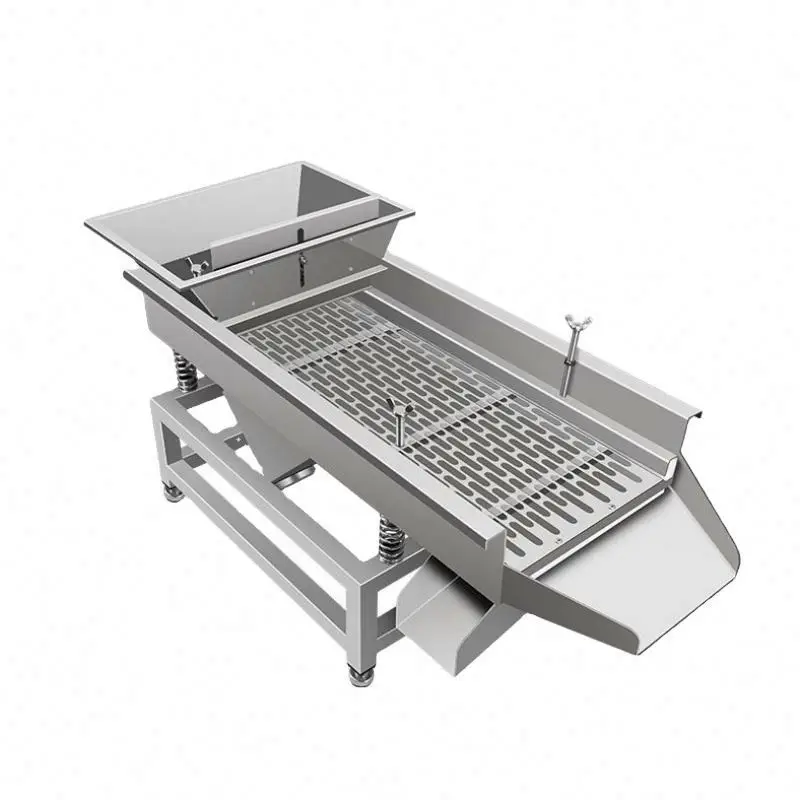
What the source record confirms
The TEBAK source record identifies a Continuous Grading Machine described as a sand, gravel, granules, ore, feed, beans, wheat, corn and grain linear vibrating screen or linear sieve machine. The product ID is 1601252466446. The source does not provide a numerical specification table for this item.
For procurement purposes, the title establishes the equipment family and the material categories presented by the seller. It does not establish a particular screening capacity, screen aperture, number of decks, vibration frequency, motor rating, machine dimensions, material grade, dust-control configuration or certification.
This guide therefore uses the source wording as a quotation scope rather than turning unverified listing language into engineering data. Buyers should attach the product ID, the exact title, a material sample and a written screening requirement to every RFQ.
The listing also contains general company, packing and delivery wording. Those sections are not model-specific technical specifications and should not replace a drawing, data sheet, test report or inspection record for this machine.
1. Procurement identity and screening scope
Use the exact source identity in the inquiry: TEBAK Continuous Grading Machine Sand Gravel Granules Ore Feed Beans Wheat Corn Grain Linear Vibrating Screen Linear Sieve Machine. Ask the supplier to confirm that the quoted configuration corresponds to product ID 1601252466446.
Clarify whether “continuous grading machine” describes a continuous-flow operating method, a product family name or a target application. Ask for a process diagram showing feed, screening, discharge and collection points.
Confirm whether the offered machine is a linear vibrating screen, a linear sieve, or a combined system with a feeder, hopper, conveyor, dust hood or collection equipment. Similar names can describe different configurations.
Define the buyer's process before discussing price. Record material name, particle-size distribution, moisture, bulk density, temperature, abrasiveness, oil content, contamination risk, required fractions and acceptable carryover.
Do not treat the list of sand, gravel, granules, ore, feed, beans, wheat, corn and grain as proof that one configuration can process all of them. Each material can require different screen media, feed control, wear protection, cleaning and sanitary measures.
Request a model drawing and a complete bill of materials. Separate base machine, screen decks, screen media, feed hopper, discharge chutes, motor, springs, supports, dust cover, controls and spare parts.
Confirm whether the item is supplied as a stand-alone screen or as part of a larger grading line. A stand-alone machine may need upstream feeding and downstream conveying that are not included in the listing.
Keep the product ID on the quotation, drawing, nameplate photo, inspection report, packing list and manual. Do not accept a visually similar substitute without written approval.
2. Source description versus verified specification
| Source wording | What it supports | What still requires confirmation |
|---|---|---|
| Continuous Grading Machine | Procurement topic: continuous grading or screening equipment | Continuous duty, feed method, operating hours, throughput and control sequence |
| Linear Vibrating Screen / Linear Sieve Machine | Equipment family and screening motion description | Vibration mechanism, frequency, amplitude, inclination, decks and screen area |
| Sand, gravel, granules and ore | Mineral or aggregate application scope stated in the title | Maximum feed size, abrasion resistance, dust handling, wear parts and actual test results |
| Feed, beans, wheat, corn and grain | Food or feed material categories stated in the title | Sanitary design, cleaning, allergen control, food-contact materials, moisture limits and pest-control requirements |
| Product images and listing copy | Reference material for configuration discussion | Dimensions, internal construction, motor, screen media, certification and included accessories |
Because the queue provides no structured numerical parameters, this guide intentionally does not publish guessed values for capacity, dimensions, power, voltage, screen opening or accuracy.
3. Material characterization before quotation
Provide a representative material sample or a laboratory particle-size report. A supplier cannot select screen media or estimate performance reliably from a broad material name alone.
For sand and gravel, record source, moisture, particle shape, top size, fines content, abrasive minerals and the number of required product fractions.
For granules, record polymer or mineral type, particle shape, bulk density, static behavior, temperature and whether the granules may bridge or blind the screen.
For ore, record hardness, abrasiveness, moisture, clay content, top size, density, magnetic properties and whether dust or slurry is present. Ask for wear recommendations and a realistic service plan.
For feed, beans, wheat, corn and grain, record moisture, oil content, contamination, expected foreign material, target grades, sanitary cleaning method and allergen controls.
Define the feed rate in the buyer's preferred unit and the allowed variation. If the supplier gives a rate, request the material, moisture, feed size and acceptance criteria used to obtain it.
State whether the buyer needs removal of oversize, undersize, foreign material, broken kernels, dust, stones, metal or multiple product grades. “Grading” can mean different separations in different plants.
Clarify whether the product must run dry, wet, warm, cold, sticky or oily material. The source title does not establish wet screening or heated screening capability.
Record the intended operating environment, including indoor or outdoor installation, ambient temperature, dust level, washdown exposure and hazardous-area requirements.
4. Screen media and separation requirements
Request a screen-media schedule listing opening shape, opening size, wire or panel construction, thickness, material grade, tension method and replacement part number.
For aggregates and ore, compare wire mesh, perforated plate, polyurethane panels or other media only after the supplier reviews abrasion, feed size and target separation.
For beans, wheat, corn and grain, confirm whether the contact surfaces are suitable for the intended application and cleaning regime. Do not infer food-contact compliance from a general stainless-steel claim.
Specify the required fractions and target cut points. The source title contains no screen aperture or grading accuracy value.
Ask whether one machine can use interchangeable screens and how quickly screens can be changed. Record required tools, access, cleaning time and safe isolation steps.
Confirm screen tension, support, sealing and edge retention. Poor sealing can allow bypass, contamination or inaccurate grading.
Inspect the screen path for dead zones, accumulation points and areas where wet or sticky material could build up. Request a cross-sectional drawing.
Ask for a spare-screen price list and recommended starting inventory based on the buyer's material and duty cycle.
Do not publish or promise a screen aperture, mesh number, grading precision or separation efficiency until it appears in a model-specific data sheet or signed test report.
5. Capacity and continuous-flow validation
The word “continuous” in the title is not a throughput specification. Ask the supplier to define continuous operation, including feed system, discharge arrangement, duty cycle, operating hours and maintenance intervals.
Request capacity in the buyer's material and unit. A rate stated for dry grain may not apply to moist grain, ore, gravel or a different bulk density.
Define feed stability. Record whether the machine needs a metering feeder, surge hopper, distributor or manual loading, and whether those components are included.
Ask for a mass-balance test: input quantity, each output fraction, retained material, dust loss, carryover and unprocessed material. Include test duration and measurement method.
Test at low, target and maximum proposed feed rates. Record screen loading, motion, product carryover, blinding, noise, vibration and motor temperature.
Confirm start-up, shutdown, emergency stop, restart and blockage-clearing procedures. A continuous-flow system needs a safe response to upstream or downstream interruption.
Do not calculate output from screen area, motor size or title wording. Those values are not supplied, and they would not alone prove practical capacity.
Ask for a performance guarantee tied to the buyer's sample and written acceptance criteria. Generic marketing output should not be treated as a guarantee.
6. Vibration system and machine mechanics
Request a mechanical drawing of the vibrating body, drive, springs or isolators, counterweights, supports, screen frame and discharge points.
Confirm vibration direction, frequency, amplitude, inclination and adjustment range. The source calls the machine linear vibrating, but gives none of these numerical settings.
Ask how the drive is mounted and whether the motor, eccentric mechanism, belt, coupling or other drive parts are included.
Confirm balancing and foundation requirements. Ask for foundation loads, support spacing, anchor details and the recommended installation surface.
Measure operating vibration at the machine and nearby structure during the acceptance test. Record whether vibration transfers to conveyors, platforms or building steel.
Ask for noise data measured under defined conditions. The title and images do not establish noise level.
Confirm bearing type, lubrication, sealing, service access and replacement procedure. Request recommended inspection intervals.
For abrasive materials, ask which components are wear parts and how wear is monitored. Confirm whether liners or replaceable wear plates are included.
Do not assume that a compact appearance means low foundation load, low vibration or low noise.
7. Feed, discharge and integration
Request a layout drawing showing feed inlet, screen decks, product outlets, reject outlet, dust extraction connection and maintenance access.
Confirm inlet and outlet dimensions only from the supplier's drawing. No connection size is provided in the source queue.
Define the number of product fractions and discharge destinations. A single-deck sieve, multi-deck screen and multiple-machine line have different discharge requirements.
Ask whether the machine includes a feed hopper or a distributor to spread material across the screen width. Uneven feed can reduce separation quality.
Confirm how undersize, oversize and intermediate fractions are collected. Request chutes or interfaces for the buyer's conveyors, bins or bagging equipment.
For dusty sand, gravel and ore, define dust hood, extraction, sealing and filter interfaces. Do not assume dust control is included.
For grain and feed, define enclosed transfer, pest control, cleaning access and cross-contamination prevention between batches.
Check whether the screen can be isolated from upstream and downstream equipment. Provide lockout points and safe access for maintenance.
Do not order a screen as a complete line unless the quotation clearly lists every upstream and downstream component.
8. Dry, wet and difficult-material applications
Ask whether the proposed configuration is for dry screening only. The title lists materials but does not state wet-screening capability.
For wet or damp feed, define moisture, stickiness, drainage, washing, spray bars, corrosion protection and effluent handling.
For clay-bearing ore or sticky granules, test blinding and buildup. Request a cleaning procedure and a recommendation for screen media.
For oily feed or grain with high moisture, confirm surface compatibility, cleaning agents, temperature and sanitation requirements.
For hot material, confirm allowable feed temperature and thermal expansion. Do not infer temperature resistance from the phrase “ore” or “grain.”
For fragile beans, wheat, corn or grain, inspect breakage, impact points, drop height and residence time.
For dusty material, define enclosure and extraction requirements. Ask for dust classification and destination-market compliance where relevant.
Use the buyer's most difficult material in acceptance testing. A free-flowing dry sample can hide problems with the actual process.
9. Food, feed and sanitary procurement
The title includes feed, beans, wheat, corn and grain, but these words do not establish food-contact suitability or sanitary design.
Ask which surfaces contact the product and request the material grade, finish, weld quality and cleanability of those surfaces.
Define cleaning method: dry clean, vacuum, brushing, compressed air, water wash or wet sanitation. Confirm whether the machine is designed for that method.
Check for dead legs, ledges, hollow sections, inaccessible screen supports and residue traps. Request an internal inspection or cleaning drawing.
Confirm allergen management, batch changeover, product retention and cross-contamination controls if several grains or feed products share the machine.
Ask for certificates or declarations only when they cover the exact model and material-contact scope. A general company profile does not prove compliance.
Define pest-control and foreign-material requirements. Confirm whether magnets, metal detection, aspiration or additional cleaning stages are included; do not assume they are part of the screen.
Perform a dry-run and a product-run sanitation inspection before acceptance. Record residue locations and cleaning time.
Do not describe the unit as a food-grade or feed-grade machine without model-specific evidence.
10. Mineral, aggregate and ore procurement
For sand, gravel, granules and ore, define maximum feed size, target fractions, abrasion, moisture, density and required wear life.
Ask for a wear-part map covering screen media, liners, chutes, frame supports, bearings and drive components.
Confirm whether the machine can handle sharp, heavy or irregular particles without excessive deformation or screen damage.
Request an abrasion test using the buyer's material. Record inspection intervals, screen replacement criteria and expected maintenance actions.
Define dust containment and worker-protection requirements. Request airflow and extraction interfaces if the plant requires enclosed handling.
Ask whether the machine should be mounted on isolation springs, a support frame, a platform or a foundation. Obtain foundation loads before civil work.
Confirm discharge chutes and downstream conveyors are compatible with the actual material and fraction size.
Do not use the same settings or screen media for gravel and grain without a supplier-approved changeover plan and test.
11. Electrical and controls confirmation
No voltage, frequency, phase, motor power or control-panel specification is provided in the queue. Request the complete electrical data sheet before ordering.
Ask for rated power, starting current, motor efficiency class, frequency, phase, voltage range, cable size, isolator, overload protection and grounding method.
Confirm whether the motor is included, whether a variable-frequency drive is included, and whether vibration adjustment is mechanical or electronic.
Request the control sequence for feeder, screen, dust extraction and downstream equipment if the machine is part of a line.
Define emergency-stop locations and the response to blocked screen, overload, loss of downstream discharge or open access cover.
Ask for wiring diagrams, terminal labels, spare electrical parts and troubleshooting instructions.
Confirm destination-market plug, cabinet, enclosure and compliance requirements. Do not infer any of these from the product title or company profile.
Match nameplate data to the quotation and acceptance test. A motor rating from a similar model is not evidence for this product ID.
12. Noise, dust and workplace safety
Request noise measurements under defined feed and installation conditions. Do not claim a decibel value without a test record.
Define guarding around moving vibration and drive components. Confirm access covers, tools, interlocks and lockout points.
Ask for safe screen-change and blockage-clearing procedures. Operators should not reach into an energized or moving screen.
For dust-generating feed, define enclosure, extraction, filter connection and cleaning requirements.
For grain and feed, assess combustible-dust risk with the responsible plant safety team. Do not claim hazardous-area compliance without applicable documents.
Confirm lifting and access requirements for screen panels, motor and drive components.
Include safety labels, manuals, training and spare-part identification in the purchase scope.
Record acceptance observations for vibration, noise, dust leakage, guards, emergency stop and maintenance access.
13. Installation and commissioning
Request an installation manual and a dimensioned layout before preparing the foundation or support frame.
Confirm machine orientation, inclination, feed direction, discharge direction, support points, anchor details and clearance.
Check that the site can support the machine and transmit acceptable vibration. Use supplier foundation loads rather than a guessed machine weight.
Commission the unit with an empty run first. Check rotation, direction, unusual noise, vibration, bearing temperature, emergency stop and guard operation.
Run a representative sample after the empty test. Record feed distribution, product fractions, carryover, blinding, dust and discharge behavior.
Document initial settings, screen media, material sample, feed rate, moisture and acceptance results.
Confirm who is responsible for installation, electrical connection, alignment, commissioning and operator training.
Do not treat a successful no-load run as proof of grading performance.
14. Maintenance and spare parts
Request a maintenance schedule covering screen media, springs or isolators, bearings, motor, drive, fasteners, seals and discharge components.
Ask for inspection criteria for cracks, loose fasteners, screen damage, bearing heat, abnormal vibration and product buildup.
Confirm lubrication type, quantity, interval and approved method. Record whether bearings are sealed or serviceable.
Request screen replacement instructions and a recommended spare-screen inventory based on the buyer's material.
For abrasive applications, define wear measurement and replacement limits for screens, liners and chutes.
For food or feed applications, define cleaning, drying, sanitation inspection and batch-change procedures.
Ask for a troubleshooting table covering low separation, carryover, blinding, uneven feed, abnormal noise, high vibration and motor overload.
Confirm local service, remote support, warranty response, spare-part lead time and packing for replacement screens.
15. Performance acceptance test
Write acceptance criteria around the buyer's actual material and target fractions. Include feed rate, moisture, bulk density, particle-size distribution and test duration.
Measure input and each output fraction. Record recovery, carryover, misplaced material, dust loss, unprocessed material and rework.
Inspect screen loading across the complete width. Uneven distribution can make a high average result misleading.
Check start-up, continuous running, shutdown, blockage clearing and restart with the proposed feed system.
Record motor current, bearing temperature, vibration, noise, dust leakage and fastener condition where applicable.
Run each intended screen media and each critical material grade. Do not approve a multi-material purchase from a single convenient sample.
Attach photographs, sample labels, screen configuration, settings and measured results to the signed acceptance record.
Define what happens if the machine does not meet the agreed separation or feed criteria: adjustment, media change, replacement, repair or commercial remedy.
16. Packing, delivery and documentation
Request a packing list naming the base machine, screen panels, motor, supports, hopper, chutes, controls, guards, tools, manual and spare parts.
Confirm packed dimensions, gross weight, lifting points, moisture protection and protection of screen media and electrical parts.
Match crate markings to product ID 1601252466446 and the buyer's purchase order.
Request photographs before closing the crate, including nameplate, screen configuration, drive, guards and accessory packages.
Confirm whether the delivered machine is assembled or requires site assembly. Request assembly drawings and fastener identification.
Keep the quotation, drawing, data sheet, inspection report, packing list, manual, certificates and correspondence together.
Do not rely on general company or packing text as a substitute for model-specific documents.
Confirm price, MOQ, lead time, shipping term, insurance, duties, warranty and after-sales support in writing.
17. RFQ checklist
- Confirm product ID 1601252466446 and the exact linear vibrating screen configuration.
- Confirm whether the machine is continuous-flow, and define duty cycle and operating hours.
- Provide material samples or particle-size data for every intended material category.
- Confirm target fractions, cut points, required recovery, carryover and acceptable grading error.
- Provide screen area, screen aperture, number of decks, media type and replacement information.
- Provide capacity tested with the buyer's material, moisture, bulk density and feed size.
- Provide vibration frequency, amplitude, inclination, drive type and foundation loads.
- Provide voltage, frequency, phase, motor power, current, controls, grounding and protection.
- Confirm feed hopper, feeder, chutes, dust cover, extraction interface and discharge equipment.
- Confirm sanitary, food-contact, feed, allergen and cleaning requirements where applicable.
- Provide dimensions, packed dimensions, net/gross weight, installation clearance and lifting points.
- Provide performance-test method, acceptance criteria, manuals, certificates and warranty terms.
18. Questions for the supplier
What are the machine dimensions, screen dimensions, number of decks and screen openings for product ID 1601252466446?
What capacity can you guarantee for the buyer's sand, gravel, ore, grain or feed sample, and under what moisture and bulk-density conditions?
What are the vibration frequency, amplitude, inclination and drive configuration?
Which screen media are supplied, and what are the opening sizes, material grades, replacement prices and lead times?
Is a feeder, hopper, dust cover, extraction connection, support frame, chute or conveyor included?
What are the actual voltage, frequency, phase, motor power, current, control and safety specifications?
Can the machine process both mineral materials and grain or feed with approved changeover and cleaning procedures?
What test report can you provide using the buyer's material and target fractions?
What are the foundation loads, operating vibration, noise data and installation clearances?
What model-specific certificates, manuals, warranty and after-sales service are included?
19. What not to assume
Do not assume the listed material categories prove universal compatibility.
Do not assume “continuous” proves a particular throughput or continuous-duty rating.
Do not invent screen aperture, deck count, capacity, power, voltage, size, accuracy, noise or vibration values.
Do not assume a feeder, conveyor, dust collector, hopper, support frame or control panel is included.
Do not assume food-contact, feed-grade, sanitary, hazardous-area or mineral wear compliance.
Do not use a company profile, packing paragraph or generic certificate as model-specific technical evidence.
Do not approve the machine without a sample test that matches the buyer's material and separation target.
20. Final procurement decision
The source-confirmed baseline for this TEBAK product is a continuous grading or screening machine described as a linear vibrating screen or linear sieve for sand, gravel, granules, ore, feed, beans, wheat, corn and grain. No structured numeric parameters are supplied in the queue.
Proceed to quotation only after the supplier provides a complete technical data sheet, drawing, screen-media schedule, electrical specification, capacity test, foundation information, safety documents and commercial terms. The final purchase order should identify product ID 1601252466446 and attach the accepted material test.
Editor's note: This guide uses the supplied Hoting queue title and product ID only. It preserves the boundary between source description and verified specification, and marks all unreturned engineering values as RFQ items.
Frequently asked questions
- What product is identified by the source?
- Product ID 1601252466446 is described as a continuous grading machine and linear vibrating screen or linear sieve for sand, gravel, granules, ore, feed, beans, wheat, corn and grain.
- Are numerical specifications supplied?
- No structured numerical parameters are supplied in the queue. Request dimensions, screen area, aperture, deck count, capacity, power and voltage from the supplier.
- Can one configuration process every listed material?
- Do not assume that. Test each intended material because moisture, density, abrasiveness, particle size, sanitation and screen media requirements differ.
- What should the RFQ include?
- Include material samples or particle-size data, target fractions, capacity, screen media, electrical data, foundation loads, dust or sanitary requirements and acceptance criteria.
- Does the title prove food-grade or mineral-duty compliance?
- No. Request model-specific material, safety, sanitary, wear and destination-market documents where required.