
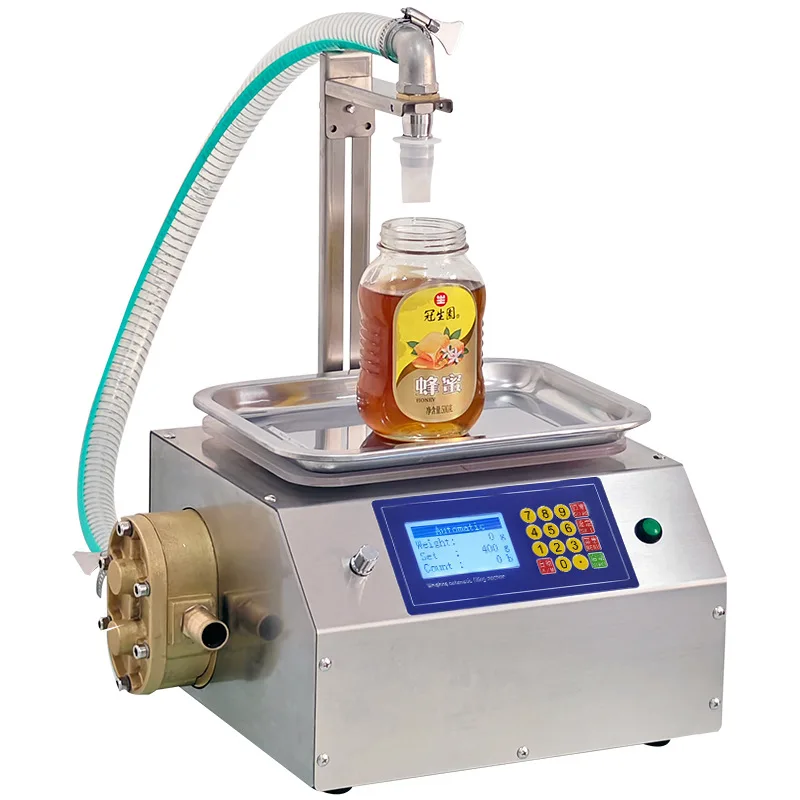
Why model separation matters in liquid filling procurement
The TEBAK Multi Function Packaging Machine is presented as a liquid bottle weighing and filling machine. The supplied source record lists two configurations: CSY-L15 and CSY-L13. They are not interchangeable specifications. CSY-L15 is listed with a 20-8000g filling range and 7L/min flow rate, while CSY-L13 is listed with a 30-1000g filling range and 12L/min flow rate. The record also gives different listed weights, package sizes, power values and application groups.
This distinction is important for importers, filling-line integrators, food and beverage processors, chemical-product distributors, lubricant suppliers and private-label packers. A purchase order should identify the exact model and then carry its own range, electrical package, flow rate, error field, package size and approved liquid list. Combining L15 and L13 into one general claim could result in the wrong machine being quoted or tested.
The source also includes a direct page-price warning: the price shown is for another model, not L15. Treat the online price as a model-selection risk, not as a confirmed quotation. Ask the supplier to issue a model-specific pro forma invoice and confirm all dimensions and performance conditions before payment.
1. Controlled product identity
The source product ID is 1601252984432. Its title describes a multi-function packaging machine for liquid bottles, water weighing and liquid filling. The detailed record names CSY-L15 and CSY-L13. The source does not provide a single unified model number for the product page, so the RFQ should state one selected model and exclude the other model's values unless both machines are being purchased.
CSY-L15 is the higher-range configuration in the supplied fields: 20-8000g filling range, 7L/min flow rate, 220V / 200W and error <=2g. CSY-L13 is the lower-range, higher-listed-flow configuration: 30-1000g filling range, 12L/min, 220V / 150W and error <=2g. The different ranges suggest different procurement use cases, but the source does not explain pump type, nozzle count, weighing method, liquid temperature or test conditions.
Do not assume that a larger filling range means higher throughput. Flow rate and filling accuracy depend on viscosity, container, hose, nozzle, target weight and operating method. Request a test with the buyer's liquid and bottle before treating any number as a production guarantee.
2. Source-confirmed model comparison
| Field | CSY-L15 | CSY-L13 |
|---|---|---|
| Listed weight | 15kg | 9kg |
| Package size | 40*35*35 | 36*36*35 |
| Filling range | 20-8000g | 30-1000g |
| Flow rate | 7L/min | 12L/min |
| Electrical field | 220V / 200W | 220V / 150W |
| Error field | <=2g | <=2g |
| Application direction | Paste, sticky liquid, oils and grease listed by source | Oils, detergent, shampoo, yogurt, white wine, sauces, honey and glue listed by source |
The table reproduces the available model fields. Package-size units are not supplied in the source excerpt, so confirm whether the values are centimeters and whether they describe the shipping carton or the machine. The listed weights also need a definition: ask whether they are net machine weight, gross packed weight or another catalog field.
3. CSY-L15 buying profile
CSY-L15 is listed with a 20-8000g filling range and a 7L/min flow rate. The source lists honey, sesame paste, various oils, glue, autumn pear paste, edible oil, sweet flour paste, chocolate paste, lubricating oil, grease, bean paste and other paste and sticky liquids as applications. These are source-listed use cases, not proof that every liquid has the same filling behavior.
The record lists 220V / 200W and error <=2g for L15. Ask what test liquid and target weight were used for the error field. A weighing error at one target weight cannot automatically be applied across the entire 20-8000g range. Request repeatability, allowable tolerance, calibration procedure and the conditions under which the measurement was taken.
For sticky materials, define the liquid temperature, viscosity or test description, nozzle size, hose length, pump setting, container opening and cleaning interval. Chocolate paste, grease, bean paste and lubricating oil may require different handling and cleaning procedures. Confirm whether the same pump, valve, hose and nozzle are supplied for all listed applications.
The source lists a 15kg weight for CSY-L15 and separately states a maximum weight of 10KG. Because the meaning is unclear and the values appear to refer to different fields, do not use either as a load or weighing limit without supplier confirmation. Ask for a nameplate, dimension sheet and manual defining net weight, gross weight, weighing range and maximum permitted product load.
4. CSY-L13 buying profile
CSY-L13 is listed with a 30-1000g filling range, 12L/min flow rate, 220V / 150W and error <=2g. Its listed applications include vegetable oil, glass water, detergent, shampoo, yogurt, white wine, soy sauce, vinegar, honey, wood glue and other liquids. The source spelling “glass water” should be clarified in the quotation rather than silently normalized to a different product.
The L13 range is narrower than L15 in the source fields. It may be more appropriate for small bottle or container targets, but the source does not provide nozzle dimensions, container-height limits, filling speed by target weight or allowable viscosity. A 12L/min catalog field should therefore be treated as a source claim requiring a defined water or product test.
Ask for the L13 weighing sensor specification, display resolution, calibration steps, zeroing procedure and error test report. Confirm whether the <=2g field is a maximum error, typical error or a catalog shorthand. Test at low, middle and high target weights within 30-1000g using the buyer's actual liquid and container.
The source lists 9kg for L13 and a separate maximum-weight field of 15KG. Preserve both until the supplier explains them. The quotation should say whether 9kg is net machine weight, packed weight or a model catalog value, and whether 15KG is a product-load limit, scale range or another specification.
5. Liquid compatibility and changeover
Liquid filling performance is strongly affected by viscosity, solids, temperature, foaming, acidity, oil content and residue. The source lists both thin liquids and viscous or sticky liquids, but does not provide viscosity limits, particle-size limits, temperature range, pump type, seal material or valve construction. Request a compatibility matrix for each selected model.
For honey, syrup, paste, glue, grease and chocolate, ask whether heating or warming is permitted and what temperature range applies. Do not infer heating capability from the ability to fill a viscous liquid. For yogurt, sauces and other food products, request the cleaning and sanitation procedure and identify all product-contact parts.
For detergent, shampoo, lubricant and glue, confirm chemical compatibility of hoses, seals, pump body, nozzle and container. A single machine may need a dedicated hose or seal kit for different products. Ask whether product-contact components can be removed without special tools and how the buyer should prevent cross-contamination.
Test foaming liquids separately. Confirm whether filling from the top, bottom or another arrangement is used, and whether the operator can reduce speed or use a drip-control function. The source does not list anti-drip performance, so it must be verified rather than promised.
6. Filling range, weighing and accuracy controls
The L15 field says 20-8000g, and the L13 field says 30-1000g. These are the most important model-selection numbers in the record. Ask the supplier to define minimum stable fill, maximum stable fill, container requirements and the relationship between target weight and flow rate.
Use a three-stage sample plan. First, test a low target near the bottom of the selected range. Second, test a representative production target. Third, test a high target near the top of the range. Record actual filled mass for multiple containers, average deviation, maximum deviation, cycle time and product residue. Repeat after the machine reaches normal operating temperature if the supplier recommends warm-up.
Clarify the <=2g error field. Ask whether it is measured at a particular target mass, with water, under laboratory conditions or during normal production. Request the scale resolution, sensor model, calibration weight requirement and the method for checking drift. Accuracy claims without test conditions are not sufficient for acceptance.
Confirm whether the machine fills by weighing each container or by timed/volumetric control. The title and fields use “weighing,” but the internal mechanism is not described. Ask for the operating principle, sensor position, tare function and response to container movement.
7. Electrical and installation checks
Both configurations are listed at 220V. L15 is listed at 200W and L13 at 150W. Confirm frequency, phase, plug type, current, grounding, switch, fuse or breaker requirement and whether the supplied unit is configured for the buyer's destination market. Do not treat 220V alone as a complete export electrical specification.
Request the exact nameplate photograph for the selected model. It should match the pro forma invoice, packing list, manual and pre-shipment inspection record. Confirm whether the listed wattage is input power or rated motor power and whether an external air supply is required. No air pressure or compressor specification is supplied in the source.
Measure the installed footprint after receiving the dimension drawing. The package values are 40*35*35 for L15 and 36*36*35 for L13, but units and whether they describe packaging are not defined. Leave space for container placement, hose routing, cleaning, calibration and operator access.
8. Packaging, shipment and model-price control
The source provides package-size fields but not units, packaging material, gross/net distinction, carton count, palletization or shock protection. Ask for a packing list with model, quantity, package dimensions, gross weight, net weight and accessories. Verify that the packing list does not interchange L15 and L13.
The description warns that the displayed price is for another model, not L15. This is a direct commercial control point. Before placing an order, request a written quotation that states product ID 1601252984432, selected model, filling range, power, package size, included nozzles, pump, hose, seals, manual and warranty. Confirm that the quoted price corresponds to that exact configuration.
Ask for separate photographs or a video of the selected model's nameplate and complete accessory set. A product page showing several model images is not enough to prove which machine will ship. Record serial numbers or batch identifiers at inspection where available.
9. Acceptance testing before shipment
Build the acceptance test around the selected liquid and target container. For L15, include at least one paste or sticky-liquid test if that is the buyer's application. For L13, include the actual oil, detergent, shampoo, yogurt, sauce, honey or glue selected for production. Do not substitute water for a viscous product and then report the result as universal performance.
The test record should include model, voltage, frequency, liquid name, temperature, container type, target mass, number of cycles, average mass, maximum deviation, flow observation, dripping, foaming, residue and cleaning time. Attach photographs of the nameplate and filled containers. If the buyer requires <=2g accuracy, state the test target and measurement method explicitly.
Check start-up, stop, tare, calibration, nozzle adjustment and recovery after a paused cycle. Confirm whether a partially filled container can be removed safely and whether product remains in the hose. Inspect seals and product-contact surfaces after cleaning. The supplier's machinery test should be retained with the buyer's inspection report.
10. Operator workflow and maintenance
Map the complete work sequence: prepare and filter liquid if required, install the correct hose and nozzle, place the container, tare the scale, select target weight, start filling, stop, verify mass, remove the container and clean the product-contact path. Confirm which steps are automatic and which require operator intervention.
Ask for an exploded parts diagram, nozzle sizes, hose lengths, seal materials, pump or valve part numbers and recommended spare parts. The source does not state a pump type or service interval. Request instructions for priming, draining, clearing a blockage, changing a seal and calibrating the weighing system.
Sticky or oily liquids may remain in the hose and nozzle after a run. Confirm whether the machine supports quick changeover, drain-back or removable product-contact parts. For food products, request a cleaning and sanitation instruction suitable for the actual materials. For chemicals and lubricants, define waste handling and chemical compatibility.
11. Model-specific RFQ checklist
- State whether the quotation is for CSY-L15, CSY-L13 or both; do not accept a combined model description.
- Confirm the selected model's filling range: L15 20-8000g or L13 30-1000g.
- Confirm flow rate under a named liquid and condition: L15 7L/min or L13 12L/min source field.
- Confirm power and electrical package: L15 220V / 200W or L13 220V / 150W, plus frequency, plug and current.
- Define the <=2g error field, test liquid, target mass, scale resolution and repeatability.
- Explain the separate maximum-weight fields: L15 10KG and L13 15KG.
- Clarify whether listed weights and package sizes are net/gross and packed/unpacked values, including units.
- Provide pump, valve, nozzle, hose, sensor, seal and product-contact material information.
- Confirm approved viscosity, temperature, solids, foaming and chemical-compatibility limits.
- Issue a model-specific price because the source warns that the page price is for another model, not L15.
- Provide the manual, calibration instructions, cleaning procedure, spare-parts list and warranty terms.
12. Questions for the supplier
Ask: Which model is included in the quotation? Does CSY-L15 fill 20-8000g and CSY-L13 fill 30-1000g under the same weighing method? What liquid and target mass support the 7L/min and 12L/min flow fields? What does <=2g error mean and how was it measured? What do the 10KG and 15KG maximum-weight fields refer to? Are 40*35*35 and 36*36*35 package dimensions, and what are their units? Which parts contact the product? What are the pump, sensor, nozzle and seal models? What is the exact price for L15 rather than the other model mentioned in the source warning?
Also ask for a video or test report using the buyer's liquid, container and target weight. Confirm the electrical nameplate, cleaning steps, changeover time and spare-parts availability. If the supplier cannot distinguish L15 from L13 in the pro forma invoice, pause procurement until the model identity is corrected.
13. Final procurement decision
The TEBAK liquid filling platform may serve different use cases through CSY-L15 and CSY-L13, but the purchase decision must be model-specific. L15 is the source-listed option with the wider 20-8000g range and paste/sticky-liquid applications. L13 is the source-listed option with the 30-1000g range and 12L/min flow field for the listed liquid applications. Neither description supplies enough test conditions to guarantee production accuracy or throughput.
Approve a quotation only after the supplier confirms the selected model, electrical configuration, filling range, accuracy method, liquid compatibility, package dimensions, weight definitions and price. Keep the product ID, model-specific quotation, nameplate photograph, sample test and inspection record together. This prevents a multi-model listing and a page-price warning from turning into a model mismatch at delivery.
Editor's note: Product facts in this guide are limited to the supplied Hoting queue record. The source's model values, application lists and commercial warning are preserved as procurement inputs, not expanded into unsupported certification or performance claims.
Key specifications
- Source product ID
- 1601252984432
- Product type
- Multi-function liquid filling and weighing machine
- Model CSY-L15
- 15kg listed weight; package size 40*35*35; filling range 20-8000g; flow rate 7L/min; 220V / 200W; error <=2g
- CSY-L15 applications
- Honey, sesame paste, various oils, glue, autumn pear paste, edible oil, sweet flour paste, chocolate paste, lubricating oil, grease, bean paste and other paste and sticky liquids
- Model CSY-L13
- 9kg listed weight; package size 36*36*35; filling range 30-1000g; flow rate 12L/min; 220V / 150W; error <=2g
- CSY-L13 applications
- Vegetable oil, glass water, detergent, shampoo, yogurt, white wine, soy sauce, vinegar, honey, wood glue and other listed liquids
- Source maximum-weight fields
- CSY-L15: 10KG; CSY-L13: 15KG; confirm whether these refer to a liquid load, weighing range or another limit
- Model selection
- The product record lists CSY-L15 and CSY-L13 separately; quote the selected model, not a combined specification
- Page price note
- Source description states that the page price is for another model, not L15; confirm the quotation model and price before ordering
Frequently asked questions
- What are the two listed models?
- The source record lists CSY-L15 and CSY-L13. They must be quoted and tested separately because their ranges, flow rates, weights, package sizes and power fields differ.
- What filling range is listed for CSY-L15?
- CSY-L15 is listed at 20-8000g with a 7L/min flow field, 220V / 200W and error <=2g. Confirm test conditions before treating these as production guarantees.
- What filling range is listed for CSY-L13?
- CSY-L13 is listed at 30-1000g with a 12L/min flow field, 220V / 150W and error <=2g. Test with the buyer's actual liquid and container.
- Can the two model specifications be combined?
- No. The source presents L15 and L13 as separate model rows. Use one selected model's specifications in the quotation and purchase order.
- Is the displayed page price safe to use?
- The source warns that the page price is for another model, not L15. Request a model-specific quotation before ordering.