
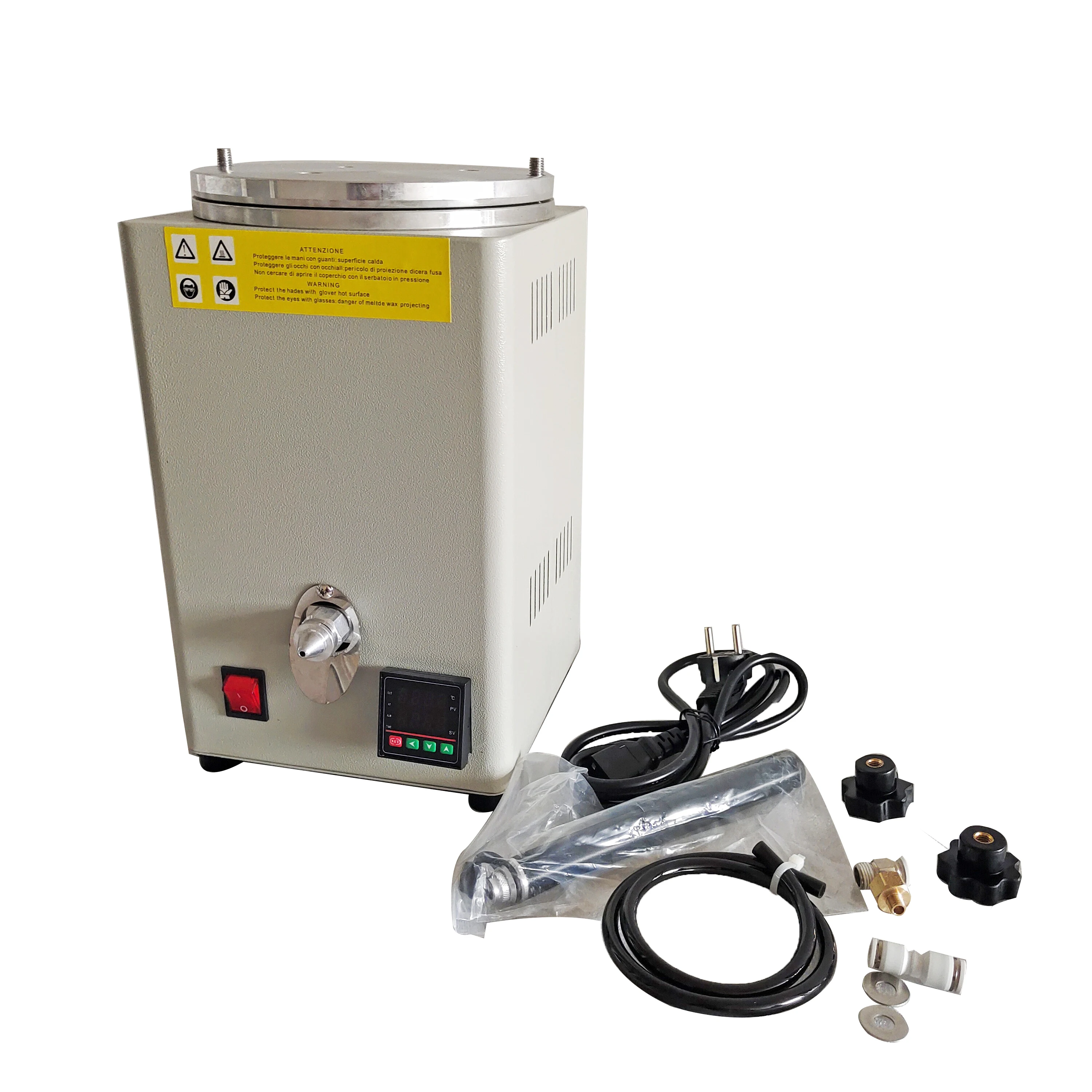
Source-controlled product identity
This TEBAK Hoting queue record describes a digital vacuum wax sprayer, small wax sprayer, jewelry tool, jewelry machinery unit and automatic wax injection machine. The structured fields include ejector force, theoretical shot volume, injection rate, injection weight, machine weight, open stroke and power. The title and fields should be treated as a source-controlled listing identity, not as a complete process specification.
Product ID 1601251474960 should remain on the quotation, drawing, nameplate photograph, sample record and inspection report. The word “sprayer” suggests wax dispensing, while “automatic wax injection machine” suggests a controlled injection process. The field “Ejector Force” is normally associated with a mechanical ejection function, but the source does not explain how it relates to wax delivery. Ask the supplier to reconcile the terminology and provide a process diagram before comparing this unit with other jewelry wax equipment.
Recorded specifications
| Source field | Recorded value | Procurement treatment |
|---|---|---|
| Ejector Force(kN) | 10kN | Source-recorded value; confirm whether this is an ejector, clamping, plunger or another mechanical force and identify the measurement condition. |
| Theoretical Shot Volume(cm³) | 20cm³ | Source-recorded theoretical volume; confirm wax density basis, usable volume, shot repeatability and whether the unit uses a reservoir or cartridge. |
| Injection Rate (g/s) | 10g/s | Source-recorded rate; confirm wax temperature, pressure, nozzle, viscosity, test method and allowable adjustment range. |
| Injection Weight (g) | 100g | Source-recorded value; confirm whether it means maximum shot weight, reservoir charge, single part weight or another catalog definition. |
| Weight (KG) | 5.5kg | Source-recorded machine weight; confirm net/gross status, accessories, packaging and lifting requirements. |
| Open Stroke(mm) | 100mm | Source-recorded stroke; confirm the moving component, open position, usable clearance and safety stop. |
| Power (kW) | 0.5kW | Source-recorded power; confirm voltage, frequency, phase, current, control power, heater load and measurement condition. |
How to interpret the capacity-related values
The record contains three values that may affect purchasing decisions: theoretical shot volume of 20cm³, injection rate of 10g/s and injection weight of 100g. They should not be combined into a guaranteed wax output without a supplier test basis. Wax density varies by formulation and temperature, and a theoretical volume does not necessarily equal the usable volume delivered through the nozzle.
Ask the supplier to define the relationship between the 20cm³ volume and the 100g injection weight. Confirm whether the 100g value is the maximum amount for one shot, the maximum wax load in a chamber, or a nominal catalog value. Request a calculation using the buyer’s wax formulation, density and target jewelry pattern. Record the wax temperature, pressure, nozzle diameter, cycle time and measured mass for every sample shot.
The 10g/s injection rate also requires a test condition. Ask whether it is a peak or average rate, whether it is adjustable, and whether it is measured at the nozzle or inside the chamber. A buyer should compare parts only when the supplier uses the same wax, temperature, nozzle, mold resistance and measurement method.
Vacuum and wax process clarification
The title includes “digital vacuum wax sprayer,” but no vacuum level, pump type, chamber volume, vacuum cycle, leakage rate, pressure range or control sequence is supplied. Ask for a process flow showing loading, heating or conditioning, vacuum generation, wax delivery, pressure hold, release and cleaning. Confirm whether vacuum is applied to the mold, the wax reservoir, a chamber around the pattern or another part of the system.
Request the digital control functions: setpoints, display units, alarms, recipe storage, sensor locations, data retention and recovery after a power interruption. Confirm which values are controlled automatically and which require manual adjustment. Do not claim a vacuum performance figure from the word “vacuum” alone.
Jewelry pattern and tooling compatibility
For jewelry production, the buyer should define the pattern material, mold type, sprue arrangement, target detail, part size and required surface result. Ask whether the machine accepts the buyer’s flask, mold, cartridge, nozzle or injection adapter. Request interface drawings, nozzle dimensions, connection method, mold clearance and the maximum pattern or mold envelope.
Confirm whether the stated open stroke of 100mm refers to mold opening, a plunger movement, a cover, a clamp or another assembly. Request a drawing with closed and open positions, reference datum and usable clearance. If the machine uses interchangeable nozzles or adapters, list every included size and identify the replacement part number.
Ejector force and mechanical movement
The 10kN “Ejector Force” value is important but ambiguous in a wax sprayer listing. Ask the supplier to identify the exact actuator and direction of force, the stroke at which the force is available, the maximum cycle rate and the safety limit. Confirm whether the force is generated hydraulically, pneumatically, electrically or by another mechanism; the source does not specify the drive type.
Request force verification at factory acceptance. The test should state the load cell location, travel position, tolerance, dwell time and repeatability. Confirm guarding around moving parts, pinch-point protection, emergency stop, overload protection and safe manual recovery after a jam. Do not assume that a force value proves suitability for a particular mold or wax process.
Electrical and installation checks
The only electrical field supplied is power of 0.5kW. Voltage, frequency, phase, current, plug, grounding, heater allocation, controller supply and protection are not recorded. Request the exact nameplate, wiring diagram, utility schedule and destination-market plug or terminal arrangement. Reconcile the 0.5kW value with any heater, vacuum pump, actuator, display and auxiliary load.
The source records a machine weight of 5.5kg, but it does not state whether this is net weight, gross weight or a base unit without accessories. Ask for overall dimensions, packed dimensions, center of gravity, bench requirements, leveling method and service clearance. Confirm whether the buyer must provide compressed air, vacuum exhaust, cooling, ventilation or a dedicated electrical circuit.
Wax material, temperature and cleaning
No wax type, melting temperature, working temperature, viscosity range, heating method, insulation, tank material or cleaning procedure is provided. Ask the supplier to define compatible wax formulations and the temperature range used for the quoted injection values. Confirm how temperature is measured, where sensors are located and what happens when the wax is outside the permitted range.
Request a cleaning procedure for the reservoir, chamber, nozzle, seals and vacuum path. Confirm whether wax can solidify in the nozzle, how the line is purged, which tools are supplied and which replacement seals or heaters are recommended. Ask for material compatibility with the buyer’s wax additives and approved cleaning agents.
Safety and compliance checks
The source does not establish CE, UL, ETL, EMC, pressure-equipment, electrical-safety or other certification for this exact model. Ask for destination-market documents, risk assessment, electrical test record, emergency-stop validation, guarding details and operating manual. If the process uses heat or pressure, request thermal protection, over-pressure protection, alarm behavior and safe depressurization instructions.
Verify that the digital controller prevents an unsafe automatic cycle after a power interruption. Confirm access control for the injection area, vacuum chamber and hot wax path. The buyer should witness emergency stop, sensor failure, over-temperature and blocked-nozzle tests before approving shipment.
Factory acceptance and sample protocol
- Approve the exact model, process diagram, wax compatibility statement, nozzle/interface drawing and electrical schedule.
- Verify nameplate values, 0.5kW power allocation, grounding, controls, emergency stop, alarms and restart behavior.
- Run a dry cycle to observe open stroke, actuator movement, guards, sensors, force measurement and recovery from a stop.
- Run sample shots with the buyer’s wax or an agreed reference wax, recording temperature, vacuum condition, injection rate, shot mass, cycle time and pattern result.
- Inspect nozzle, seals, chamber, cleaning access, spare parts, manuals and certificates against the approved quotation.
RFQ checklist
- Formal model code and confirmation that the product is a wax sprayer, wax injector, or a combined configuration.
- Meaning and test basis of 10kN Ejector Force; actuator type, direction, travel, tolerance and safety limit.
- Relationship between 20cm³ theoretical shot volume and 100g injection weight; density and usable-volume basis.
- 10g/s injection-rate test condition, adjustment range, nozzle, temperature, pressure, viscosity and measurement point.
- Vacuum level, pump/chamber arrangement, cycle sequence, leakage specification, alarms and data logging.
- Meaning of 100mm Open Stroke, closed/open drawings, usable clearance, stops and mold interface.
- Wax type, temperature range, viscosity, heating method, sensor location, reservoir and cleaning procedure.
- Voltage, frequency, phase, current, plug, grounding, heater/pump/controller loads and protection.
- Net/gross weight, packed dimensions, bench requirements, service clearance, ventilation and lifting needs.
- Guards, emergency stop, thermal protection, pressure protection, restart behavior and destination-market compliance.
- Warranty, spare seals/nozzles/heaters, MOQ, lead time, commissioning, training and sample-test responsibility.
Buyer’s decision framework
This listing may suit a jewelry buyer evaluating a compact digital wax dispensing or injection unit, but the terminology must be reconciled before ordering. Treat the product title and seven structured fields as source-controlled values, not as a complete process guarantee. A defensible purchase decision should use a model-specific drawing, wax compatibility test, measured shot data, electrical schedule, safety file and witnessed factory acceptance test.
Frequently asked questions
Is the 20cm³ shot volume the same as the 100g injection weight?
The source lists both values but does not explain their relationship. Ask the supplier to define each term and provide the wax density and test conditions.
What does the 10kN Ejector Force operate?
The field is recorded as 10kN, but the source does not identify the actuator or movement. Request a mechanical diagram and force test report.
What does 100mm Open Stroke refer to?
The source does not identify the moving component. Request closed/open drawings and confirm mold, nozzle and operator clearance.
Can the machine process any jewelry wax?
No compatibility range is recorded. Confirm wax type, temperature, viscosity, additives, cleaning method and sample results with the supplier.
Is 0.5kW the complete electrical requirement?
It is the source-recorded power value, but the allocation and supply conditions are not provided. Request the nameplate and utility schedule for the exact configuration.
Source and contact
This guide is based on the Hoting queue record for product ID 1601251474960. Before purchase, request a current quotation, model-specific process diagram, mechanical drawing, electrical schedule, wax compatibility test, safety documents and witnessed sample result. For sourcing questions, contact the TEBAK sales team through the site’s current inquiry channel.
Key specifications
- Ejector Force(kN)
- 10kN
- Theoretical Shot Volume(cm³)
- 20cm³
- Injection Rate (g/s)
- 10g/s
- Injection Weight (g)
- 100g
- Weight (KG)
- 5.5kg
- Open Stroke(mm)
- 100mm
- Power (kW)
- 0.5kW