
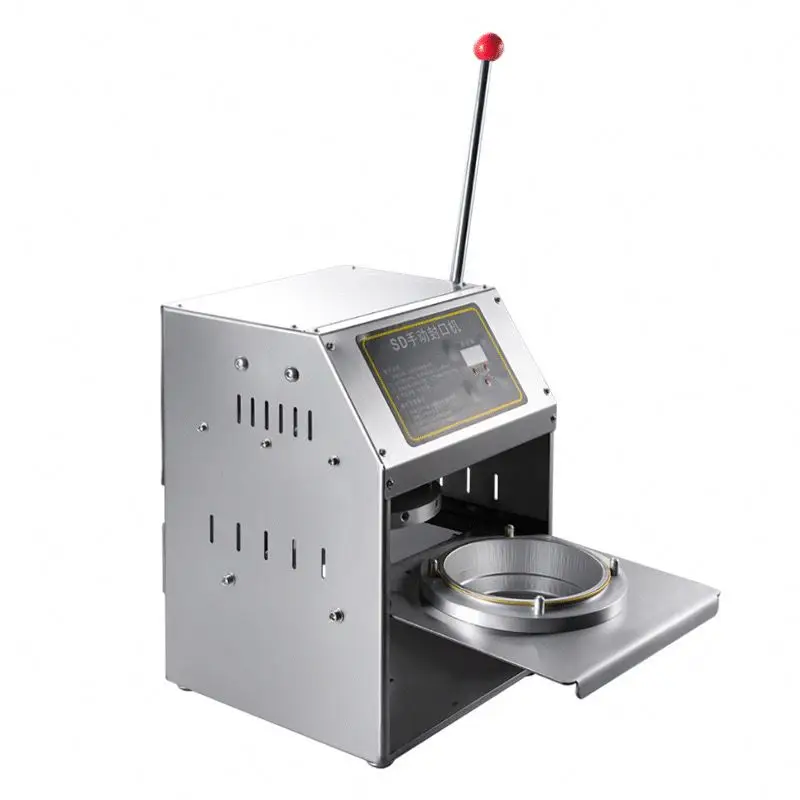
Source-controlled product identity
The Hoting queue identifies Product ID 1601247462401 as a TEBAK electric aluminum foil box sealing machine for fast-food containers. The source records voltage 220V, speed 250-300 pcs/h, weight 30KG, dimensions 350*350*850mm and power 1.1kW.
The source does not provide the die or mold dimensions, container material and size range, film specification, sealing temperature, warm-up time, actual cycle test, control interface, electrical frequency, phase, plug, safety guarding or certification. These are supplier confirmation points. Do not treat “customized”, “manual”, “semi-automatic” or the listed speed as a complete production specification.
This guide is for takeaway kitchens, food factories, meal-prep operations, catering suppliers, central kitchens, food-container distributors, restaurant groups and packaging integrators. The correct purchase decision depends on the buyer’s container geometry, lidding film, food process, electrical installation, required seal quality and verified throughput.
Recorded specifications
| Field | Recorded value | Buyer action |
|---|---|---|
| Product ID | 1601247462401 | Require the ID on the quotation, nameplate, inspection sheet and shipping documents. |
| Voltage | 220V | Confirm frequency, phase, plug, tolerance, current draw and destination-market wiring requirements. |
| Power | 1.1kW | Confirm whether this is rated input power, heater power or total connected load. |
| Listed speed | 250-300 pcs/h | Ask for a timed test using the buyer’s exact container, film and operator method. |
| Weight | 30KG | Confirm net or gross weight, accessories and lifting points. |
| Dimensions | 350*350*850mm | Confirm L*W*H order, unboxed or packed status and operating clearance. |
| Machine description | Electric aluminum foil box sealing machine; manual/semi-automatic in listing | Define loading, film placement, die change and discharge steps in the RFQ. |
| Seal specification | Not provided | Confirm film type, temperature, dwell, pressure, seal width, leak target and peel requirement. |
Define the container and film before selecting the machine
A tray sealer is matched to a container and lidding system, not just to the word “foil”. Prepare drawings or samples for every container that the machine must handle. Record length, width, height, rim profile, corner radius, flange width, nesting condition and material.
Confirm whether the buyer uses aluminum trays, PP containers, CPET, paperboard-coated trays or another food-contact format. The source does not define compatibility. Ask for a supplier test with the exact container and lid film, and retain the test report with the purchase order.
For film, record structure, thickness, width, roll or pre-cut format, sealant layer, temperature window and compatibility with the tray rim. Do not assume that all aluminum foil lids or films seal at the same temperature.
Ask whether the sealing die is dedicated to one footprint or can be exchanged. Request die cost, changeover time, spare die lead time and the tolerance of the die to container variation.
Clarify the “manual” and “semi-automatic” workflow
The title combines electric, manual and semi-automatic descriptions. These words can describe different parts of the cycle. Ask the supplier to map the complete process: operator loads container, places film, starts cycle, machine heats and seals, operator removes pack, and film is cut or rewound.
Confirm whether the machine has a foot switch, push button, timer, temperature controller, automatic film feed, film cutting, container indexing or only a powered heater. Request a process video and a cycle diagram for the quoted configuration.
Define the operator actions required for one finished pack. A listed 250-300 pcs/h may exclude loading, film alignment, die cleaning, container change, rejected packs and breaks. Use a timed acceptance test that includes the actual operator workflow.
Ask whether the machine can run continuously, intermittently or only in short manual cycles. Confirm duty cycle, cooldown procedure and what happens if a container is missing or misaligned.
Throughput verification
The recorded speed is 250-300 pcs/h. Treat it as a listing specification until verified. Request the test conditions: container size, film, sealing temperature, operator count, loading method, die, pack rejection rate and measurement period.
Run a production simulation with buyer-supplied containers and film. Measure completed sealed packs per hour, first-pass yield, leak failures, wrinkles, film waste, warm-up time, die-change time and operator workload.
Separate theoretical cycle speed from sustained output. Count only accepted packs that pass visual and leak checks. If the line requires an extra person for film handling or container presentation, include that labor in the capacity calculation.
Test at the lower and upper end of the buyer’s product range. A machine that seals one small tray quickly may not maintain the same rate with a larger footprint, deeper container or different film.
Seal quality and food-packaging acceptance
Define what a good seal means for the buyer. Check continuous seal around the full rim, no channels, burns, wrinkles, contamination, open corners or film misalignment. Record seal width and appearance against an approved sample.
Run leak or integrity testing suitable for the pack. The source provides no leak rating, peel force, burst test, vacuum test or shelf-life claim. Do not invent these values. Ask the buyer’s quality team to define the appropriate method.
Test clean and contaminated rims because food residue can change sealing results. Record the cleaning and filling process used during the test. Confirm whether the machine requires a minimum flange or flat sealing area.
For hot, oily, wet or acidic foods, verify film and container compatibility separately. The machine’s electrical power does not establish food-contact compliance or shelf-life performance.
Heating, temperature and controls
The source lists 1.1kW power but no sealing temperature, controller range, temperature accuracy or warm-up time. Request the heater type, sensor, control method, alarm behavior and replacement parts.
Confirm whether temperature is adjustable by recipe and whether the controller shows actual or setpoint temperature. Ask how the machine protects against overheating, open-circuit sensors and a failed thermostat.
Test warm-up from a cold start and recovery after repeated cycles. Record temperature stability, cycle-to-cycle variation and the seal result at the beginning and end of the test.
Do not publish or promise a sealing temperature based on the 1.1kW figure. Power is not a temperature specification and does not define the compatible film window.
Electrical and installation review
The recorded voltage is 220V. Confirm frequency, phase, plug type, protective earth, current, breaker recommendation and permissible voltage tolerance for the destination country.
Confirm whether 1.1kW is the total connected load. Ask for a wiring diagram, nameplate photograph, grounding method and electrical protection requirements. The buyer’s electrician should approve the installation before production use.
Plan ventilation, heat clearance, operator access, film storage and cleaning space. The listed 350*350*850mm dimensions may describe the machine envelope, but the operating footprint can be larger once a roll, container stack and operator are added.
At commissioning, inspect cables, switches, controller, heater, guards and emergency controls. Record the actual current and verify stable operation under the buyer’s supply conditions.
Die, customization and changeover
The title calls the machine customized, but the source does not include a die drawing or customization scope. Request the exact die outline, cavity dimensions, rim profile, material, surface finish and tolerance.
Confirm whether one die is included, whether the die is removable and how it is aligned. Ask for the changeover procedure, tooling, fasteners, cleaning method and maximum changeover time.
For several container formats, request a written die quotation for each format. Keep model, die code, container drawing and film specification linked in the purchase file. Do not accept a generic “customized” statement without a drawing approval step.
Use a first-article approval with buyer-supplied packaging. Check seal quality, pack appearance, lid position, edge clearance and the ability to remove the container without damage.
Weight, dimensions and logistics
The source records 30KG and 350*350*850mm. Confirm whether the dimensions are L*W*H and whether they are unboxed. Ask for carton size, gross weight, pallet details, lifting points and center of gravity.
For a 30KG machine, plan safe handling during unpacking and placement. Confirm whether two people or lifting equipment are required and whether the base needs anchoring.
At receipt, photograph the package before opening. Verify the product ID, model, electrical nameplate, die, controller, film path parts, manuals and spare parts against the packing list.
Do not use the machine dimensions as the shipping dimensions. Freight and workspace planning require separate packed and operating measurements.
Factory acceptance test proposal
- Verify Product ID 1601247462401, model, nameplate and quotation configuration.
- Confirm 220V frequency, phase, plug, earth, tolerance, current and breaker requirements.
- Confirm 1.1kW as total connected load or heater rating.
- Approve the die drawing for each container footprint.
- Test exact buyer containers and lidding film.
- Record warm-up time, setpoint, actual temperature and controller accuracy.
- Run a timed capacity test using the actual operator workflow.
- Measure accepted packs per hour, rejected packs, film waste and warm-up exclusion.
- Inspect continuous seal, corners, wrinkles, burns, contamination and alignment.
- Perform the agreed leak or integrity test and record results.
- Test at least two container sizes or the full required range.
- Verify film loading, cutting, indexing and changeover method.
- Check guards, wiring, earth, switches, alarms and emergency controls.
- Verify 30KG weight, 350*350*850mm dimensions, packing and accessories.
- Record warranty, die replacement, spare heaters/controllers and service response.
RFQ checklist
- Product ID 1601247462401 and exact machine configuration.
- 220V frequency, phase, plug, current, earth, tolerance and breaker data.
- 1.1kW definition: heater power versus total connected load.
- Container drawings, material, dimensions, rim, flange and corner radius.
- Film structure, thickness, width, roll/pre-cut format and sealant layer.
- Die drawing, die material, included die, spare die price and changeover method.
- Temperature range, control accuracy, warm-up and recovery data.
- Timed 250-300 pcs/h test conditions and accepted-pack definition.
- Leak/integrity test method, seal width and rejection criteria.
- Manual/semi-automatic process diagram and operator count.
- Weight 30KG defined as net/gross; packed dimensions and lifting points.
- Machine size 350*350*850mm defined as unboxed L*W*H or another field.
- Guarding, alarms, emergency controls, manual and maintenance schedule.
- Warranty, spare parts, die service, packaging and delivery documents.
Safety and compliance
This equipment combines electrical power, heated sealing surfaces, moving tooling and food-packaging operations. Keep hands away from the die and sealing area, isolate power before cleaning or die changes, and wait for the heated parts to cool.
Use the correct electrical protection and protective earth. Do not operate with damaged cables, bypassed guards or an unstable base. Keep film, packaging and food residues clear of hot surfaces and electrical parts.
Follow the buyer’s food-hygiene program. Clean contact and work surfaces using an approved method, prevent cross-contamination and verify that packaging materials are suitable for the intended food application.
Request destination-market machinery documents and a model-specific manual. The source does not provide CE, ISO or other certification, so none should be claimed without matching evidence.
Buyer decision framework
This candidate has five usable starting fields: 220V, 1.1kW, 250-300 pcs/h, 30KG and 350*350*850mm. The purchase remains conditional on container and film matching, die approval, verified throughput, seal-integrity testing and electrical documentation.
Approve the order only when the supplier maps the die to the buyer’s container, demonstrates an accepted pack at the required rate and confirms the complete electrical and safety configuration. Keep the listed speed separate from the buyer’s tested sustained capacity.
Frequently asked questions
What voltage and power are recorded?
The source records 220V and 1.1kW. Confirm frequency, phase, plug, current, total connected load and protection requirements before installation.
What speed is listed?
The source lists 250-300 pcs/h. Treat this as a specification to verify with the buyer’s exact container, film, die and operator workflow.
What are the recorded weight and dimensions?
The source records 30KG and 350*350*850mm. Confirm net/gross status, packed size and whether the dimensions are unboxed L*W*H.
Does it seal every foil container?
No such universal compatibility is established by the source. Confirm the container material, rim, film and die with samples and a signed drawing.
Is 1.1kW the sealing temperature?
No. 1.1kW is a power field, not a temperature specification. Request heater, sensor, controller, temperature range and warm-up data.
Source and contact
This guide is based on the Hoting queue record for Product ID 1601247462401. Recorded fields are 220V, 250-300 pcs/h, 30KG, 350*350*850mm and 1.1kW. Before purchase, request container and film compatibility, die drawing, electrical documents, timed acceptance test, seal-integrity method, safety manual, spare parts, warranty and destination-market compliance documents through the TEBAK sales inquiry channel.
Key specifications
- Voltage
- 220V
- Speed
- 250-300 pcs/h
- Weight
- 30KG
- Dimension (L*W*H)
- 350*350*850mm
- Power
- 1.1kW