
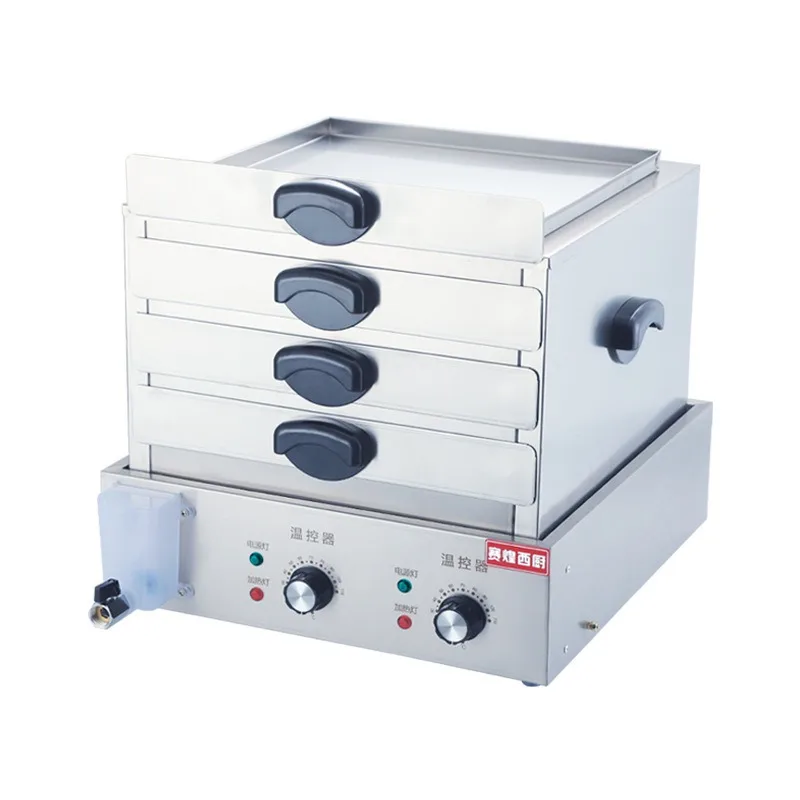
Why this electric drawer steamer needs a specification-led purchase
The TEBAK Electric Drawer Multifunction Steamer is presented in the source record as restaurant equipment for steamed vermicelli rolls and rice noodles. For this guide, the controlled identity is product ID 1601366152854, the electric drawer multifunction steamer title, the 220V/50Hz electrical field, and the 0.5cm steam-hole field.
A buyer should not convert a short marketplace record into a complete machine specification. A steam cabinet can be suitable for a small noodle counter, a commissary kitchen, a restaurant prep line or a food-service equipment distributor, but the decision depends on steam generation, tray geometry, drainage, controls, insulation, cleaning access and local electrical compliance. Those details are not supplied here. They must be confirmed on a quotation, drawing, nameplate photograph and pre-shipment inspection record.
This B2B buying guide therefore separates source-confirmed facts from open RFQ items. It is designed to help an importer, dealer, restaurant group or contract kitchen prepare a useful inquiry without assuming output, heating speed or food-safety performance that has not been documented.
1. Controlled identity from the source record
The source title identifies an electric drawer multifunction steamer for vermicelli rolls, rice noodles and steamed vermicelli rolls. The category labels are “DIY Supplies” and “ELECTRICAL,” and the product-name field is “Steamer+Steamer.” The listed voltage and frequency are 220V/50Hz. The listed steam-hole size is 0.5cm.
These fields establish the product family and one electrical supply condition. They do not establish the number of drawers, the number of trays, the total heating power, the steam pressure, the water volume, the production rate or the overall dimensions. The purchase order should carry the source product ID and the confirmed revision of the supplier drawing so that the selected configuration cannot be confused with another steamer in the supplier catalogue.
2. Source-confirmed specification table
The table below repeats only information visible in the source record. “Not provided” is a procurement control, not an estimate. Ask the supplier to complete every open row before approving a sample or production order.
| Field | Source value or control |
|---|---|
| Product ID | 1601366152854 |
| Product family | Electric drawer multifunction steamer |
| Food application wording | Vermicelli roll, rice noodle and steamed vermicelli roll machine |
| Category labels | DIY Supplies; ELECTRICAL |
| Product name field | Steamer+Steamer |
| Supply voltage | 220V |
| Frequency | 50Hz |
| Steam hole size | 0.5cm |
| Rated power | RFQ required |
| Drawer count and internal size | RFQ required |
| Tray dimensions and material | RFQ required |
| Output per batch | RFQ required |
3. Confirm what “drawer” means
“Electric drawer multifunction steamer” can describe a cabinet with pull-out trays, a slide-out steaming compartment, or a compact unit with removable racks. The source record does not define the mechanism. Ask for a front, side and open-drawer drawing. The drawing should show the number of levels, clear distance between levels, usable tray area, door or drawer travel, handle clearance and the location of the steam inlet and drain.
For a restaurant, the usable working height matters as much as the external footprint. A drawer that accepts a tray but cannot be removed safely beside a hot service counter may slow production. Request the empty and loaded drawer weight, the hot-surface zones, the handle temperature expectation and the recommended loading sequence. Confirm whether trays are lifted out individually or whether the whole drawer assembly moves together.
Where the machine is intended for rice noodle or vermicelli-roll production, ask whether the supplier has a recommended tray material and thickness. Do not treat a photograph as proof of food-contact suitability. Request a material declaration and cleaning instructions for every surface that can contact batter, rice slurry, water or condensed steam.
4. Electrical review for the 220V/50Hz field
The source field states 220V/50Hz. That value must be matched to the destination market, plug arrangement, protective device and installation method. The record does not state rated current, rated power, phase, earth arrangement, cable cross-section, plug type, leakage protection or controller rating. These are mandatory quotation fields for an electric heating appliance.
Ask the supplier to provide a nameplate image and an electrical schematic. The schematic should identify the heating elements, thermostat or temperature controller, over-temperature protection, indicator lamps, water-level protection if applicable, earth point and terminal block. Confirm whether the quoted 220V/50Hz unit is single-phase and whether the plug is supplied, replaced by the buyer or shipped without a plug.
Do not infer power from the word “electric” or from the machine size. A compact steamer may use a low-power heater, while a multi-drawer cabinet may require a dedicated circuit. The final installation drawing should state the required breaker, cable, socket or isolator, ventilation clearance and grounding method. Local electrical review remains the buyer’s responsibility.
5. Steam path and the 0.5cm steam-hole field
The source record lists a steam-hole size of 0.5cm. Preserve this value exactly in the inquiry, but ask the supplier to define what it measures: a nozzle diameter, a tray hole, a cabinet vent, a steam distribution opening or a perforation in a cover. One number without a drawing is not enough to predict steam distribution.
Request a cross-section or annotated photograph showing the steam inlet, distribution path, condensate route, vents and drain. Confirm whether steam is generated inside the cabinet or supplied from an external generator. If an external generator is required, the quotation must identify its power, water connection, pressure limits and control interface. If the heater is integral, ask where water is added, how the level is maintained and how the tank is drained.
For rolled vermicelli or rice noodle work, uneven steam can affect cooking consistency across trays. A sample test should compare the front, middle and rear of a tray, and the upper and lower levels if multiple drawers are supplied. Record water temperature, preheating time, loading mass, steaming time and finished-product observations. These measurements belong to the buyer’s acceptance test; they should not be invented in the product listing.
6. Capacity and workflow questions
Capacity is not provided in the source record. Ask the supplier to quote usable tray dimensions, number of trays per drawer, number of drawers, maximum recommended load, water consumption per batch and the recommended batch interval. Ask whether the stated output, if any, refers to raw batter, finished rolls, kilograms, pieces, trays or operating hours.
Map the machine to the intended workflow. A small food stall may value short loading and unloading paths, while a central kitchen may need repeatable batch records, drain access and a larger water supply. For a distributor, the package should include a clear installation sheet and spare-part list so the product can be supported after delivery.
Include a line in the RFQ asking the supplier to state the operating assumptions behind any capacity claim. The buyer should receive the same tray, water and loading definitions in the quotation, sample test and final inspection. This prevents a capacity number from changing meaning between sales, production and commissioning.
7. Materials, hygiene and cleaning
The source does not provide cabinet material, tray material, insulation material, gasket material or surface finish. Request a material schedule separating food-contact surfaces, steam-path components, external panels, handles, fasteners and seals. If stainless steel is proposed, ask for the grade and the areas where it is used rather than accepting a generic “stainless” description.
Cleaning access should be demonstrated with the machine cold and isolated from power. Confirm whether drawers, trays, water tanks, drain screens, covers and steam baffles can be removed without special tools. Ask for a cleaning chemical compatibility statement and instructions for removing starch residue and mineral scale. The supplier should state whether any component must be dried after cleaning to prevent corrosion or odor.
Food-contact compliance depends on the destination market and the exact materials. Do not copy a company-level quality statement into a product-level certification claim. Request product-specific declarations, test reports or certificates where required by the importer and destination authority.
8. Controls, temperature and safety
No temperature range, controller type, timer, display, alarm or interlock is supplied. Ask the supplier to document the control panel and its operating sequence. The quotation should identify temperature-setting range, display resolution if applicable, timer range, heating indicator, low-water warning, over-temperature cutout and recovery behavior after the drawer is opened.
Steam creates burn, condensation and slip hazards. Request a risk-control description covering hot surfaces, drawer stops, handles, vents, pressure relief if applicable, drain routing and emergency isolation. Confirm whether the drawer can be opened during heating and what happens to the heater when water is low. These questions are especially important when the machine will be used by staff in a fast service environment.
Ask for a wiring diagram, insulation test procedure and earth-continuity test record for the shipped configuration. The acceptance plan should include a cold visual inspection, empty heating test, loaded steam test, leakage check, drain test and emergency-stop or isolation check where such functions are supplied.
9. Installation and site planning
Before ordering, obtain the external dimensions, service clearances, door or drawer travel, net weight, gross weight and lifting points. None of those values is included in the source record. The installation drawing should show the 220V/50Hz connection, water fill method if needed, drain height, ventilation clearance and the location of the rating plate.
Measure the route from receiving dock to kitchen. Door widths, lift capacity, stairs, counter height and drainage can affect the practical installation. Ask whether the unit is intended for a countertop, floor stand or custom cabinet. Do not fabricate a support from a product photograph; obtain the approved load and support requirements from the supplier.
If the machine is used in a wet kitchen, coordinate electrical protection and drainage before delivery. The buyer should define who is responsible for installation, commissioning, local wiring, water connection, testing and staff training. Record these responsibilities in the purchase order rather than relying on a chat message.
10. Sampling and acceptance test
A sample order should test the exact configuration quoted for production. Use the same voltage and frequency stated in the source record, 220V/50Hz, and document the plug or connection arrangement. Photograph the nameplate, wiring compartment, drawer layout, steam hole and included accessories before operating the machine.
Run an empty test to check heating indication, control response, unusual noise, leakage, drawer movement and drain behavior. Then run a loaded test using the buyer’s intended batter or rice-noodle process. Record the tray position, loading mass, water condition, preheating time, steaming time and product result. If multiple levels are supplied, test each level and note any difference in cooking uniformity.
Acceptance should compare the delivered machine to the signed drawing and specification sheet. A pass should require the correct product identity, 220V/50Hz nameplate, confirmed 0.5cm steam-hole interpretation, safe electrical connection, complete drawers and trays, cleanable surfaces, operating controls and supplied documents. A failed test should produce a written corrective-action plan before shipment or payment release.
11. Packaging, spares and after-sales support
Packaging details are not provided. Ask for packed dimensions, gross weight, moisture protection, shock protection, drawer restraints and a packing list. If the machine contains removable trays, handles or control parts, the packing method should prevent them from moving into the heating chamber during transport.
Request a recommended spare-parts list for heaters, thermostats, controllers, indicators, switches, seals, handles, trays, drain components and fasteners. The supplier should state part numbers, lead times, storage conditions and whether replacement requires a qualified technician. Include photographs or drawings for parts that may be difficult to identify after installation.
For an importer or dealer, ask for a troubleshooting chart covering no heat, uneven steam, water leakage, control failure, excessive condensation, drawer binding and abnormal electrical readings. Warranty scope, response time, remote diagnosis method and replacement policy should be written into the commercial terms.
12. RFQ checklist for this TEBAK steamer
- Confirm product ID 1601366152854, title, revision and exact machine configuration.
- Confirm the product is an electric drawer multifunction steamer for the intended vermicelli-roll or rice-noodle workflow.
- Confirm 220V/50Hz, phase, rated power, rated current, plug or terminal arrangement and earth method.
- Define the 0.5cm steam-hole field with a drawing and state its function and tolerance.
- Provide drawer count, tray count, usable dimensions, tray material and maximum recommended batch load.
- Provide water-fill, steam-generation, condensate, drain and cleaning procedures.
- Provide temperature, timer, controller, alarm, low-water and over-temperature details.
- Provide external dimensions, net/gross weight, clearances, installation drawing and packing list.
- Provide product-specific material declarations, applicable certificates and electrical test records.
- Agree sample testing, pre-shipment inspection, spare parts, warranty, training and after-sales response.
13. Supplier questions to resolve before purchase
Ask the supplier to answer these questions in the quotation rather than replying with a catalogue link: What exactly does the 0.5cm steam-hole size describe? How many drawers and trays are included in the quoted unit? What is the rated power at 220V/50Hz? Is steam generated internally or supplied externally? What is the usable tray size and batch load? How is water added and drained? What prevents dry heating? Which surfaces are food-contact surfaces? What is the confirmed material and finish for trays and the steam chamber? What are the external dimensions, weight and service clearances? Which documents and test records ship with the machine?
If the supplier cannot answer these questions, keep the product at RFQ or sample-review stage. A low headline price does not compensate for an undefined electrical load, an incompatible tray system or a cleaning process that does not fit the kitchen.
14. Final procurement decision
This TEBAK product is a candidate for buyers seeking an electric drawer steamer for vermicelli-roll and rice-noodle workflows. The source-confirmed anchors are the product identity, 220V/50Hz supply field, 0.5cm steam-hole field and multifunction steamer description. The commercial decision still depends on the supplier’s completed drawing, electrical data, capacity definition, hygiene documentation, sample test and inspection evidence.
Approve the order only when the supplier has converted the open RFQ fields into a signed configuration. Keep the source product ID on the quotation, purchase order, inspection report and carton record. This simple traceability step helps prevent a different drawer steamer or a different electrical version from being shipped under the same general product title.
Editor’s note: Product facts in this guide are limited to the supplied Hoting queue record. Company-level claims or generic supplier descriptions are not treated as product-specific certification, performance evidence or customer proof.
Key specifications
- Product type
- Electric drawer multifunction steamer; vermicelli roll and rice noodle steaming machine
- Source product ID
- 1601366152854
- Category labels in source
- DIY Supplies; ELECTRICAL
- Product name field
- Steamer+Steamer
- Voltage and frequency
- 220V/50Hz
- Steam hole size
- 0.5cm
- Configuration wording
- Electric drawer multifunction steamer; exact drawer and tray configuration requires confirmation
- Intended food applications
- Steamed vermicelli roll and rice noodle production, subject to supplier confirmation
- Rated power
- Not provided in the source record; request the nameplate value
- Working capacity
- Not provided; confirm trays, drawer dimensions, batch load and output
Frequently asked questions
- What voltage and frequency are listed for this steamer?
- The source record lists 220V/50Hz. Confirm the phase, rated power, current, plug or terminal arrangement and earth method before ordering.
- What does the 0.5cm steam-hole specification mean?
- The source lists a 0.5cm steam-hole size but does not define its function. Ask for an annotated drawing to confirm whether it is a nozzle, vent, tray opening or another feature.
- How many drawers or trays are included?
- The source record does not provide drawer or tray counts. Require the supplier to state the exact configuration, usable dimensions and batch load in the quotation.
- Is the machine already certified for my market?
- No product-specific certification is provided in the source record. Request applicable declarations, test reports and electrical safety records for the exact shipped configuration.
- Can I use the machine for my own rice-noodle process?
- The title and description identify vermicelli-roll and rice-noodle steaming applications, but process suitability must be confirmed through a sample test using the buyer’s recipe, tray and loading method.