
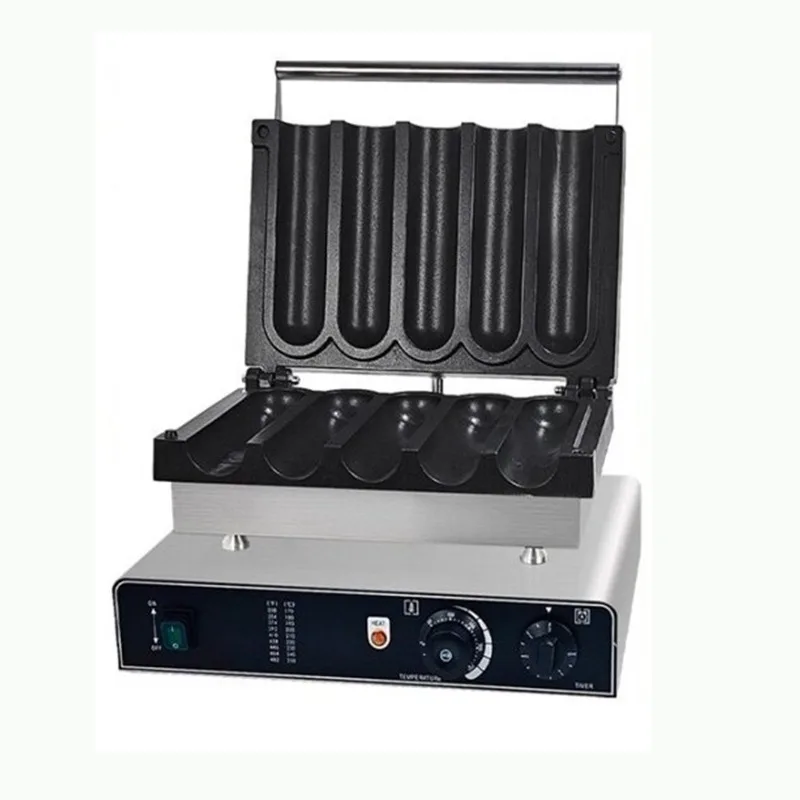
Eight real figures, in a picture, with the lid open
The fourth image is a specification sheet, and it is the first one in this run of items that actually answers a buyer's questions. It is headed Product Parameters, it carries a badge in a dashed border reading Aikai Electromechanical, and beneath the heading there is a line of text that reads Producf Specification. It then draws the machine in three-quarter view with dimension lines, and prints a table of eight rows.
| Row | Value | Row | Value |
|---|---|---|---|
| Product name | CNC two-grid chicken roll machine | Rated power | 1500W |
| Mold size | 225*56*2mm | Rated voltage | AC 220V |
| Product Size | 250*360*290mm | Temperature range | 50°C ~ 300°C |
| Box size | 425*445*325mm | Timing function | 1 ~ 5 minutes |
Two things make this table worth reading closely. The first is that the words on it are new. Searching the whole catalogue of five hundred and twelve records for the label Timing function returns nothing, and for Mold size nothing. Temperature range appears in one other record. Rated power appears in seven, Rated voltage in nine. So this is not a standard template that the catalogue reuses; it is a table that somebody built for this machine, and it is the only place where these particular questions are asked.
The second is that the numbers agree with each other, which is rarer than it sounds. The box is four hundred and twenty-five by four hundred and forty-five by three hundred and twenty-five millimetres, which is sixty-one thousand four hundred and fifty-six cubic centimetres, against the machine's own twenty-six thousand one hundred cubic centimetres, a ratio of two point three five. In the earlier items of this series the same check produced two point two seven and two point eight three, so a box a little over twice the volume is what ordinary foam and carton packing produces, and this table's two size rows are consistent with one another.
The badge is the part to notice. It names a company called Aikai Electromechanical, and that name appears in no record in the catalogue, because it exists only inside this image. The listing is branded TEBAK and the company paragraph in the description names Hengshui Mengshang Trading Co. So the one picture in the gallery that tells the truth about the machine is the picture that carries somebody else's name on it, and a buyer photographing that panel will be photographing a brand the listing never mentions.
The arithmetic the table does allow, and the one figure it leaves out
Three useful numbers follow from the eight. At one thousand five hundred watts on a two hundred and twenty volt supply the machine draws about six point eight amperes, so it will run from an ordinary ten ampere circuit and will not run from a six ampere one. One full timer cycle at five minutes uses one and a half kilowatts for a twelfth of an hour, which is nought point one two five kilowatt hours, so a stall doing a batch every ten minutes uses roughly nought point seven five kilowatt hours an hour.
And the machine is specified for alternating current at two hundred and twenty volts only. There is no second voltage row and no frequency row. A buyer in a market supplied at one hundred and ten volts cannot use the machine without a transformer, and a resistive load of one and a half kilowatts needs a transformer rated above that figure, not at it, because a transformer pressed to its nominal limit will run hot and will sag under a load that switches on and off all day.
What the table leaves out is any weight at all. It gives the box size, so the volumetric weight can be worked out: sixty-one thousand four hundred and fifty-six cubic centimetres divided by six thousand is ten point two kilograms, and divided by five thousand is twelve point three kilograms. But with no actual weight on the page, the buyer cannot tell whether the shipment will be billed on the actual weight or on that volumetric figure, and ten kilograms of volume is a real line in a freight quotation. A table that gives the box and withholds the weight has given the buyer half of a costing.
Two control panels for one machine, and a timer that disagrees with itself
The gallery shows two different fronts for the same machine, and they are not the same appliance to operate.
The first and sixth images, and the clean product shot in the fourth, show an analogue front: a green rocker switch, a printed guide table of temperatures in degrees Fahrenheit and Celsius, a round heat indicator lamp, a rotary temperature dial with a numbered scale, and a rotary timer dial whose scale is marked from nought to five. The third and seventh images show a digital front: a red rocker switch, a red light-emitting display for temperature, a red display for time, up and down buttons under each, and a label reading Intelligent temperature display, with the Chinese characters for temperature display and time display printed above the two windows.
Those are two different machines to buy. A rotary dial has no reading, so a cook sets it by habit and cannot repeat a setting exactly; a digital panel lets a setting be written down and repeated. The maintenance differs, the failure modes differ, and the price differs. Nothing in this listing says which front will be shipped, and nothing in the parameter block distinguishes them, so the only way to know is to ask, and to have the answer written into the order.
The timer then contradicts itself three times. The first image says, in words, nought to five minutes timing knob control. The specification table says the timing function is one to five minutes. The sixth image shows the rotary dial's scale, which runs from nought to five. So the table and the photographs disagree at the bottom of the range, and the bottom of the range is where a thin wrap is cooked. A minute either way is not a rounding difference when the whole cycle is five minutes.
The fifth image is headed Product Details and makes three claims, two of which the pictures do not support. The first panel reads Double tube design, with the sub-line double-sided constant temperature heating, which describes two heated plates rather than tubes. The second reads Anti-scalding design and shows a handle with a ribbed grip, which is fair. The third reads Touch screen design and shows the button-and-display front, which is not a touch screen; every control in that photograph is a switch, a button or a display window. A separate record in this catalogue is the only one whose text claims a touch screen, and this listing is not it, because the words here exist only in the picture.
The same confusion runs through the model name. The specification table calls the machine a CNC two-grid chicken roll machine. Computer numerical control is a term for machine tools driven from programmed coordinates, and the front in the sixth image is a mechanical rotary timer with no numerical control of any kind. Either the digital front is the one the name refers to and the analogue front is a different model sharing the page, or the prefix is decoration. Either way it is the buyer who has to ask which one arrives.
Two grids, or five channels
The name says two-grid. The photographs are worth counting, with the caveat that a count from a picture is a reading and not a measurement. In the first and sixth images the press is shown open, and both the upper and the lower plate carry long concave channels separated by ridges. I count five across the upper plate and five across the lower, which would mean five rolls formed in each cycle.
Two readings are possible and they lead to different questions. If grid counts the heated plates, then two-grid only restates that the machine has an upper and a lower heated plate, and it says nothing about how many rolls come out. If grid counts the channels, then the name and the photographs disagree, and the machine photographed is not the machine named. A second listing in the same catalogue, which shares three photographs with the twin listing described below, states two grids in its own title as well, so the family's text consistently says two while this listing's own photographs show five.
The mould row does not settle it either. It reads two hundred and twenty-five by fifty-six by two millimetres, and the third figure is the problem: two millimetres is the thickness of a plate, not the depth of a groove that a filled wrap is pressed into. Which of the three numbers is the depth, and which is a wall thickness, is not stated. The question to ask is how many rolls the machine forms per cycle and what the groove depth is, in millimetres, because both of those decide whether the machine fits the product the buyer already sells.
Stainless steel, non-stick, and neither one named
The third image is captioned High quality stainless steel material. Every photograph of the working surfaces in this listing shows them black: the channels in the first and sixth images are black, the closed press in the third and fourth images is black, and the plate edges are black. A stainless steel plate without a coating is the colour of steel. So either the plates are coated and the caption describes the body, or the caption describes a plate that is not the one photographed.
The title says non-stick, and the words non-stick appear four times in the catalogue: in this listing, in its twin, in a mini-pancake machine, and in a bubble-waffle machine. In none of the four is the coating material named. The catalogue does name one twice, in two records that are not these, using the words PTFE and Teflon. So the catalogue knows the vocabulary and does not use it here, and a buyer importing a cooking surface has no way to tell from this page whether the black surface is polytetrafluoroethylene, a ceramic, a silicone or a plain seasoned steel.
This matters more than it would for a machine tool, because the temperature row on the table runs to three hundred degrees Celsius. At that ceiling the identity of the coating stops being a matter of taste and becomes the specification: the question is not whether the surface is non-stick but what its own maximum working temperature is, and whether it is declared for food contact at all. The commonest non-stick coatings are quoted with service limits below the three hundred degrees this table allows, and the honest way to put that is as a question to the seller rather than as a conclusion here, because the answer depends on the coating, which is unidentified.
The catalogue's own habit shows that this can be stated. Forty records mention food grade, FDA, LFGB or food contact. Twenty-one give a net weight and fifteen a gross weight. This listing gives none of those things, and its 1500 watts and 300 degrees make it the appliance in this series with the most to declare.
The safety devices the table does not list
A cooking appliance of this class normally carries a set of safety items that a buyer checks before importing, and the table's eight rows include none of them. There is no mention of a thermal cut-out or an over-temperature thermostat independent of the controller; no statement of what happens if the timer is left on; no insulated-handle temperature limit; no earth continuity or leakage statement; no ingress protection figure; no statement of the timer's accuracy; no warm-up time to reach the set temperature; no recovery time between one batch and the next; and no crumb tray or drip management, which matters for a machine that presses filled wraps and will leak.
There is also no certification anywhere in the record, in text or in picture. The security marking on the front panel of the machine in the photographs and the badge on the specification table are the seller's own, and neither the description field nor the parameter block mentions a standard, a test report or a mark. For an appliance that is plugged in at one and a half kilowatts and puts a heated surface in contact with food, those are the two files a buyer needs before shipping, and neither is on the page.
Two listings, one product, and not one shared photograph
The catalogue contains a second listing whose title to this one reads like a line with a prefix removed. This listing is titled TEBAK Electric Mexico Chicken Wraps Toaster Barbecue Burrito Baker Machine Non-stick Chicken Meat Burrito Heating Roll Machine. The other is titled Electric Mexico Chicken Wraps Toaster Barbecue Burrito Baker Machine Non-stick Chicken Meat Burrito Heating Roll Machine. Remove the leading brand word and the two titles are the same string.
The resemblance does not stop at the title. Their parameter blocks are identical row for row, Product name reading Chicken burrito maker, Application reading Food Processing Machine, Function reading Multifunctional, and Usage reading Sancks, that last one a misspelling of snacks in both. Their description fields are identical as well: both are eight hundred characters, both open with the same sentence, both carry the same four parameter rows and the same company paragraph, and no character differs between them.
What differs is the photography. This listing's gallery is nine files, one main image and eight gallery images, and the other listing's gallery is nine files as well. The two sets share nothing: not the main image, not one of the eight gallery images. So a buyer who finds both listings has two pages that are identical in every purchasable respect and different in every picture, and no basis at all on which to choose between them except the pictures, which are of the same machine.
This is a different pattern from the shared template paragraphs the earlier items of this series documented. A shared company paragraph is furniture. Here the product title, the product specification rows and the product description are the same because they are the same product, listed twice, and the divergence in the photographs suggests two shooting sessions rather than one. Two listings doing this in one catalogue splits the same demand across two pages that compete with each other, which is the buyer's problem only in that neither page can be compared with the other on price, stock or delivery, because neither mentions any of them.
What the family's other listings do
Four records in the catalogue use the words non-stick, and five mention a burrito, a wrap or a tortilla. Three of them are worth setting beside this one, because together they show three different ways of handling the same specification problem.
One is titled Commercial 2 Grids Eggs Roll Machine 1500W Electric Chicken Roll Machine with 300C Degree Temperature Control. That listing states in its title the three figures this listing keeps in a picture, one thousand five hundred watts, three hundred degrees and two grids, and its parameter block contains nothing at all, zero rows. It also shares three of its photographs with the twin listing described above. So the same machine's numbers appear as prose in one page and as a branded table in another, and in neither page do they appear in the structured data a buyer searches.
Another publishes a twenty-row parameter block, the largest in this family, and it is the family's cautionary example. Its rows include Weight reading eight kilograms, Voltage reading two hundred and twenty volts, Dimension as six hundred by three hundred and twenty by two hundred and forty millimetres, Warranty of one year, and Power reading eight hundred and fifty kilowatts. Eight hundred and fifty kilowatts is a thousand times a plausible value for a countertop food machine. The same block opens with a row whose label is item and whose value is value, the literal placeholder left in place. A twenty-row block is closer to what a buyer wants than a four-row block, and a thousand-fold unit error in it is worse than no block at all, because the number looks specific.
The third states Volts as two hundred and twenty to two hundred and forty, fifty to sixty hertz, and Power as one point six kilowatts, correctly formatted and unit-correct. It is the best-behaved record in the family, and it is also the only one of the four that states its power and voltage where a buyer can read them rather than inside a photograph.
What the description field contains
The description is eight hundred characters, one of the four hundred and ten records in this catalogue that stop at exactly that length. It opens by repeating the title in full, then restates the four parameter rows label by label and value by value, then goes straight into the company paragraph and is cut off. It carries no packing heading of either of the two kinds this catalogue uses.
The company paragraph takes five hundred and fifty-five of the eight hundred characters, so nearly seven tenths of the field is boilerplate about a business that sells CNC carbide inserts, turning tools and milling tools, and the machine being sold is a cooking press. The window closes inside the phrase the quality control s, so the last word is left unfinished, and the sentence it interrupts is the one about quality control standards.
The field contains one word that is misspelled, and the misspelling is instructive. The Usage row reads Sancks. Searching the catalogue for that spelling returns two records, this one and its twin. Searching for the correct spelling, Snacks, returns one record. So in a catalogue of five hundred and twelve listings the word is typed wrongly twice as often as it is typed correctly, and the row it sits in is one of only four rows this listing has to describe its machine. Since the parameter block and the description field are generated from the same source text, the error is copied into both, and into both listings.
That last point is the reason the packing headings thread from the previous two items resolves as it does. Forty-five descriptions carry a packing and shipping heading in the one spelling, seventy-three in any of the three spellings, and one hundred and forty-four carry the other heading, Packing and Delivery. Two hundred and ninety-five carry neither. This listing is in that last group, and so is its twin, so a buyer looking for the one piece of information that decides freight cost finds no section at all rather than an empty one.
What the listing still does not state
The weight, actual and gross, despite giving the box. The coating material on the working surfaces, despite a non-stick claim and a three hundred degree ceiling. Whether the two working surfaces are stainless steel or coated steel, since the caption and the photographs disagree. Any food-contact declaration, any electrical certification, any test report. The mains frequency. The number of rolls formed per cycle, and the groove depth of the mould. The warm-up time, the recovery time between batches, and the timer's accuracy. The safety devices listed above. Spare plates, spare thermostats, and the price of a replacement timer. The country of manufacture. The warranty and the party that honours it. And the price itself, which appears in neither the parameter block nor the description, so the buyer cannot tell from this page whether the second listing of the same product is the same offer.
The table gives eight figures and the listing gives no more. That is the whole of the published specification, and it is already better than most of this catalogue.
Incoming inspection on arrival
- Photograph the machine's own rating plate and compare the volts and hertz on it with the specification table, and with the supply at the destination. A one and a half kilowatt heating appliance on the wrong voltage will not work and may not be repairable locally.
- Identify the working surface before first use: note the colour, ask the seller in writing what the coating is and what its maximum working temperature is, and keep the answer with the file for the customs and food-contact paperwork.
- Count the channels in the upper and lower plates and measure one groove's depth and width, and compare them with the mould row's two hundred and twenty-five by fifty-six by two millimetres, which does not identify a depth.
- Determine which front was shipped, the analogue dial version or the digital version, and record it; if the order did not state one, that is the point to raise with the seller rather than at the end of the first month.
- Time a full cycle against the printed range, since the listing states nought to five minutes in one image and one to five in the table, and check the plate temperature against the dial or the display at a point the kitchen will actually use.
- Run a full batch of the buyer's own product, not a test wrap, and check the leakage from a filled wrap into the hinge and the wiring chamber, which no part of this listing addresses.
- Weigh the machine on a scale, and keep the figure together with the box dimensions, so that the next shipment's volumetric weight can be reconciled against the freight invoice.
Questions buyers ask about this class of listing
Is a specification inside a picture as good as a specification in a field?
For reading, yes; for searching and comparing, no. The eight figures on this table are enough to size a circuit, choose a transformer and estimate an energy cost. But they live in an image, so no search finds them and no side-by-side comparison includes them, and a buyer assembling a shortlist of suppliers will not see them at all unless they open every picture on every page.
Should I buy from the listing with the table or from its twin?
The two pages are identical in title, specification rows and description, including the same misspelling, and they share no photographs. Nothing purchasable distinguishes them. Pick one, and ask both the same written questions, because the answers are the only information the pages do not already have in common.
Does the 2 Grids name mean two rolls per cycle?
Not necessarily. A sibling listing states two grids in its title and this listing's own photographs show five channels per plate. The word may count the two heated plates rather than the channels. Ask for the number of rolls per cycle and the groove depth, in millimetres.
Is 300 degrees a problem?
Not by itself. It is a working temperature the machine is built to reach, and the table states it plainly, which is to the listing's credit. The problem is that the surface's identity is not stated, so a buyer cannot check whether the coating is rated to that ceiling for food contact. Ask for the coating and its rated maximum, in writing.
Can I use it on a 110 volt supply?
The table gives one voltage row, alternating current at two hundred and twenty volts, and no frequency. In a one hundred and ten volt market the machine needs a transformer rated comfortably above one and a half kilovolt-amperes, and the frequency question still has to be answered.
What does the Aikai badge mean?
It is the name on the specification sheet, it appears in no record in the catalogue, and it is not the brand on the listing or the company in the description. It is most likely the manufacturer's own plate. Ask the seller which entity manufactured the machine and which entity will honour the warranty, because the two pages name different companies.
Why the grid question is worth thirty-six rolls an hour
The ambiguity between a two-grid name and a five-channel plate reads like a labelling quibble until it is priced. The listing's own two figures fix the ceiling: at five minutes a cycle and one and a half kilowatts, the machine can complete at most twelve cycles in an hour, and each cycle consumes nought point one two five kilowatt hours.
| Cycles per hour | Energy consumed | Rolls if two per cycle | Rolls if five per cycle |
|---|---|---|---|
| 12 (the timer's ceiling) | 1.50 kWh | 24 | 60 |
| 6 (allowing loading and wrapping) | 0.75 kWh | 12 | 30 |
So the question of whether the plate forms two rolls or five is not a matter of vocabulary. It is the difference between twenty-four and sixty rolls an hour at the machine's own limit, which is a difference of thirty-six rolls an hour, or a factor of two and a half in output from the same electricity. A buyer pricing a stall, a counter or a delivery kitchen is buying output per hour, and this listing's own text says two while its own photographs show five.
The energy figures are the buyer's to plan with and are modest: a full hour at the timer's ceiling costs one and a half kilowatt hours of heating, and no kitchen will run a press flat out for an hour because somebody has to fill and wrap the rolls between batches. The six-cycle row is the more useful planning case, and the true sequence time, including opening the press, filling five moulds and closing it, is not stated anywhere in the listing, which is why the throughput figure has to be measured on arrival rather than taken from the page.
What to put in the written order
- The supply the machine is built for, in volts and hertz, stated as a value rather than as a range, together with a statement that the unit matches the destination supply with or without a transformer.
- The control front, described as either the rotary dial version or the digital display version, and recorded in the order so that the shipment can be checked against it.
- The number of rolls formed per cycle, and the mould groove depth and width in millimetres, stated separately from the plate thickness.
- The identity of the working-surface coating and its own maximum working temperature, plus the food-contact declaration the buyer's market requires.
- The net and gross weight, so that the volumetric weight of ten point two kilograms derived from the box can be checked against the invoice.
- The safety items: whether there is a thermal cut-out independent of the controller, what the timer does at the end of its range, and the leakage and earth figures for the destination market's approval route.
- The name of the manufacturer, the ownership of the Aikai plate, and the entity that will honour the warranty, since three different names appear across the listing, the description and the specification image.
- Whether the price quoted is for one unit and which of the two identical listings the quotation refers to, because the catalogue carries the same product twice and neither page states a price.
Scope, sources and method
Every figure attributed to the machine comes from the product record for ID 1601365439606 in the catalogue file and from the nine images listed in that record, one main image and eight gallery images. The specification table's eight rows are quoted as printed, including the spelling Producf Specification and the badge reading Aikai Electromechanical. The power, voltage, temperature and timer values are the seller's own and are not corrected here.
The arithmetic is confined to what those values support. Six point eight amperes is one thousand five hundred watts divided by two hundred and twenty volts, and it is presented as a nominal figure for a resistive load rather than as a measured current. Nought point one two five kilowatt hours is one and a half kilowatts sustained for five minutes. The box-to-machine volume ratio of two point three five uses the two size rows on the table and treats each as a rectangular box. The volumetric weights of ten point two and twelve point three kilograms apply the six thousand and five thousand divisors to the box size.
The count of channels in the plates is a reading of two photographs, is stated as a reading, and is the only visual count in this article on which a question turns. All other counts are searches of the five hundred and twelve records taken as text, case-insensitively, with the search term stated beside each figure. Where a count depends on a rule rather than a phrase, the rule is stated.
No machine was opened, weighed, plugged in, heated or used to cook. No coating was sampled or identified, and no claim is made here about whether any particular coating is safe at any particular temperature; the coating is unidentified on the page and the question belongs to the seller and to a food-contact specialist. No certification was inspected. No freight quotation was sought. Nothing here is food-safety advice, electrical-safety advice, customs or import-compliance advice, or a substitute for the buyer's own testing, and the two products discussed are not compared with any machine outside this catalogue.
Appendix: where the nine images come from
Eight of this listing's nine images appear in no other record in the catalogue: the main image and the first seven gallery images are used by this record alone. The ninth is the payment and courier panel headed SHIPPING SERVICE, carrying the marks of seven express carriers and seven payment methods, and it is used by two records in the catalogue. In the previous item the same panel appeared as a file of one hundred and ninety-two thousand six hundred and forty-six bytes shared by one hundred and nineteen records; the copy in this listing is a different file, a PNG of two hundred and forty-seven thousand seven hundred and forty-six bytes, and only two records use it. The same artwork therefore exists in the catalogue in at least two files that differ in format and in size.
The gallery's total weight is one million one hundred and eighty thousand three hundred and ninety-six bytes, and the borrowed panel is about a fifth of it, so this listing's pictures are mostly its own. That is the opposite of the previous item, where more than half the gallery was supplier furniture.
One structural detail is worth recording because it affects how the page loads. Eight of the nine images are addressed over plain hypertext transfer protocol with no transport security, and the specification table that carries the only real data in the listing is one of them. Forty-seven records in this catalogue have a gallery that is entirely unencrypted in this way, so this is a catalog-wide habit rather than a fault peculiar to this page; but it means the one image a buyer most needs to read is served over a connection a modern browser will warn about, and in a page that is otherwise served securely.
Key specifications
- Product name
- Chicken burrito maker
- Application
- Food Processing Machine
- Function
- Multifunctional
- Usage
- Sancks