
Eight parameters, and no numeral describing the product
Product ID 1601253088164 carries eight parameter rows, which is more than most records in this catalogue, and the first thing worth saying about them is what they do not contain. The values are, in order: gas metal melting furnace; Refractory; Melting Meta; Customers' requirements; High Pure; Customers' requirements; Customers' requirements; and China. Read those eight values and count the numbers that describe the machine. There are none.
The qualification is worth making precisely, because the raw feed does contain six digit characters inside this block. All six belong to the HTML escape code for an apostrophe, which appears three times, twice inside each of the three placeholder rows. Strip the escape and every value is free of digits. So the honest statement is not that the block contains no digit characters, which would be false, but that not one of the six digits has anything to do with the product, and after the escapes are removed the eight values contain no numeral at all.
That measurement turns out to be one of a family. Of the three hundred and sixty-one records in this catalogue that have any parameters, fifty contain no numeral in any value once entity escapes are removed, and this record is one of the fifty; counting the escape codes themselves the figure is forty-six, and this record is not among those forty-six. The distinction is small but it is the sort of distinction this record forces a reader to make, because most of its content is formatting rather than specification.
The one row that was completed is the first, which reads a gas metal melting furnace. That word gas is the single most consequential word in the record, because it decides the entire class of machine, and it appears here and in the title and nowhere else. Everything that follows from it, which is the gas to be used, the pressure it must be supplied at, the burner's heat input, the ventilation needed, and the way the gas train is tested for leaks, is absent from the record. The eighth picture of the kit shows a hose, a regulator and an instruction leaflet, and the leaflet is discussed below; the parameters say nothing about any of it.
The last row is a place of origin, and it is the only row in the block that is both complete and useful. It reads China. That is a real fact about the product, it is checkable against the packing and the documents, and it is worth noting that it is one of only two rows here that answer a question a buyer actually asked.
Three of the eight values say only that the customer will decide
The height, the top diameter and the bottom diameter are all given as Customers' requirements. Each of those three values is stored in the feed with the apostrophe written as an HTML escape, so the rows read as an entity rather than as plain text, and three of the eight rows, which is thirty-seven and a half per cent of the block, carry no information about the product at all.
Those three rows are not incidental. They are the only rows that could have told a buyer how big the furnace is, and they are the ones that were left blank, which means the record's entire specification of size is a promise that the size will be whatever is ordered. That is a legitimate way to sell an item that is genuinely made to order, and the catalogue contains other records that do it. What makes this block different is how far it goes: a made-to-order product still has fixed properties, and the fixed properties here are the two rows that say refractory and high pure, neither of which is a figure.
The counts are worth giving, because they place the block at the extreme rather than in the middle. Twenty-two records in the catalogue contain a value of this kind, meaning a value that defers to the customer or offers customisation instead of stating a figure, and they include plain wording such as customized, optional, as required and customize drawings for processing. Of those twenty-two, the largest number of such values in a single record is three, and exactly four records hold three: this record, and the three siblings that share its parameter template. The next highest in the catalogue is two, held by two records, one of which has a colour and a shape deferred to the customer, and one of which has a voltage and a frequency marked optional.
So the statement is not that deferring to the customer is unique to this record, because twenty-two records do it somewhere. The statement is that the most extreme example in the catalogue of a parameter block given over to the customer is this family of four, and this record is one of them. For a buyer the practical consequence is that the listing cannot be used to compare prices, because comparing prices requires comparing what is being sold, and three of the eight rows here say the thing being sold is to be determined.
What the eight pictures actually show, since they carry the specification
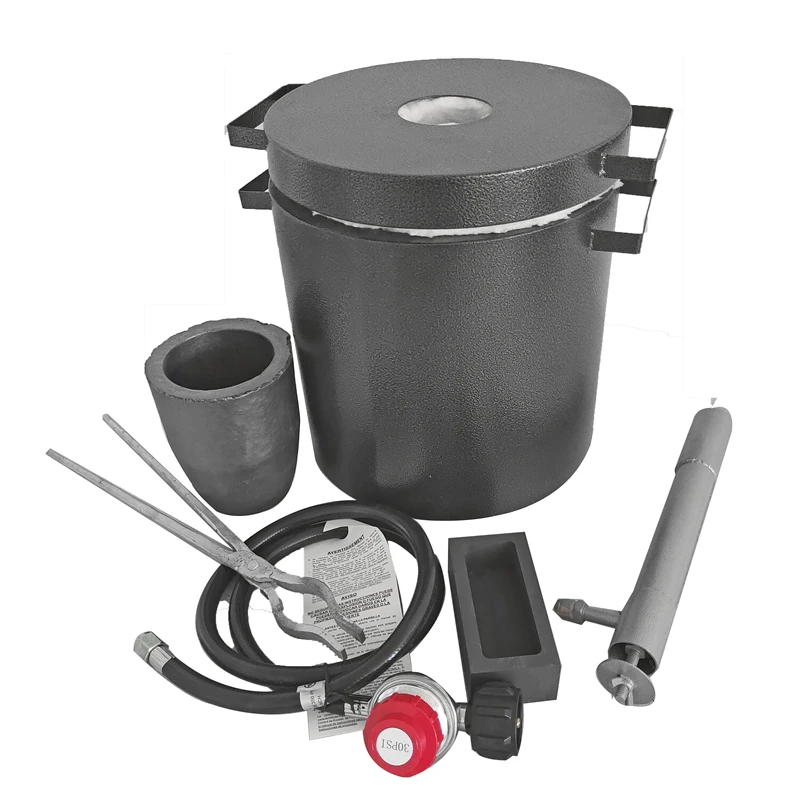
The record's real content is in its gallery, and the gallery is not a set of views of one object. It is a kit, photographed item by item. Reading the eight pictures in order: a refractory-lined furnace body with its lid, a graphite crucible, a rectangular graphite ingot mould, a gas regulator and hose with an instruction leaflet, a gas burner, crucible tongs, the whole kit laid out together, and a view into the packing carton.
The furnace itself is a tapered drum with a lining visible as a cream-coloured surface through a central hole in the lid. Both the lid and the body carry two handles, four in total, which is how such a unit is lifted while cold. The two diameters the parameters left to the customer are exactly the two that a tapered drum has, which is why those rows exist in the template at all, and the picture is the only place where it becomes clear that the body tapers rather than being a straight cylinder. Nothing in the record says whether the furnace is meant to be used with the lid on, what the central hole is for, or whether there is a grate to carry the crucible above the flame.
The crucible is a plain graphite pot, photographed on its own against a white ground, and its top edge is visibly nicked and eroded in that photograph. The mould is a rectangular graphite block with a bar-shaped cavity, which is an ingot mould, and the kit contains one of them. The tongs are a long pair for lifting a hot crucible. The burner is a cast tube with a brass-threaded inlet on its side and a star-shaped fitting at its foot, which on this class of burner is the air control. None of those five objects has a single figure anywhere in the record: no crucible capacity, no mould cavity dimensions, no tong length, no burner tube diameter, no heat input.
The consequence for a buyer is worth stating plainly. This record sells a melting furnace and every specification that would let a buyer choose it, or check it on arrival, or compare it with another supplier's furnace, is either a photograph or a promise. The photographs are informative, and a buyer can learn from them that the kit is complete and what the parts look like. They cannot tell a buyer how much metal the furnace will melt, how hot it will get, or how long it will take, and those are the three questions a furnace purchase is made of.
The family: seven listings, one set of six photographs, and gas and electric in the same title
Six of this record's eight pictures are used by other records in the same catalogue. Downloading the images and comparing addresses across all five hundred and twelve records shows that those six files appear in seven records in total, and that the seventh record is this one. The seven are the records at positions 162, 163, 175, 195, 196 and 197 alongside this one, and they are the catalogue's melting furnace family.
Reading the family's titles together is where this becomes worth a buyer's attention. Three of the seven titles describe the machine as electric or digital: one calls it a mini digital electric gold melting furnace, another calls it a mini digital electric gold melting furnace and then also says melting gas in the same line, and a third manages to contain the words propane, graphite crucible, electric and gas in a single title. This record's own first parameter describes the same photographed object as a gas metal melting furnace. So one set of six photographs, showing one lined drum, one crucible, one mould, one burner and one hose, serves listings that a buyer would sort into gas and electric categories, and at least three of the titles sort it into both at once.
The family also settles a question this record leaves open, and does so in a way that complicates rather than resolves it. Three of the seven titles carry capacities: one says six kilograms, and two say six, ten and twelve kilograms. This record's title carries no capacity at all. So the capacity information for these pictures exists elsewhere in the catalogue and simply is not in this listing, which means a buyer who found this listing alone would not know that the product comes in three sizes. It also leaves the unit ambiguous, because six kilograms could be the crucible's metal capacity, the charge weight, or the weight of metal the furnace will melt in one heat, and a title cannot distinguish those. The four records that carry a full parameter block, including this one, state no capacity in any row.
One more comparison is worth making and it is the sharpest of the three. Three of the four parameter blocks in this family are identical to each other down to the byte, and the fourth, this record's, differs from them in exactly one place: the first row, where the other three still read item equals value. The template was built once, copied four times, and completed once.
Three sibling records still carry the word value where a value should be
In the three sibling records that share this record's eight-row block, the first row's value is the word value. Not a placeholder that looks like a placeholder in some other way, but the literal string that labels the field, sitting in the field. Those three records have an item row that reads item, occupied by the word value.
It is easy to read that as an isolated slip. It is not. Nineteen records in this catalogue contain a parameter whose value is literally the word value, which is about five per cent of the records that have parameters at all, and those records sit in widely separated parts of the catalogue, from the furnace family at positions 175 and 195 and 196 through positions 110, 131, 133, 242, 269, 273, 288, 291, 294, 295, 324, 333, 406, 428, 482 and 496. Whatever produces this catalogue's parameter blocks is capable of shipping the field's own label as its content, and it does so often enough that a buyer should look for it.
For a buyer the practical lesson is a habit rather than a fact. A parameter block is worth reading as a document and not only as a set of numbers, because the failures are informative. A value reading value means the field was never filled. A value reading Customers' requirements means the field was filled with a promise. A value reading Melting Meta, as this record's application row does, means the field was filled with text that was then cut off, in this case two characters short of the word metal. None of the three is a measurement, and all three appear in one block of eight rows, which is why this record repays reading in full even though it contains no figures to read.
A gas furnace that states no temperature, no gas and no burner rating
The title names three metals: gold, silver and copper. A furnace that melts those three has to reach a temperature above the melting point of the most refractory of them, and it has to hold that temperature long enough for a charge to become liquid and homogeneous. The record gives no temperature at all. There is no working temperature, no maximum temperature, no time to reach working temperature, and no statement of how long a given charge takes. This guide does not supply those figures either, because a furnace's working temperature is a property of the machine on test and not a number that can be inferred from a photograph, and any figure published here would be an invention.
The gas side of the same problem is worse, because it is a safety question rather than a productivity one. The record says gas in its first row and never says which gas. Propane, butane, liquefied petroleum gas and natural gas require different jets, different supply pressures and different regulators, and a burner set up for one will not run correctly on another. The record states no supply pressure, no jet size, no burner heat input in kilowatts or British thermal units, and no burner tube diameter. It also contains no reference to ventilation, to the clearance required around the furnace, to what may be placed above it, or to what the operator should wear. For an appliance that burns gas in a workshop and melts metal in an open crucible, that is the most serious gap in the record, and it is not a gap this guide can fill.
The questions to send are therefore the ones that establish the machine rather than the ones that establish its price. What is the maximum working temperature and the time to reach it from cold. What is the melting capacity in kilograms for each of the three metals named, and is that capacity the crucible's or the furnace's. Which gases will the burner run on, and what supply pressure and jet does each require. What is the burner's rated heat input. What ventilation and clearances does the supplier require. What does the supplier require the operator to wear. And what is the refractory's working temperature limit and its expected life, since the lining is a wearing part and the pictures show it in place.
The gas train's safety leaflet is about a barbecue grill, in Spanish and French
The eighth item in the kit is a hose and a regulator, and photographed with them is an instruction leaflet. The leaflet is headed Avertissement, which is French for warning, and its body is in Spanish. The Spanish text warns that an incorrect installation can cause a fire, damage to property, serious injury or death, and it then gives numbered instructions that refer to a parrilla, which is a grill, and to quemadores, which are burners, along with a leak test and a warning not to use an open flame to look for a leak, and a note describing an excess-flow control.
So the safety documentation supplied with a metal-melting furnace is the documentation for a gas grill, written for a Spanish-speaking market, with a French heading. That is not an interpretation of the pictures; it is what the leaflet in the photograph says. The kit itself is consistent with the same origin: the regulator carries a marking of thirty pounds per square inch on a red cap, which is the sort of adjustable regulator sold for propane burners and forges, and the hose carries a tag. None of those figures appears in the record's parameters, and the record states no supply pressure, no hose length, no hose working pressure and no regulator outlet pressure.
Three things follow. The first is that the safety argument in this kit is carried by a leaflet written for a different appliance, which means the buyer has no furnace-specific procedure for connecting the gas, testing it and lighting it, and no furnace-specific statement of what to do if a leak is found. The second is that a gas appliance sold into a market usually has to satisfy that market's rules before it can be used or sold on, and this record states no certification, no test report and no approval of any kind for the gas train or for the furnace, so the buyer must establish those requirements for their own market and ask the supplier what is held. The third is that the regulator's thirty pounds per square inch marking is, on its own, not a specification of the furnace: it says what the regulator may deliver at most, and the burner's own requirement is what matters, and that requirement is not in the record.
The practical instruction that follows for a buyer is to treat the gas train as a separate purchase until the supplier has answered in writing. Ask what the burner requires at its inlet, what jet is fitted and what jets accompany it, what the hose's working pressure and length are, whether the regulator is adjustable and over what range, whether the leaflet supplied is a furnace leaflet and in which languages, and what certification the supplier holds for the gas components and for the assembled appliance in the destination market.
The insulating lining is visible in the packing photograph
The last picture is a view into the carton, looking down. It shows the furnace body with a thick white fibrous lining around the cavity, a sleeve inside it, the crucible wrapped in paper and stowed inside the furnace itself, and parts bagged at the edges. Two observations follow, and both are the sort a buyer should make from a photograph because the record makes them nowhere else.
The first is a handling question. The lining is a white fibrous material and it is visible and exposed in the photograph, including around the mouth of the cavity, which means the buyer's receiving staff will meet it on unpacking. Materials of that kind carry handling requirements in many markets, because the fibre can become airborne when it is cut, abraded or disturbed, and this record supplies no material declaration, no safety data, no instruction about dust, no statement of whether the fibre has been sealed or coated, and nothing about personal protection during unpacking or during any later relining work. Ask for the material declaration and for the supplier's own handling instruction, and decide before the carton is opened who will open it and what they will wear.
The second is a packing question. The crucible is a graphite part, and graphite is brittle; a crucible that takes a knock in transit may arrive with a crack that is not visible until it is heated, at which point it can fail with molten metal in it. This record's own photograph of the crucible shows a top edge that is already nicked. It also shows the crucible packed inside the furnace cavity, which is an efficient use of space and places a fragile part at the centre of the heaviest object in the box. Ask how the crucible is protected, ask for a photograph of the packed carton before it is closed, and inspect the crucible's rim and wall carefully on arrival before it is ever put in the furnace.
The gallery is about fourteen and a half megabytes
Downloading this record's eight images and weighing them gives a total of fourteen million six hundred and fifty-two thousand and seventy-three bytes, which is about fourteen and a half megabytes across eight files, an average of about one point eight megabytes each, with the smallest at about one point one megabytes and the largest at about two point seven megabytes.
That matters here more than it would on a record with a full specification, because on this record the pictures are the specification. A buyer on a slow connection, or on a phone, is downloading the only documentation that exists for this product, and the record's own text does not repeat any of it. It is also the reason this guide's description of the kit is written from the pictures rather than from the parameters: there was nothing else to read.
The slug of this record is worth a note for the same reason. It is eighty characters long and it ends in the middle of a word, at the letters that begin jewellery, because the slug is cut at the eighty-character limit. That does not break the page, because the truncated slug is used whole and consistently in the page's own address, but it does mean the address ends in a fragment of a word, and a buyer copying it from one place to another should copy all of it. The same eighty-character cut, in the middle of a word, has appeared in several earlier items in this series.
Made to order, and nothing fixed
Three of this record's eight rows defer to the customer, which means the product is made to order in at least its three dimensions. That is a normal arrangement for a refractory body, and it puts one obligation on the seller that this record does not meet: a made-to-order product must state what is fixed and what may vary. What may vary here is the height and the two diameters. What is fixed is not stated, so a buyer cannot tell whether the lining material, the lining thickness, the wall thickness, the shell material, the burner mount and the lid's opening are standard or whether each of them is also a matter for negotiation.
The other side of the same coin is a commercial risk that is easy to miss. When three dimensions are made to order, whoever states them carries the risk that they are wrong. If the buyer states them and the furnace arrives at those dimensions but does not do the job, the dimensions are correct and the furnace is still useless. If the buyer states them loosely and the factory interprets them, then any dispute about what was ordered turns on what was written. The protection is to state the dimensions as a drawing with tolerances rather than as a sentence, to get the factory to confirm the drawing before production, and to have the confirmation refer to a numbered drawing revision so that there is a document to point at later.
The working dimensions a buyer needs to fix are these: the internal diameter and internal depth of the cavity, because those decide what crucible will fit; the cavity's shape and taper, because a crucible has to sit level; the wall and lining thickness, because those decide how fast the furnace loses heat and how long it holds temperature; the external diameter and height, because those decide where the furnace can stand and what clearance it needs; the mass of the whole unit, because a lined drum is heavy and someone has to move it; and the diameter of any opening in the lid and what it is for. None of those is in the record, so all of them have to be asked for, and the answer should be a drawing.
What the record does not state at all
- The working temperature, the maximum temperature and the time to reach either from cold.
- The melting capacity in kilograms for gold, silver and copper, and whether that capacity is the crucible's or the furnace's.
- Which gases the burner will run on, and the supply pressure and jet required for each.
- The burner's rated heat input, its tube diameter and its air control's adjustment range.
- The crucible's capacity, its material grade and its expected life, and how many crucibles accompany the kit, the title having promised crucibles in the plural.
- The ingot mould's cavity dimensions and the weight of ingot it produces.
- The tongs' length and the loads they are rated to lift.
- The refractory's grade, thickness, working temperature limit and replacement interval.
- The shell material, the lining's fixing method, and whether the lining is replaceable by the buyer or only by the factory.
- The internal cavity dimensions, the wall thicknesses and the unit's mass, all three dimensions having been left to the customer without a range.
- The hose's length and working pressure, the regulator's outlet pressure and adjustment range, and whether the fittings match the destination market's cylinders.
- Ventilation, clearance and siting requirements, and any requirement about what may be placed above or beside the furnace.
- The personal protection the supplier requires during operation, during unpacking and during relining.
- A material declaration for the insulating fibre visible in the packing photograph, and the supplier's handling instruction for it.
- A furnace-specific instruction leaflet, in a language the operators read, rather than the grill leaflet shown in the kit photograph.
- Certification or test reports for the gas train and for the assembled appliance.
- The number of cartons, their dimensions and gross weights, and the total volumetric weight, for a kit containing a lined drum, a brittle graphite crucible and a gas train.
- Whether the crucible, the mould and the tongs are included at the listed price or are options, since the parameters name none of them.
- Consumable part numbers, prices and availability for the crucible, the lining and any burner jets.
- Warranty period and scope, spare parts, and who services the machine in the buyer's country.
- Price, minimum order quantity, price breaks, delivery term, lead time and transit time.
Incoming inspection when the kit arrives
- Before opening the carton, decide who will unpack and what they will wear, and treat the white fibrous lining as a material to be handled rather than swept up, since the record supplies no material declaration or handling instruction for it.
- Photograph the carton and its markings as received, before opening, because the record states no carton count, no case dimensions and no gross weight, and the photographs will be the only record of what arrived and how it was packed.
- Photograph the opened carton as it presents itself, and compare the layout with the record's own packing photograph, since the record supplies no packing list and that picture is the only statement of contents that exists.
- Inventory the kit against the pictures: furnace body, lid, crucible, ingot mould, burner, tongs, hose, regulator and leaflet. Note that the title says crucibles in the plural and count how many arrived.
- Inspect the crucible's rim and wall under good light before it is ever heated, and record any nick or crack photographically, since the record's own photograph of the crucible shows a nicked rim and a cracked crucible can fail with molten metal in it.
- Inspect the refractory lining for cracks, for loose material and for the coating, and measure the cavity's internal diameter and depth with a rule, since the record states neither.
- Measure the external diameter, the height and the mass of the body, and record all three, since the record left the dimensions to the customer and there is nothing to check them against except the buyer's own order drawing.
- Check the furnace against the order drawing rather than against the listing, at the tolerances agreed, since three of the eight parameters say the dimensions are to be specified by the customer.
- Read every plate, label and marking on the burner, the hose and the regulator, and record the pressure ratings, the gas type the components are marked for and any standard they reference.
- Confirm that the regulator's outlet pressure matches what the burner requires, and confirm that the fittings suit the cylinders in use, before any gas is connected.
- Carry out a leak test on every joint using the supplier's method and a soap solution, never a flame, and record the result with a photograph and a note of the pressure at which it was held.
- Establish the ventilation and clearances the installation will use, and record them, since the record states no siting requirements and the leaflet in the kit is written for a grill.
- Record the temperature at which the furnace first reaches working heat and the time taken, using an independent measurement rather than the appearance of the flame, since the record states no temperature and no warm-up time.
- Record the time taken to melt a known weight of one of the named metals, and the weight, since the record states no capacity and no melting time and the only way to know what the furnace will do is to measure it once yourself.
- Establish the lining's behaviour under use by checking it after the first few heats and recording what changed, since no life figure is given for a part that wears.
- Keep all of the above as the buyer's own specification file, because the eight photographs and this inspection record will together be a fuller specification of the delivered machine than anything the supplier published.
What the catalogue says, counted
The counts below come from scanning all five hundred and twelve records, and they are this guide's own measurements of the feed rather than supplier statements, with the search terms named so that the same counts can be reproduced.
| Observation | Records | Share |
|---|---|---|
| Records that have any parameter rows at all | 361 | 70.5% |
| Records with parameters whose values contain no numeral once HTML entity escapes are removed, this record the only member of the furnace family among them | 50 | 9.8% |
| The same count with entity escapes left in place, which is four fewer because the escape code itself contains digits | 46 | 9.0% |
| Records containing a value that defers to the customer or offers customisation instead of stating a figure | 22 | 4.3% |
| Records holding three such values, which is the maximum in the catalogue and is held by this record and its three template siblings | 4 | 0.8% |
| Records holding two such values, the next highest | 2 | 0.4% |
| Records containing a parameter whose value is literally the word value, which three of this record's siblings do | 19 | 3.7% |
| Records containing the word burner, which this record does not | 2 | 0.4% |
| Records containing the word crucible, this family among them | 4 | 0.8% |
| Records containing the word graphite | 5 | 1.0% |
| Records containing the word refractory | 4 | 0.8% |
| Records containing the word furnace | 11 | 2.1% |
| Records containing a word for melting | 15 | 2.9% |
| Records containing the word tongs, which none does despite the tongs in this kit | 0 | 0% |
| Records containing a word for jewellery, matched on the stem jewel, this record among them | 15 | 2.9% |
| Records using all-gallery images that no other record uses, which this record is not: six of its eight are shared with six other records and two are its own | 101 | 19.7% |
| Records sharing this record's six shared images, which is the size of the furnace family including this record | 7 | 1.4% |
| Records whose description the supplier's company-name sentence appears in | 384 | 75.0% |
| Records referring to the ISO 9001 standard in that paragraph | 136 | 26.6% |
| Records containing the string OED&ODM, the misspelling used here and elsewhere | 329 | 64.3% |
| Records containing the string this filed, the misspelling used here and elsewhere | 319 | 62.3% |
| Records containing the phrase 70% for expert, as used here | 265 | 51.8% |
Four rows carry the argument of this guide. The first is the pair of no-numeral rows: fifty records have parameters and no product numeral in them, and the fact that the count changes to forty-six when the entity escapes are counted as they are stored is itself a description of how this feed is assembled, with document text pasted in and its escapes surviving into the field. The second is the run of deferral rows: twenty-two records defer something to the customer, four hold three deferrals, and exactly four is both the maximum and this record's family, which is the strongest statement in this guide that the block is not merely thin but is deliberately left open. The third is the nineteen records whose value is the literal word value, which shows that a parameter block can ship without being filled and that a buyer should read the field names as carefully as the figures. The fourth is the family row: seven records sharing six pictures, of which this is one and the largest image family this series of guides has yet measured.
The house-style counts are unchanged once more: the company-name sentence in three quarters of the catalogue, the ISO 9001 reference in just over a quarter, the misspelled abbreviation in about two thirds, the phrase this filed in about five eighths and the claim that seventy per cent of products are for experts in about half.
The specification to send before ordering
| Item | What to require in writing |
|---|---|
| Machine class | Whether the machine quoted is the gas furnace, the propane furnace or the electric furnace, since six pictures are shared across listings that claim all three, and which listing the quotation refers to. |
| Temperature | The working temperature, the maximum temperature, the time from cold to working temperature and the stability of the temperature in use, none of which the record states. |
| Capacity | The melting capacity in kilograms for each named metal, whether the figure is the crucible's capacity or the furnace's, and the melting time for a stated charge, resolving the six, ten and twelve kilogram figures that appear in sibling listings and in none of this family's parameter blocks. |
| Gas | Which gases the burner will run on, the supply pressure and jet required for each, and confirmation that the jet fitted matches the gas the buyer will actually use. |
| Burner | The rated heat input, the tube diameter, the air control's adjustment range and the burner's own part number, since the word burner appears nowhere in this record. |
| Gas train | The hose's length and working pressure, the regulator's outlet pressure and adjustment range, the thread and fitting types, and confirmation that they match the cylinders in use in the buyer's market. |
| Dimensions | A drawing with tolerances for the cavity's internal diameter, depth and taper, the wall and lining thicknesses, the external dimensions and the unit's mass, since three of the eight parameters leave the dimensions to the customer without naming a range. |
| Refractory | The lining's material, grade, thickness, working temperature limit and expected life, whether it is replaceable by the buyer, and its replacement part number and price. |
| Crucible | The capacity, material grade, wall thickness and expected life of the crucible, how many accompany the kit, their individual price and their packing protection. |
| Mould and tooling | The ingot mould's cavity dimensions, the ingot weight it produces, the tongs' length and rated load, and whether each is included at the quoted price. |
| Safety | A furnace-specific instruction leaflet in a language the operators read, replacing the grill leaflet shown in the kit photograph; the ventilation and clearance requirements; the supplier's required personal protection for operation, unpacking and relining; and a material declaration and handling instruction for the insulating fibre. |
| Certification | Any certificate or test report held for the gas components and for the assembled appliance, and a statement of which market each applies to. |
| Packing | The number of cartons, each carton's dimensions and gross weight, the total volumetric weight, the protection provided for the graphite parts, and a photograph of the packed carton before it is closed. |
| Inspection | A pre-shipment inspection of the assembled kit with the burner lit and the furnace brought to heat, the results recorded, and photographs of the furnace, the crucible and the burner nameplates taken before packing. |
| Commercial | Unit price for the complete kit and for each item separately, minimum order quantity, price breaks, delivery term, lead time, warranty period and scope, spare parts availability and who services the machine in the buyer's country. |
Frequently asked questions
Does the record contain any specification at all?
It contains eight parameter rows and no numeral that describes the product. Once the HTML escape code for an apostrophe is removed, none of the eight values contains a digit. The values are a product class, a material class, an application truncated mid-word, three deferrals to the customer, a claim about purity, and a country of origin. The specification that does exist is in the eight photographs, which show a refractory-lined drum and lid, a graphite crucible, a graphite ingot mould, a gas burner, tongs, a hose and a regulator, the kit laid out and a packing shot.
The three dimensions all say the customer's requirements. What does that mean in practice?
It means the furnace is made to order in its height and in its top and bottom diameters, which are the three dimensions that define a tapered drum's size. A made-to-order product still has fixed properties, and the record states none: no range within which the dimensions may be chosen, no fixed wall or lining thickness, no fixed material, no fixed mass. Practical protection is to state the dimensions as a drawing with tolerances, to require the factory to confirm the drawing before production, and to have that confirmation cite a numbered revision so there is a document to point at if the delivered furnace does not match what was ordered or does not do the job.
Why does it matter that six pictures are shared with other listings?
Because those listings describe different machines. The same six photographs appear in seven records, and among those titles three claim the machine is electric or digital, one contains both propane and electric, and one contains propane, electric and gas together, while this record's first parameter calls it a gas metal melting furnace. Three of the family's titles also carry capacities of six, ten and twelve kilograms, and this title carries none. A buyer who sees only this listing cannot know that the product is offered in three sizes, and a buyer comparing this listing with a sibling may be comparing one photograph set against contradictory descriptions of it.
Is there a capacity figure anywhere?
Not in this record, and not in any of the four parameter blocks in its family, which between them state no capacity at all. Three of the seven family titles carry capacity figures of six, ten and twelve kilograms. Those figures do not say which is meant: a crucible's metal capacity, a charge weight and a furnace's melting capacity are three different things, and a title cannot distinguish them. Ask for the capacity per metal and for a statement of what the figure refers to.
What documentation comes with the gas side of the kit?
What the kit photograph shows is a leaflet headed Avertissement, which is French for warning, with a Spanish body that refers to a parrilla, meaning a grill, and to quemadores, meaning burners, and that covers leak testing, a warning against using a flame to find a leak, and an excess-flow control. It is grill documentation, not furnace documentation. Ask for a furnace-specific leaflet in the operator's language, and treat the gas train as a separate purchase until the supplier has answered in writing about the burner's inlet requirements, the jet, the hose and the regulator.
Is the machine certified for my market?
The record states no certification, no test report and no approval for the furnace or for the gas train, and the kit's own leaflet is written for a different appliance. A gas-burning appliance is normally subject to the rules of the market it is used or resold in, and this guide cannot tell you what those rules are for your market. Establish them yourself, and ask the supplier exactly which certificates or test reports are held and for which market each applies, before committing to an order.
Is anything in the kit a consumable?
Two things at least. The crucible is a graphite part that is heated and cooled repeatedly and handled with tongs, and the refractory lining is exposed to flame and to slag and will eventually need replacement. Both are visible in the photographs, neither has a parameter, and neither has a stated life or a stated replacement price. Ask for the service life of each, for the replacement part numbers and prices, and for the procedure and the required protection when the lining is replaced.
What should be done on arrival?
Photograph the carton before opening and the open carton before unpacking, since the record supplies no packing list and its own packing photograph is the only statement of contents. Inspect the crucible's rim and wall under good light before it is ever heated, because graphite is brittle and the record's own photograph of the crucible shows a nicked rim, and a cracked crucible can fail with molten metal in it. Measure the cavity, the external dimensions and the mass, because the dimensions were left to the customer and there is nothing to check them against except your own order drawing. Then leak-test every gas joint with soap solution before the first lighting, record the result, and record the actual time to working heat and the actual melting time for a known charge, because those are the figures the record does not have.
Is this machine related to anything else in the same catalogue?
Yes, more closely than any item in this series so far. Six of its eight pictures are shared by seven records, and three of those records carry a parameter block that is byte-identical to this one, differing only where this record filled in the first row and they did not. So the missing figures here are partly recoverable from siblings, and the recovery is instructive: the siblings' own parameter blocks are equally empty, and the extra information they add sits in their titles rather than in their data. The two remaining pictures, the kit layout and the packing shot, are used by this record alone.
Source, scope and what this guide does not claim
Everything about the product comes from the record for Product ID 1601253088164 as it stands: an eight-row parameter block, an eight-hundred-character description that ends mid-word at the phrase TEBAK have vario, and eight gallery images. The parameter values are quoted verbatim, including the HTML escape used for the apostrophes in the three deferral rows, which this guide reproduces as words in the running text so that the published page is not corrupted and quotes literally in the parameter list where the raw form matters. The images are described as they appear, item by item: a refractory-lined tapered drum with a handled lid and a central opening, a graphite crucible whose rim is visibly nicked, a rectangular graphite ingot mould, a hose and regulator with a leaflet headed Avertissement in French with a Spanish body referring to a grill and its burners, a cast burner with a brass-threaded side inlet and a star-shaped air fitting, a pair of crucible tongs, the kit laid out together, and a view into the packing carton showing an exposed white fibrous lining with the wrapped crucible stowed inside the cavity.
The arithmetic is this guide's own and the assumptions behind it are stated. The digit count was made by searching each parameter value twice, once as stored and once with HTML entity escapes removed, and the two results differ, which is why both figures are given rather than one. The image total of fourteen million six hundred and fifty-two thousand and seventy-three bytes, the average of about one point eight megabytes, the smallest file of about one point one megabytes and the largest of about two point seven megabytes all come from downloading all eight files and weighing them, and each file was also digested to confirm that the eight are eight distinct images. The family of seven was established by normalising every image address in the catalogue to one scheme and counting which records share each of this record's first six pictures, and the byte-identity of three siblings' parameter blocks was confirmed by comparing their serialised parameters. No temperature, no capacity, no gas pressure, no burner rating and no dimension is estimated anywhere in this guide, because the record supplies none and an estimate of a furnace's thermal performance would be a fabrication rather than a specification.
The catalogue counts are this guide's own scans of all five hundred and twelve records with the search terms named so that they can be reproduced. Three hundred and sixty-one records carry parameter rows; fifty contain no numeral once entity escapes are removed and forty-six counting them; twenty-two contain a value deferring to the customer; four of those hold three such values and those four are this record and its three siblings; two hold two; nineteen contain a parameter whose value is the literal word value; the words burner, crucible, graphite, refractory and furnace appear in two, four, five, four and eleven records respectively; no record contains the word tongs. The four house-style counts of three hundred and eighty-four, three hundred and twenty-nine, three hundred and nineteen and two hundred and sixty-five, and the ISO 9001 count of one hundred and thirty-six, are unchanged from the previous rounds' measurements.
Nothing here asserts that the supplier has misrepresented anything, and nothing here should be read as an assessment of the machine's quality or safety. A parameter block whose values defer to the customer, a template whose first field still holds the word value, an application value truncated two characters short of its word, one set of photographs serving listings that describe both a gas and an electric machine, capacities present in some titles and absent from the parameter blocks, and a gas appliance arriving with a grill leaflet are all ordinary consequences of listings assembled by hand at speed, and the counts above show how common each pattern is across this catalogue. Above all, nothing here is engineering approval, a gas installation specification or purchase advice. A furnace that burns gas is a safety-critical appliance, and its installation, its ventilation, its clearances, its leak testing and the protection worn by whoever operates it are matters for the buyer's own market rules and for a qualified person on site, and not for anything in a supplier listing or in this guide.
Key specifications
- item
- gas metal melting furnace, the record's own value, and the only row that was filled in on this record: the same template in three sibling records still reads item equals value, the literal placeholder word
- Type
- Refractory, which names a class of heat-resistant material rather than a type of machine
- Application
- Melting Meta, truncated mid-word inside the field boundary; the word intended was almost certainly metal, and the value stops two characters early
- Height
- Customers' requirements, stored in the feed with the HTML entity for the apostrophe; no dimension, no range and no statement of what the customer may choose between
- Composition
- High Pure, which is a claim about purity and not a composition: no material is named and no figure is given
- Top Diameter
- Customers' requirements, the same placeholder as the height
- Bottom Diameter
- Customers' requirements, the same placeholder again, which with the top diameter describes a tapered body whose two diameters are both unspecified
- Place of Origin
- China
- Temperature
- not a parameter and not stated anywhere, although the title names gold, silver and copper as the metals to be melted
- Capacity
- not a parameter and not stated anywhere, although three records using these same six pictures carry six, ten and twelve kilograms in their titles
- Gas type and pressure
- not a parameter and not stated anywhere, although the first row calls the machine a gas furnace and the kit includes a hose and a regulator
- Burner heat input
- not a parameter and not stated anywhere; the word burner appears in only two records in the whole catalogue and this is not one of them
- Crucible and mould
- no parameter, no capacity, no material grade and no life, although both are shown in the pictures and the title names crucibles in the plural
- Refractory grade and lining life
- not stated: no grade, no thickness, no working temperature and no replacement interval for a part that wears out
- Packing and freight
- not stated: no carton count, no case dimensions, no gross weight and no volumetric weight for a kit containing a lined drum, a crucible and a gas train
- Safety documentation and certification
- not stated. The only safety paper visible in the kit is a leaflet headed in French and written in Spanish about a barbecue grill, with no furnace-specific instructions and no certificate of any kind
- Commercial terms
- not stated: no price, no minimum order quantity, no delivery term, no lead time and no warranty