
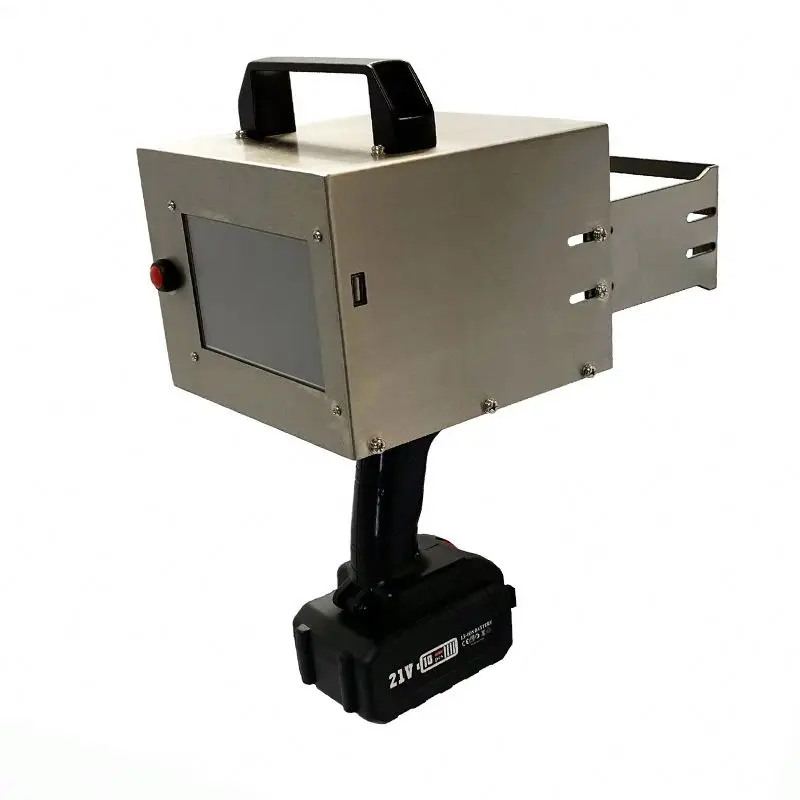
The listing publishes no parameters, and the specification is a photograph
Product ID 1601247239713 is titled as a hand-held automotive chassis frame marking machine with a lithium battery, and its parameter list is empty. Not one figure. Where a parameter list would normally sit, there is nothing, and the description field is not a description either: it is seven section headings with no content under them. Product Description appears three times, Packing & Delivery twice and Company Profile twice, and between them the field carries a single line of text that repeats the title. The company paragraph that follows is cut off mid-sentence at the words the quality control standards are based, and it contains the same two typos these records usually carry, with OEM written as OED and product as productc.
The only specification in the whole record is a photograph: the third gallery image is a picture of a thirteen-row table headed Detailed Product Parameter. Everything a buyer would normally copy into a request for quotation exists only as pixels. That has consequences a buyer should weigh before treating the record as a specification.
- The figures cannot be copied into an enquiry, a comparison sheet or an internal specification without being retyped, which is where transcription errors enter an order.
- They cannot be searched, filtered or compared by any procurement system, because they are not text.
- They are invisible to anyone reading the listing in a text-only or accessibility mode, and to any automated catalogue import.
- They cannot be corrected in place. If one figure is wrong, the whole image has to be replaced, which is why suppliers rarely bother.
The practical rule for this record is the one used throughout this series: treat the listing as a lead, treat the parameter table as a claim, and put every figure that will appear on the purchase order into the written quotation so that the contract, not the photograph, carries the specification.
Two model numbers, and what they encode
The table names two models: XY/SD-4-9030 and XY/SD-4-12030. Read as one machine with two configurations rather than two products, the number decodes cleanly, and it can be checked against the row directly below it.
- XY is the series prefix that appears on the maker plates and in the model tables of this family of marking machines.
- SD identifies the type within that series.
- 4 is the generation.
- The trailing four digits are the working window in millimetres: 9030 is 90 by 30, and 12030 is 120 by 30.
The decoding is confirmed by the working area row, which gives exactly those two windows, 90mm x 30mm and 120mm x 30mm. So the two model numbers are one machine offered with two window widths, and the buyer's question is not which machine but which window. The record never says which of the two is quoted, and it publishes no price for either, so the model number in the quotation is the only way to know what is being bought.
Two consequences follow. First, if the quotation says only hand-held marking machine, the window is undetermined and the buyer may receive the narrower one. Second, the working area is a window rather than a guaranteed marking field: the usable area is what remains after the head's own travel and the operator's approach, and on a hand-held tool the operator is also the fixture.
Which of the two windows clears a seventeen-character chassis number
The title names chassis frame marking, and a chassis identification number is generally seventeen characters. The length a marking occupies is the character width plus the space between characters, multiplied by the count. Working that through gives the following, and the window's long side has to exceed it.
| Character width + spacing | Length for 17 characters | 90mm window | 120mm window |
|---|---|---|---|
| 3mm + 0.5mm | about 60mm | fits | fits |
| 4mm + 1mm | about 85mm | 5mm of margin | fits |
| 5mm + 1mm | about 102mm | does not fit | 18mm of margin |
| 6mm + 1mm | about 119mm | does not fit | 1mm of margin |
On a benchtop machine a five millimetre margin would be adequate, because the workpiece is clamped and the head starts from a fixed origin. On a hand-held tool it is not, and this is the point that decides the order. The operator positions the head against a frame rail, watches for the start point, triggers, and holds the machine steady for the duration of the mark; a few millimetres of hand movement at the start consumes the margin, and a mark that runs into the end of the window is a rejected chassis. With a 4mm wide character the ninety millimetre model leaves five millimetres of margin and the one hundred and twenty millimetre model leaves thirty-five, so for a seventeen-character chassis number the 12030 model is the one to specify, and the 9030 is the one to avoid unless the character height is reduced to a size the vehicle's own specification may not allow.
The record does not state the character width it assumes, the character height it can produce beyond the three millimetre figure used in its speed row, or the pitch between characters. All three belong in the quotation.
Three figures that need scrutiny before they reach an order
Three rows in the table are the ones a buyer should not accept as written, because each is either impossible, meaningless or describing a different quantity from the one the label suggests.
The pin at HRC 92
HRC is the Rockwell C scale, which uses a diamond cone under a heavy load and is conventionally used for materials whose hardness falls in the range where that cone produces a usable reading, roughly up to about 70 HRC. A reading of 92 is above the top of the scale as it is normally defined and used, so HRC 92 is not a hardness that can be measured on the C scale. A figure of 92 is, however, entirely ordinary on the Rockwell A scale, HRA, which is the scale conventionally used for cemented carbides and for thin hard materials, where typical values sit in the high eighties and low nineties. The most likely reading of the row is therefore that the pin is cemented carbide with a hardness of about 92 HRA, and that the unit was mistyped.
Why it matters: the buyer is specifying a consumable. A pin is not a permanent part; it wears and is replaced, and what governs the cost of ownership is the pin's material, its geometry, its life expressed against a known material and depth, and the price and lead time of a replacement. Ask for the pin material and grade, the pin's part number, its quoted life on the buyer's own material at the buyer's own depth, the price of spares and the minimum order for them. A hardness figure with the wrong scale tells the buyer nothing about any of that.
The repeat accuracy of 0.01mm
The table quotes a repeated accuracy of 0.01 millimetres, which is ten micrometres. On a machine whose head is carried by a hand and pressed against a frame rail, the placement of a mark is determined by the hand, not by the mechanism. Ten micrometres is roughly a seventh of the thickness of a sheet of paper. It is a plausible figure for the resolution of the carriage or the encoder inside the machine, and it is not achievable as the placement repeatability of a hand-held tool. The figure that matters for a buyer is the difference between the datum edge the operator locates against and the first character of the mark, and that belongs in the quotation as a practical tolerance, not as a machine resolution.
A useful way to test the claim during a sample trial is to ask for ten marks started from the same physical datum, then measure the spread of the first character's position. The spread observed is the number the buyer actually needs, and it will be larger than 0.01mm.
The minimum marking depth of 0.01mm
The depth row reads 0.01 to 1.5 millimetres, said to depend on the material. The lower end is not a useful depth for an impact mark. Ten micrometres is less than a fifth of the thickness of a human hair and well inside the surface roughness of the sort of steel a chassis rail is made from, so a mark of that depth is not a mark that can be read or verified. The lower bound in the row is best read as a default value carried over from the original equipment's software limits rather than as a description of a deliverable mark.
The upper bound deserves equal care, in the opposite direction. One and a half millimetres is a substantial depression, and on a structural member it is a question for the buyer's own engineering function: how much material may be displaced from a load-bearing rail, and whether the applicable vehicle identification requirement accepts an indented-dot mark at all or requires characters that are stamped. That question is settled by the buyer's market and its authority, not by this record, and it should be settled before the machine is ordered rather than after the first sample is rejected.
Marking speed is given as a character rate, which is the figure that matters
The speed row reads not more than fifty millimetres per second, quoted for characters three millimetres tall, or three to four numbers per second. Two different quantities are given in one row, and the second is the useful one.
Three to four characters per second means a seventeen-character chassis number is marked in about four and a quarter to five and two thirds seconds of marking time, before the operator positions the machine, triggers it and moves it to the next vehicle. On a line that is the figure that sets the takt, so it belongs in the quotation next to the character height it assumes.
The two halves of the row can also be cross-checked, and the check is informative. If a character is four millimetres wide with one millimetre between characters, then five millimetres of travel carries one character, and three to four characters per second is fifteen to twenty millimetres of travel per second. That is well under the fifty millimetres per second ceiling, which tells the buyer that the ceiling describes rapid traverse and positioning rather than the marking itself. A buyer who reads fifty millimetres per second as the marking rate will over-estimate throughput by a factor of about two and a half to three.
Two further figures are missing from the row and belong beside it: the dot frequency with which the head strikes, and the dot spacing it is set to. Together they decide whether a character looks solid or dotted, and neither appears anywhere in the record.
No air line, no computer: the two claims that are worth checking backwards
The first gallery image makes four claims in boxes, and two of them are the commercial reason this class of machine exists: no need for computer, and no air pump required. Those two claims are the ones a buyer should test, because they are the difference between a tool that can go to the vehicle and a tool that needs a service drop beside it.
An air-driven marker needs a compressor, a filter and a hose, and on a chassis line that means either an existing air point within hose reach of every workstation or a new one. A battery machine needs neither, which is why a hand-held battery tool is often the only practical way to mark a frame rail in a bay that has no air. The trade is that the battery machine carries its energy on board, so the figures that replace the compressor's specification are the battery's.
Those figures are absent. The table says Li-battery and stops there: no voltage, no capacity in amp-hours, no runtime per charge, no charge time, no number of batteries supplied, no price for a spare, and no charger input voltage or plug for the destination. For a production tool those numbers decide the shift plan. If a battery gives a certain number of hours and the charger needs longer than that to refill it, the operator needs a second and possibly a third battery to cover a shift, and those belong in the quotation as line items rather than as an afterthought. Ask for runtime measured at the buyer's own character height and depth, not at a laboratory setting, and for the price and lead time of spare batteries and a spare charger.
The environment row is worth a second look for the same reason. It reads minus five to forty degrees, written without a degree symbol. A workshop at minus five degrees may be within the machine's stated range, but a lithium battery at that temperature delivers less capacity and, depending on its protection circuit, may refuse to charge at all. The machine's ambient range and the battery's own operating and charging window are two different specifications, and only the first is given. Ask for the second in writing if the machine is going to a cold or unheated workshop.
What a hand-held 5.8 kilogram tool means for the person holding it
The machine weight row gives 5.8 kilograms, with no split between the machine and its battery and no gross weight for the packed case. For a tool that is held rather than clamped, 5.8 kilograms is a substantial load to hold away from the body while the head marks a frame rail, and the photographs show where that load sits: the battery hangs below the body and the carrying handle is on top, so the balance shifts as the battery is fitted.
Three groups of numbers belong in the quotation as a result, and none of them appear in the record.
- Weight with and without the battery, so the buyer can judge the balance rather than the total.
- Vibration emission, measured to the relevant hand-held tool standard, together with the duration of each mark, because daily exposure is a function of both. A buyer who has to manage hand-arm vibration exposure will need an emission figure and the standard it was measured to, and a supplier who has never been asked will usually not have one.
- Noise level at the operator's position, because a dot-peen head striking steel is an impact source and a line of several machines is a hearing-protection question.
Two practical mitigations are worth pricing at the same time. A support or counterbalance arrangement, if the volume justifies one, removes the weight from the operator; and a second battery, as above, removes the pressure to rush the mark to save charge. Neither is mentioned in the record.
The samples: a correct delimiter convention, a valid check digit, and two third-party names
The record's use-scheme panels are the most informative images it has, and they are worth reading closely because they say more about the machine and about the supplier than the specification table does.
The samples show serial strings, casting numbers, a multi-line tyre sidewall code, and vehicle identification numbers. The vehicle numbers are shown enclosed by star symbols. That is the correct convention: a vehicle identification number is conventionally bounded by a symbol at each end so that characters cannot be added to it later, and a supplier whose samples show it is showing that the machine can produce the delimiter as part of the string. The question to ask is whether the software inserts the delimiter automatically around the variable field or whether the operator types it, because the second is where a missing delimiter originates.
On the check digit, one of the two star-bounded strings in the sample panel reads as seventeen characters, and it satisfies its own check digit. The standard rule weights each position, using the sequence 8, 7, 6, 5, 4, 3, 2, 10, 0, 9, 8, 7, 6, 5, 4, 3, 2, with letters transliterated to values. Applying it to the characters as printed gives the products 24, 35, 12, 25, 12, 21, 4, 20, 0, 54, 40, 0, 54, 5, 32, 12 and 18. Their sum is 368, and 368 divided by 11 leaves a remainder of 5, which is exactly the character occupying the ninth position. The string therefore passes. The other star-bounded string in the same panel counts as eighteen characters, and eighteen is not a legal length for a vehicle identification number, so it is either a frame number rather than an identification number, or it carries a typographical error.
Both observations carry the same warning for a buyer, and it is not about the machine. Strings that pass a check digit are, by construction, identifiers that were generated for real vehicles rather than invented for a photograph. A buyer should not lift the supplier's sample images into their own catalogue, specification or training material, because doing so republishes somebody else's vehicle data.
The same panels also contain third-party names and marks: the three-pointed star of a German car maker appears as a marked sample, and a Japanese manufacturer's name appears in the second sample panel beside what looks like tyre sidewall data. Neither is presented with any statement of authorisation. A buyer whose work is original-equipment marking for a vehicle maker must hold the authorisation for the marks it produces, and the fact that a supplier offers a trademarked sample as a demonstration is a due-diligence question worth asking early rather than late. If the buyer's own use is unbranded or aftermarket, the safer instruction is to require that the machine and the sample material supplied with it carry no third-party mark.
The gallery shows more machines than the one in the title
Counting the machines visible across the eight images rather than the machines named in the title is instructive. The record shows the hand-held machine without a screen, captioned as a hand-held lithium battery marking machine; a second enclosure fitted with a screen and captioned as an electric marking machine; a blue benchtop machine standing on a plate with clamps; a pale enclosure of a different shape with hand grips; and a machine on a column with a handwheel at the top. A further image shows a rack of finished machines in rows, in more than one finish.
Only the first of those is the machine the title describes. The blue benchtop machine also carries a red maker plate naming a machine tool company and listing that company's own product range, which is the same kind of plate that appears on a different marking machine in this family. Reading the gallery as a product photograph therefore over-states what is being sold, and a buyer comparing records can easily attribute the wrong machine's abilities to this one.
The rack photograph is the one image that shows manufacturing rather than a single unit, and it shows several product families together. That is normal for a maker, and it supports a specific request: ask for the nameplate and serial number of the exact unit that will be shipped, and for confirmation of which line builds it. With no parameters in the listing and a mixed gallery, the nameplate on arrival is the only unambiguous statement of what was supplied.
On packing, the record does show the delivery arrangement, and it is better than most: the machine is shown in a black case, then the closed case, then the case inside a carton printed with handling marks and a label carrying a customer name field, an item name field and a model field. An English-language user manual and a set of accessories are visible beside the machine. What is not stated is the case's weight, the carton's dimensions and gross weight, the accessory list, or the manual's edition. The model field on the carton label is the field to check on arrival, against the ordered model number, which as set out above is also the only statement of which working window was supplied.
What the record does not state at all
- Which of the two model numbers is being quoted, and the price of each.
- The character width, character height range and inter-character pitch the machine is capable of.
- The dot frequency and the dot spacing range, which together decide how solid a character looks.
- Battery voltage, capacity, runtime per charge, charge time, number of batteries supplied, spare battery and charger prices, and the charger's input voltage and plug.
- The battery's own operating and charging temperature window, as distinct from the machine's ambient range.
- Weight with and without the battery; packed weight; case weight; carton dimensions.
- Vibration emission, the standard it was measured to, and noise level at the operator's position.
- Duty cycle, and whether the machine tolerates continuous line use without a rest period.
- How a string is entered with no computer attached: on-screen keypad, stored list, barcode or two-dimensional code input, or file transfer.
- Whether the machine validates the length and format of a vehicle identification number before marking, whether it can refuse a repeat of a number already marked, whether it stores an audit log with timestamps, and whether the settings can be locked against operator change.
- Whether a repeat function exists so that the same number can be marked a second time on the same vehicle without being retyped, which is the point at which a character is most likely to be mistyped.
- Pin material and grade, pin part number, quoted pin life, spare pin price and minimum order.
- Marking depth achievable on the buyer's own material and thickness, and the number of passes needed to reach it.
- Warranty period and what it covers; spare parts availability in years; service arrangements in the destination country.
- Certification: electrical safety for the destination market, battery transport documentation, and any declaration of conformity.
- Whether the software can produce the star delimiter automatically around the variable field.
Incoming inspection when the machine arrives
- Read the model number on the machine and on the carton label before unpacking, and confirm which working window it denotes, since the window is encoded in the trailing digits of the model number and is the single fact that decides whether a seventeen-character chassis number fits with margin.
- Measure the actual working window by moving the head to each limit of travel and measuring the distance with a steel rule, then subtract the approach clearance the operator will need.
- Weigh the machine with and without the battery and record both, then weigh the packed case, because the record gives only one figure and it does not say which of the three it is.
- Count the batteries and chargers delivered against the order, and record the battery's own label data: voltage, capacity in amp-hours, and the date code, since a battery that has been in stock for a long period may already be partly aged.
- Check the charger's input voltage and plug against the destination supply before it is plugged in.
- Mark a sample on the buyer's own material at the depth and character height required, then measure the depth with a depth gauge and the character height and pitch with calipers.
- Mark the same string ten times from the same datum and measure the spread of the first character's position; that spread, not the printed repeat accuracy figure, is the placement tolerance the process will hold.
- Mark a full seventeen-character string on a piece of the actual rail material and inspect for legibility, for the delimiter being present at both ends, and for the mark staying inside the window with the operator's normal technique rather than a careful one.
- Time the marking of a full string, including the operator's positioning, to get a real takt figure rather than the character rate in the table.
- Check that a repeat function marks the same string a second time without retyping, and that the machine can be set to refuse a duplicate.
- Inspect the pins under magnification before first use and again after the trial, and record the wear pattern, because the pin is the consumable that sets running cost.
- Confirm that the delivered manual is in a language the operators read, and that its edition matches the firmware fitted.
- Measure noise at the operator's position and, if the buyer manages hand-arm vibration exposure, obtain or request an emission figure for the tool as supplied.
- Check the machine and the supplied sample material for any third-party mark, and record what is found, so that the buyer's own compliance position is documented from the first day.
The specification to send before ordering
| Item | What to require in writing |
|---|---|
| Model and window | State the model number explicitly, with the working window in millimetres, and require the same number on the proforma invoice, the carton label and the nameplate. |
| Character geometry | Character width, character height range, inter-character pitch, and the maximum number of characters in one line inside the quoted window. |
| Depth | The depth achievable on the buyer's own material and thickness, the number of passes, and the depth tolerance. |
| Rate | Characters per second at the required character height and depth, and the measured time for one full string including the operator's positioning. |
| Pin | Material and grade, part number, quoted life on the buyer's material at the buyer's depth, spare price and minimum order. |
| Battery | Voltage, capacity, runtime per charge at the required setting, charge time, number of batteries and chargers supplied, spare prices, and the operating and charging temperature windows. |
| Weight | Machine with and without battery, and packed gross weight with carton dimensions. |
| Data entry and control | How a string is entered with no computer attached, whether a list can be loaded, whether input is validated for length and format, whether a repeat of the same number can be refused, whether an audit log exists, and whether settings can be locked. |
| Delimiter | Whether the software inserts the start and stop symbol automatically around the variable field. |
| Exposure | Vibration emission with the standard used, and noise level at the operator's position. |
| Compliance | Electrical certification for the destination market, battery transport documentation, and confirmation that neither the machine nor the supplied sample material carries a third-party mark. |
| Commercial | Packing, delivery term, lead time for the ordered window and for spare pins, warranty period and coverage, and the spare parts horizon in years. |
Frequently asked questions
Is this machine pneumatic or does it need a compressor?
It is a battery machine, and the record states that no air pump is required and no computer is needed. That is its main practical advantage on a chassis line, because it can be taken to the vehicle where there is no air point. The trade is that battery runtime, charge time and spare battery cost become the specification that matters, and none of the three is stated.
Which of the two models should be ordered for chassis numbers?
The 12030, whose window is 120 by 30 millimetres, unless the character width can be held to about three millimetres. At a four millimetre character width a seventeen-character string needs about 85 millimetres, which leaves only about five millimetres of margin in the 90 by 30 window, and on a hand-held tool that margin is consumed by the operator's own positioning.
Can it mark a full vehicle identification number?
The printed content row lists letters, numbers, characters, logos, Chinese characters and serial numbers, so the character set is not the constraint; the window is. Whether the resulting indented-dot mark satisfies the vehicle identification requirement of the buyer's own market is a question for the buyer's authority and should be settled before ordering.
What does a pin hardness of HRC 92 mean?
It cannot be read literally, because the Rockwell C scale does not run that high. It is most likely a figure on the Rockwell A scale, which is the scale used for cemented carbides and which commonly reads in the high eighties and low nineties. Treat the row as evidence that the pin is carbide and ask for the grade, the part number and the quoted life.
Is a repeat accuracy of 0.01 millimetres meaningful on a hand-held tool?
Not as a placement tolerance. Ten micrometres is a plausible internal resolution for the carriage or encoder, but the position of a mark made by a hand-held head is set by the hand. Ask instead for the mark-to-datum tolerance observed in a trial on the buyer's own parts.
Does the machine need a computer or software licence?
The record says no computer is needed, and the image claims support that. What is not described is the interface that replaces it: how the string is keyed in, whether a list can be loaded, whether the entry is validated, and whether the settings can be locked. Those questions decide whether the machine is an error-proofed production tool or a device that relies on the operator being careful.
What arrives in the box?
The record's packing image shows the machine in a carry case, the case in a carton with handling marks and a label carrying customer, item and model fields, and an English manual with accessories. The accessory list, the case weight and the carton dimensions and gross weight are not stated and should be fixed in the order.
Are the samples in the photographs safe to reuse?
No. One of the star-bounded strings in the sample panel satisfies its own check digit, which means it is an identifier generated for a real vehicle rather than an invented example, and the panels also contain third-party manufacturers' names and marks. The buyer should produce their own sample images and require that supplied material carries no third-party mark.
Source, scope and what this guide does not claim
Everything in this guide is drawn from the record for Product ID 1601247239713 as it stands: an empty parameter list, a description field containing seven headings and no content, and eight gallery images. The thirteen-row parameter table referenced throughout is the table shown in the record's own third gallery image, where the model numbers, working areas, depth, speed, pin hardness, power, environment and weight figures are printed. No figure has been supplied from any other source.
The arithmetic is this guide's own and is marked as such wherever it appears. The string-length table multiplies a character width plus a spacing by seventeen; the throughput cross-check converts three to four characters per second into fifteen to twenty millimetres per second at a five millimetre pitch; the window margins subtract those lengths from the two quoted windows; and the check-digit computation applies the standard position weights and the standard transliteration to the sample string as printed, with the products and the remainder given so that a reader can repeat it. The hardness discussion relies on the conventional ranges of the Rockwell C and Rockwell A scales and on the general practice of using the A scale for cemented carbides; it does not assert a measured value for any pin. Vehicle identification numbers are governed by standards covering content and structure, location and attachment, and check-digit computation, and a buyer should confirm against the applicable edition for their own market rather than against a marketing photograph. The sample strings are read from those photographs, and the character counts are stated as read.
Nothing here is a statement about the quality of the supplier's product, which this guide has not tested, and nothing here asserts that any party acted improperly. The observations about third-party marks and about the maker plate are recorded so that a buyer knows which questions to ask, and the conclusions drawn from them are the buyer's own procedural steps: confirm the entity that quotes and invoices, obtain the nameplate and serial of the unit to be shipped, require a sample marked on the buyer's own material, and settle any regulatory question with the buyer's own authority before the order is placed.
Key specifications
- Product name
- Handheld Electric Marking Machine (from the parameter table in the 3rd gallery image)
- Model No. (in the image only)
- XY/SD-4-9030 and XY/SD-4-12030
- Listing parameters published
- none - the listing's parameter list is empty
- Standard working area
- 90mm x 30mm (XY/SD-4-9030); 120mm x 30mm (XY/SD-4-12030)
- Marking depth
- 0.01-1.5mm (stated as depending on the material)
- Marking speed
- not more than 50mm/second, quoted for characters 3mm tall, or 3-4 numbers per second
- Printed content
- letters, numbers, characters, logos, Chinese characters, serial numbers
- Repeated accuracy
- 0.01mm
- Pin hardness
- HRC 92 (stated)
- Power supply
- Li-battery; no voltage, capacity, runtime or charge time stated
- User provided
- NON (i.e. no computer and no air supply needed)
- Machine power
- not more than 250W
- Working environment
- -5 to 40 C (written without the degree symbol)
- Machine weight
- 5.8kg; gross and net not distinguished
- Noise, vibration, duty cycle
- not stated anywhere in the record
- Software, data entry, validation
- not described; the machine is stated to need no computer
- Warranty, certification, spare pins, manuals
- not stated; an English manual is visible in the packing photograph
- Title claims vs record
- the title names a hand-held automotive chassis marking machine; the gallery also shows benchtop and column machines