
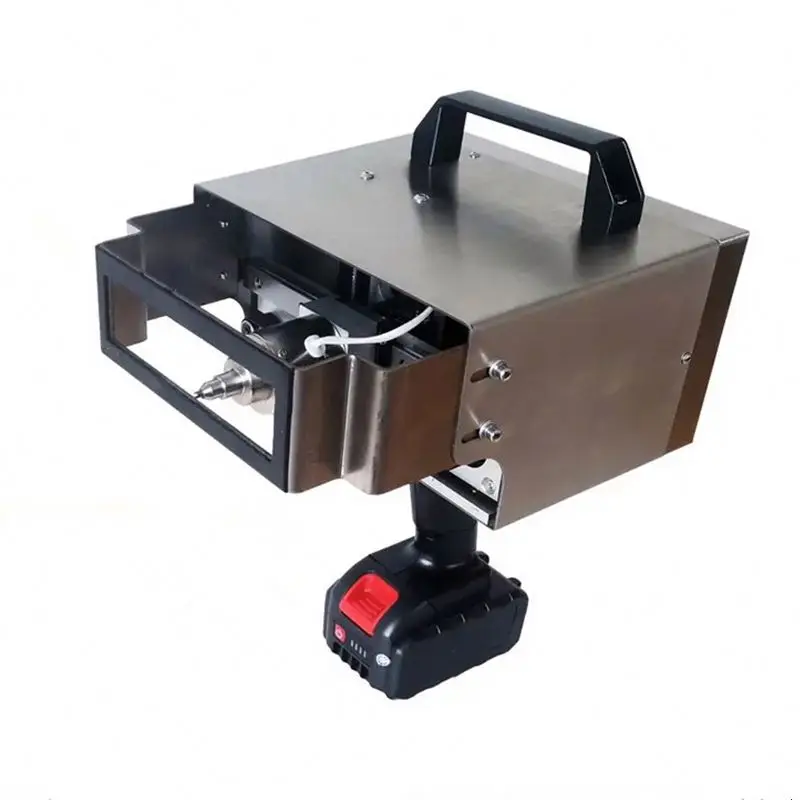
Source-controlled product identity
The Hoting queue identifies Product ID 1601247181784 as a portable marking tool listed under the title "TEBAK Handheld Lithium Battery Marking Machine Marker for Automotive Chassis Frame Marking Code Serial Number".
This record is close to bare. The parameter block is empty, and the description consists of the product title followed by four section headings, Product Description, Packing & Delivery, Company Profile and a repeated Company Profile, with no content under the first two. The only content in the record is the company profile text, which describes the supplier as a professional supplier of product machines, CNC carbide inserts and turning and milling tools under the TEBAK brand.
There is therefore no technical specification of any kind in this record: no marking technology, no marking area, no character height, no battery data, no weight and no throughput. Everything below separates what the title asserts from what a buyer must obtain in writing, and nothing in this article should be read as a confirmed specification of this product.
What the record does and does not contain
| Item | Record value | Status |
|---|---|---|
| Product name | TEBAK Handheld Lithium Battery Marking Machine Marker for Automotive Chassis Frame Marking Code Serial Number | Title |
| Form factor | handheld, from the title | Title assertion |
| Power source | lithium battery, from the title | Title assertion |
| Intended application | automotive chassis frame marking, codes and serial numbers, from the title | Title assertion |
| Parameter block | empty | Absent |
| Product description body | empty apart from headings | Absent |
| Marking technology | not stated | Missing and decisive |
| Marking area, character size, depth | not stated | Missing |
| Battery voltage, capacity, runtime, charge time | not stated | Missing |
| Weight and dimensions | not stated | Missing |
| Packing and delivery terms | headings only, no content | Absent |
The presence of the Packing & Delivery heading with no content is worth noting in itself: the listing is structured as though terms were intended to be published there. A buyer should ask for those terms rather than infer them, and should treat the empty description as a sign that the listing has not been completed rather than as a sign that the product is unavailable.
The first question: which marking technology is this
The title uses the generic words "marking machine" and "marker" without naming a technology, and the choice of technology determines almost everything else about the purchase: the mark appearance, the depth achievable, the materials that can be marked, the consumables, the noise level and the price band.
Three technologies plausibly fit a handheld, battery-powered marking tool for chassis frames. The first is dot peen marking, also called dot marking or pin marking, where a hard stylus is driven into the surface to form a pattern of indents; it produces a permanent, deformation-based mark and is the common choice for metal parts that must be traceable for the life of the product. The second is scribe marking, where a sharp point scratches continuous lines into the surface; it produces a shallower, finer mark. The third is laser marking, where a focused beam alters or removes the surface; a handheld battery-powered laser marker is a different class of tool with different safety requirements.
The combination of handheld form factor, lithium battery power and chassis frame marking points most strongly at dot peen marking, which is the technology normally used for marking vehicle identification and serial numbers on frames, but the record does not state it and the point must be confirmed in writing rather than assumed.
Ask the supplier to state the marking technology by name, and to supply a photograph of a mark produced by this unit on a steel surface at known character height. A photograph of a mark, not of the machine, is the single most useful piece of pre-purchase evidence for a marking tool, because it shows the mark quality that the machine actually produces.
Automotive chassis frame marking: the application drives the specification
The title names automotive chassis frames as the application, and that names a demanding set of conditions that the record does not address. A chassis frame presents marked surfaces in awkward orientations, including vertical faces, downward faces and areas partly shielded by other components, and it presents a range of surface conditions from bare steel to painted, primed, galvanised or lightly rusted metal.
Ask which materials the unit is rated to mark and at what depth, and whether it can mark through paint and primer or whether the surface must be prepared first. Marking through a coating without removing it is a functional requirement on many production lines, and its absence changes the process around the tool.
Ask what marking depth the unit achieves and how the depth is set or adjusted, since traceability marking is often specified as a minimum depth and a mark that is too shallow fails the requirement while a mark that is too deep can damage thin sections. Ask whether depth is set electronically, mechanically or by an operator pressure control, because a pressure-controlled tool depends on operator consistency in a way that a fixed-stroke tool does not.
Ask how the tool behaves against curved and irregular surfaces, since a chassis frame is not a flat plate, and whether a standoff, a guide foot or a magnetic base is supplied to keep the stylus at a consistent distance. Ask also whether the unit can mark in an overhead or inverted position, because a battery-powered handheld tool used under a vehicle is subject to that orientation.
Ask finally about noise. Dot peen marking is an impact process and produces a level of noise that varies with the material and the marking pattern, and in a workshop or on a line this is a practical operating consideration rather than a detail.
Battery data: the whole reason for the form factor, and entirely absent
The title states lithium battery power, which is the feature that makes the tool independent of a cable and usable under a vehicle. The record then gives no battery information at all, so the practical runtime of the tool is unknown.
Ask for the battery chemistry and nominal voltage, the capacity in amp-hours or watt-hours, and the marked runtime in actual marking time rather than in hours of standby. Ask for the charge time, whether the charger is supplied, whether the charger accepts the voltage used in the buyer's market, and whether the battery is internal and non-replaceable or a removable pack. A removable pack allows a second battery to extend the working day; an internal battery means the tool is unavailable while charging, and on a two-shift operation that difference can outweigh a price difference.
Ask for the expected battery cycle life and the replacement price and lead time, because a proprietary battery for an imported tool becomes a supply problem if the original battery can no longer be obtained. Ask specifically whether the battery is a standard format available from other suppliers or a proprietary pack made only for this tool.
Ask also whether the tool can operate while connected to a charger or to mains power, which determines whether a flat battery stops production or only slows it, and whether there is any battery protection against deep discharge, since a tool left unused for a long period can be ruined by a battery that self-discharges below its safe threshold.
Marking content: codes, serial numbers and what the tool must store
The title names marking codes and serial numbers. What the tool can mark is a function of its controller and its input method, not of its marking head, so the record leaves an important set of questions open.
Ask how content is entered and stored: whether the unit has a keypad, a touch screen, a memory of stored templates, or whether content is sent from a computer or a handheld terminal. Ask whether it can mark sequential serial numbers automatically, whether it can increment counters, and whether it can apply a date or shift code, because those functions separate a tool that can be used for traceability from one that can only copy a fixed pattern.
Ask what character sets and fonts are available, and specifically whether the character height can be changed and within what range. Ask what the maximum number of characters per mark is and what the maximum marking line length is, because a vehicle identification number or a long serial number may exceed the marking window of a small handheld unit, and that limit cannot be worked around after purchase.
Ask whether the marking pattern is a five by seven dot matrix or a different format, since dot matrix density determines legibility when the mark is read by a person or verified by a machine. If the buyer's process includes automated mark reading, ask whether the marks produced by this tool have been read successfully by camera-based verification systems, and treat a claim to that effect as needing evidence from the supplier.
Ask finally whether the marking parameters are stored per job, whether an incorrect setting or an accidental keypress can be locked out, and whether the tool records what it marked. On a traceability application, the ability to show what was marked and when is often required by the buyer's own quality system.
Regulatory requirements: the buyer's responsibility, and a question for the supplier
Vehicle identification numbers, chassis numbers and other traceability marks are frequently governed by regulation or by a manufacturer's own standard, specifying the character set permitted, the character height, the marking location, the depth or permanence of the mark, and the surface preparation allowed. Whether any particular tool can satisfy those requirements depends on the standard that applies to the buyer, on the material being marked, and on how the mark is subsequently verified.
The record contains no statement of compliance with any standard or any regulation, and a supplier cannot be expected to certify a tool against a regulation the buyer has not identified. The practical approach is for the buyer to state the standard that applies to their product and ask the supplier two direct questions: whether the tool has been used to produce compliant marks for that standard, and whether references or sample marks can be provided. Treat the answer as evidence only if it is specific to the standard in question and supported by a sample.
If the tool is intended for marking on safety-critical or homologated components, involve the buyer's own quality and compliance function before the purchase decision rather than after delivery, since a marking tool that cannot produce a compliant mark has little residual value in that application.
Documentation, spares and the company profile statement
The company profile in this record states that the supplier's quality control standards are based on ISO9001 certifications, without a certificate number, an issuing body or a scope, and it states that the supplier designs and sells a range of product machines, CNC carbide inserts and turning and milling tools. A handheld battery-powered marking tool is adjacent to that range rather than central to it, which makes it worth confirming that the supplier stocks and supports this specific product rather than acting as an intermediary.
Ask which documents ship with the unit: an operating manual in a named language, a wiring or exploded parts diagram, a stylus or pin specification, a battery and charger specification sheet, and a packing list. Ask also for the stylus part number and price, since the stylus is the consumable that wears on a dot peen tool and a tool with no stylus supply is not usable in the long run.
Ask for the warranty period, what it covers, and the price and lead time of the parts most likely to be needed: stylus, battery, charger, spring or drive components, and the controller where one is fitted. Ask whether the tool has a stated duty cycle or a thermal limit that stops it after continuous use, because a maker of a handheld impact tool should be able to state that figure.
Missing information to request before ordering
- The marking technology, stated by name.
- A photograph of a mark produced on steel at a stated character height, and on the material the buyer will actually mark.
- Materials that can be marked, and whether painted, primed or galvanised surfaces can be marked without preparation.
- Marking depth achieved, how depth is set, and the tolerance on that depth.
- Character height range, maximum characters per mark, and maximum marking line length.
- Marking window and marking area, and how the mark is positioned relative to the workpiece for repeatable placement.
- Marking speed, stated as characters per second or per minute, and the time for a typical serial number.
- Whether a standoff, guide foot, magnetic base or fixture is supplied, and whether one is required for vertical or overhead marking.
- Noise level in decibels for typical marking, if the supplier can state it.
- Battery chemistry, nominal voltage, capacity, stated runtime in marking time, charge time and whether the charger is included.
- Whether the battery is internal or a removable pack, whether it can be replaced by the buyer, and its price, lead time and cycle life.
- Whether the unit runs from a charger or mains supply while in use.
- Charger input voltage range and plug type for the buyer's market.
- How marking content is entered and stored: keypad, touch screen, stored templates or external input.
- Whether sequential numbering, counters, date codes and shift codes are supported.
- Available fonts and character sets, and the marking pattern format.
- Whether the tool records or logs what it has marked, and whether parameters can be locked or password protected.
- Weight of the unit with battery, and its dimensions and grip arrangement.
- Duty cycle or thermal limit, and any protection against overheating.
- Stylus or pin specification, part number, price and expected life.
- Warranty period, coverage and the excluded items.
- Documents supplied: manual and its language, parts diagram, battery and charger specification, packing list.
- Whether the tool has been used to produce marks compliant with the standard the buyer must meet, with specifics.
- Full packing details: carton size, gross weight, carton count and transit protection for the unit.
- MOQ, unit price at the target quantity, sample or trial unit terms, lead time and shipping terms.
- Which parts are expected to wear and their replacement prices and lead times.
Acceptance and incoming inspection
Because the record carries no specification, the purchase order should be built from the supplier's written answers, and the delivered unit tested against them. Before ordering, and if the value of the order justifies it, buy one unit and trial it on the buyer's own material in the buyer's own working position, because a marking tool that performs well on a bench may behave differently used vertically under a frame.
On arrival, check the unit against the ordered configuration: model, battery type, charger type and plug, supplied accessories, and the stylus or pin installed. Check the unit for transit damage and confirm that the battery is not deeply discharged by attempting a charge and noting whether the charger indicates a normal charge cycle.
Then mark a test plate of the buyer's own material with the buyer's own content, at the character height and depth that the application requires, and measure the results rather than assessing them by eye. Measure the character height, measure the mark depth with an appropriate gauge, and check the legibility of the mark and the consistency of the dot spacing. Mark a sequence of serial numbers to confirm that automatic incrementing works and that each mark is correct, since a numbering fault is easier to find in a sequence than in a single mark.
Run the tool continuously for long enough to establish the practical runtime and to provoke any thermal limit, and record how many marks were completed and how long the battery lasted. That test converts the supplier's runtime claim into a measured figure for the buyer's own working pattern, which is the figure the buyer's production planning needs.
Finally, confirm the documents and the spare parts listed above, and confirm the stylus part number so that a first spare can be ordered with the unit rather than after the first stylus wears out.
Buyer decision framework
The source for this guide is a title, an empty parameter block, an empty description body and a company profile. The title states a handheld, lithium battery powered marking machine or marker intended for automotive chassis frame marking of codes and serial numbers. Nothing else about the product is established by the record.
Three written answers decide whether this product is worth pursuing. First, the marking technology, because a dot peen tool, a scribe tool and a laser marker are different purchases with different mark characteristics and different safety requirements, and the title does not say which this is. Second, the marking capability in measurable terms, meaning the character height range, the maximum characters per mark, the achievable depth and the materials that can be marked, because those figures determine whether the tool fits the buyer's traceability requirement at all. Third, the battery arrangement, meaning the runtime, whether the pack is replaceable, and the price and availability of a replacement, because a handheld tool whose battery cannot be replaced after a short life is a disposable purchase.
Where the supplier answers those three questions in writing and supports them with a photograph of a mark and a specification sheet, a single trial unit is a reasonable next step. Where the supplier cannot state the marking technology, the buyer should not proceed, because that single omission makes every other specification unverifiable.
Buyers whose application requires a regulated or homologated marking standard should also confirm the position with their own quality function before ordering, since the record gives no basis for assuming compliance with any standard.
Frequently asked questions
What marking technology does this unit use?
The record does not say. The combination of a handheld form factor, lithium battery power and chassis frame marking points towards dot peen marking, but that is an inference from the title, not a stated specification. Ask the supplier to name the technology and to provide a photograph of a mark produced by the unit.
Can it mark a full vehicle identification number?
Unknown. A long identification number requires both a sufficient character count and a sufficient marking line length, and neither figure is in the record. Ask for the maximum characters per mark, the maximum line length and the character height range before assuming the tool can produce a complete number in one mark.
How long does the battery last?
No battery data is recorded. Ask for the stated runtime in marking time rather than standby time, the charge time, and whether the battery is internal or a replaceable pack, and then verify the runtime in a continuous test of the trial unit.
Can it mark through paint on a chassis frame?
The record does not address surface condition. Ask which materials can be marked and whether painted, primed or galvanised surfaces can be marked without preparation, and test the answer on a painted sample before relying on it.
Is the unit suitable for marking under a vehicle, in awkward positions?
Not established. Ask whether a standoff, guide foot or magnetic base is supplied, whether the unit is rated for vertical and overhead marking, its weight with the battery, and how the mark is positioned repeatably on a curved frame.
Does the marking meet our traceability standard?
The record claims no compliance with any standard. State the standard that applies to the buyer and ask the supplier whether the tool has produced compliant marks for it, with specifics. For regulated or homologated marking, confirm the position with the buyer's own quality function before ordering.
What consumables does it need?
On marking tools of this type the stylus or pin is the part that wears. Ask for its specification, part number, price and expected life, and order a spare with the unit, since the record gives no consumables information at all.
Can the tool store templates and mark sequential numbers?
Not stated. Ask how content is entered, whether sequential numbering, counters and date codes are supported, what fonts and character heights are available, and whether the marking parameters can be locked to prevent a wrong setting being used on a production part.
Source and contact
This guide is based on the Hoting queue record for Product ID 1601247181784. The record contains a title, an empty parameter block and an empty description body, so this article quotes the title directly, marks every technical value as unestablished, and lists the questions a buyer must have answered in writing before purchase. The inference that the tool is a dot peen marker is presented as an inference from the title, not as a specification, and no compliance with any marking standard is claimed.
Request the marking technology, a mark sample photograph, the marking capability figures, the battery and charger specification, the consumables part numbers, the warranty terms and the full packing and delivery terms through the TEBAK sales inquiry channel before placing an order.