
Two rows in the specification, a voltage in the picture
The specification block inside the description has two rows. Brand reads TEBAK, and blade material reads Stainless Steel. Neither is a measurement, and the second names a part that a lever press does not have: a hand juicer of this type presses a halved fruit against a cone or between a bowl and a plunger, and it cuts nothing, so a blade material row describes a component the machine in the photographs does not contain.
The third image is where the numbers are, and it is headed Product Parameters. It gives five rows.
| Row | Value |
|---|---|
| Model | Manual juicer |
| Voltage | 220/240V |
| Product size | 220*170*430mm |
| Packaging size | 435*255*480mm |
| Applicable Scope | Western Restaurant Equipment, Cake Shop Equipment, Chinese Restaurant Equipment, Bakery Equipment |
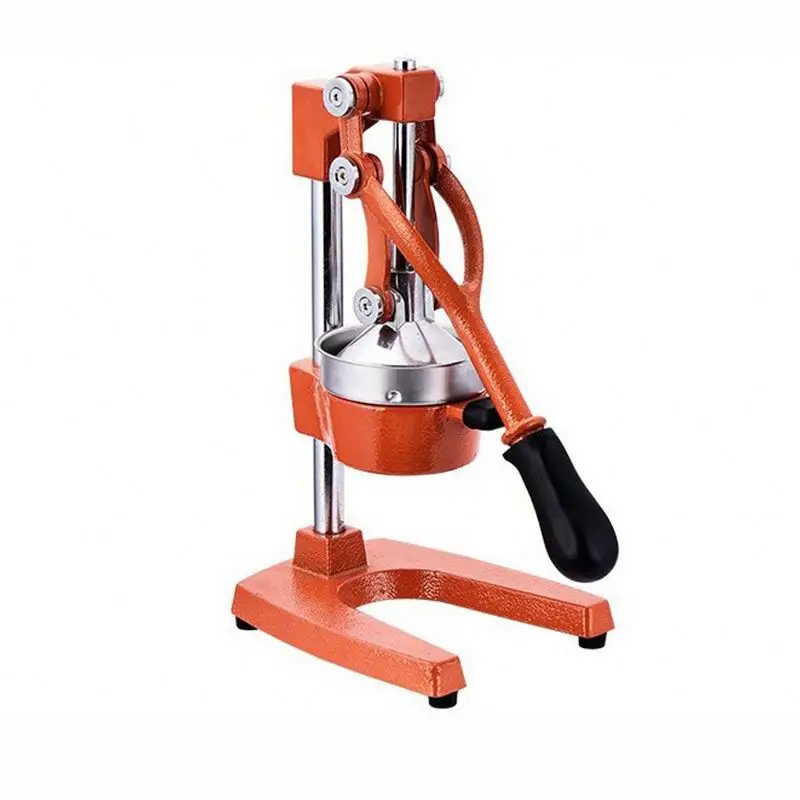
The machine is called a manual juicer in its own model row, and it is manual in every sense a photograph can show. The first, second, fifth and sixth images are four different versions of the same hand press: a vertical pillar, a cast base, a bell-shaped ram above a bowl, and a long lever with a grip at the end that a person pulls down. There is no cord, no plug, no switch, no display and no motor in any of the five photographs of the machine. A lever that a hand pulls needs no supply, and the row reading two hundred and twenty to two hundred and forty volts describes a machine that does not exist on this page.
What makes this more than a slip is where the row sits. It is the second row of a five-row table, above the product size, so it is not a stray line at the bottom of a template that somebody forgot to delete; it is in the position where a buyer looks for the specification that matters most. And the listing's own text never uses the word voltage at all, so the only place in the whole record where an electrical figure appears is inside the picture, where a search cannot find it and where a buyer assembling a shortlist will not see it unless they open every image.
This catalogue does know how to say manual properly. Eighty-six of the five hundred and twelve records use the words manual or hand-operated, and ten of those also mention a voltage somewhere in their text, usually because the machine really does have a small motor or a heated component beside the manual action. So the combination is not unheard of here. It is the photographs that settle this one: four views of a hand press with nothing electrical on it, and a table that supplies a supply voltage for the pull of a lever.
Claims a hand press cannot consume
The fourth image is headed Product Features and carries seven bullets: versatile functions, good wear resistance, energy saving and noise reduction, exquisitely crafted, fastening, high performance and strong drive. Three of the seven describe a powered machine.
Energy saving is a claim about the electricity a machine consumes, and this machine consumes none, because a person supplies the energy. Noise reduction is a claim about the sound a motor, pump or gearbox makes, and the only sounds this machine makes are the creak of a pivot and the pop of a fruit. Strong drive describes a transmission delivering torque from a motor, and the drive here is a hand, an arm and a lever. None of the three is false in the sense of being a lie about a measured quantity; they are simply statements about a category of machine this is not, which is what happens when marketing copy written for an electrical appliance is pasted onto a press.
That the copy is imported rather than composed is visible in the catalogue's own numbers. Searching the five hundred and twelve records for the phrase energy saving returns two records, and neither is a manual machine. Searching for the word noise returns nine. Neither phrase appears in this record's text at all, so both live only in the picture. The feature list has therefore been carried across from another product's artwork, and it has carried the wrong vocabulary with it.
The number the title sells on is not in the specification
The title ends with the capacity, one point five litres, and a capacity is the first thing a buyer of a juicer compares. It appears in the title and in no other field of the record. Not in the two-row specification block, whose rows are the brand and the blade material. Not in the picture table, whose five rows are the model, the voltage, two sizes and a scope. Not in the description beyond the title it repeats. So the one figure the listing is sold on is a search term rather than a specification, and a buyer checking it against anything has nothing to check it against.
The catalogue behaves the same way more often than not. Twenty-four of the five hundred and twelve titles state a capacity, and twenty-eight parameter blocks state one, but only six records state a capacity in both places. This listing is one of the eighteen that carry it in the title and nowhere in the data, so it is in the majority of the pattern rather than an exception to it.
Nor is there any other measurement to fall back on. The listing gives no juice yield, no bowl volume, no diameter of the pressing cone, no maximum fruit size, no weight, and no force required on the handle, which is the figure that decides whether a person can work the machine through a service of two hundred oranges or whether they will give up after twenty.
Kitchen equipment, or a car and a hotel
The title says the juicer is for car and hotel use. The table's applicable scope says Western restaurant equipment, cake shop equipment, Chinese restaurant equipment and bakery equipment. The two lists have nothing in common. A car is not a restaurant, and neither the title nor the table explains how a lever press with a cast base and a four hundred and thirty millimetre pillar is meant to be used in one, where the base needs a flat, stable surface and the lever needs a clear arc above it.
Nor is either list a specification. Restaurant equipment is a category on an equipment sellers' site, and stating a category is not stating a requirement the machine meets. The Applicable Scope label itself is used by no other record in the catalogue: the phrase appears in this listing's picture and in none of the other five hundred and eleven records, so this table's structure is unique even where its numbers are not.
Four finishes and two mechanisms, with no colour row
The photographs show four different versions of the machine, and nothing in the record says which one is sold.
The first image is orange, with two round chrome pillars in an open A-shaped base and a black rubber grip on the lever. The second is black, sits on a solid rectangular base with a recessed tray for the juice, and carries the same style of grip. The fifth is red, and differs in construction as well as in colour: its pillar is a square section rather than a round bar, its lever ends in a plain cylindrical handle with no rubber grip, and its bowl is a polished steel cup in a painted holder. The sixth is fully chrome-plated from base to lever, and its lever is a two-part linkage with an extra pivot, so the pull is compounded rather than direct, which is a different mechanism and not only a different finish.
The difference is not cosmetic for a buyer. A painted cast-iron body and a fully chromed machine are two different products at two different costs, one of them needing paint repair if it chips and the other needing polishing and showing every fingerprint. A direct lever needs one force on the handle, a compound linkage needs another, and the two mechanisms throw the ram through different distances. Whether the finish is chosen by the customer or fixed by the supplier is the question, and the listing does not answer it: there is no colour row, no finish row and no material row for the body, the base or the lever.
What the record does offer on materials is the single row reading blade material, stainless steel. The photographs disagree with it in two ways. There is no blade, and the metal parts visible are a bell-shaped ram, a bowl and, in the chrome version, the whole frame, which are pressed and plated forms rather than cutlery. The row is a template's answer to a question this machine does not ask.
The packing section is empty, and the crates are not this machine's
The description carries a heading reading Packing & Delivery and then, two characters later, another heading reading Company Profile, with nothing at all between them. Two heading lines with a space between them is as empty as an empty section can be.
Of the one hundred and forty-four descriptions in this catalogue that carry that same heading, only nine go on to describe any packing material, and this is not one of them. The catalogue's other packing heading, the one spelled packing and shipping, is emptier still: seventy-three descriptions carry it and in sixty-five of them the next content is the seller's company paragraph. So the two headings that exist to answer the freight question are, in the great majority of records, decoration.
The gallery then supplies a packing picture that answers a different question. The seventh image is a photograph of plywood sheets, of several finished export crates on a factory floor, and of a long stack of stencilled wooden cases carrying markings in several languages, including a made-in-China line. It is a real export packing photograph, and it is used by forty-two records in this catalogue, which is enough on its own to show that it is not a picture of this product's packing. The table's packaging size row gives a carton of four hundred and thirty-five by two hundred and fifty-five by four hundred and eighty millimetres, which is a cardboard box a person can carry; the picture shows wooden cases that take a pallet truck. A crate is not a carton, and forty-two listings cannot each ship inside the cases photographed.
Two listings, one product, eight of nine images shared
The catalogue holds a second listing of the same juicer, and the two pages differ in a way that is the exact opposite of the duplicate pair found in the previous item of this series.
The titles are two arrangements of the same words. This listing reads TEBAK Hot Sales Stainless Steel Manual Juicer for Car & Hotel Use Commercial Grade 1.5L Capacity Squeeze Fruit & Pomegranate. The other reads TEBAK Commercial Grade 1.5L Manual Juicer - Hot Sales Stainless Steel Squeezer for Fruit/Pomegranate. Every merchandising term is present in both: the brand, hot sales, stainless steel, manual juicer, commercial grade, one point five litres, squeeze or squeezer, fruit and pomegranate. The order differs, and the word capacity is spelled out as a number in one and written as litres in the other.
The parameter blocks are identical row for row. Both have exactly two, the brand reading TEBAK and the blade material reading Stainless Steel. Neither has a capacity, a dimension or a weight, so the two pages carry the same two non-measurements in the same two labels.
The galleries agree almost entirely. Each listing has nine images, one main image and eight gallery images. Eight of the nine are the same files, and the eight include all four machine photographs, the parameters table and the features panel. Only the main image differs. So the two pages show the same machine, from the same four angles, with the same specification table and the same feature list, and are told apart by one thumbnail.
Set this beside the previous item's duplicate pair, where the titles, the parameter rows and the description field were identical to the character and the two galleries had nothing in common. Two consecutive items, two duplicated products, and the duplication is executed in opposite ways: one pair duplicates the text and replaces the photographs, the other keeps the photographs and rewrites the text. In both cases a buyer who finds both pages has no basis for choosing, and in both cases the pages compete with each other for the same search terms.
A better-specified sibling, and a unit that was cut off
The catalogue holds a third manual juicer which shows what this listing's specification could have looked like. It has eight parameter rows: a product name reading manual orange lemon juicer, a filter diameter of one hundred and twenty millimetres, a pressure cap diameter of one hundred and eighteen millimetres, a base thickness of forty millimetres, a housing material of stainless steel, a packing size of two hundred and ten by two hundred and eighty by five hundred and twenty millimetres, a dimension of one hundred and ninety by two hundred and sixty by four hundred and seventy millimetres, and a weight.
That is what a buyer of a juicer needs: the two diameters that decide which fruit will fit, a dimension to plan a counter around, a packing size for freight and a weight for the invoice. It shares no photograph with this listing, so it is a different machine rather than another copy.
Its weight row, however, reads five k. The unit was cut off before the letter that makes it a mass, so the row that exists to answer the freight question answers it ambiguously. That makes three specimens in this series of a unit left truncated or doubled: a power row reading eight hundred and fifty kilowatts where eight hundred and fifty watts was meant, a machine with a mechanical rotary timer called CNC, and now a weight of five k. The pattern is that the rows are present and the last character of care is not.
The arithmetic the table does allow
Three checks can be run on the two size rows the picture table gives. The product is two hundred and twenty by one hundred and seventy by four hundred and thirty millimetres, which is sixteen thousand and eighty-two cubic centimetres. The carton is four hundred and thirty-five by two hundred and fifty-five by four hundred and eighty, which is fifty-three thousand two hundred and forty-four. The ratio is three point three one, which is higher than the two point two seven, two point three five and two point eight three found in earlier items of this series, and there is a reason visible in the dimensions: the machine is four hundred and thirty millimetres tall in a four hundred and eighty millimetre box, and the box is four hundred and thirty-five millimetres long against a product two hundred and twenty millimetres long, because the lever projects. A press with a long handle needs a box longer than its body, so the ratio is high for a legitimate reason, and the two rows are consistent with each other.
The carton's volumetric weight is eight point eight seven kilograms at the six thousand divisor and ten point six five kilograms at the five thousand divisor. The listing gives no actual weight at all, and this is a machine built around a cast base and a steel pillar, so the volumetric figure may well bill rather than the actual weight. A buyer who cannot see the weight cannot tell which of the two numbers the freight quotation will use.
Only two per cent of the gallery belongs to this listing
The nine images weigh one million nine hundred and fifteen thousand two hundred and eighty-five bytes. Nearly all of that weight belongs to somebody else.
| Image | Bytes | Used by |
|---|---|---|
| Main image | 42,482 | this record alone |
| Images 1 to 6 (four machine shots, parameters table, features panel) | 855,932 | this record and one other listing |
| Image 7 (plywood and export crates) | 824,225 | 42 records |
| Image 8 (payment and courier panel) | 192,646 | 119 records |
So the only file unique to this listing is the thumbnail, at forty-two thousand four hundred and eighty-two bytes, which is two point two per cent of the gallery. The six product and information images are shared with the twin listing described above. The packing photograph is shared with forty-one other records. The payment and courier panel, which is the same file that has appeared in earlier items of this series at one hundred and ninety-two thousand six hundred and forty-six bytes, is shared with a hundred and eighteen others.
The consequence for a buyer is practical. Everything in the gallery that could answer a question is either the artwork of a second listing of the same product or a catalogue-wide panel, and the one image that is this listing's own is the one designed to be looked at rather than read.
One technical point is worth recording because it reverses a pattern from the previous two items. All nine of this listing's images are addressed over secure transport. In the two preceding items eight or nine of the images were served over plain hypertext transfer protocol, and forty-seven records in this catalogue have a wholly unencrypted gallery. This record is not one of them, so the insecurity of the galleries is a habit that varies by listing rather than a property of the catalogue.
What the listing does not state
The capacity, in any field other than the title. Any dimension, in any field other than a photograph. The weight, actual or gross, despite giving the carton size. The finish or colour of the machine, despite showing four. The material of the bowl, the ram, the pillar and the base, as distinct from the one blade row. The diameters of the pressing cup and the bowl, which decide which fruit fits. The force needed on the handle, and the maximum number of strokes a person can sustain. The juice yield as a share of fruit weight. Whether the machine can be taken apart for cleaning, and whether any part is dishwasher-safe. The food-contact status of the metal that touches the juice, in a catalogue where forty records elsewhere mention food grade, FDA or LFGB. Any certification. Any warranty, and the party that honours it. And the price, which appears on neither of the two listings of this product.
Incoming inspection on arrival
- Confirm which finish was shipped against the order, since four are photographed and none is named, and photograph the machine as unpacked.
- Check the base for flatness and for the feet, because a hand press transmits the whole force of a pull into the base rather than into a motor mount.
- Measure the pressing cup and the bowl diameters against the fruit the buyer actually sells, and check that the lever's arc clears the counter edge and any shelf above.
- Weigh the machine and the carton, and keep both figures with the carton dimensions, so that the volumetric weight of eight point eight seven kilograms derived from this listing's own packing row can be reconciled with the freight invoice.
- Determine whether the metal that contacts juice carries any food-contact declaration, and ask the seller in writing for it if not, since the listing does not mention one.
- Work the press through a realistic service: a hundred strokes, at the pace a counter would use, and check the pivot for play, the ram for alignment and the bowl for movement during the pull.
- Check the two headings in the description against the packing actually used, since the packing section is empty and the packing photograph belongs to forty-two records.
Questions buyers ask about this class of listing
Does the 220/240V row mean there is an electrical version?
No photograph in the record shows one, and no cord, plug, switch or motor appears in any of them. The likeliest reading is that the table was assembled from a template for a powered kitchen appliance and the voltage row was not removed. Ask the seller to confirm in writing that the machine is hand-operated and has no electrical components, so that nothing in the customs documentation describes a voltage for a manual press.
If the voltage row is wrong, can I trust the two size rows?
They check out against each other, which the voltage row cannot. The carton is three point three one times the product's volume, and the difference is explained by the lever projecting beyond the body: the product is four hundred and thirty millimetres tall in a four hundred and eighty millimetre box and two hundred and twenty millimetres long in a four hundred and thirty-five millimetre carton. The two rows agree, so they were probably measured from the same machine, and the voltage row came from somewhere else. Measure both on arrival anyway.
Which finish will I get, and does it matter?
Nothing in the record says, and it matters more than it looks. A painted cast body and a chrome-plated machine are different products at different costs, and the red version in the fifth image has a square pillar while the others have round ones, which is a construction difference rather than a colour. The chrome version in the sixth image has a compound two-pivot lever, so the force needed on the handle is not the same as on the direct-link versions. Settle the finish and the mechanism in writing.
Is the 1.5 litre capacity the bowl or the juice?
The title does not say, and no other field repeats the figure. If it is the bowl, it is the volume of fruit halves the bowl holds before pressing; if it is the container, it is something else entirely. Ask which, and ask for the bowl diameter as well, since diameter decides which fruit fits and the volume does not.
What is the machine actually meant for, a car or a restaurant?
The title says car and hotel use; the picture table's applicable scope says restaurants, cake shops and bakeries. The two lists share no term. A lever press with a cast base and a four hundred and thirty millimetre pillar needs a fixed, flat surface, which is not what the car mention suggests. Treat the car line as a search term and ask the seller to describe the mounting surface the machine expects.
Why do two listings show the same machine?
They carry the same two parameter rows and eight of the same nine images, so they are the same product offered twice. Their titles are rearrangements of the same merchandising words, so they will compete for the same searches. Ask the seller which listing is current, and ask whether the price, the finish and the delivery terms are the same on both, because neither page states a price at all.
What a hand press is normally specified by
The class this machine belongs to is a lever press, and the class has a short and settled list of figures that a buyer works from. Six of them decide whether the machine fits a job at all, and none of the six appears anywhere in this listing.
- The diameter of the pressing cup, because it decides the largest fruit that will seat in it.
- The diameter of the bowl below the cup, and the clearance between the two, because together they decide the smallest fruit that will not slip sideways.
- The stroke of the ram, which is how far the cup travels, and therefore how much of a fruit is pressed in one pull.
- The lever's mechanical advantage, or the force at the handle rim needed to press a given fruit, which is what decides whether a person can work the machine for an hour.
- The footprint and the base mass, because a hand press transmits the whole pull into whatever it stands on rather than into a motor mount.
- The net mass of the machine, which is both the freight figure and the number that tells a buyer whether it will walk across a counter under load.
The catalogue holds a third manual juicer that answers three of the six properly: it gives a filter diameter of one hundred and twenty millimetres, a pressure cap diameter of one hundred and eighteen millimetres and a base thickness of forty millimetres, along with a dimension, a packing size and a weight row. That is the standard available in this catalogue for this class of machine. This listing gives none of the six, and its one material row names a blade that a press does not have.
Four consecutive items, the same seven questions
This item is the fourth in a run, and the run can be read as a single experiment because the same questions were asked of each record.
| Item 257, water gun | Item 258, shearing machine | Item 259, wrap toaster | Item 260, this juicer | |
|---|---|---|---|---|
| Parameter rows | 3 | 3 | 4 | 2 |
| Rows that are measurements | 0 | 0 | 0 | 0 |
| Specification carried in an image | 3 figures | 4 rows, all deferred to a human | 8 rows | 5 rows, one of them impossible |
| Description length | 800 | 799 | 800 | 799 |
| Characters of supplier boilerplate in that field | 384 | 524 | 555 | 553 |
| Images in the gallery | 9 | 9 | 9 | 9 |
| Images served over plain http | 8 | 0 | 8 | 0 |
| Second listing of the same product | not established | not established | yes, and the two galleries share nothing | yes, and eight of nine images are shared |
Three things stand out from reading the four together. The first is that not one of the four records puts a single measurement in its structured data, although between them the four pictures contain sixteen real figures and four named-but-unanswered rows. The second is that the boilerplate grows across the run: three hundred and eighty-four characters in the first item, then five hundred and twenty-four, then five hundred and fifty-five, then five hundred and fifty-three, so that by the end of the run roughly seven tenths of the description field is a paragraph about cutting tools. The third is that the pattern of duplication changes between the last two items while remaining duplication: the toaster's twin shares everything except the photographs, and this juicer's twin shares the photographs and rewrites the title.
The specification column is the one that improves. Item 257 gave three figures and no voltage; item 258 named four quantities and answered none of them; item 259 gave eight figures that agree with each other; item 260 gives five, one of which describes a power supply for a machine that has no electrical part. So the run does not show a catalogue that cannot specify its products. It shows one where the specification depends on whoever built the page, and where the buyer cannot tell which kind of page they are on until they open the pictures.
A correction to the previous item
The article for the shearing machine, the item before last, stated that its gallery was served over plain hypertext transfer protocol. That is wrong. All nine of that listing's images, the main image and the eight gallery images, are addressed over secure transport, and the record's image URLs contain no unencrypted entry at all. The plain-http galleries were in the two items on either side of it: the water gun, where eight of nine images are unencrypted, and the wrap toaster, where eight of nine are. So the observation remains true of those two records and was attached to the wrong one, and the count of records with a wholly unencrypted gallery is unaffected. The same review confirmed this item's own gallery is entirely encrypted, and the table above is corrected to say so.
Scope, sources and method
Every figure attributed to the machine comes from the product record for ID 1601648932706 in the catalogue file and from the nine images listed in that record, one main image and eight gallery images. The picture table's five rows are quoted as printed, including the voltage row, which is reported as printed and is not corrected here. The two parameter rows, the four headings in the description field and the position of the two adjacent headings are quoted from the record itself.
The arithmetic uses only that record's own numbers. Sixteen thousand and eighty-two cubic centimetres is the product size treated as a rectangular box; fifty-three thousand two hundred and forty-four is the carton treated the same way; three point three one is their ratio. The volumetric weights of eight point eight seven and ten point six five kilograms apply the six thousand and five thousand divisors to the carton size. No weight is stated by the listing, so no basis for a freight charge is asserted.
The identification of four finishes and two lever mechanisms is a reading of five photographs, is stated as a reading, and is the only visual judgment in this article on which a question turns. All counts are searches of the five hundred and twelve records taken as text, case-insensitively, with the search term stated beside each figure. Image reuse counts are counts of records whose main image or gallery contains the identical URL.
No machine was unboxed, weighed, assembled, pulled, disassembled or used to press fruit. No metal part was sampled or tested for food contact, and nothing here is a food-safety, electrical-safety or import-compliance opinion. No freight quotation was sought, and the two products discussed are not compared with any machine outside this catalogue.
Appendix: the description field, character by character
The description is seven hundred and ninety-nine characters, one of the sixty-one records in this catalogue that stop at exactly that length against four hundred and ten that stop at eight hundred. It opens with the heading Product Description, then the title, then the heading Specification, then the two parameter rows, then the heading Packing & Delivery, then the heading Company Profile two characters later, then the supplier's company paragraph, then it stops.
So four headings appear in eight hundred characters and one of them, the specification, contains two rows of which neither is a measurement, while another, the packing, contains nothing. The company paragraph takes five hundred and fifty-three of the seven hundred and ninety-nine characters, which is sixty-nine per cent of the field, and it describes a business selling CNC carbide inserts, turning tools and milling tools, not juicers.
The paragraph ends mid-clause at the quality control, and the field stops there because the window is fixed rather than because the sentence ended. The description's second line reads 2025 Hot Sales, and that phrase appears in exactly one record in the catalogue, which is this one: no title in the catalogue contains the year 2025 at all, and three titles contain 2024. In October 2026 a listing still opening with 2025 hot sales is advertising last year, and it is the only record that does.
Key specifications
- Brand
- TEBAK
- blade material
- Stainless Steel