
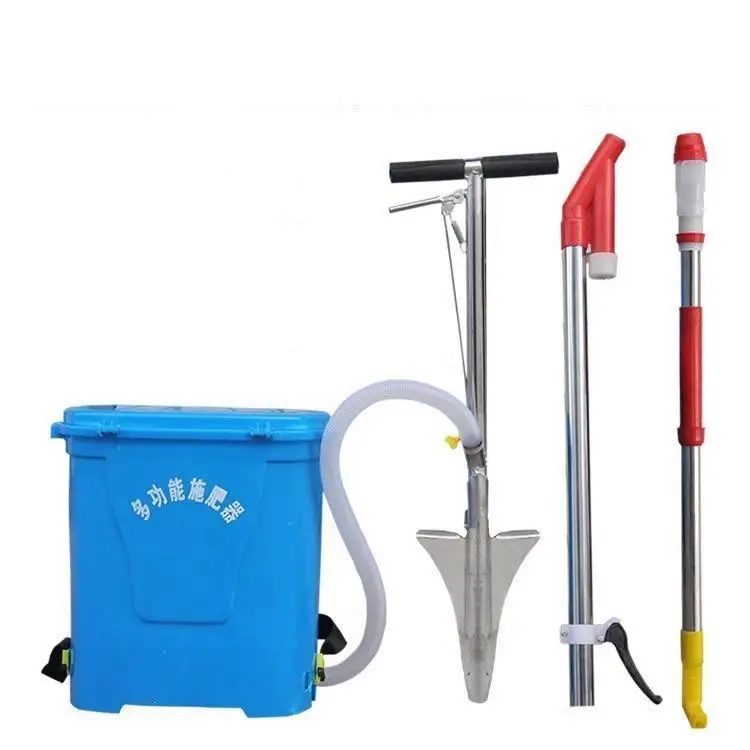
What this record actually tells a buyer
The Hoting queue carries Product ID 1601251652672 as a 25 litre agricultural fertilizer application machine for greenhouse use, described as a back type applicator for granular fertilizer, with a weight of 4.2 kilograms and a custom colour. Those four lines are the entire specification. Everything a buyer would need in order to compare this machine with another, or to work out whether one tank covers a day's planting, is absent from the parameter block.
Eight detail images accompany the record, and they carry considerably more information than the parameters do. Read together they identify a knapsack style applicator with a plastic barrel, a padded harness, a corrugated delivery hose and a hand held wand fitted with an injection foot, and they state three facts the parameter block omits: a filled weight, the barrel's outer dimensions, and the fact that the wand is offered in four different forms.
This guide takes those images as the primary evidence, states the arithmetic a buyer can run on the published numbers, and lists what still has to be obtained in writing before an order is placed.
The parameter block does not identify which machine is being sold
One image in the record is a product display page headed multi specification free choice, and it shows four wands against the same barrel:
| Variant as named on the image | Wand form | Tube material |
|---|---|---|
| Dotted stainless steel pipe | Straight rod with a top grip and a small dispensing tip | Stainless steel |
| Point PVC pipe | Straight rod with a top grip and a small dispensing tip | PVC |
| Handle stainless steel pipe | Rod with a trigger lever handle | Stainless steel |
| Handle PVC pipe | Rod with a trigger lever handle | PVC |
Nothing in the parameter block distinguishes these four. The record says only that the machine applies granular fertilizer and holds 25 litres, so a buyer cannot tell which wand is included, whether the price covers one wand or all four, or whether the barrel is the same in every variant. The photographs suggest the barrel is common to all four, and that only the wand changes, but that is an inference from images rather than a statement in the record.
The tube material is the part that changes how long the tool lasts. Granular fertilizer is abrasive and it carries moisture, and a stainless steel tube resists both abrasion from the granules and corrosion from a damp charge far better than a plastic tube. A PVC tube is lighter and cheaper, and it will be the first part to wear through or crack, particularly where it bends at the handle. For a machine that is used season after season on a hard mineral product, the stainless variant is the one to price first, and the plastic variant is the one to consider only if the tool is expected to be a consumable. Ask which material the quoted price covers, and ask the price of both, because the difference is the whole question.
One of the marketing pages in the record shows the wand with a mechanical trigger linkage running along the shaft and no motor, battery or pump anywhere in the eight images. Treat this as a manual applicator until the supplier states otherwise in writing, and if a pump assisted version exists in the same range, ask how it is identified so that the two are not confused in a quotation.
The weight line, and the number that matters more than it
The parameter block gives a weight of 4.2 kilograms. One of the detail images carries a label that reads 25L barrel ~ 22.5kg, together with barrel dimensions of 45 centimetres across and 46 centimetres high, a note that the barrel is made of thickened PVC, and a description of the harness as widened straps with a soft rubber back pad.
That label is ambiguous in a way that matters, because 22.5 kilograms can be read two ways and the two readings differ by the weight of the machine:
| Reading | What 22.5 kilograms covers | Weight of fertilizer in a full barrel | Implied bulk density of the product | Total load carried on the back |
|---|---|---|---|---|
| Loaded weight | Barrel, wand and fertilizer together | 22.5 minus 4.2, which is 18.3 kg | 18.3 divided by 25 litres, which is 0.732 kg per litre | about 22.5 kg |
| Product weight | 25 litres of fertilizer alone | 22.5 kg | 22.5 divided by 25 litres, which is 0.900 kg per litre | 22.5 plus 4.2, which is 26.7 kg |
The difference between the two readings is exactly the 4.2 kilograms of the machine, and it is not a cosmetic difference. An operator carries this load on the shoulders for the whole time it takes to empty the barrel, so 22.5 kilograms and 26.7 kilograms are two different jobs. The two readings also imply two different fertilizers: a bulk density of 0.732 kilograms per litre sits in the light end of the range for prilled nitrogen products, while 0.900 sits in the middle of the range for compound granules.
Ask the supplier to confirm whether 22.5 kilograms includes the machine, and ask for the bulk density of the product the figure was measured with. If the figure was measured with water, which is 1.000 kilograms per litre and therefore 25 kilograms for a full barrel, the label is simply a capacity statement and neither reading is right; that is the third possibility and the most likely explanation for a round number.
The 4.2 kilogram figure deserves one more comment. It is the number a buyer compares between machines and the number that appears in the quotation, but it is the least important of the three weights, because the operator carries the barrel and not the empty machine. A machine that is 1 kilogram heavier empty but 3 kilograms lighter full is the better machine, and only the barrel's own capacity and the product's density decide that.
How much fertilizer one tank holds, in kilograms
Twenty five litres is a volume, and fertilizer is bought and spread by weight, so the capacity has to be converted before it means anything. The conversion is one multiplication, and the density is the number the buyer must supply, because it varies between products and between batches by enough to change the answer:
| Bulk density of the fertilizer | Weight of product in a 25 litre barrel | Total carried, including 4.2 kg of machine |
|---|---|---|
| 0.60 kg per litre | 15.0 kg | 19.2 kg |
| 0.70 kg per litre | 17.5 kg | 21.7 kg |
| 0.80 kg per litre | 20.0 kg | 24.2 kg |
| 0.90 kg per litre | 22.5 kg | 26.7 kg |
| 1.00 kg per litre | 25.0 kg | 29.2 kg |
To find the density of the product actually being used, fill a one litre container level, weigh it, subtract the weight of the container, and multiply by twenty five. It is a two minute measurement that turns a volume specification into a usable load figure. Repeating the measurement on each new delivery is worthwhile, because a bulk density that drifts from 0.8 to 0.95 changes the load on the operator's back by nearly four kilograms and changes the amount of product delivered per stroke by the same proportion.
The barrel's geometry can be checked against the capacity in the same way. A barrel whose outer face measures 45 by 46 centimetres has a face area of 2,070 square centimetres, and 25 litres is 25,000 cubic centimetres, so the internal depth works out at about 12 centimetres. A barrel that slim, hanging flat against the operator's back, is consistent with the padded panel and the two straps shown in the image, and it also explains why the shape is a panel rather than a drum.
Calibration: the step that decides whether the machine does anything useful
A spot applicator delivers a dose at a point in the soil, so its output is defined in grams per application rather than in kilograms per hectare, and the conversion between the two is the calculation that decides whether the machine suits a farm at all. Two numbers are needed: the dose the applicator delivers at one trigger pull, and the number of points to be fertilized per hectare.
Measure the dose by the accumulation method rather than by trying to weigh one stroke. Weigh a quantity of the actual product, run the wand through a fixed number of strokes, release the trigger in the same way each time, and weigh how much left the barrel. Dividing the weight used by the number of strokes gives grams per stroke, and doing it over at least twenty strokes removes most of the error of a single measurement. If the wand has any adjustment, which the record does not say, run the test at each setting, because the settings are what the operator will use in the field.
Then convert to a per hectare rate. For a square planting grid, the number of points per hectare is ten thousand divided by the square of the spacing in metres, and the rate works out as follows:
| Plant spacing | Points per hectare | kg per hectare at a 10 g dose | kg per hectare at a 20 g dose | kg per hectare at a 30 g dose |
|---|---|---|---|---|
| 0.2 by 0.2 m | 250,000 | 2,500 kg | 5,000 kg | 7,500 kg |
| 0.3 by 0.3 m | 111,111 | 1,111 kg | 2,222 kg | 3,333 kg |
| 0.4 by 0.4 m | 62,500 | 625 kg | 1,250 kg | 1,875 kg |
| 0.5 by 0.5 m | 40,000 | 400 kg | 800 kg | 1,200 kg |
| 0.6 by 0.6 m | 27,778 | 278 kg | 556 kg | 833 kg |
| 0.8 by 0.8 m | 15,625 | 156 kg | 313 kg | 469 kg |
| 1.0 by 1.0 m | 10,000 | 100 kg | 200 kg | 300 kg |
The table is a warning as much as a calculation. A dose that seems modest in the hand becomes a very large rate on a tight spacing: twenty grams at 0.3 metre spacing is 2,222 kilograms per hectare, which is far above any normal recommendation, while the same twenty grams at one metre spacing is 200 kilograms per hectare, which sits inside the normal band for many field crops. The applicator's dose has to be chosen from the agronomic recommendation and the plant spacing, not from what feels like a sensible squeeze of the trigger.
The same arithmetic gives the tank's working capacity in a more useful unit than litres, the number of plants it fertilizes:
| Dose per stroke | Strokes per 25 litre barrel at 22.5 kg of product |
|---|---|
| 10 g | 2,250 strokes |
| 15 g | 1,500 strokes |
| 20 g | 1,125 strokes |
| 25 g | 900 strokes |
| 30 g | 750 strokes |
| 40 g | 563 strokes |
| 50 g | 450 strokes |
Read that table against the spacing table and the machine's real capacity becomes clear. At a 25 gram dose on a half metre grid, one barrel fertilizes 900 plants, and a hectare on that grid holds 40,000 plants, so a single barrel covers about 2.25 per cent of a hectare and a hectare takes about 44 barrels, which is roughly 990 kilograms of product. Each of those barrels also means a fresh 25 litre fill and another 22.5 to 26.7 kilograms lifted onto the shoulders, which is the part of the job the specification never mentions.
What the claims in the images mean, and what they leave open
The record's own images make four claims, and each of them describes a real mechanism, so it is worth separating the mechanism from the unstated measurement.
| Claim in the record's image | Mechanism behind it | What the record does not state |
|---|---|---|
| Effectively improve fertilizer utilization rate | Placing fertilizer below the surface instead of broadcasting it on top reduces losses, because surface applied nitrogen can be lost to the air and to run off before the roots reach it | The size of the improvement, the depth at which placement occurs, and the trial it was measured in |
| Deep fertilization, no root damage | A foot pushed into the soil beside the plant delivers product below the roots rather than through them | The insertion depth, the distance from the plant that the foot should be placed, and the soil conditions the claim holds for |
| Soft soil and hard ground, time saving and labour saving | The foot is driven by the operator's weight and arm rather than by a motor, so it works wherever a person can push it in | The force required, the maximum soil hardness the foot will enter, and whether a foot or a spare is supplied for stony ground |
| Multi specification free choice | Four wand variants are made against the same barrel | Which variant is quoted, whether all four cost the same, and whether the barrel differs between them |
The second row carries the most risk of the four. The distance from the stem matters as much as the depth, because placing a concentrated dose directly against the stem can injure the plant, and placing it too far away leaves it out of reach. The record gives neither number. Ask for the recommended offset from the plant and the recommended depth, and ask whether the foot has a depth mark, because without a mark the operator has no way to repeat yesterday's placement.
One further claim appears as a comparison page. It sets the applicator against two older methods, broadcasting granular fertilizer by hand from a bucket, which it labels uneven and wasteful, and opening a trench and pouring from a bag, which it labels time consuming and laborious. Both criticisms are fair. The page is marketing rather than specification, and it offers no measurement to support the improvement, so treat it as an explanation of why the tool exists rather than as evidence of how well it works.
The barrel, the harness and what is visible of the build
The dimension image shows the barrel from behind, and four features are legible. The body is described as thickened PVC. The two straps are described as widened. A green padded panel is clipped to the back of the barrel and described as a soft rubber back pad. The delivery hose leaves the bottom of the barrel through a fitting that carries a metal clip, and in the main product image the hose is a corrugated flexible tube, which is the right choice for a hose that has to follow a wand without kinking.
Those four features describe the parts that take the load. A padded panel against the operator's back and wide straps are the difference between carrying 22.5 kilograms comfortably and carrying it painfully, and they are worth checking physically on a sample because stitching and foam are the parts that fail first. Ask whether the pad is removable for cleaning, whether the straps are adjustable for a person wearing a jacket, and whether spare straps are available, because a broken strap ends the season for that machine.
The bottom hose fitting is the second wear point. It is the joint that flexes every time the wand is lifted, and it carries a clip in the image, so ask whether the fitting is a standard hose size that can be replaced locally or a proprietary part that has to be ordered from the supplier. The barrels in this class are also usually fitted with a filter screen at the outlet, which the record's text mentions in passing on one image, and a screen is what stops a single lump of damp product from blocking the wand; ask whether it is fitted and whether spare screens and seals are supplied.
What the record does not state
The parameter block contains four lines, so the list of missing figures is long. None of the following appears anywhere in the record or in its images:
- The granule size range the machine will meter, and whether it handles prilled and compound products equally well
- The dose per stroke, and whether the dose can be adjusted at all, and if so over what range and by what means
- The applied rate in grams per application that the machine is designed for
- The insertion depth of the foot, the offset from the plant, and the width of the disturbed soil
- The force needed to insert the foot, and the maximum soil hardness the machine is intended for
- The length of the wand, the length of the delivery hose, and the reach of the assembly in use
- The material of the hose and of the foot, and the wall thickness of the tube in the two wand materials
- Whether the dose mechanism is a plunger, a gate or a rotor, and what happens to the setting when the barrel is nearly empty
- The empty weight of the barrel alone, as distinct from the 4.2 kilogram figure, and the weight of the wand alone
- Whether the machine is manual or pump assisted, and whether any powered version exists in the range
- The colour options and the minimum order quantity for a custom colour, which the parameter block reduces to the single word customized
- Whether the barrel can be used with liquid or only with granular product, since one image describes the tool as multifunctional
- The packing method, the packed weight and the packed dimensions, and the number of units per carton
- The minimum order quantity, the price of a sample, and the price breaks
- The warranty period and what it covers, and the list of spare parts with their prices
- The country of origin documentation and any certificate the destination market requires for an agricultural implement
The item about liquid use is worth separating from the rest, because one of the images carries the description multifunctional on the barrel in Chinese characters, and a barrel that is offered for both dry and liquid use has different seals and a different outlet than one built for granules alone. If liquid use is intended, the seal material and the hose material both have to be confirmed as compatible, because a PVC hose and a barrel built for dry product may not hold a liquid charge without leaking at the bottom fitting.
Questions to put to the supplier before ordering
- Which of the four wands does the quoted price include, and what is the price of each of the four?
- Is the quoted wand tube stainless steel or PVC, and can both be supplied in the same order?
- Does the label reading 25 litre barrel about 22.5 kilograms mean the loaded weight including the machine, or the weight of 25 litres of product alone?
- What bulk density of product was that figure measured with, and was it measured with fertilizer or with water?
- Is the machine manual, and if a pump assisted version is available, how is it identified in a quotation?
- What is the dose delivered per stroke, and is the dose adjustable? Please state the range and the increments.
- What granule size range will the machine meter without bridging or blocking?
- What is the recommended insertion depth, and what is the recommended distance from the plant stem?
- What force is needed to insert the foot, and what is the hardest soil condition the machine is intended for?
- Can the barrel be used with liquid product, and if so what are the seals and the hose made of?
- Is a filter screen fitted at the outlet, and are spare screens, seals and hose clips supplied?
- What is the length of the wand and of the hose, and what is the reach of the assembly on the operator's back?
- Does the barrel have a lid seal, and does the lid stay closed when the barrel is carried at a working angle?
- What is the empty weight of the barrel alone, and the weight of the wand alone?
- What colours are available, and what is the minimum order quantity for a custom colour?
- What is the minimum order quantity for a standard colour, and what is the sample price?
- What are the packed weight and packed dimensions, and how many units go in a carton?
- What is the warranty, what does it cover, and what is the price list for spare parts?
- What documents are supplied for an agricultural implement, and what does the destination market require?
- What are the payment terms, the trade term and the production lead time for our quantity?
Questions one, two, three and six are the ones that decide whether a quotation can be compared at all. Without the wand variant the tube material is unknown, and without the weight basis and the dose per stroke the machine cannot be specified to a farm.
Incoming inspection when a machine arrives
- Weigh the machine as delivered and compare with the 4.2 kilogram figure, recording whether the wand and hose were included in the weight.
- Measure the barrel across and high, and compare with the 45 by 46 centimetre dimensions shown in the record's own image.
- Fill the barrel with water to the marked level and confirm the usable volume, remembering to subtract the weight of the empty barrel rather than trusting the moulded figure.
- Check the barrel material for impact damage and for thin sections, and check the lid for a seal and for a positive closing action.
- Weigh one litre of the fertilizer to be used, on the actual delivery, and calculate what a full barrel will weigh in product.
- Run at least twenty strokes into a container and weigh the output, to establish grams per stroke on the actual product rather than on a sample.
- Repeat the stroke test at the start, the middle and the end of a full barrel, because a gate or plunger that delivers a different dose as the barrel empties cannot be calibrated.
- Push the foot into soil of the type and condition it will work in, and record the effort required and the depth achieved.
- Confirm the offset from the plant stem that the foot actually achieves, and mark the shaft if a reference is needed for repeatability.
- Load the barrel with product, carry it for the length of a working pass, and check the straps and the pad for pressure points and for stitching that moves under load.
- Fill the barrel to the working level, cap it, and invert it with the wand closed to check whether the lid and the bottom fitting leak.
- Inspect the hose at both ends, flex it through its full range, and check the clips and the strain relief where the hose leaves the fitting.
- Check the wand tube material against the order, and check the wall thickness at the handle, which is where a plastic tube fails.
- Confirm the spare filter screen, the seals and the hose clips were supplied as ordered, and put them in one labelled bag with the machine.
Answers to the questions this record raises most often
Is this a broadcast spreader or a spot applicator?
It is a spot applicator. The images show a barrel carried on the back with a hose to a hand held wand fitted with an injection foot, and the fertilizer is placed at a point rather than broadcast over an area. That changes every downstream number, because the machine is calibrated in grams per application and not in kilograms per hectare.
How much does it weigh when full?
The record gives 4.2 kilograms empty and a barrel label reading 25 litre barrel about 22.5 kilograms. If 22.5 kilograms includes the machine, the product load is 18.3 kilograms and the total is 22.5. If it describes the product alone, the total is 26.7 kilograms. The supplier has to say which, and the bulk density of the product settles the rest.
How much fertilizer does one barrel spread?
It depends on the dose and the spacing, and the two together can be worked out from the tables above. At a 25 gram dose on a half metre grid, one barrel fertilizes about 900 plants, which is roughly 2.25 per cent of a hectare on that grid, so a hectare takes about 44 barrels, or around 990 kilograms of product.
Can the dose be adjusted?
The record does not say, and no adjustment control is legible in the images. Ask directly, and if it can be adjusted, ask for the range, the increments and a table of output per setting, because a dose mechanism that cannot be set and repeated is not a metering device.
Which wand should be ordered?
For sustained work on an abrasive granular product, the stainless steel tube in either the dotted or the handle form is the safer choice, and the handle form gives the operator a lever to work the foot into firm ground. The PVC variants are lighter and cheaper and are reasonable where the machine is expected to be replaced rather than maintained. Ask the price of all four before deciding, since the difference may be small.
Will one barrel last a day?
That is a question about the dose, the spacing and the area to be covered, not about the machine. Work out the number of plants to be fertilized, multiply by the dose, and divide by the weight the barrel holds on the density basis the supplier confirms. The result is the number of refills, and the number of refills is the number of times 22.5 to 26.7 kilograms is lifted onto the operator's back.
Is it suitable for greenhouse work?
The record describes it as a greenhouse fertilizer applicator and one image describes it as widely applicable across orchard and farmland. A spot applicator of this type suits beds and rows where the placement point can be chosen by hand. Ask whether the wand length suits the bed width in the house, and whether the low working height in a greenhouse creates a problem with a long wand in a narrow aisle.
What is not answered anywhere in the record?
The granule size range, the dose per stroke, whether the dose adjusts, the insertion depth, the offset from the plant, the wand and hose lengths, the empty weight of the barrel alone, the price, the minimum order quantity, the packing, the warranty, the spare parts list and the payment terms. None of those figures appears in the record or in any of its images.
Source, scope and what this guide does not claim
This guide is based on the Hoting queue record for Product ID 1601251652672, a 25 litre agricultural fertilizer application machine described as a back type applicator for granular fertilizer, weighing 4.2 kilograms, with a custom colour. The parameter block of that record contains those four lines and nothing else, so the weight of the machine, the capacity and the intended product are the only published figures.
Three further figures are taken from the record's own images rather than from its parameters, and each is identified as such in the text: the label reading 25 litre barrel about 22.5 kilograms, the barrel dimensions of 45 centimetres across and 46 centimetres high with a thickened PVC body, a widened strap harness and a soft rubber back pad, and the four wand variants named on the product display page as dotted stainless steel pipe, point PVC pipe, handle stainless steel pipe and handle PVC pipe. All eight detail images were examined. One of them is the same factory photograph that appears on other records from this supplier, and it carries a sign bearing the name of a trading company in Chinese characters, which identifies the company rather than this product.
Four passages are the author's arithmetic rather than published data, and are set out here so they are not mistaken for specifications. The two readings of the 22.5 kilogram label are derived by adding and subtracting the published 4.2 kilogram machine weight, and the bulk densities of 0.732 and 0.900 kilograms per litre are 25 litres divided into those two product weights. The internal depth of about 12 centimetres follows from dividing 25,000 cubic centimetres by the 2,070 square centimetre face derived from the stated 45 by 46 centimetres. The points per hectare column is ten thousand divided by the square of the spacing, and the kilograms per hectare columns are the dose in grams multiplied by the points per hectare and divided by one thousand. The strokes per barrel column is 22,500 grams divided by the dose in grams, and the statement that a hectare takes about 44 barrels at a 25 gram dose on a half metre grid follows from 40,000 points divided by 900.
Unless a figure appears in the lists above, it is not in this article because it is not in the record. This record states no granule size range, no dose per stroke, no adjustment range, no insertion depth, no offset from the plant, no wand length, no hose length, no barrel weight on its own, no material for the hose or the foot, no metering mechanism, no power source, no filter or seal details, no spare parts, no packing, no weight or dimensions when packed, no price, no minimum order quantity, no warranty, no certificate and no payment or delivery terms.
A buyer can settle the whole specification with four questions and one measurement: which wand variant and which tube material are quoted, whether the 22.5 kilogram label includes the machine, what the dose per stroke is and whether it can be set, and what one litre of the intended fertilizer weighs on the actual delivery. Everything else in this guide follows from those five answers, through the TEBAK sales inquiry channel.
Key specifications
- Capacity
- 25L
- Weight
- 4.2kg
- Use for
- granular fertilizer
- Color
- customized
- Barrel label on the record's own image
- 25L barrel ~ 22.5kg
- Barrel outer size on the record's own image
- 45cm across, 46cm high
- Barrel material on the record's own image
- thickened PVC
- Harness on the record's own image
- widened straps and a soft rubber back pad
- Wand variants shown on the record's own image
- dotted stainless steel pipe; point PVC pipe; handle stainless steel pipe; handle PVC pipe
- Power source
- none stated in the record and none visible in any of the eight images