
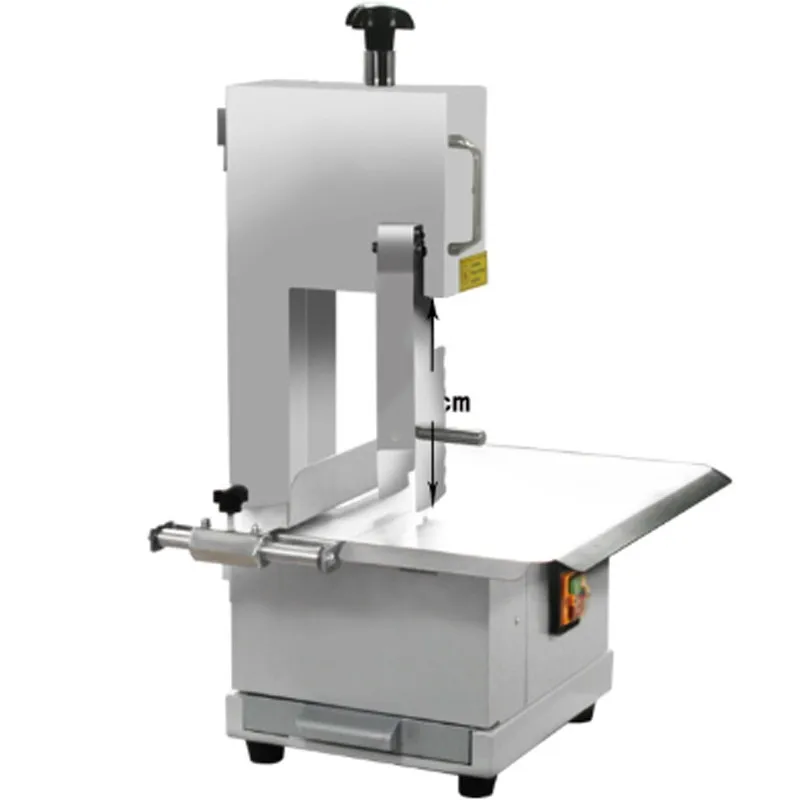
Source-controlled product identity
The Hoting queue identifies Product ID 1601251066042 as a TEBAK industrial 304 frozen meat processing electric saw for frozen or fresh chicken, beef, goat meat and bone cutting. The source contains five model rows with overall dimension, voltage, rated power and net weight.
The models recorded in the source are SJY-W120BC, SJY-W120A, SJY-F210A, SJY-F250A and SJY-F280A. This guide preserves the model-level values exactly as supplied and does not merge them into one generic specification.
The source does not provide cutting height, cutting width, blade length, tooth pitch, blade speed, material temperature limits, output, table size, food-contact declaration, safety guard design or certificates. These items must be confirmed for the selected model before purchase.
Recorded model specifications
| Model | Overall dimension (cm) | Voltage (V) | Rated power (kW) | Net weight (kg) |
|---|---|---|---|---|
| SJY-W120BC | 50*40*72 | 220 | 0.85 | 30 |
| SJY-W120A | 50*40*72 | 220 | 0.85 | 30 |
| SJY-F210A | 62*50.5*102 | 220 | 1.5 | 53 |
| SJY-F250A | 62*50.5*102 | 220 | 1.5 | 54 |
| SJY-F280A | 62*50.5*103 | 220 | 1.8 | 60 |
The source labels the range as an industrial 304 frozen meat processing saw, but it does not state whether every visible or wetted part is 304 stainless steel. Confirm the material schedule for the exact model and distinguish frame, table, guards, fasteners, blade guides and food-contact parts.
How to choose among the five models
Start with the recorded envelope and electrical data, then verify the actual cutting job. SJY-W120BC and SJY-W120A share the same listed dimensions, voltage, rated power and net weight: 50*40*72 cm, 220 V, 0.85 kW and 30 kg. Their functional difference is not defined in the source, so request a model comparison rather than assuming that the two rows are interchangeable.
SJY-F210A and SJY-F250A share the listed dimensions of 62*50.5*102 cm, voltage of 220 V and rated power of 1.5 kW. Their listed net weights differ: 53 kg for SJY-F210A and 54 kg for SJY-F250A. Request the drawing and cutting-envelope difference that justifies the model selection.
SJY-F280A is listed at 62*50.5*103 cm, 220 V, 1.8 kW and 60 kg. Its one-centimetre height difference and higher rated power should not be treated as a capacity guarantee. Confirm the blade, throat, worktable and cutting performance for the intended material.
Use Product ID 1601251066042 and the exact model code on the RFQ. Ask the supplier to identify which model is being quoted, whether the quoted dimensions include guards and handles, and whether the net weight excludes accessories, packaging and optional equipment.
Do not select a model based only on net weight or rated power. The correct choice depends on the largest product cross-section, cut thickness, frozen temperature, bone content, production schedule, operator workflow, installation access and sanitation requirements.
Define the cutting application
The source names frozen and fresh chicken, beef, goat meat and bone. These are different cutting conditions. Describe species, product form, frozen or chilled state, approximate temperature, density, bone content, dimensions, weight and required finished cut.
For chicken, state whether the machine will cut whole birds, portions, frozen blocks or bone-in sections. For beef and goat meat, provide the largest cross-section, bone hardness, fat content and whether the product is carcass, primal, portion or block.
For bone, describe the maximum cross-section and material condition. A bone-cutting requirement may place different loads on the blade and guides than a soft meat slicing task. Require a witnessed test cut using representative samples.
Specify the target cut: slices, portions, sections, blocks or irregular pieces. Include target thickness, tolerance, acceptable surface quality, maximum waste and whether repeated cuts must be held at a fixed dimension.
Request capacity only with test conditions. A meaningful capacity statement includes material type, temperature, dimensions, cut thickness, operator count, duty cycle, blade condition and acceptable yield. Do not compare a generic pieces-per-hour number between models.
Blade and saw-system information to confirm
The source does not identify blade length, width, thickness, tooth pitch, material, speed or tension. Ask whether the machine is a continuous band saw or another saw architecture, and request a labeled drawing of the blade path, wheels, guides, guards, table and drive.
For a band saw, request the blade specification, wheel diameter, tracking system, tension range, guide material, replacement method and approved tooth profiles for meat, fish or bone if those uses are planned. Confirm which blades are included with the quoted machine.
Request maximum cutting height, maximum cutting width, throat or table dimensions, workpiece support and feed method. None of these values are present in the source record, even though the five models have different listed overall dimensions.
Test blade tracking, tension retention, cut straightness, drift, vibration, tooth damage, surface finish and replacement time. Record results separately for frozen meat, fresh meat and bone.
Ask how the machine handles a stalled blade, broken blade, hard obstruction or product jam. Confirm containment of fragments, power isolation and the inspection required before restarting.
Electrical and installation planning
All five listed models show 220 V in the source. The source does not provide frequency, phase, current, plug, breaker, grounding or voltage tolerance. Confirm these values for the destination country and exact machine configuration.
Rated power is listed as 0.85 kW for SJY-W120BC and SJY-W120A, 1.5 kW for SJY-F210A and SJY-F250A, and 1.8 kW for SJY-F280A. Rated power is not the same as cutting capacity or energy consumption. Request motor model, duty cycle, overload protection, thermal protection and starting current.
Ask for a wiring diagram, emergency-stop circuit, control-panel protection and grounding method. Confirm whether the electrical enclosure is suitable for the planned washdown, condensation and cleaning environment.
Use the recorded overall dimensions for preliminary layout only. Confirm whether 50*40*72 cm, 62*50.5*102 cm and 62*50.5*103 cm include guards, protruding controls, handles and service access.
Plan space for product loading, operator movement, blade replacement, sanitation, maintenance and emergency access. Verify doorway clearance, floor loading, lifting points and final installation orientation before shipment.
304 stainless-steel and hygiene checks
The product title includes “304,” but the source does not provide a component-by-component material schedule. Request written confirmation of the stainless-steel grade for the frame, table, guards, exposed fasteners, blade guide area and other product-zone parts.
Ask which surfaces contact meat, bone or product residue. Confirm polymer, rubber, seal, lubricant and coating materials in the food zone. A 304 designation for one component does not prove that the complete machine is food-contact compliant.
Inspect welds, corners, fasteners, joints, drainage, table edges, blade guides and hard-to-reach areas. Avoid designs that retain residue, cleaning chemicals or standing water.
Request a cleaning and sanitation procedure stating permitted water pressure, water temperature, chemical concentration, contact time, drying method and lubrication points. Do not infer washdown suitability from a stainless appearance or the product title.
Define changeover controls if the same machine will process poultry, beef, goat meat and bone. Ask for the cleaning sequence, removable parts and inspection criteria before the next product is introduced.
Operator safety and guarding
A powered meat and bone saw presents cutting, entanglement, pinch, ejection and unexpected-start hazards. Confirm fixed and interlocked guards, blade access control, a reachable emergency stop and a defined jam-clearing procedure for the exact model.
Request guard dimensions, safe blade exposure, product clamps, push tools, anti-slip surfaces and operator position. Confirm whether two-hand control, presence sensing or other protective functions are included or optional.
Test the emergency stop during unloaded and controlled loaded conditions. Record blade run-down, stopping time, restart prevention, alarm behavior and reset requirements.
Request risk assessment, operating manual, maintenance manual and training material. PPE should support, not replace, guarding and safe operating procedures.
Confirm how the machine responds to blade breakage, loss of tension, stall, overload, overheating and hard obstruction. Request evidence that fragments are contained and that the machine cannot restart unexpectedly after power recovery.
Capacity, workflow and sanitation time
Request a capacity statement in kilograms per hour or pieces per hour with material, temperature, dimensions, cut thickness, operator count, active cutting time and planned pauses.
Clarify whether loading is manual, whether the product is clamped, how the feed is controlled and how cut pieces leave the table. If a model is described as suitable for automatic production, request the complete process diagram; the source does not state automation features.
Calculate practical capacity from available time, cutting time, loading, blade changes, cleaning, product changeover, jams and rework. Record the difference between theoretical motor operation and saleable output.
For frozen product, test the coldest expected condition. Record product temperature, dimensions, feed force, blade loading, cut thickness, surface quality and waste. Do not describe a model as capable of frozen cutting at a specific temperature unless the supplier test supports it.
Factory acceptance test
- Verify Product ID 1601251066042, exact model code and quoted configuration.
- Measure overall dimensions and confirm whether the recorded values include guards, handles and controls.
- Verify the model-level voltage, rated power and net weight against the specification table.
- Confirm frequency, phase, current, plug, breaker, grounding and wiring diagram for the destination.
- Identify saw architecture, blade type, blade dimensions, tooth pitch, speed, tension and guides.
- Measure maximum cutting height, width, throat, table dimensions, clearances and working envelope.
- Run representative frozen and fresh chicken, beef, goat meat and bone samples as applicable.
- Record material temperature, dimensions, cut thickness, tolerance, cycle time, waste and operator actions.
- Test blade tracking, straightness, drift, vibration, tooth damage, surface finish and replacement time.
- Test guards, interlocks, emergency stop, restart prevention, jam clearing and broken-blade response.
- Inspect stainless grades, weld finish, fasteners, food-contact materials, drainage and sanitation access.
- Measure electrical current, motor temperature, noise, vibration and stopping time during defined loads.
- Run the cleaning procedure and inspect for residue, standing water and inaccessible product zones.
- Verify manuals, risk assessment, training, maintenance schedule, spare parts and destination-market certificates.
- Attach test photos, measured results, serial number, samples and deviations to the purchase record.
RFQ checklist
- Product ID 1601251066042 and exact model: SJY-W120BC, SJY-W120A, SJY-F210A, SJY-F250A or SJY-F280A.
- Overall dimensions including guards, handles, controls and service clearances.
- Voltage, frequency, phase, current, rated power, motor model, breaker and grounding.
- Net weight definition and packed weight, dimensions, lifting points and shipping protection.
- Maximum cutting height, width, throat, table dimensions, feed method and product support.
- Blade type, length, width, thickness, tooth pitch, material, speed, tension and guide system.
- Material and temperature conditions for frozen and fresh chicken, beef, goat meat and bone.
- Guaranteed capacity with cut thickness, operator count, duty cycle, yield and test sample.
- Frame, table, guards, fasteners, blade guides and product-zone material grades.
- Food-contact declarations, cleaning method, washdown limits, drainage and lubricant requirements.
- Guards, interlocks, emergency stop, jam clearing, blade-break containment and restart prevention.
- Noise, vibration, operating temperature, condensation and frost limits.
- Accessories, push tools, clamps, spare blades, guides, bearings, belts and consumables.
- Installation, commissioning, training, warranty, service response and spare-parts lead time.
- Factory acceptance procedure using the buyer's representative products and temperatures.
Buyer decision framework
This listing provides useful model-level data for five electric saw configurations. It does not provide enough information to choose a model by capacity or cutting performance. Use the recorded dimensions, 220 V supply, rated power and net weight as the starting point for a supplier comparison.
Before commercial approval, obtain the exact model drawing, blade specification, cutting envelope, test-cut results, hygiene details, guarding, electrical documents and destination-market compliance records.
Compare models using verified cut quality, practical output, blade life, cleaning time, operator count, serviceability and total operating cost. Do not treat higher rated power or higher net weight as proof of better performance.
Frequently asked questions
Which models are listed?
The source lists SJY-W120BC, SJY-W120A, SJY-F210A, SJY-F250A and SJY-F280A.
What are the listed dimensions and power?
SJY-W120BC and SJY-W120A are listed as 50*40*72 cm and 0.85 kW. SJY-F210A and SJY-F250A are listed as 62*50.5*102 cm and 1.5 kW. SJY-F280A is listed as 62*50.5*103 cm and 1.8 kW.
What voltage is recorded?
All five model rows record 220 V. Frequency, phase, current and destination-market electrical details still require confirmation.
What are the listed net weights?
SJY-W120BC and SJY-W120A are listed at 30 kg, SJY-F210A at 53 kg, SJY-F250A at 54 kg and SJY-F280A at 60 kg.
Can every model cut frozen meat and bone?
The product title describes frozen meat and bone cutting, but model-specific cutting capacity and temperature limits are not supplied. Require representative test cuts for the selected model.
Is the whole machine 304 stainless steel?
The title includes 304, but the source does not provide a complete material schedule. Request written confirmation for every product-zone and exposed component.
Source and contact
This guide is based on the Hoting queue record for Product ID 1601251066042. The recorded model specifications are reproduced from the source record. Before purchase, request exact model drawings, cutting performance, blade data, electrical details, hygiene and safety documents, acceptance testing and warranty terms through the TEBAK sales inquiry channel.
Key specifications
- Specification
- Overall dimension(cm) | voltage(v) | Rated power(kw) | Net weight(kg)
- SJY-W120BC
- 50*40*72 | 220 | 0.85 | 30
- SJY-W120A
- 50*40*72 | 220 | 0.85 | 30
- SJY-F210A
- 62*50.5*102 | 220 | 1.5 | 53
- SJY-F250A
- 62*50.5*102 | 220 | 1.5 | 54
- SJY-F280A
- 62*50.5*103 | 220 | 1.8 | 60