
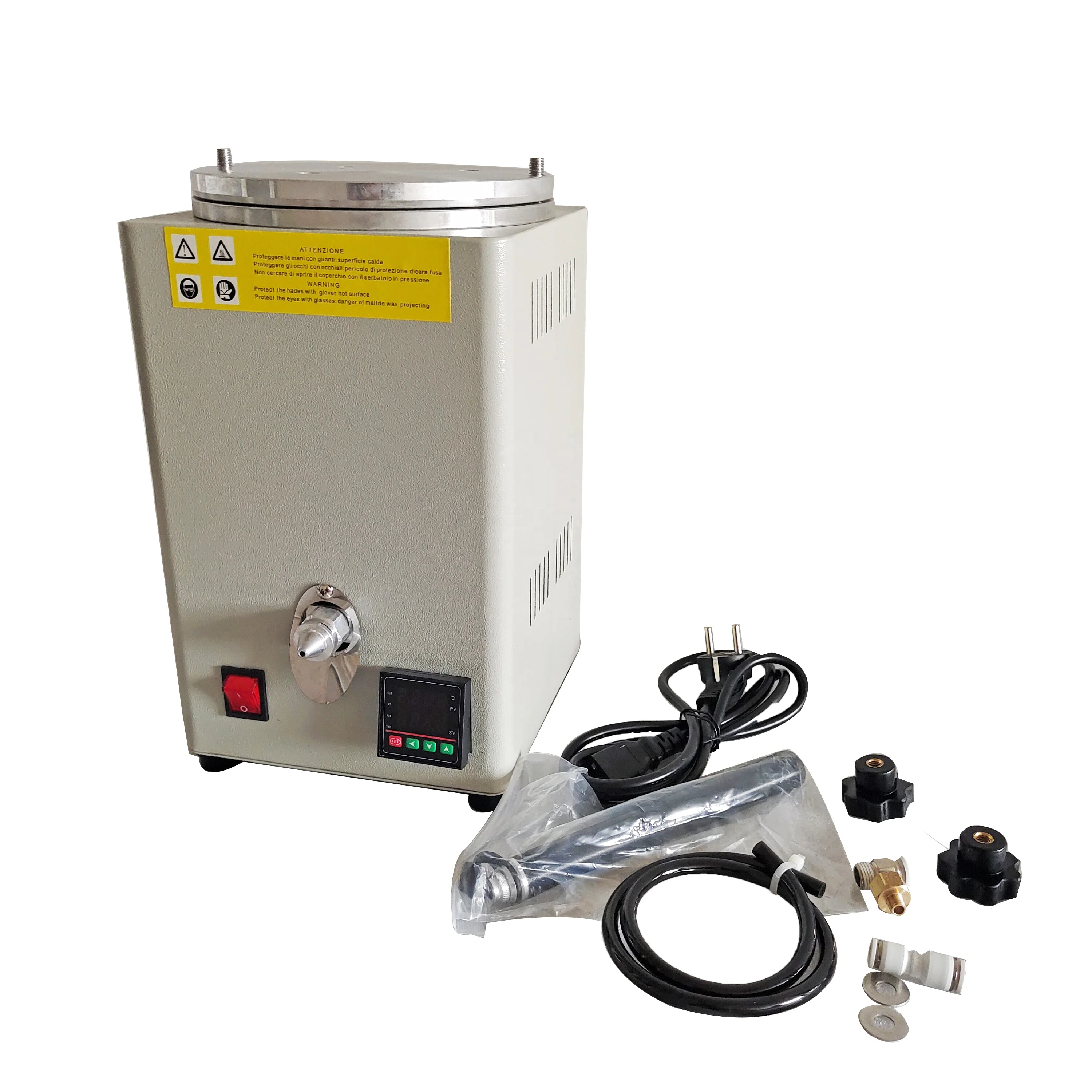
Source-controlled product identity
The Hoting queue identifies Product ID 1601255058989 as a TEBAK jewelry wax injection machine, listed as a 2/2.5kg and 2/2.5L machine rated 500W and fitted with a double nozzle, for jewelry wax injection work. The structured record supplies seven machine parameters: ejector force 10kN, theoretical shot volume 20cm³, injection rate 10g/s, injection weight 100g, machine weight 5.5kg, open stroke 100mm and power 0.5kW.
The title and the description text describe this equipment in three different ways. The title calls it a jewelry injection machine and a wax casting machine with double nozzle for wax injection. The description text opens with the phrases digital vacuum wax sprayer and small wax sprayer, then adds jewelry tools and automatic wax injection machine. A vacuum wax sprayer and a wax injection machine are not the same piece of equipment: an injection machine forces molten wax from a heated cylinder or tank into a closed mould under controlled pressure, while a sprayer applies a wax layer to a surface. The 500W rating and the recorded 0.5kW power field agree with a small heated injection unit, and the recorded ejector force, injection weight and open stroke all describe an injection machine. This guide therefore treats the record as a wax injection machine and flags the sprayer wording as unclarified, rather than merging the two.
The record contains no voltage, frequency, phase, heating power, wax melting temperature, temperature control accuracy, tank capacity in kilograms or litres, mould plate dimensions, injection pressure, cycle time, control type or air supply requirement. Those fields are treated below as confirmation items rather than assumptions.
This equipment category is used in jewelry workshops, casting houses, model shops and small production studios that inject wax patterns for investment casting, for rubber-mould and metal-mould wax pattern work, for sample and small-batch production, and for repair or replacement of broken wax patterns.
Recorded specification table
| Field | Recorded value |
|---|---|
| Source Product ID | 1601255058989 |
| Ejector Force | 10kN |
| Theoretical Shot Volume | 20cm³ |
| Injection Rate | 10g/s |
| Injection Weight | 100g |
| Machine Weight | 5.5kg |
| Open Stroke | 100mm |
| Power | 0.5kW |
These seven values are reproduced exactly as recorded, including the unit expressions as they appear in the source. They are not converted, rounded or reinterpreted.
Title claims that still need clarification
Four elements of the title are not represented anywhere in the structured parameter set, so each one must be confirmed before an order is placed.
2/2.5kg. The most natural reading is that two variants exist, one with a 2kg tank or wax capacity and one with a 2.5kg capacity. The record does not confirm this, does not state whether both variants are offered under the same product ID, and does not state the price difference. Ask which capacity is being quoted.
2/2.5L. A parallel litre figure appears in the same title. If the two figures refer to the same tank, the relationship between 2kg and 2L depends on the density of the wax actually used, so the two numbers are not interchangeable. Confirm whether the capacity is specified by mass, by volume, or both, and under what wax density the figure is quoted.
500W. This agrees with the recorded 0.5kW power field. Confirm whether the figure is total installed power, heating power only, or motor power only, because on an injection machine the heater is usually the dominant load and the figure quoted sometimes covers only part of the machine.
Double nozzle. No nozzle parameter appears in the record. Ask for the number of nozzles, the nozzle orifice diameter, the nozzle spacing or centre distance, whether the nozzles can be used independently or only together, whether each nozzle has its own temperature control, and what the second nozzle is intended to add. On a small unit a second nozzle may exist to reach two mould positions, to feed a single large mould from two points, or to allow different wax colours to be kept available, and those uses imply different setups.
Injection weight against stated capacity
The recorded injection weight is 100g, while the title refers to 2kg and 2.5kg. These are different quantities and should not be confused with each other.
Injection weight describes the mass of wax that the machine can deliver into a mould in one shot. Capacity describes how much wax the machine can hold in its reservoir or tank. A machine that holds several kilograms of wax may still deliver a shot of only a fraction of that amount, and that is normal, because the shot size is limited by the injection cylinder, the plunger stroke and the pressure the machine can develop.
For the buyer, the practical consequence is that the 100g shot figure is the number that matters for mould size. A wax pattern or a multi-cavity mould tree that needs more than 100g in a single shot will require a larger machine or will have to be injected in stages, and the supplier should state plainly which of those two approaches applies. The theoretical shot volume of 20cm³ should be read together with the injection weight of 100g, and the buyer should confirm the wax density at which the theoretical volume figure was calculated, because 20cm³ corresponds to roughly 19 to 20g of typical jewellery wax rather than to 100g.
Ask the supplier to reconcile the 20cm³ theoretical shot volume, the 100g injection weight and the 10g/s injection rate in a single written statement so that the three figures can be used together for mould planning. Until that reconciliation is provided, the numbers should be used only as a rough indication of machine class.
Ejector force, open stroke and mould handling
The recorded ejector force is 10kN and the open stroke is 100mm. Together these describe the machine's ability to separate the mould halves and push the finished wax pattern out.
Ejector force has to be sufficient to open the mould without distorting the pattern, and on jewellery moulds the force requirement depends on the mould type, the mould size, the number of cavities and how much flash has formed between the plates. Ask the supplier what mould sizes and mould types the 10kN figure was intended for.
The 100mm open stroke limits the height of the mould that can be loaded and the height of the mould tree that can be injected. Ask for the maximum mould height, the maximum and minimum mould thickness, and the plate or mounting dimensions, none of which are recorded. Buyers who already own moulds should send the mould dimensions to the supplier and ask for a written statement that the moulds fit.
Confirm also whether the machine is supplied with a mould clamp, a locating plate or any standard mounting interface, and whether the ejector mechanism is adjustable in both travel and force.
Wax compatibility and thermal control
The record provides no wax melting temperature, no temperature control accuracy and no heater power figure, so the thermal capability of the machine is entirely unverified. This matters more than almost any other specification for jewellery wax work.
Different waxes used in jewellery pattern making melt and flow at different temperatures, and a machine that is adequate for a low-melting carving wax may not be suitable for a harder injection wax used for rubber-mould production. The RFQ should therefore state the exact wax or wax family the buyer uses, its recommended injection temperature range, and its recommended mould temperature, and should ask the supplier to confirm that the machine can hold the required temperature within a stated tolerance.
Ask for the temperature control method, whether by a thermostat with a dial, by a digital controller with a setpoint and display, or by a programmable cycle, and for the resolution and the accuracy of the control. Ask whether the nozzle, the cylinder and the tank have separate heating zones or share one heater, because a machine with a single heater cannot maintain a temperature gradient and may inject wax that is hotter or colder than the mould requires.
Ask also how the wax is kept from solidifying between cycles, whether the machine has a standby or idle temperature mode, and what the warm-up time is from cold to working temperature. None of these values appear in the record.
Electrical supply and site requirements
The record lists the machine power as 0.5kW but provides no voltage, frequency or phase. Every one of those must be confirmed in writing.
Ask for the supply voltage, frequency and phase, the current draw at the stated supply, the plug and cable standard, the earthing requirement and the protection arrangement. Where the machine will be used in a country whose supply differs from the supplier's default, request the nameplate photograph for the exact configuration being ordered, because a small machine of this type is often built in a fixed voltage variant rather than a selectable one.
Ask whether the machine needs a compressed air supply in addition to electricity, since some wax injection machines use air for clamping or assist functions and others do not. The record does not say. If air is required, request the working pressure and the consumption figure, and treat the compressor as a separate item in the budget.
Confirm the working environment requirements: ambient temperature range, ventilation or fume extraction recommendations for molten wax, and any surface or bench requirement. At 5.5kg the machine is light enough to place on a workbench, so confirm the bench footprint including clearance for the mould, the wax feed and the operator's hands.
RFQ checklist
- Exact model and the product ID 1601255058989, with a photograph of the machine nameplate.
- Written confirmation of whether the unit is supplied as a 2kg variant, a 2.5kg variant, or both.
- Confirmation of whether capacity is stated by mass, by volume, or both, and the wax density assumed.
- Reconciliation of the 20cm³ theoretical shot volume, the 100g injection weight and the 10g/s injection rate.
- Whether the 0.5kW figure is total installed power, heating power or motor power.
- Number of nozzles, orifice diameter, spacing, independent operation and separate temperature control per nozzle.
- Maximum mould height, thickness range and mounting or plate dimensions.
- Mould clamp, locating plate and ejector adjustment details.
- Recommended wax types, injection temperature range and mould temperature range.
- Heater power, temperature control method, control accuracy and whether heating zones are separate.
- Warm-up time, standby mode and behaviour when the machine idles between cycles.
- Supply voltage, frequency, phase, current, plug standard, earthing and protection class.
- Whether a compressed air supply is required, and if so the pressure and consumption figures.
- Machine dimensions and bench footprint, which are not recorded.
- Ventilation or fume extraction requirements for molten wax.
- Included accessories, moulds if any, tools, spare parts and consumables, and what is priced separately.
- Operating manual language, wiring diagram and recommended maintenance schedule.
- Certification and conformity documents applicable to the destination market.
- MOQ, sample or trial terms, unit price at the target quantity, lead time, packing and shipping terms.
- Warranty period, service response time and the price of the most likely wearing parts.
Acceptance and factory tests
Because the record leaves the thermal and mould-related specifications open, the trial is the only reliable way to confirm that the machine suits the buyer's work. Agree the test in writing before the order is placed.
Ask the supplier to inject a wax pattern using the buyer's own wax and, where possible, the buyer's own mould. Record the temperature setpoint, the actual temperatures reached at the tank, the cylinder and the nozzle, the injection pressure or cycle setting used, and the number of shots attempted.
Inspect the injected patterns for complete fill, surface finish, porosity, flashing, short shots and distortion, and record how many acceptable patterns were produced from the sample run. Where the buyer's wax is not available, ask which wax was used in the test and obtain its data sheet, so the result can be compared with the buyer's own material.
Verify the ejector force in practice by opening a representative mould and confirming that the pattern is released without deformation. Check the open stroke against the buyer's tallest mould. Confirm that the nozzles can be operated as intended and that each one reaches its set temperature.
Run the machine long enough to observe whether temperature stability holds during repeated cycles, and record the ambient temperature during the test. Verify the machine nameplate against the ordered electrical specification, check the earthing and the protection arrangement, and record the serial number so that the delivered unit can be compared with the tested one.
Packaging, shipping and after-sales
The record contains no packing data. Request the packed dimensions and packed weight, the packing method, and whether the nozzles and any loose accessories are packed separately and protected against transit damage.
Ask what documentation travels with the shipment, including the operating manual, the wiring diagram, the spare-parts list and the recommended maintenance schedule, and confirm the language of the supplied documents.
Confirm the warranty period, what is covered and what is excluded, the response time for technical questions, whether remote support is available, and the lead time and price for the most likely replacement parts, which on an injection machine are typically the heater, the temperature controller, the nozzle assembly and the seals.
Buyer decision framework
The source confirms a compact TEBAK jewellery wax injection machine of 5.5kg with a recorded ejector force of 10kN, a theoretical shot volume of 20cm³, an injection rate of 10g/s, an injection weight of 100g, an open stroke of 100mm and a power rating of 0.5kW, offered under a title that refers to 2kg and 2.5kg capacities and a double nozzle.
The purchase decision rests on five written answers. Which capacity variant is being quoted, and whether it is stated by mass or by volume. How the three recorded shot figures relate to each other and what mould size they support. Whether the buyer's own moulds fit within the 100mm open stroke and the unstated mould thickness limits. Whether the machine can hold the buyer's wax at the required temperature with a stated accuracy, and whether the heating zones are independent. And what electrical supply and any air supply the machine requires on site.
A supplier who answers all five in writing and who injects a pattern with the buyer's own wax and mould is offering something considerably more useful than a lower price on an open specification. Where those answers cannot be obtained, the buyer should plan for a trial purchase and verify the machine on arrival rather than committing to production capacity in advance.
Frequently asked questions
Is this a wax injection machine or a wax sprayer?
The title and the recorded parameters describe a wax injection machine: heated reservoir, controlled injection, ejector force of 10kN and an open stroke of 100mm. The description text also uses the words wax sprayer, which does not match an injection machine. Ask the supplier to clarify which equipment is actually being sold under this product ID.
Is the capacity 2kg or 2.5kg?
The title lists both. Confirm which variant is quoted, whether both are available under the same product ID, and whether the figure refers to wax mass, tank volume, or something else.
Does the 100g injection weight mean the machine can only inject 100g?
The recorded injection weight is 100g per shot. That is the practical limit for a single shot, and it is a different quantity from the 2kg or 2.5kg capacity figure. Confirm how the supplier intends the 100g, the 20cm³ and the 10g/s figures to be read together.
What waxes can it use?
The record does not state a wax type or a temperature range. Give the supplier the exact wax being used and ask for a written confirmation of the recommended injection temperature and mould temperature, and of the temperature accuracy the machine can hold.
What mould size will fit?
The record gives a 100mm open stroke but no maximum mould height, thickness range or plate dimensions. Send your mould dimensions to the supplier and ask for a written confirmation that they fit.
What is the double nozzle for?
The record does not describe the nozzle arrangement. Ask for the number of nozzles, the orifice diameter, the spacing, whether they operate independently, and whether each has separate temperature control.
What electrical supply is required?
The record states 0.5kW but no voltage, frequency or phase. Confirm the supply, the current draw, the plug standard and the earthing requirement, and ask whether a compressed air supply is also needed.
Source and contact
This guide is based on the Hoting queue record for Product ID 1601255058989. It reproduces the seven recorded parameters exactly, including the unit expressions as supplied, and it keeps the injection-machine reading separate from the wax sprayer wording in the description rather than merging the two into a single claim.
Request the capacity clarification, the shot-figure reconciliation, the nozzle specification, the temperature and heater data, the mould limits, the electrical and air requirements, the drawings and the trial results through the TEBAK sales inquiry channel before placing an order.
Key specifications
- Source Product ID
- 1601255058989
- Ejector Force(kN)
- 10kN
- Theoretical Shot Volume(cm³)
- 20cm³
- Injection Rate (g/s)
- 10g/s
- Injection Weight (g)
- 100g
- Weight (KG)
- 5.5kg
- Open Stroke(mm)
- 100mm
- Power (kW)
- 0.5kW