
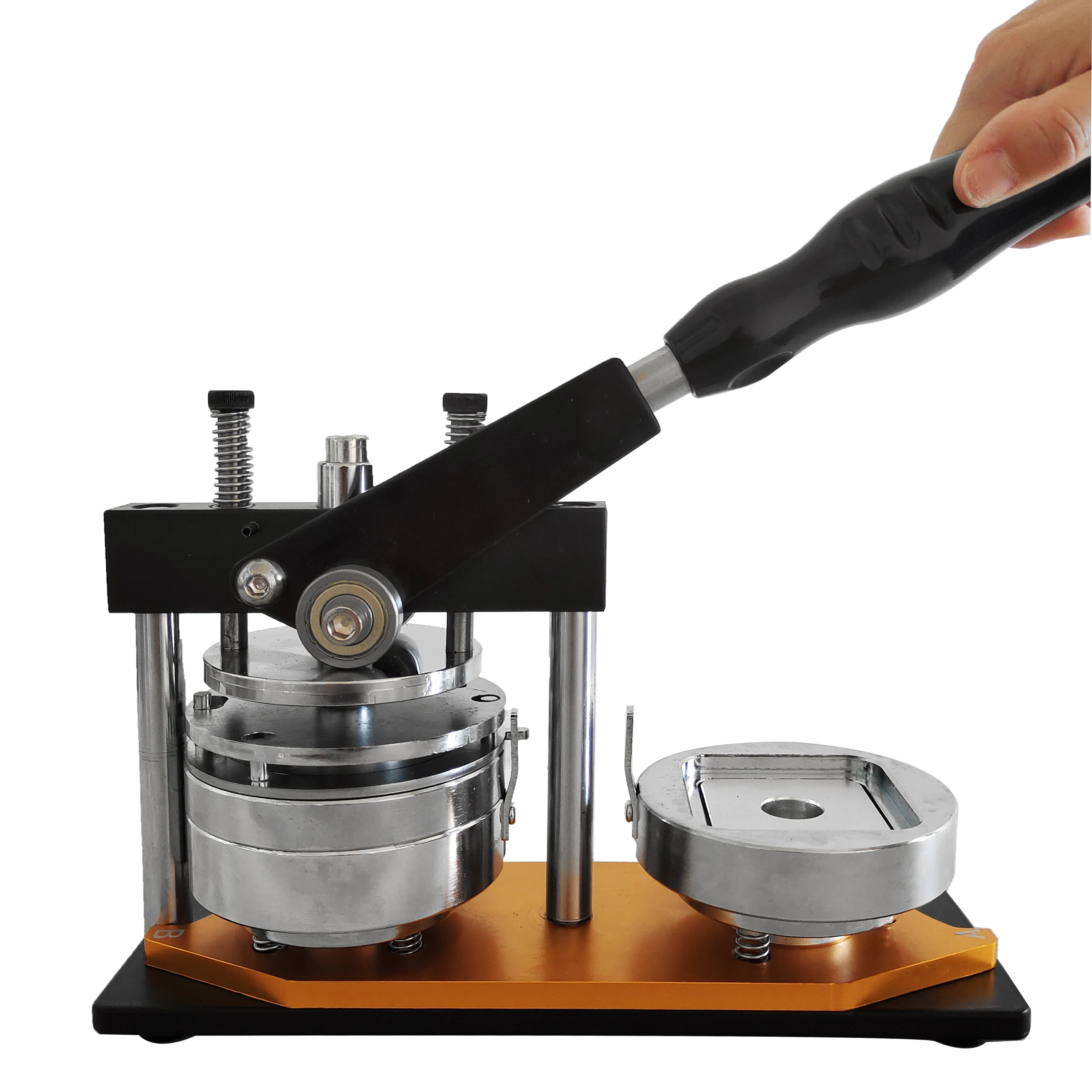
Source-controlled product identity
The Hoting queue identifies Product ID 1601245466462 as a manual do-it-yourself kit listed under the title "TEBAK Manual DIY Rectangle 50*50MM Square Badge Machine Fridge Magnet Machine Kit with 1000 Magnetic Components and Paper Cutter".
This is a kit rather than a single machine. The recorded description lists three groups of contents, and the recorded parameter block carries only packaging data. There is no machine specification, no die specification, no throughput figure and no materials breakdown in the record. The article below therefore reproduces what the record states, separates the badge reading of the title from the fridge magnet reading, and marks every technical value as a question for the supplier.
What the record actually states
| Item | Recorded value | Status |
|---|---|---|
| Kit contents, item 1 | one magnet making machine, size 50*50mm | Recorded description |
| Kit contents, item 2 | one paper cutter, size 50*50mm | Recorded description |
| Kit contents, item 3 | 1000pcs magnet components, stated as metal shells, magnet, cardboard and mylar, to make 1000 fridge magnets | Recorded description |
| Selling unit | single item | Recorded parameter |
| Package size | 40 x 16 x 29 cm | Recorded parameter |
| Gross weight | 30 KG | Recorded parameter |
| Machine dimensions and net weight | not stated | Missing |
| Die size, die type and interchangeability | not stated | Missing |
| Throughput and cycle time | not stated | Missing |
| Magnet specification and materials breakdown | not stated | Missing |
| Spare parts and consumables reorder data | not stated | Missing |
The record's company profile describes the supplier as a professional supplier of product machines, CNC carbide inserts and turning and milling tools under the TEBAK brand, with customers across several regions and quality control standards stated as based on ISO9001 certifications. That profile is written for an industrial tooling business, which is worth noting: a craft kit of this type sits well outside that described product range, so the buyer should confirm that the supplier actually stocks and supports the kit rather than acting as an intermediary for it.
Badge machine or fridge magnet machine: the title's central ambiguity
The title contains both descriptions. It calls the product a "Square Badge Machine" and, in the same phrase, a "Fridge Magnet Machine Kit". Those are two different products that share a press body but not a consumable system.
A badge machine, also called a button machine, presses a printed graphic between a transparent cover and a metal front shell, then crimps a back part carrying a pin, a clip or a keyring. A fridge magnet machine presses a printed graphic between a transparent mylar film and a metal shell, then attaches a magnetic back, and the record's own contents list names the consumables as metal shells, magnet, cardboard and mylar, which is the magnet system.
The contents list and the consumables named in the record point to the fridge magnet reading, and the phrase "1000 Magnetic Components ... to make 1000 fridge magnets" reinforces it. The words "Badge Machine" in the title are therefore most likely a category or keyword use rather than a description of the die fitted.
This matters commercially because dies are usually not interchangeable across the two systems, and the consumables are not interchangeable at all. Before ordering, ask the supplier to state in writing what die or dies are fitted to the machine as shipped, whether the same press accepts badge dies and magnet dies, and whether the die is designed for the 50 by 50 mm square magnet format named in the title. Ask for a photograph of the die or dies included in the kit, since a photograph settles the question faster than a description.
The 1000-piece component set: what to break down
The record states that the kit includes 1000 pieces of magnet components described as metal shells, magnet, cardboard and mylar, enough to make 1000 fridge magnets. One figure is given for four different component types, and that is not enough to plan a production run.
Ask the supplier for a component breakdown in numbers rather than categories: how many metal shells, how many magnets, how many cardboard inserts and how many mylar covers, and whether the count is 1000 of each or 1000 total. Ask whether the quantities are exactly matched to produce 1000 finished magnets with no spares, because a set with no spares means any damaged component during learning or production reduces the finished output below 1000.
Ask also for the material specification of each component. For the metal shell, ask for the material and the plating or coating, its external dimensions and its depth, and whether the surface is supplied plain for printing or pre-printed. For the magnet, ask whether it is a ferrite or a rare-earth magnet, its thickness, its holding force and whether it is supplied as a full-area sheet or as a smaller magnet bonded to the shell, because the strength and the cost of the finished product both depend on that choice. For the mylar cover, ask for the thickness and whether it is clear or has a finish. For the cardboard insert, ask for the thickness and its size relative to the 50 by 50 mm format, since an insert that is undersized produces a loose graphic and a visible ring.
Finally, ask for the consumables reorder terms: the price of each component at the volumes likely to be reordered, the minimum reorder quantity, the lead time, and whether the reorder components are identical to those supplied in the kit or from a different production batch, because a change in shell depth or magnet thickness between batches changes the pressing result and the buyer's graphic tolerances.
Manual operation: throughput before price
The title describes the machine as manual, and no cycle time is recorded. On a manual press the practical question is not the price of the kit but how many finished magnets per hour a single operator can produce, because that figure divided into the order volume determines the labour cost of the buyer's own product.
Ask the supplier for the stated cycle time per piece, the force required at the handle or lever, and the operator position between loading, pressing and unloading. Ask whether the machine requires one or two pressing actions per magnet, which is common on machines of this type where the shell and the graphic are crimped in one stroke and the magnet is attached in a second, or where a single stroke completes the unit.
Ask whether a bench clamp or a permanent mounting is required, because a manual press that moves during operation slows an operator down more than any specification suggests. Ask whether the machine can be operated one-handed, leaving the second hand free for loading, and whether the die can be changed without tools and how long a change takes, since a kit sold for production use is often also sold for mixed short runs.
Ask finally what maintenance is required, whether any part of the press is treated as a wearing part, and whether a repair or spare parts service exists, since an imported manual press with a deformed die and no spare supply becomes scrap.
The paper cutter described as 50 by 50 mm
The second item in the kit is described as a paper cutter with a size of 50 by 50 mm. On a cutter, a 50 by 50 mm figure most plausibly describes the cut format rather than the machine, so the record does not say what kind of cutter is supplied.
Two very different tools fit that description. One is a die-based punch that cuts a 50 by 50 mm square from a sheet in a single press or lever action, which is fast and produces a consistent size. The other is a guillotine or trimmer with a sliding or lever blade, which cuts a straight line and requires the operator to cut four sides to produce a square, which is slower and produces a less consistent result.
Ask the supplier which type is supplied, what the cutting capacity is in sheets per action and in maximum sheet thickness, what blade or die type is used, and whether replacement blades or dies are available and at what price. Ask whether the cutter matches the 50 by 50 mm format of the press die exactly, because a cutter that produces a graphic 1 mm larger or smaller than the die opening changes how the finished magnet looks at the edge.
Ask also what the intended graphic material is. Photographic paper, coated stock, adhesive-backed stock and laminated sheets behave differently in a cutter, and the buyer's chosen graphic material determines whether the supplied cutter is adequate.
Packed size and the 30 kg gross weight: an arithmetic check worth doing
The record gives a single package size of 40 by 16 by 29 cm and a single gross weight of 30 KG. Those two figures are consistent with each other less obviously than they first appear, so it is worth doing the arithmetic before the freight is quoted.
The stated carton volume is 40 x 16 x 29 cm, which is 18,560 cubic centimetres, or roughly 0.0186 cubic metres. A gross weight of 30 kg in that volume gives a packed density of about 1.6 grams per cubic centimetre, which is substantially denser than water and much denser than typical packed machinery, which usually falls in a far lower band. The two figures are not impossible, since a compact manual press with a heavy die could in principle reach that density, but the combination is unusual enough that the buyer should confirm both figures rather than assume one of them.
Ask the supplier to confirm the gross weight for a single kit and to state the net weight of the machine separately, so that the two figures can be checked against each other. If the gross weight turns out to be materially lower, the freight and the delivered cost change; if it is correct, it is worth asking how the weight is distributed, because a 30 kg kit in a small carton is a handling risk for the courier network and for the buyer's own receiving staff.
Note also that the package size is the packed carton, not the machine. No machine dimensions are recorded, so the buyer cannot yet plan a bench footprint or a storage location from this record. Ask for the machine's own length, width, height and weight, and for the dimensions of the die and the cutter separately, since those are the parts that determine the working area.
Certification, documentation and the statement in the company profile
The record contains no certification information for the kit. The company profile states that quality control standards are based on ISO9001 certifications, without a certificate number, an issuing body or a scope. If documentation matters for the purchase, ask for the certificate document and check whether it covers this product or only the wider company operation, and treat a company-level statement as background rather than as a product guarantee.
Ask what documentation ships with the kit: assembly and operating instructions, a parts list, a die fitting and changeover guide, and a consumables specification sheet listing the shell, magnet, mylar and cardboard dimensions. That last document is the one that lets the buyer reorder components from a second source if needed, and it is the document most often missing from kits of this kind.
Missing information to request before ordering
- Written statement of whether the machine is a badge press, a fridge magnet press, or both, and which die or dies are fitted as shipped.
- Photograph of the die or dies included in the kit.
- Die format confirmation: whether it produces the 50 by 50 mm square named in the title, and the finished external dimensions of the magnet.
- Whether the same press accepts badge dies and magnet dies, and the price of each additional die.
- Machine dimensions, machine net weight and bench footprint.
- Manual operation cycle time per finished magnet, and the number of pressing actions per unit.
- Force required at the handle, and whether bench mounting or clamping is needed.
- Die changeover time and whether tools are required.
- Paper cutter type: die punch or guillotine trimmer.
- Cutting capacity in sheets per action, maximum material thickness, and blade or die replacement parts and prices.
- Component breakdown in numbers: shells, magnets, cardboard and mylar, and whether each is 1000 or 1000 total.
- Whether the component set includes spares or is exactly matched to 1000 finished units.
- Metal shell material, plating or coating, external dimensions and depth, and whether supplied plain or pre-printed.
- Magnet type, thickness, holding force, and whether supplied as a full sheet or a bonded piece.
- Mylar thickness and finish, and cardboard thickness and size relative to the die format.
- Consumables reorder price per component, minimum reorder quantity, lead time and whether components are from an identical production batch.
- Recommended graphic materials and any materials the die cannot handle.
- Maintenance requirements, wearing parts and spare parts availability.
- Assembly and operating instructions, parts list, die changeover guide and component specification sheet, with the language of each document.
- Certification documents held for this product, and whether any apply to the kit itself.
- Confirmation of the single-kit gross weight and the separately stated machine net weight.
- Carton dimensions, carton count, packing method and whether the press is protected against die damage in transit.
- MOQ, unit price at the target quantity, sample or trial kit terms, lead time and shipping terms.
- Warranty period, what is covered, and the price and lead time of the most likely replacement parts.
Acceptance and incoming inspection
Because the record carries no machine or die specification, the purchase order should be built from the supplier's written answers and the delivered kit checked against those answers.
Begin with a count check against the written contents list: the press, the cutter, and the 1000 components broken down by type. Count the components rather than accepting the label, because on kit products the consumable count is the most common shortfall. Inspect the metal shells for dents and deformation, inspect the mylar for creasing and scratches, and check the magnets for chipping and for consistent thickness within the batch.
Inspect the press for damage to the die, since a die is the most easily damaged part in transit. Check the handle or lever for smooth travel through the full stroke and check that the die aligns with the press base without side load. Confirm that the installed die is the format ordered, and measure it rather than trusting the marking.
Then run a production test of at least twenty units using the buyer's own graphic material. Measure the finished magnet, check that the graphic sits square in the shell with even margins on all four sides, check that the mylar is not creased or trapped, and check that the magnet holds the finished piece against the intended surface with the intended load. Record the material, the operator and the cycle time achieved, and compare that cycle time with the figure quoted by the supplier, because a kit that takes twice as long per piece as quoted changes the buyer's production plan.
Test the cutter on the same material and check that the cut size matches the die opening, and measure the squareness of the cut, since a cutter that produces a parallelogram is difficult to detect from a sample photograph but obvious in a finished magnet. Finally, confirm that the documentation listed above is present in the carton.
Buyer decision framework
The source confirms a manual kit containing a pressing machine and a paper cutter, both described at 50 by 50 mm, together with 1000 magnet components described as metal shells, magnet, cardboard and mylar, packed as a single item in a 40 by 16 by 29 cm carton with a gross weight of 30 KG.
This kit suits a buyer who produces small runs of square fridge magnets, whether for souvenirs, corporate gifts, retail own-brand ranges or craft sales, and who wants a low capital entry into producing them in house rather than buying finished magnets. It is a starter kit rather than a production line, and the decision should be made on three written answers.
First, what the machine and its die actually are, since the title describes both a badge machine and a fridge magnet machine and the consumables in the record point to the magnet system. Second, what the throughput is, because on a manual press the labour cost per finished magnet matters more than the kit price and no cycle time is recorded. Third, what the consumables cost to reorder and in what minimum quantity, because the economics of the buyer's own product depend on the component price and availability far more than on the one-off price of the kit.
Where those answers can be obtained in writing, with a photograph of the die and a component specification sheet, the kit is a reasonable entry into this product category, and a single sample kit should be bought and tested before any volume order. Where the supplier cannot state the die format or the component specification, the buyer is effectively buying an unlabelled kit whose consumables cannot be reliably reordered, and should treat the purchase as a sample rather than as a supply decision.
Frequently asked questions
Is this a badge machine or a fridge magnet machine?
The title calls it both. The contents list names the consumables as metal shells, magnet, cardboard and mylar and describes making fridge magnets, which points to the magnet system. Ask which die is fitted as shipped and request a photograph of the die before ordering.
Are 1000 components enough for 1000 magnets, with no spares?
That is how the record reads, with a single figure of 1000 covering four different component types. Ask for the quantities broken down by type and ask whether any spares are included, because a component set with no spares cannot deliver 1000 finished units once any piece is damaged.
How fast can one person produce magnets with this kit?
No cycle time is recorded. Ask for the stated cycle time per finished magnet and the number of pressing actions per unit, then verify it during the sample test, since on a manual press throughput drives the labour cost of the buyer's product.
Does the cutter cut a 50 by 50 mm square in one action?
The record describes a paper cutter of 50 by 50 mm without saying what type. A die punch cuts the square in one action while a trimmer cuts one side at a time. Ask which is supplied, what the cut capacity is, and whether replacement blades or dies are available.
Why does the 30 kg gross weight need checking?
A 30 kg gross weight in a 40 by 16 by 29 cm carton corresponds to a packed density of roughly 1.6 grams per cubic centimetre, which is high for packed machinery. The figures are not impossible but they are unusual together, so ask the supplier to confirm the gross weight and to state the machine net weight separately.
Can I reorder consumables separately?
Ask for the price of each component at reorder volumes, the minimum reorder quantity, the lead time, and whether reorders match the components supplied in the kit. Ask also for a component specification sheet, which is what allows the buyer to source components elsewhere if needed.
Do I get instructions with the kit?
The record does not say. Ask for assembly and operating instructions, a parts list, a die changeover guide and a component specification sheet, and confirm the language of each document.
Can the same machine also make badges?
Not established by the record. Ask whether the press accepts badge dies as well as magnet dies, what each additional die costs, and how long a die change takes, before assuming the kit can serve both product lines.
Source and contact
This guide is based on the Hoting queue record for Product ID 1601245466462. The record states the kit contents in a short description and carries only three packaging parameters, so this guide quotes those phrases and figures directly and marks every machine, die, throughput and materials value as a question for the supplier. The badge reading and the fridge magnet reading of the title are kept separate rather than merged, and the arithmetic check on the packed size and gross weight is presented as a question to confirm rather than as a defect.
Request the die clarification, the component breakdown by type and quantity, the cycle time and bench requirements, the cutter type and capacity, the machine net weight, the consumables reorder terms and the documentation list through the TEBAK sales inquiry channel before placing an order.
Key specifications
- Selling Units
- Single item
- Single package size
- 40X16X29 cm
- Single gross weight
- 30KG