
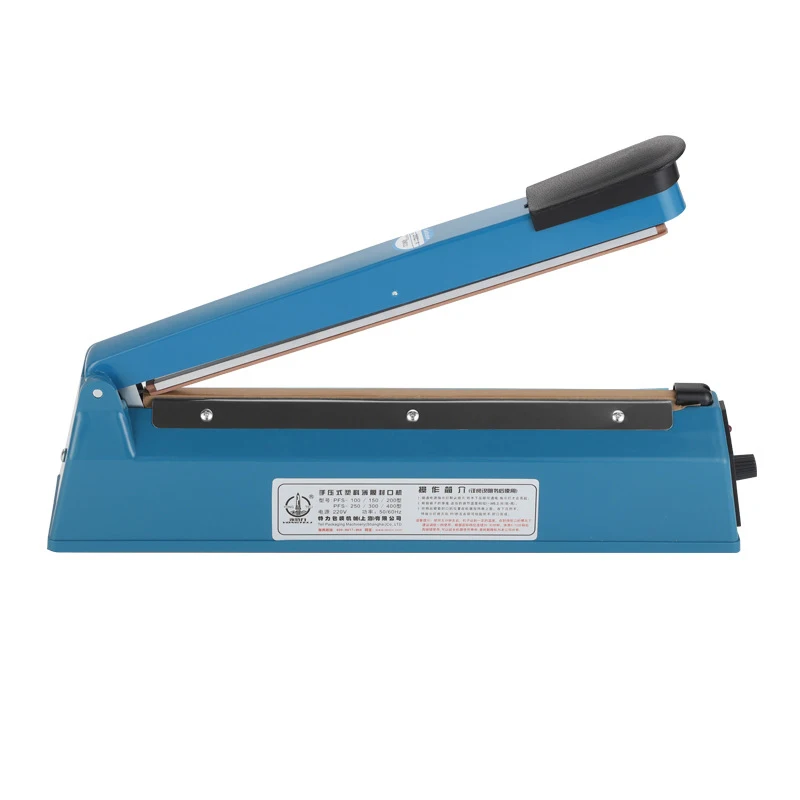
What the source record confirms
The TEBAK product record identifies a manual hand sealing machine for food packing and plastic bags. Its source specification lists “50/60HZ” under Rated power, sealing thickness written as “45 wires,” 8 adjustable heating gears, a product size of 40*14.5cm, seal mode as “Press manually,” product voltage of 220V and weight of 1.68kg.
This guide preserves the source wording instead of correcting ambiguous fields by assumption. “50/60HZ” is retained as supplied and is not rewritten as a wattage value. “45 wires” is also retained as supplied and is not converted into millimetres. Ask the supplier to define both fields on the quotation and nameplate before purchase.
The product title mentions thermal shock sealing, hand sealing, heat sealing and impulse heat sealing. These terms describe the product listing language, but the queue does not provide sealing-bar temperature, heating time, bag-material compatibility, wattage, sealing width, throughput, controller type, certification or warranty. Those values require model-specific confirmation.
1. Product identity and procurement boundary
Keep the RFQ tied to the TEBAK hand sealing machine, product ID 1601251673095. Ask the supplier to place the product ID, model or configuration code on the quotation, product label, packing list, manual and pre-shipment photographs.
The queue describes the machine as a food-packing manual plastic-bag heat sealer. It does not establish food-contact compliance, the type of food being packed, the bag film structure or the accepted package format. Confirm the actual bag material and the required seal quality with a sample test.
Do not assume that every plastic bag can be sealed with the same heat setting. Request the approved film families, thickness range, laminate structure, coating and maximum seal width for the exact unit.
Request a complete configuration list: sealing machine body, heating element, sealing strip, controller or timer, power cord, spare parts, tools and manual. If the supplier offers different bar lengths, heating elements or voltage versions, record the selected option in the purchase order.
The source company profile contains TEBAK brand and company-level promotional wording. Those statements do not establish model-specific electrical certification, food-contact suitability, sealing performance, warranty or destination-market compliance. Request documents for the exact delivered configuration.
2. Confirmed source specifications
| Field | Source value | Procurement treatment |
|---|---|---|
| Product ID | 1601251673095 | Match the quotation, label, packing list and shipment documents. |
| Product name | hand sealing machine | Confirm the exact model and sealing-bar configuration. |
| Rated power field | 50/60HZ | Preserve the source wording; ask the supplier to provide actual wattage and confirm whether this field means frequency. |
| Sealing thickness | 45 wires | Preserve the source wording; ask for the defined unit, film basis and supported material range. |
| Heating gear | 8 adjustable | Confirm the control method, temperature relationship, timer behavior and repeatability of each setting. |
| Product size | 40*14.5cm | Confirm measurement order and whether this is overall body size or sealing length and width. |
| Seal mode | Press manually | Confirm operator action, sealing cycle, pressure method and safety requirements. |
| Product voltage | 220V | Confirm frequency, current, plug, cable, grounding and destination-market wiring. |
| Weight | 1.68kg | Confirm whether this is net machine weight and request packed gross weight separately. |
The source list contains both “Rated power: 50/60HZ” and “Product voltage: 220V.” These are not enough to establish electrical power consumption. Ask for a nameplate photograph showing voltage, frequency, current and wattage.
3. Define the sealing application
Before ordering, send the supplier the bag material, film thickness, laminate structure, bag width, bag opening, product type and required seal appearance. A heat sealer should be selected against the actual film and package rather than the product title alone.
Confirm whether the buyer will seal polyethylene, polypropylene, laminated film, coated paper, foil laminate or another structure. The source does not provide a material list or compatibility chart.
Define the bag dimensions and the distance from the product to the seal. Confirm whether the 40*14.5cm source field refers to the overall machine, the sealing bar, the working area or another dimension.
Ask for a cross-section or photograph of the finished seal. Record acceptable seal width, continuity, appearance, peel behavior, leakage resistance and maximum allowable wrinkles for the buyer's package.
For food packing, define whether the seal is only a closure or part of a validated packaging process. Do not claim shelf life, hermeticity, food safety or contamination control without a product-specific test and applicable documentation.
Ask whether the operator must remove crumbs, powder, oil or moisture from the bag mouth before sealing. Define a preparation step in the work instruction if contamination affects seal quality.
Confirm whether the machine is intended for intermittent manual operation. The source identifies manual pressing but provides no cycle time, daily duty, heating recovery time or recommended operating schedule.
4. Heating gear and temperature control
The source lists “8 adjustable” heating gears. Ask the supplier to define what each gear represents: a temperature level, a heating-time level, a power setting or a combined control.
Request the temperature range, temperature measurement point, heating response, dwell-time behavior and recovery after repeated seals. Do not convert gear numbers into temperatures without model-specific evidence.
Confirm whether the machine has a timer, thermostat, electronic controller, indicator light or only a manual heat setting. Record each included control in the quotation.
Ask for a setting chart using the buyer's film. If a chart is supplied, require the test film, thickness, bag width, pressure, heating time and cooling time to be identified.
Define the acceptable heat-affected zone. Excess heat can deform film, while insufficient heat can create an incomplete seal. Request sample evidence at low, middle and high heating settings.
Confirm whether the operator must maintain the handle or press bar for a defined time and whether the machine has a cooling or hold stage. The source only states “Press manually,” so the complete cycle remains to be confirmed.
Ask how the heating element and sealing strip are replaced. Request part numbers, access procedure and safe isolation instructions before maintenance.
Do not claim that the eight gears provide eight calibrated temperature points. Treat them as adjustable source-listed settings until the supplier provides their meaning and repeatability.
5. Sealing thickness field and film definition
The queue records sealing thickness as “45 wires.” This wording is ambiguous. Preserve it in the RFQ and ask the supplier to state the intended unit, decimal format and measurement basis.
Request a drawing or specification sheet that defines the minimum and maximum film thickness, whether the value refers to one layer or combined layers, and whether laminated films are included.
Ask the supplier to provide the original source table or nameplate for the “45 wires” field. Do not rewrite it as 45 microns, 0.45mm or another unit without evidence.
Test the thinnest and thickest buyer-approved bags. Record the film construction, number of layers, heat setting, press duration, cooling time and seal result.
Confirm whether the bag mouth must be flat and aligned across the full sealing length. Ask how the machine handles folded, gusseted, printed, metallized or coated film.
Define allowable seal offset and wrinkles. A nominal thickness field does not prove that a bag can be sealed with a particular fold, gusset or contamination condition.
Ask whether the heating strip is replaceable and whether replacement parts differ by sealing-bar length or film family. Record the part number for the selected configuration.
6. Manual pressing and operator workflow
Because the source lists “Press manually,” document the operator workflow before purchase. Confirm how the bag is positioned, how the opening is held, how the press bar is closed, how the seal cycle ends and how the bag is removed.
Ask for the handle or press-bar travel, required hand force, opening clearance and safe hand position. The source provides no ergonomic or safety dimensions.
Confirm whether the operator must keep pressure applied during heating and cooling. Ask whether a timer, latch, spring return or other mechanism is included.
Request a sample video with the buyer's bag size. The video should show loading, alignment, pressing, release and the finished seal without hiding the operator's hand position.
For repetitive packing, measure the actual operator cycle in a controlled test. Do not publish or promise throughput because the queue provides no cycle-time or production-capacity field.
Ask whether the machine can be used by left-handed and right-handed operators, and whether the working height can be integrated into the buyer's packing table. These are installation questions, not confirmed product features.
Define the training steps for heat setting, seal inspection, jam or film misalignment, cleaning and shutdown. Keep the work instruction tied to the exact model and voltage.
7. Electrical planning and verification
The product voltage is listed as 220V, while the rated-power field is written as 50/60HZ. Confirm the complete nameplate: voltage, frequency, phase, current, wattage, plug type, cable length and grounding method.
Ask whether 50/60HZ is an operating-frequency requirement, a catalog field, or a mistaken label. Do not assume that a 220V unit is compatible with both frequencies without written confirmation.
Request the electrical diagram and the location of the power switch, indicator, fuse, controller and heating element. Confirm whether the machine includes overload protection or thermal protection.
Ask how the machine behaves after a power interruption. Confirm restart behavior, heating-state recovery and operator reset requirements.
For export orders, specify destination plug, cable standard, language of labels and manual, grounding requirements and any required inspection or declaration document.
Do not infer wattage from the eight heating gears, product size or weight. Actual power consumption must come from the nameplate or test record.
Require the supplier to identify the electrical configuration in pre-shipment photographs. Match the photograph to the product ID, quotation and packing list.
8. Dimensions, sealing length and workstation fit
The source lists product size as 40*14.5cm. Confirm the order of the dimensions and define the reference points. Ask whether this is overall machine size, sealing bar size, working surface or another catalog measurement.
Request a dimensioned drawing showing sealing length, usable bag clearance, handle travel, base footprint, cable exit, service access and operator clearance. The source does not provide these separate values.
Confirm the maximum bag opening that can be placed across the sealing area. Do not assume that a 40cm product-size field means a 40cm usable sealing length.
Ask whether the machine needs a flat, heat-resistant, grounded or otherwise specified support surface. Request installation instructions for the exact configuration.
Confirm the machine's net weight and packed weight. The source lists 1.68kg, but it does not define whether this includes accessories, cable, packaging or a particular option.
Plan safe cable routing and a clear hand area. Keep the power cord away from the heated sealing zone and provide access for cleaning and strip replacement.
For a packing line, confirm whether the machine can be moved between stations or needs a fixed location. Do not infer portability requirements solely from the 1.68kg field.
9. Seal quality and acceptance criteria
The queue provides no seal-strength, leakage, temperature, cycle-time or repeatability values. Define those acceptance criteria with the supplier before ordering.
Use the buyer's actual bags and product conditions for a sample test. Record film material, film thickness as defined by the supplier, bag width, heating gear, press duration, cooling time and operator method.
Inspect seal continuity along the full usable length. Check for gaps, channels, burn-through, wrinkles, film distortion, contamination and incomplete bonding.
Define the test method for peel strength or leak resistance when the package requires it. The source does not provide a standard, so the buyer and supplier must agree on the method and pass level.
Test at least the selected low, middle and high heating settings. Record the actual gear number and avoid describing it as a temperature unless the supplier provides a calibrated temperature reference.
Repeat the test across multiple bags to observe variation. Do not use one visually acceptable sample to claim repeatability.
Inspect the first and last seals in a continuous session. Heating recovery, operator fatigue and film contamination can affect results, but the source record provides no production-capacity evidence.
Require a signed acceptance sheet that identifies the product ID, bag material, settings and test results. Keep photographs of the nameplate and finished samples.
10. Cleaning, maintenance and spare parts
Request the cleaning method for the sealing surface, heating element cover, sealing strip, support surface and handle. Confirm whether the machine must be cool and disconnected before cleaning.
Ask which cleaning agents and tools are approved. Do not use a solvent, abrasive or wet method unless the supplier confirms compatibility with the machine and electrical parts.
Request maintenance intervals for the heating strip, PTFE or insulating cover if present, timer or controller, spring, hinge, switch and power cable. These component names are procurement questions, not claims that every part is included.
Ask for replacement part numbers and lead times for the heating element and sealing strip. Confirm whether parts vary by 40*14.5cm source size, voltage or configuration.
Define how the operator identifies a worn strip, uneven heat, damaged insulation, loose connection or inconsistent seal. Request troubleshooting instructions tied to the exact model.
Ask whether the 1.68kg weight includes removable parts and whether spare parts are included in the quoted package. Record all accessories in the packing list.
Do not claim a warranty period, service response time or spare-parts stock unless the supplier provides written terms for product ID 1601251673095.
11. Food-packing and compliance checks
The source title uses food packing wording, but it does not provide food-contact, hygiene, electrical, EMC or destination-market certification. Ask the supplier which documents apply to the exact model and configuration.
Confirm whether any machine surface, sealing strip, cover or accessory contacts the package or material. Request material information for the relevant part rather than assuming food-contact suitability.
Define the buyer's hygiene procedure, cleaning frequency, protected storage and inspection record. These are process requirements and should not be presented as confirmed machine features.
Ask whether the machine is intended for direct production use, a packing room, a clean area or another environment. The product record does not provide an environmental rating.
Confirm electrical grounding, insulation and local safety requirements for the destination. A 220V listing alone is not proof of compliance with every market.
Request current model-specific declarations, test records and manuals if the buyer's market requires them. Do not substitute company-level ISO9001 wording for product-specific documentation.
For products with oils, powders, moisture or residues near the seal, define the contamination-control method and acceptance test. A clean visual seal is not the same as a validated food package.
12. Packaging and export checks
Request packing photographs showing the sealer, power cord, heating components, spare parts, tools, manual and labels. Match the packed contents to the quotation.
Confirm package dimensions, net weight and gross weight. The source only lists a 1.68kg product weight and does not provide logistics values.
Protect the pressing arm, sealing strip and heating surface from impact. Ask how the supplier immobilizes the press mechanism and protects the power cord during transport.
Confirm the destination plug and cable labeling before shipment. Ask whether adapters are included or whether the buyer must specify a replacement cord.
Request a pre-shipment video showing the nameplate, voltage, frequency field, heating gear adjustment, manual pressing cycle and a sample seal with the selected bag.
For international shipment, request the packing list, commercial identification, manual language and any destination-market documents required by the buyer's broker or safety team.
13. Pre-shipment acceptance test
Confirm product ID 1601251673095, hand sealing machine identity, product voltage of 220V and the exact included accessories.
Photograph the nameplate and clarify the source “50/60HZ” rated-power field. Record actual voltage, frequency, current and wattage from the supplier's document or test.
Clarify “45 wires” in writing and record the supplier's defined unit, film basis and supported sealing-thickness range.
Test the eight adjustable heating gears with the buyer's representative bag. Record what each gear controls and the resulting seal quality.
Verify the 40*14.5cm source size and distinguish overall machine size from usable sealing length. Record the dimensioned drawing reference.
Run manual pressing cycles and inspect handle movement, safe hand clearance, heat indication, release behavior and any abnormal heating.
Repeat seals on the selected bag at approved settings. Record continuity, appearance, contamination tolerance and the agreed strength or leak result.
Confirm 1.68kg net or product weight and record packed gross weight separately. Photograph the product, accessories and packing.
Resolve any discrepancy between the quotation, nameplate, sample test and packing list before shipment.
14. RFQ checklist
- Confirm product ID 1601251673095 and exact hand sealing machine configuration.
- Define the bag material, film structure, bag opening, package contents and required seal appearance.
- Clarify what “50/60HZ” means and provide actual wattage, current, frequency and nameplate data.
- Clarify the unit and measurement basis for “45 wires”; do not convert it without written evidence.
- Confirm what the 8 adjustable heating gears control and request a setting chart.
- Define 40*14.5cm as overall size, sealing length or another source measurement.
- Confirm manual press travel, cycle, hold time, release method and operator safety.
- Confirm 220V frequency, phase, plug, cable, grounding, protection and destination-market wiring.
- Provide usable sealing length, bag clearance, footprint and maintenance access drawing.
- Provide seal-quality acceptance criteria, test method, sample material and repeat-test requirements.
- Provide heating element, sealing strip, insulation, controller and spare-part specifications.
- Provide cleaning, maintenance, troubleshooting, warranty and service terms for the exact model.
- Provide food-packing documentation only if the exact machine configuration has such evidence.
- Confirm 1.68kg net/product weight, packed gross weight, package dimensions and shipping marks.
- Provide included accessories, manual language, product label and pre-shipment test records.
15. Questions for the supplier
What does the source field “Rated power: 50/60HZ” mean? Please provide the actual wattage, current, frequency, phase and nameplate photograph.
What unit and measurement basis does “Sealing thickness: 45 wires” use? Please provide the supported film range and original specification sheet.
What does each of the 8 adjustable heating gears control: temperature, time, power or a combined setting?
Does 40*14.5cm describe the overall body, sealing bar, usable sealing length or another dimension? Please provide a drawing.
Which bag materials, laminate structures and film thicknesses were used in your sealing test?
What are the manual pressing cycle, hold time, cooling time, operator hand position and safe-release instructions?
What are the actual voltage, frequency, current, wattage, plug, cable, grounding and protection details for the 220V version?
What sealing width, seal strength, leak result, repeatability and test method can you document with the buyer's representative bags?
Which heating elements, sealing strips, insulation parts and spare components are included and available?
What model-specific electrical, food-packing, safety, warranty and destination-market documents are supplied?
16. What not to assume
Do not treat “50/60HZ” as a wattage value. The source labels it under rated power but does not provide actual power consumption.
Do not convert “45 wires” into microns, millimetres or another thickness unit. Obtain the supplier's definition first.
Do not treat 8 heating gears as eight calibrated temperature values. Confirm the control logic and test each selected setting.
Do not treat 40*14.5cm as a 40cm usable sealing length without a dimensioned drawing.
Do not infer bag-material compatibility, seal strength, throughput, temperature range, timer behavior or production capacity from the listing title.
Do not claim food-contact compliance, CE, warranty, insulation class, EMC performance or another certification without model-specific evidence.
17. Final procurement decision
The TEBAK hand sealing machine has a source-defined baseline for a manual plastic-bag heat-sealing application: 8 adjustable heating gears, 40*14.5cm product-size wording, manual pressing, 220V product voltage and 1.68kg weight. The source also lists “50/60HZ” under rated power and “45 wires” as sealing thickness; both fields require definition before a purchase order is finalized.
Proceed only after the supplier identifies the electrical configuration, film-thickness unit, usable sealing length, heating-control meaning, accepted bag materials, seal-quality test method and model-specific documentation. A buyer-specific sample test should be completed before shipment.
Editor's note: This guide uses the supplied Hoting queue fields only. It preserves the ambiguous source labels and does not add unsupported power, temperature, material, certification, warranty, throughput or food-safety claims.
Key specifications
- Product name
- hand sealing machine
- Rated power field
- 50/60HZ
- Sealing thickness
- 45 wires
- Heating gear
- 8 adjustable
- Product size
- 40*14.5cm
- Seal mode
- Press manually
- Product voltage
- 220V
- Weight
- 1.68kg
Frequently asked questions
- What heating control is listed?
- The source lists 8 adjustable heating gears. Confirm whether each gear controls temperature, heating time, power or a combined setting.
- What does 45 wires mean?
- The source lists sealing thickness as 45 wires without a defined unit. Preserve the wording and ask the supplier for the measurement basis and supported film range.
- What is the product voltage?
- The source lists 220V. Confirm frequency, current, actual wattage, plug, grounding and destination-market wiring.
- What does 50/60HZ mean?
- The source places 50/60HZ under Rated power, but that does not establish wattage. Request the actual nameplate and electrical specification.
- Is this suitable for food packing?
- The title uses food-packing wording. Confirm the bag material, seal requirements and any model-specific food-contact or destination-market documents before ordering.