
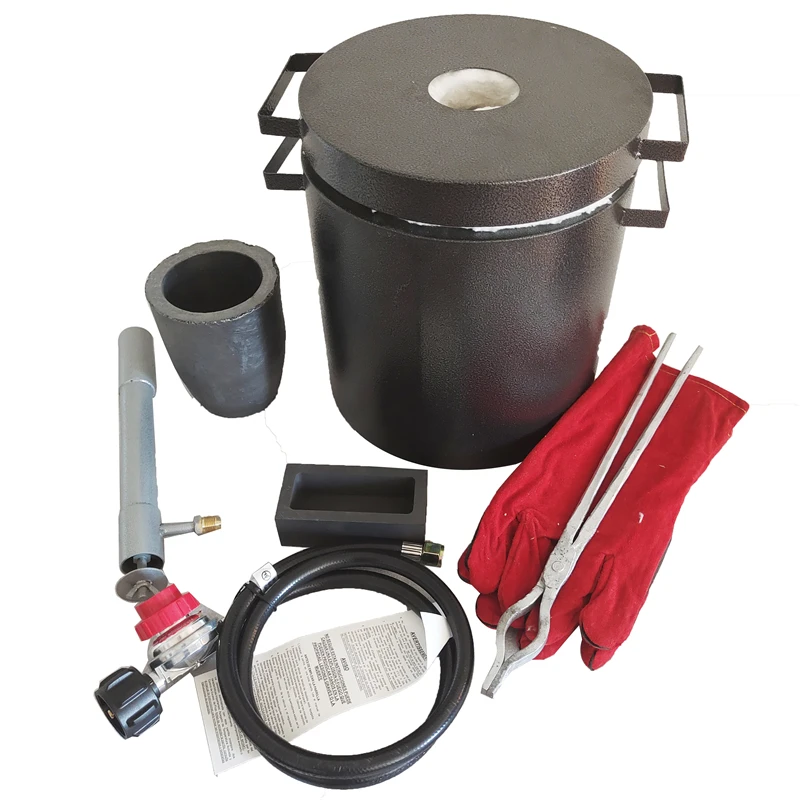
Source-controlled product identity
The Hoting queue identifies Product ID 1601251077878 as a TEBAK high-temperature mini small melting furnace for tin, silver, copper, aluminium and gold applications. The source description calls it a mini digital electric gold melting furnace and also uses the phrase “melting gas gold melting furnace.” That wording must be clarified before an RFQ is finalized.
The structured fields list the type as “Refractory,” the application as “Melting Meta,” the composition as “High Pure,” and the place of origin as China. Height, top diameter and bottom diameter are all listed as “Customers' requirements.”
This record provides no numeric temperature, crucible size, metal capacity, power, voltage, current, frequency, heating time, dimensions, weight, controller accuracy, refractory thickness, fuel or gas specification. Those values must not be borrowed from another TEBAK listing or inferred from the title.
This B2B procurement guide is therefore built around configuration control. It helps jewellery workshops, metal recyclers, casting operations, laboratories, repair businesses and distributors define the furnace they need, request a model-specific quotation and accept the delivered unit using measurable tests.
Recorded specifications and missing fields
| Field | Source value | Buyer action |
|---|---|---|
| Product ID | 1601251077878 | Use this identifier on the quotation, drawing, purchase order, inspection report and shipping record. |
| Brand | TEBAK | Confirm nameplate, exact model, revision and delivered branding. |
| Type | Refractory | Clarify whether this describes the lining, body, furnace category or material composition. |
| Application | Melting Meta | Replace this broad wording with the exact metals, alloys, charge form and batch objective. |
| Composition | High Pure | Request the actual refractory, crucible, lining and metal-contact material specifications. |
| Height | Customers' requirements | Provide the approved height, tolerance and clearance drawing. |
| Top diameter | Customers' requirements | Define opening, lid, crucible clearance and loading access. |
| Bottom diameter | Customers' requirements | Define base footprint, stand, tip resistance and service clearance. |
| Place of origin | China | Keep origin separate from performance, safety and certification claims. |
| Temperature | Not supplied | Request maximum, operating range, sensor location, accuracy, uniformity and test method. |
| Capacity | Not supplied | Request usable charge mass by metal and exact crucible volume. |
| Utilities | Not supplied | Request voltage, frequency, phase, power, current, plug, grounding and any gas or air needs. |
| Dimensions and weight | Not supplied beyond customer-defined height/top/bottom fields | Request a model drawing, net weight, gross weight and package dimensions. |
Resolve the wording before selecting the machine
The title names tin, silver, copper, aluminium and gold, while the description calls the product a digital electric gold melting furnace. Ask the supplier to confirm whether one machine configuration is intended for all named metals or whether the listing represents a family of configurations.
Clarify the phrase “melting gas gold melting furnace.” The structured record does not specify gas fuel, gas assist, inert-gas protection or a gas connection. Do not place a gas requirement in the purchase order until the supplier provides a written process and utility diagram.
Request one exact model code, one nameplate sample, one approved data sheet and one configuration drawing. If multiple variants exist, require a separate table for each variant.
Ask the supplier to distinguish electric heating, gas heating, gas shielding, gas purging and ventilation. These are different functions with different site and safety requirements.
Confirm whether the furnace is intended for melting only, holding, alloying, refining, degassing or controlled pouring. The current source record does not establish any of these additional functions.
Do not use the words “high temperature,” “high pure” or “digital” as substitutes for a measured temperature range, material certificate or control specification.
Define the metal and batch requirement
Send the supplier the exact metal or alloy, purity, charge form, mass, target melt temperature, holding time, pour temperature and production frequency.
Separate gold, silver, copper, aluminium and tin requirements. Do not assume a crucible or lining suitable for one metal is automatically suitable for every listed metal.
State whether the charge is ingot, granule, scrap, wire, powder, pre-alloyed material or mixed return. Charge form affects loading, oxidation, contamination and safe operating procedure.
Define the required liquid condition: first liquid, fully liquid, homogeneous alloy, pour-ready bath or a measured process temperature. A melting-furnace quotation should state how the endpoint is judged.
Request metal-specific usable capacity, not only a nominal crucible volume. Require the maximum safe fill height and the mass limit for each buyer-approved metal.
Ask how cross-contamination is controlled. For precious-metal work, define dedicated crucibles, cleaning, sampling and recovery procedures.
Confirm whether fluxes, cover materials, inert gases or vacuum are allowed. The source record does not list any such process media.
Crucible, refractory and lining requirements
No crucible material or size is supplied. Request the crucible drawing, internal volume, wall thickness, rim, base, lifting method, maximum temperature, metal compatibility and replacement part number.
Clarify whether the “High Pure” field applies to the crucible, furnace lining, product material, refractory composition or a supplier marketing category.
Request the complete refractory specification: material grade, density, thickness, temperature rating, thermal conductivity, installation method and repair procedure.
Inspect the furnace opening, lid, crucible seat and refractory clearance. Customer-defined top and bottom diameters must be reflected in the final drawing.
Ask for a maintenance schedule for refractory inspection, thermal cycling, cracks, erosion, spalling and replacement.
Define what parts are exposed to molten metal, vapour, flux, smoke or cleaning chemicals. Request compatible materials and surface treatments.
Do not assume that a product labelled “refractory” includes a qualified lining system. Require photographs, drawings and material documentation for the delivered configuration.
Temperature and digital control
The record contains no numeric temperature. Request maximum temperature, normal operating range, ramp rate, hold time, recovery time, uniformity and continuous-duty limits.
Ask for sensor type and location: chamber, crucible, lid, work zone or another point. The displayed temperature must be linked to the measurement point.
Define control accuracy, display resolution, overshoot, alarm thresholds, calibration method and acceptable deviation at the buyer's target temperature.
Request controller model, HMI language, recipe storage, password roles, parameter backup, alarm history and manual override rules.
Test empty, partial and approved full charges. Record the ramp and hold curves using an independent calibrated instrument where appropriate.
Test restart after power loss, sensor fault, over-temperature condition, lid opening, emergency isolation and controller fault.
Do not publish or contract a maximum temperature that has not been tied to the selected model, sensor location, holding time and test record.
Electrical and possible gas utilities
No voltage, frequency, phase, power, current, plug, cable or grounding information is supplied. Request a complete electrical data sheet and wiring diagram.
Confirm the buyer's available supply and calculate breaker, cable, isolation and ventilation requirements from the supplier's final rated data.
Ask whether gas is required at all. If the supplier confirms gas fuel, purge or shielding, request gas type, pressure, flow, connection, shutoff, detection, ventilation and operating procedure.
Do not connect a gas line based on the listing phrase alone. The RFQ must explicitly state whether the unit is electric, gas-fired, gas-assisted or gas-free.
Request component list, controller, sensor, heater, fuse, breaker recommendation, emergency isolation and protective-earth details.
Test power interruption, utility loss, emergency stop or isolation, over-temperature protection, sensor disconnection and controlled restart.
Request destination-market electrical and machinery documentation. China origin does not establish certification for the buyer's country.
Dimensions, installation and handling
Height, top diameter and bottom diameter are customer-defined fields. Provide the supplier with an approved drawing including tolerance, opening clearance, base support and service envelope.
Request net weight, gross weight, centre of gravity, lifting points, package dimensions and floor-loading requirements.
Define the installation surface, non-combustible clearance, ventilation, lighting, operator position, pour path and access for maintenance.
Confirm lid clearance, crucible insertion, tool access, sample removal and safe handling of hot components.
Ask whether the configuration is portable, fixed, bench-mounted or supplied with a stand. The current record does not state a portable design.
Require a layout showing cable routing, any gas or air connections, exhaust, drains and emergency access.
Measure the delivered unit against the approved customer dimensions before commissioning. Do not accept “customers' requirements” as a completed specification.
Safety and operating procedure
Request a manual covering hot surfaces, molten metal, refractory, crucible failure, fumes, splashes, electrical isolation, gas hazards if applicable, fire response and emergency shutdown.
Define PPE with the supplier and site safety professional: heat-resistant gloves, face and eye protection, clothing, footwear, ventilation and respiratory controls where required.
Confirm handling tools, tongs, crucible lifter, pouring tools, lid handle, heat shields and spill containment. The source does not list included accessories.
Do not load wet, sealed or unknown containers. Establish charge inspection, drying and contamination-control procedures.
Test lid stability, tip resistance, hot-surface marking, cable protection, grounding, over-temperature protection and emergency isolation.
Define the exclusion zone around the furnace, pour path and cooling area. Record the safe distance and operator position in the site SOP.
Request the prohibited-metal and prohibited-material list. Do not assume all metals named in the title can be processed under the same recipe.
Hygiene, contamination and maintenance
For jewellery, precious-metal or laboratory use, define contamination limits and sampling requirements. Request a cleaning method that does not damage the crucible or refractory.
Identify parts exposed to metal vapour, flux, dust and cleaning media. Request material compatibility and replacement intervals.
Define how crucibles are labelled, stored, inspected and assigned to metals. Keep a batch record for high-value materials.
Request inspection frequency for sensors, heaters, cables, refractory, lid, crucible seat and control panel.
Ask for spare parts list and lead time: crucible, sensor, heater, controller, fuse, switch, cable, refractory and fasteners.
Verify that maintenance instructions match the delivered model, dimensions and utilities. A generic manual is not enough for a custom-height or custom-diameter furnace.
Record downtime, heating-cycle variation, lining damage and failed alarms during the warranty period.
Factory acceptance test
- Verify Product ID 1601251077878, TEBAK brand, exact model, revision and nameplate.
- Resolve the meaning of “melting gas gold melting furnace” and document whether gas is used.
- Verify Type Refractory, Application Melting Meta and the meaning of High Pure in the final data sheet.
- Verify height, top diameter and bottom diameter against the approved customer drawing.
- Verify electrical voltage, frequency, phase, power, current, grounding and protection.
- If gas is required, verify gas type, pressure, flow, connection, shutoff, detection and ventilation.
- Verify crucible material, volume, charge limit, compatibility and replacement part.
- Run the buyer's exact metal or alloy under an agreed safe process.
- Measure ramp, target temperature, hold, uniformity and recovery with defined instruments.
- Measure first liquid, fully liquid and pour-ready endpoints according to the approved test method.
- Test controller alarms, sensor fault, over-temperature, utility loss, power interruption and restart.
- Inspect refractory, lid, crucible seat, insulation, cable, grounding and emergency isolation.
- Verify PPE, handling tools, pour path, exclusion zone, ventilation and spill procedure.
- Verify dimensions, weight, package, lifting points, manuals, spare parts and warranty.
- Sign the acceptance report only after all configuration fields and test results are recorded.
RFQ checklist
- Product ID 1601251077878, TEBAK brand, exact model, variant and nameplate image.
- Clarification of electric, gas, gas-assisted, gas-purge or hybrid architecture.
- Target metals, alloys, purity, charge form, batch mass, melt endpoint and pour requirement.
- Maximum temperature, operating range, ramp, hold, uniformity, accuracy and sensor position.
- Crucible material, drawing, internal volume, safe fill, metal compatibility and spare part.
- Refractory material, density, thickness, temperature rating, protection and replacement method.
- Height, top diameter, bottom diameter, tolerance, opening, base, lid and service clearance.
- Voltage, frequency, phase, power, current, plug, cable, grounding, breaker and wiring.
- Gas type, pressure, flow, connection, detection, shutoff and ventilation if gas is confirmed.
- Controller, HMI, recipe, password, alarm, calibration and parameter-backup details.
- Net weight, gross weight, centre of gravity, lifting, package and installation requirements.
- PPE, hot-metal procedure, handling tools, spill response, exclusion zone and emergency SOP.
- Contamination control, dedicated crucibles, cleaning, maintenance and inspection schedule.
- MOQ, sample, lead time, shipping, installation, training, warranty and service response.
- FAT plan with buyer's metal, instruments, limits, records, deviations and sign-off.
Buyer decision framework
This source confirms a TEBAK high-temperature mini melting-furnace product identity, refractory type, metal-melting application, high-pure composition wording, customer-defined height and diameters, and China origin. It does not confirm a numeric temperature, capacity, crucible, power, dimensions, weight, gas requirement or certification.
Approve a supplier only after the exact architecture and configuration are documented. The buyer should insist on a model drawing, metal-specific test, electrical or gas utility sheet, crucible specification, refractory documents, safety manual and FAT report.
Compare offers by measured melt performance, safe operation, repeatability, contamination control, replacement parts and support. Do not compare this record with another furnace listing merely because the titles use similar metal names.
Frequently asked questions
What is the listed furnace type?
The structured source field lists “Refractory.” Ask the supplier whether this refers to the lining, body, product category or material system.
Which metals are named?
The title and description mention tin, silver, copper, aluminium and gold. Confirm each metal, alloy, batch size, crucible and process temperature in writing.
What is the maximum temperature?
No numeric maximum temperature is supplied for this queue item. Request the exact model's measured range, accuracy, sensor position and test record.
What is the capacity?
No capacity or crucible size is supplied. Request usable charge mass by metal, crucible volume and safe fill height.
Are height and diameters fixed?
No. Height, top diameter and bottom diameter are listed as customer requirements, so the approved drawing must define the ordered configuration.
Is gas required?
The description contains the phrase “melting gas gold melting furnace,” but no gas specification is provided. Confirm the architecture and utilities before ordering.
Where is the product made?
The source lists China as the place of origin. This does not by itself establish certification or performance.
Source and contact
This guide is based on the Hoting queue record for Product ID 1601251077878. It preserves the supplied TEBAK identity, refractory/type/application fields, high-pure wording, customer-defined dimensions and China origin. Request the complete model data sheet, drawing, utility requirements, crucible and refractory documentation, safety files, test plan and warranty through the TEBAK sales inquiry channel.
Key specifications
- Type
- Refractory
- Application
- Melting Meta
- Height
- Customers' requirements
- Composition
- High Pure
- Top Diameter
- Customers' requirements
- Bottom Diameter
- Customers' requirements
- Place of Origin
- China
- Source Product ID
- 1601251077878