
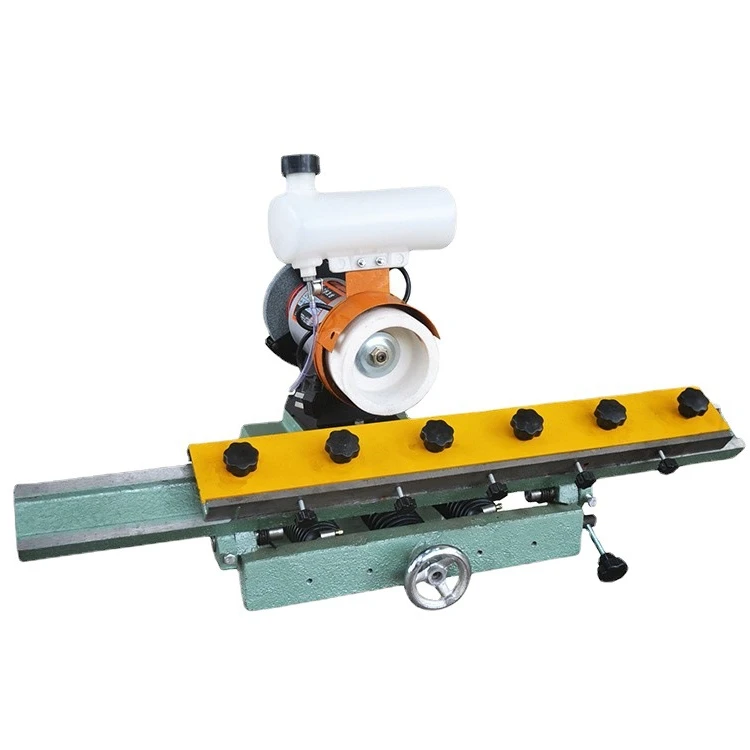
What the MF206 source record confirms
The TEBAK MF206 is listed as a straight knife sharpener and planer blade sharpening machine. The source parameter block gives a maximum sharpening length of 650mm, maximum sharpening width of 50mm and maximum sharpening thickness of 5mm. It also lists 220V, 50Hz, single phase, a motor power of 550W/750W, a spindle speed of 2850r/min, a 100*60*32mm grinding wheel, a 34° to 42° machining corner range, 870*500*530mm dimensions and a 23kg/50kg weight field.
This guide treats those values as source-listed procurement data. The slash values for motor power and weight are not silently combined: the buyer should confirm which configuration, packing condition or option each value represents.
The product title uses saw blade sharpening, blade grinding, straight knife sharpening and planer blade sharpening wording. The numerical parameter block specifically describes a straight knife sharpener. Confirm the intended blade family, clamping method and delivered configuration before ordering.
1. Product identity and procurement boundary
Keep the RFQ tied to TEBAK MF206 Straight knife sharpener, product ID 1601280715702. Ask the supplier to place the model on the quotation, nameplate, electrical diagram, test record and packing list.
The source record names TEBAK and describes the machine as made in China. The queue also includes a company introduction referencing Hengshui Mengshang Trading Co., Ltd., TEBAK design and sales, and ISO9001-based quality-control wording. Those company-level statements do not establish model-specific certification, accuracy, warranty or destination-market compliance. Request evidence for the exact MF206 configuration.
Do not merge MF206 with another sharpener or assume that the title's saw-blade wording means circular saw blades are supported. Confirm the workpiece geometry, clamping fixture, blade edge orientation and allowable material.
Request a configuration code if the supplier offers different motors, grinding wheels, fixtures, guards, tables or electrical versions. This is particularly important because the source lists both 550W and 750W motor power and both 23kg and 50kg weight values.
2. Confirmed source specifications
| Field | Source value | Procurement treatment |
|---|---|---|
| Product ID | 1601280715702 | Match the quotation, nameplate and shipment documents. |
| Model | MF206 Straight knife sharpener | Confirm the exact configuration and options. |
| Maximum sharpening length | 650mm | Confirm the usable clamping length and end-clearance limits. |
| Maximum sharpening width | 50mm | Confirm whether this is blade width, exposed edge width or fixture capacity. |
| Maximum sharpening thickness | 5mm | Confirm supported blade thickness and clamping tolerance. |
| Voltage | 220V, 50Hz, single phase | Confirm nameplate, current, plug and destination-market wiring. |
| Motor power | 550W / 750W | Confirm which motor is included in the quoted machine. |
| Spindle speed | 2850r/min | Confirm whether this is no-load speed and how it relates to the wheel. |
| Grinding wheel specification | 100*60*32mm | Confirm wheel material, grit, hardness, flange and replacement part number. |
| Machining corner range | 34° ~ 42° | Confirm reference datum, adjustment method and repeatability. |
| Dimension | 870*500*530mm | Confirm whether dimensions include handles, guards or table extensions. |
| Weight | 23kg / 50kg | Confirm net/gross meaning and packing condition for freight planning. |
The source contains spelling variations such as “S harpening” and “W eight.” The guide normalizes the labels for readability while preserving the supplied values.
3. Blade compatibility and workpiece definition
Before purchase, send the supplier drawings or representative samples of every blade to be sharpened. Include blade length, width, thickness, edge angle, material, flatness, hole pattern, back geometry and any coating.
The 650mm maximum sharpening length should not be treated as a blanket statement that every 650mm blade can be processed. Ask for the effective stroke, clamping allowance, end access, minimum length and fixture overlap.
The 50mm width field requires a written definition. It may refer to the blade body, cutting edge width, clamping width or another supplier measurement. Request a dimensioned drawing showing where width is measured.
The 5mm thickness field also requires confirmation of the supported range, not only the maximum. Ask for minimum thickness, thickness tolerance and whether thin blades can be clamped without distortion.
Clarify whether the MF206 is intended for straight planer knives, woodworking blades, paper knives, plastic knives, food-processing blades or other tools. The title contains several application phrases, but the parameter block identifies a straight knife sharpener. Do not infer a universal blade range.
Ask whether blades with carbide inserts, serrations, hollow backs, segmented edges or hardened coatings are permitted. If not, record those exclusions in the purchase specification.
4. Grinding wheel and spindle specification
The source lists a 100*60*32mm grinding wheel and 2850r/min spindle speed. Request the wheel drawing, arbor diameter, flange arrangement, permissible speed, wheel material, grit, grade, balance requirement and replacement part number.
Do not select a replacement wheel only by matching outside dimensions. Wheel type and abrasive grade must match the blade material and the machine's rated speed. Ask the supplier to confirm the approved wheel specification in writing.
Clarify whether 2850r/min is the spindle speed, motor speed or a no-load value. Request the relationship between spindle speed, wheel diameter and permissible peripheral speed.
Ask how the wheel is dressed, trued and balanced. Confirm whether a dressing tool is included, whether it is adjustable, and how often dressing is expected for the buyer's material.
Request the wheel guard drawing and safety instructions. Confirm that the guard covers the required area and that the delivered wheel, flange and guard are a matched set.
For abrasive dust control, ask for the recommended extraction arrangement, splash or dust shield and cleaning procedure. The source does not provide an extraction system or enclosure, so these must not be assumed.
5. Angle adjustment and edge geometry
The source lists a machining corner range of 34° to 42°. Confirm the reference plane: ask whether the angle is the bevel angle, included angle, table tilt, wheel approach angle or another datum.
Request a drawing showing the angle scale and the zero reference. Ask how the angle is set, locked and checked, and whether the scale is graduated in degrees or relies on a fixture setting.
Confirm the smallest adjustment increment, repeatability and allowable deviation over the full 34°–42° range. No angle accuracy value is provided in the queue.
Test the same blade at two or more angle settings. Measure the resulting edge with the buyer's chosen gauge or inspection method, and record the blade material, wheel, feed, pass count and coolant or dry condition.
Ask whether the machine can maintain the angle along the full 650mm stroke. End-to-end taper, fixture deflection, table play and wheel wear can affect long straight knives.
If the buyer needs a specific bevel or relief geometry, provide a section drawing and acceptance tolerance. A source-listed angle range is not proof of finished-edge accuracy.
6. Table, fixture and workholding questions
Request a dimensioned drawing of the work table, clamping rail, stops and blade supports. The source provides overall dimensions of 870*500*530mm but does not identify table size or usable working area.
Confirm how a blade is secured, how flatness is supported, and how the fixture prevents lifting or movement during grinding. Ask whether clamps are standard or optional.
Check the fixture against the maximum 650mm length, 50mm width and 5mm thickness fields. Confirm minimum dimensions and whether a shorter blade requires an adapter or additional stop.
Ask whether the fixture supports a blade with a non-uniform back, holes, slots or a special profile. Request the allowable workpiece flatness and straightness.
Confirm access to the full edge, especially at both ends. A physical stop or guard can reduce usable length even if the nominal machine capacity is 650mm.
Request a sample clamping video using the buyer's longest and shortest blades. Verify that set-up is repeatable and that the operator can maintain safe hand clearance.
7. Motor power and electrical planning
The source lists 220V, 50Hz, single phase and motor power of 550W/750W. The slash notation indicates a configuration question, not a combined 1,300W rating. Ask the supplier to identify the exact motor installed in the quoted unit.
Request the electrical nameplate showing voltage, frequency, phase, rated current, motor power, rotation direction and plug. Confirm whether 220V is line-to-neutral and whether the machine needs a dedicated circuit.
Ask whether the 550W and 750W options use different frames, wiring, switches, protection or grinding capacity. Record the option in the purchase order and pre-shipment checklist.
Confirm motor protection, overload behavior, emergency stop, grounding and restart behavior after a power interruption. These functions are not specified in the queue.
Ask whether the machine uses a variable-speed drive, soft starter or direct switch. Do not infer a controller from the listed spindle speed.
For export orders, confirm plug type, cable length, wiring colors, labeling and destination-market documentation. A 220V/50Hz source listing does not prove compatibility with every local installation.
8. Dimensions, weight and installation
The source lists machine dimensions of 870*500*530mm. Confirm the measurement order, datum points and whether the size includes guards, handwheels, handles, electrical box, stops or packaging fixtures.
Request a footprint drawing with operator clearance, blade loading access, wheel-changing access and maintenance space. Do not design a workstation from overall dimensions alone.
The weight field is 23kg/50kg. Ask whether 23kg is net machine weight and 50kg is gross packed weight, or whether they represent different configurations. Confirm the result on the packing list and freight quotation.
Confirm lifting points, pallet requirements, carton dimensions and center of gravity. A 50kg packed unit may need different handling equipment than a 23kg bare machine.
Ask about leveling, vibration isolation, floor flatness and anchoring. The source does not confirm whether anchoring is required.
Request an installation manual showing electrical connection, wheel installation, guard fitting, table alignment and first-run checks.
9. Accuracy, finish and acceptance criteria
The queue provides capacity and speed-related values but no sharpening accuracy, surface finish, edge straightness, burr limit or repeatability. Define these metrics with the supplier before ordering.
For a straight knife, specify acceptable edge straightness along the processed length, bevel-angle tolerance, thickness removal, burr condition and surface appearance. Choose an inspection method that both parties can reproduce.
Use the buyer's blade material and a representative sample for testing. Record the starting edge, number of passes, wheel specification, feed setting, angle setting and final inspection result.
Do not accept a generic “sharp” demonstration as a technical test. Request measurements or a signed acceptance sheet with photographs and sample identification.
Confirm whether the machine removes material uniformly over 650mm. Inspect the leading and trailing ends as well as the center.
Ask how wheel wear is compensated and how the operator verifies the table or fixture remains aligned. These maintenance checks can affect repeatability over time.
10. Operating sequence and training
Request the full operating sequence for the exact MF206. It should cover blade inspection, fixture loading, angle setting, wheel check, guard check, grinding passes, dressing, shutdown and cleaning.
Clarify how the operator controls feed and travel. The source does not state whether travel is manual, powered, fixed-speed or variable. Ask for controls, adjustment ranges and operator training requirements.
Confirm whether the machine has end stops, travel limits, a return mechanism or a table lock. Do not assume these features from the sharpener title.
Request a training checklist covering wheel mounting, balance, dressing, blade clamping, angle setting, spark or dust control, emergency stop and inspection.
Ask for language options in the manual and labels, spare wheel instructions and a troubleshooting chart. Record the required language in the order.
Define the procedure for a bent, cracked, overheated or incorrectly clamped blade. Operators should not continue grinding a damaged workpiece without a documented decision path.
11. Safety and maintenance questions
Request the machine risk assessment, guard design, emergency-stop specification and operating instructions for the exact configuration. Do not claim CE or another certification unless current model-specific documents are supplied.
Confirm wheel-breakage protection, eye protection requirements, dust or spark controls, electrical grounding and safe access around the rotating spindle.
Ask for maintenance intervals for spindle bearings, table guides, clamps, motor, switches, guards and wheel dressing tools. Request a list of consumables and recommended spares.
Confirm how abrasive dust is removed and whether compressed air is prohibited near bearings or electrical components. The approved cleaning method should be written in the manual.
Ask how alignment is checked after transport. A long fixture or table can shift during shipping; request a commissioning check before production use.
Record the warranty scope for motor, spindle, table, electrical parts and grinding accessories separately. The source queue does not provide warranty terms.
12. Packaging and export checks
Request photographs of the packed MF206 and a packing list that identifies the machine, grinding wheel, flange, guards, clamps, dressing tools, stops, manual and spare parts.
Clarify whether the 23kg/50kg values are net and gross. Confirm carton dimensions and the shipping mark before booking freight.
Check that the wheel is protected from impact and moisture and that the spindle, table and angle mechanism are immobilized for transit.
Ask for a pre-shipment video showing the machine running, angle adjustment, clamping and the exact included accessories. Match the video configuration to the quotation.
For destination markets, request electrical labels, manual language, declaration documents and any required inspection records. Do not treat a company introduction or “made in China” wording as a compliance certificate.
13. Pre-shipment acceptance test
Confirm model MF206, product ID 1601280715702, motor option, wheel specification, fixture set, dimension, weight interpretation and electrical nameplate.
Test a representative straight knife or planer blade within the supplied 650mm, 50mm and 5mm limits. Record blade material, dimensions, starting condition and target edge geometry.
Verify 220V, 50Hz, single-phase operation and the installed motor power. Record whether the unit is the 550W or 750W version.
Measure or document spindle speed under the supplier's stated test condition. Confirm wheel dimensions, flange, guard and dressing method.
Set two or more angles in the 34°–42° range and verify the angle-reference method. Record how the buyer checks the resulting bevel.
Run the machine through start, travel, grinding, return, stop and emergency-stop functions. Inspect vibration, noise, wheel tracking, clamping stability and operator access.
Photograph the nameplate, accessories, packing, wheel, clamps and finished sample. Any discrepancy should be resolved before shipment.
14. RFQ checklist
- Confirm the exact MF206 configuration and product ID 1601280715702.
- Confirm whether the machine is intended for straight knives, planer blades, saw-related work or a defined combination.
- Define the measurement basis for 650mm length, 50mm width and 5mm thickness.
- Confirm minimum and maximum workpiece dimensions, flatness and allowable materials.
- Confirm whether the motor is 550W or 750W and identify the exact installed option.
- Provide the electrical nameplate, current, plug, cable, grounding and wiring diagram.
- Confirm whether 2850r/min is spindle speed or no-load motor speed.
- Provide grinding wheel material, grit, hardness, flange, arbor, guard and replacement part number.
- Define the 34°–42° reference, adjustment increment, lock and repeatability.
- Provide table, clamp, stop and usable working-area drawings.
- Clarify whether 23kg and 50kg mean net/gross or different configurations.
- Provide machine footprint, packing dimensions, lifting points and installation clearance.
- Provide blade-edge accuracy, straightness, burr and finish acceptance criteria.
- Provide safety documents, guarding, emergency stop, maintenance and spare-parts list.
- Confirm included accessories, warranty terms, inspection records and destination-market compliance.
15. Questions for the supplier
Which exact motor option is included: 550W or 750W? Please send the nameplate photograph and wiring information.
Do the 650mm, 50mm and 5mm limits refer to blade length, blade width and blade thickness? Please provide a dimensioned workpiece and fixture drawing.
Is the MF206 intended for straight planer knives, woodworking blades, paper knives, food-processing blades or other tools? Which materials and edge geometries are excluded?
What does 2850r/min represent, and what wheel specification is approved? Please provide grit, material, hardness, flange, arbor and replacement details.
How is the 34°–42° angle measured and adjusted? What are the adjustment increment and repeatability?
Which values do 23kg and 50kg represent? Please provide net weight, gross packed weight, carton dimensions and shipping photographs.
What are the machine's sharpening accuracy, edge straightness, burr limit and surface-finish results when tested with the buyer's sample?
What safety guards, emergency-stop functions, dust controls, manuals, certificates and warranty terms are included in the quoted configuration?
16. What not to assume
Do not add 550W and 750W together. The source lists alternative power values and the delivered configuration must be confirmed.
Do not treat 23kg and 50kg as one machine weight. Ask whether they represent net/gross or different versions.
Do not infer that every saw blade is supported because the title includes saw blade wording. The parameter block identifies a straight knife sharpener.
Do not infer sharpening accuracy from capacity, spindle speed or angle range. Require a test with the buyer's blade and agreed measurements.
Do not select a replacement wheel solely by matching 100*60*32mm. Confirm abrasive type, grit, hardness, flange, arbor and rated speed.
Do not claim CE, ISO9001, warranty, dust extraction, coolant, automatic travel or any other feature without model-specific evidence.
17. Final procurement decision
The TEBAK MF206 has a source-defined baseline for straight-knife sharpening: 650mm maximum length, 50mm maximum width, 5mm maximum thickness, 220V/50Hz single phase, 2850r/min spindle wording, 100*60*32mm wheel, 34°–42° angle range and 870*500*530mm dimensions. The motor and weight fields require configuration confirmation.
Proceed only after the supplier identifies the exact motor, net/gross weight, fixture, wheel and blade compatibility. A buyer-specific pre-shipment test should verify clamping, angle setting, wheel safety, grinding travel, edge geometry and the full electrical configuration.
Editor's note: This guide uses the supplied Hoting queue fields only. It preserves the source's dual motor-power and dual weight values and does not add unsupported accuracy, material, certification, warranty or performance claims.
Key specifications
- Model
- MF206 Straight knife sharpener
- Max. sharpening length
- 650mm
- Max. sharpening width
- 50mm
- Max. sharpening thickness
- 5mm
- Voltage
- 220V,50Hz, single phase
- Motor power
- 550W / 750W
- Spindle speed
- 2850r/min
- Grinding wheel specifications
- 100*60*32mm
- Machining corner range
- 34° ~ 42°
- Dimension
- 870*500*530mm
- Weight
- 23kg / 50kg
Frequently asked questions
- What is the MF206 maximum sharpening length?
- The source lists a maximum sharpening length of 650mm. Confirm the usable stroke and clamping clearance for the buyer's blade.
- What motor power is supplied?
- The source lists 550W / 750W. The supplier must identify which motor option is included in the quoted configuration.
- What angle range is listed?
- The source lists a machining corner range of 34° to 42°. Confirm the angle reference, adjustment increment and repeatability.
- What does the 23kg / 50kg weight field mean?
- The source lists both values without defining them. Ask whether they are net/gross weights or different configurations.
- Which blades can be sharpened?
- The parameter block identifies a straight knife sharpener. Confirm the exact blade family, material, geometry and fixture before ordering.