
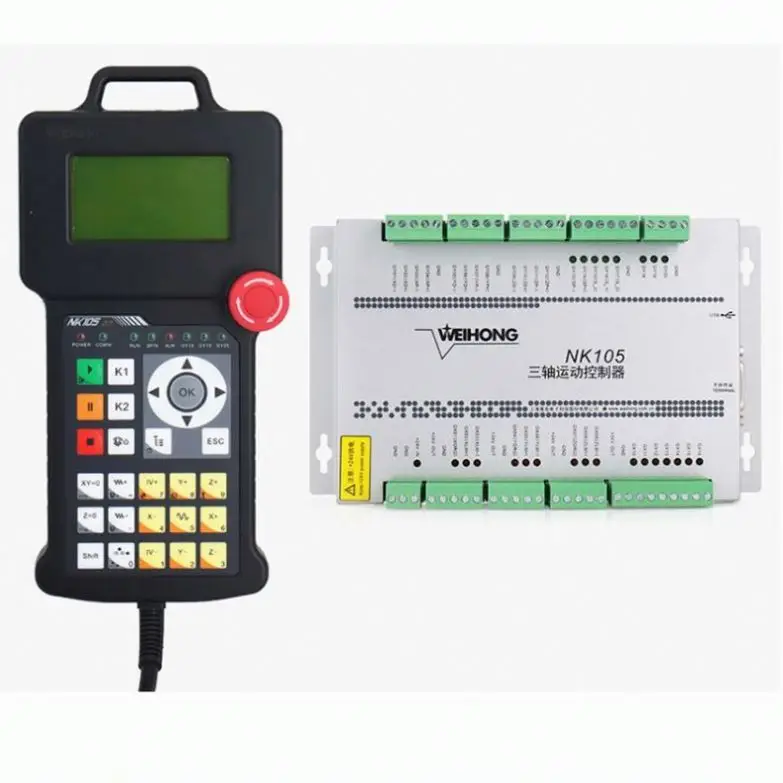
A CNC engraving controller should be purchased as a complete control-system interface, not as a handwheel or display in isolation. The TEBAK Hoting queue record identifies product ID 1601261632756 with the wording “TEBAK 3-axis 4-axis Controller NK105 G2 G3 Handle DSP Controller Original Engraving Machine Motion Control System.” The same record provides 1.5KG weight, 128M memory, 24V DC current mode, 256M FLASH, and a 128 * 64 graphic LCD module.
The title contains both 3-axis and 4-axis wording, while the description line specifically says “3-Axis handle.” The record does not confirm whether the quotation is for a 3-axis or 4-axis complete system, whether NK105 G2 and G3 are both available, or which firmware and axis hardware are included. This guide preserves the source wording and makes the configuration boundary a first-line RFQ and sample-acceptance item.
1. What product ID 1601261632756 confirms
Use product ID 1601261632756 on the quotation, controller label, wiring drawing, firmware record, packing list, and purchase order. The source identifies a TEBAK NK105 G2/G3 handle or DSP controller for an engraving machine motion-control application. It lists the following fields, but it does not provide a full electrical or mechanical datasheet.
| Recorded field | Source value | Buyer action |
|---|---|---|
| Brand | TEBAK | Use TEBAK and product ID 1601261632756 on the unit, documents, and sample files. |
| Product wording | 3-axis 4-axis Controller; NK105 G2 G3 Handle DSP Controller | Confirm the exact generation, axis count, firmware, and included control hardware before approval. |
| Application wording | Engraving machine motion control system | Confirm machine type, axes, motor drivers, spindle or engraving head, limit switches, and control cabinet. |
| Weight | 1.5KG | Confirm whether this is controller-only net weight, a handle assembly weight, or a packed value. |
| Memory | 128M | Request the memory type, function, usable capacity, file-storage behavior, and firmware allocation. |
| Current mode | 24V DC | Confirm input voltage, acceptable tolerance, current draw, polarity, protection, connector, and required power supply. |
| FLASH | 256M | Confirm whether this is onboard storage, firmware memory, user-file storage, or a nominal chip capacity. |
| Monitor | 128 * 64 graphic LCD module | Confirm display interface, viewing area, language, backlight, keypad, and replacement-part identity. |
2. Resolve the 3-axis and 4-axis configuration
The queue title says “3-axis 4-axis Controller,” and the description says “3-Axis handle.” These phrases do not prove that one unit can control four interpolated axes, that a fourth axis is enabled, or that the quotation includes the matching axis card, driver, motor, cable, and software parameter. Ask the supplier to state one exact configuration on the quotation: axis count, model suffix, firmware version, board revision, and included accessories.
Request a controller photograph showing the model label and a wiring diagram showing every axis output. Confirm whether the fourth axis is a rotary axis, an auxiliary axis, a slave axis, or an optional function. Ask whether a fourth axis requires an additional board, license, firmware setting, or different power and I/O arrangement.
Test the actual machine motion sequence for the buyer's work. A controller may have a fourth connector but still lack the interpolation, homing, toolpath, or post-processor behavior required by the production application. Write the approved axis configuration into the purchase order and prevent firmware substitution without written change approval.
3. NK105 G2 versus NK105 G3
The source includes both NK105 G2 and NK105 G3 wording but does not explain whether these are selectable versions, a compatibility range, or a copied title. Request the exact model shipped, board revision, firmware build, boot screen, manual, and parameter backup. Do not accept a G2 unit against a G3 quotation unless the supplier documents functional equivalence for the buyer's machine.
Compare the two proposed versions by axis capacity, motor-driver signals, encoder or feedback support if used, input and output count, file formats, memory behavior, screen and keypad, communication ports, firmware update method, and machine parameter compatibility. These fields are not provided in the queue record and must not be inferred from the product name.
Capture the controller's identification screen during sample approval. Store a copy of the firmware and machine parameters with the purchase record. If the supplier says that G2 and G3 use the same wiring, request a pin-to-pin confirmation and a signed compatibility statement.
4. 24V DC power acceptance
The source lists “Current mode” as 24V DC. This is a voltage-mode description, not a complete power specification. Ask for rated input voltage range, maximum and typical current, startup current, polarity, grounding, connector pinout, reverse-polarity protection, overvoltage protection, and recommended power-supply capacity.
Confirm whether 24V DC powers only the controller, the handle and LCD, or additional I/O and external modules. A controller cabinet may have separate supplies for drivers, relays, spindle equipment, sensors, and the handwheel. Do not connect a new controller to an existing cabinet until the wiring diagram and current requirement are approved.
During testing, record supply voltage at the controller terminals while the LCD, keypad, file operation, and machine outputs are active. Check startup after a controlled power interruption and verify whether parameters and user files remain intact. Do not publish a current value that the supplier has not supplied or the buyer has not measured.
5. Memory and 256M FLASH wording
The record lists Memory as 128M and FLASH as 256M without identifying the memory technology or allocation. Request a block diagram or datasheet that explains which storage holds firmware, machine parameters, user programs, toolpath files, logs, fonts, and temporary data. A nominal chip capacity is not the same as usable file capacity.
Test file creation, naming, deletion, overwrite, power recovery, and backup using the buyer's real program sizes. Confirm whether the controller accepts the buyer's file extension, directory structure, character set, and transfer method. Record the largest approved file and the behavior when storage is full.
Ask whether firmware updates can erase parameters or user files. Require a backup and restore procedure for axes, limits, steps per unit, acceleration, spindle settings, I/O mapping, origin offsets, and language settings. A controller should not enter production until a verified recovery file exists.
6. 128 * 64 graphic LCD module
The source specifies a 128 * 64 graphic LCD module. It does not state the physical display size, active area, pixel technology, backlight, contrast range, viewing angle, connector, keypad arrangement, or enclosure. Confirm whether the displayed value is pixel resolution and request the display and handle drawing.
Inspect characters, menus, alarms, coordinates, feed rate, spindle or output status, program names, and parameter pages under normal workshop lighting. Test the LCD after startup, after extended operation, and at the low and high ends of the approved supply-voltage range. Confirm that the screen remains readable when the operator wears the intended gloves or stands at the normal viewing angle.
Request replacement details for the LCD, membrane keypad, encoder or handwheel, cable, and front panel. Confirm whether the handle is a sealed assembly or a serviceable module. Do not claim waterproof, dustproof, sunlight-readable, or industrial-temperature performance without a stated rating and test evidence.
7. Handle, DSP, and operator controls
The title uses “Handle DSP Controller,” but the record does not list the handwheel type, pulse increment, selector switches, keys, emergency stop, cable length, connector, or operator controls. Ask for a front-panel drawing and a control map identifying each key, selector, indicator, and rotary control.
Define the handwheel increment and direction behavior for every axis. Test positive and negative movement, zero return, feed hold, cycle start, reset, manual jog, program selection, and any spindle or auxiliary controls. Confirm whether the operator can accidentally move an axis when the machine is in automatic mode.
If the controller is supplied for retrofit use, compare the handle cable and connector with the existing cabinet. Pin compatibility must be established from drawings, not from connector shape. Ask whether a cable extension, adapter, shield termination, or ferrite component is required.
8. Motor driver and machine compatibility
The source does not specify stepper or servo motor compatibility, pulse frequency, direction signal, enable signal, differential or single-ended outputs, encoder inputs, or driver voltage. Request a complete interface table for the controller and the buyer's selected drivers.
Confirm steps per revolution, microstep or electronic-gear settings, maximum pulse rate, acceleration and deceleration range, backlash compensation, homing, soft limits, hard limits, and alarm inputs. These settings may determine whether the engraving machine moves accurately and safely, but none are confirmed by the queue fields.
Build a compatibility matrix listing controller output, driver input, motor type, voltage, current, signal level, cable, shield, and connector for each axis. Test one axis at a time with the tool removed or the machine otherwise made safe. Verify direction, travel, homing, limit response, and emergency-stop behavior before interpolated motion.
9. I/O, spindle, and engraving-head integration
“Engraving machine motion control system” does not specify spindle output or engraving-head control. Ask for input and output count, signal voltage, relay ratings, analog or pulse outputs, spindle enable, speed control, coolant or dust extraction outputs, probe input, limit inputs, and emergency-stop chain behavior.
Confirm whether the controller controls a spindle, laser-like head, engraving motor, pneumatic tool, or another process device. Do not assume that an engraving controller includes a power stage for the head. External relays, inverters, motor drivers, or interface boards may be required.
Test every production interlock: door or guard, limit, alarm, emergency stop, tool or head enable, and cycle hold. Record the normal and fault states. A controller should fail to a safe machine state when an interlock opens, and the exact behavior must be confirmed in the wiring diagram and sample test.
10. File formats and toolpath workflow
The queue record does not identify supported file formats, transfer interfaces, post-processors, coordinate conventions, or program limits. Ask for the manual and sample programs for the buyer's CAM workflow. Confirm whether files are transferred by USB, serial, network, memory card, or another method.
Test a small and a representative production program from the buyer's system. Compare axis order, units, decimal handling, origin, sign convention, feed rate, spindle or head commands, program end, pause, and alarm behavior. Do not infer compatibility from the word DSP or from a product photograph.
Keep the approved post-processor version with the controller record. If G2 and G3 use different syntax or parameters, document the exact conversion path. A file that loads successfully can still produce wrong motion if units, axis mapping, or coordinate origin are different.
11. Accuracy, motion, and acceptance testing
No positioning accuracy, repeatability, interpolation error, maximum speed, acceleration, or machine-size limit is supplied. These values must be set from the buyer's engraving tolerance and machine mechanics. Request supplier test conditions and define the assembled-machine acceptance method separately.
Start with homing repeatability and linear travel. Then test single-axis moves, diagonal interpolation, circular or shaped paths, repeated return to origin, feed-rate changes, and stop or resume behavior. Measure the finished test pattern using the buyer's normal inspection method and record material, cutter or head, feed, speed, and program file.
Do not attribute a machine error to the controller without checking mechanics, couplings, leadscrews, belts, drivers, power, grounding, and tool or head condition. The controller should be accepted as part of the full motion system, with the responsibility boundaries written into the RFQ.
12. Firmware, parameters, and change control
Request firmware version, release notes, parameter list, language pack, update process, and rollback method. Confirm whether the controller has separate configuration for 3-axis and 4-axis operation and whether a firmware update can change I/O or motion behavior.
Create a controlled backup containing firmware identification, machine parameters, axis direction, steps, limits, homing, acceleration, feed, output mapping, display language, and file-transfer settings. Label the backup with product ID 1601261632756, controller serial number, machine serial number, and approval date.
Require written notice before board revision, LCD replacement, connector change, firmware change, memory allocation change, or supplier substitution. “Original” in the source title is treated as product wording only; it does not replace serial traceability or change-control evidence.
13. Weight, enclosure, and installation
The source lists 1.5KG, but it does not define whether this is net controller weight, handle weight, assembled weight, or shipping weight. Ask for the dimensional drawing, mounting pattern, cable-entry position, front-panel cutout, center of gravity, and packed dimensions.
Check that the machine cabinet or operator arm can support the actual assembly without vibration or cable strain. Confirm mounting screws, brackets, spacers, grounding point, ventilation, and service access. A 1.5KG value does not establish enclosure strength or the correct mounting method.
Inspect cable routing around moving machine parts and keep signal cables separated from motor and spindle power cables as required by the supplier's wiring guidance. Confirm shield termination, grounding, strain relief, bend radius, and connector locking. Record the final installation drawing for repeat builds.
14. Environmental and electrical reliability checks
The queue record does not provide operating temperature, storage temperature, humidity, vibration, dust, coolant, or EMC information. Request the environmental limits and applicable test evidence for the exact controller and handle configuration.
Test startup, continuous display, program transfer, manual jogging, alarm recovery, and controlled power cycling at the approved workshop conditions. Check for display corruption, lost parameters, file errors, false inputs, and unexpected motion. Do not claim industrial-grade, dustproof, EMC-compliant, or wide-temperature performance without product-specific evidence.
Confirm the cabinet's grounding and protective devices before operating the controller. The 24V DC entry should be protected and labelled, and the operator should be able to isolate the machine safely. Keep electrical safety documentation separate from the controller's memory and display specifications.
15. Supplier and company-profile verification
The description identifies Hengshui Mengshang Trading Co., Ltd. as a professional supplier and describes TEBAK as its brand for design and sales. It also includes a company-profile statement that quality-control standards are based on ISO9001 certifications. Treat these as supplier statements requiring normal due diligence; they do not certify this controller or its machine compatibility.
Request the legal entity on the quotation, invoice, packing list, warranty, and firmware record. Confirm whether the supplier manufactures, designs, distributes, or integrates the controller. Ask for the responsible technical contact, inspection location, serial traceability, spare-parts policy, repair route, and change-notification process.
If an ISO9001 certificate is presented, verify holder, scope, issuer, validity, and entity match. Keep management-system evidence separate from electrical, firmware, motion, EMC, display, and machine-integration evidence for product ID 1601261632756.
16. RFQ checklist for product ID 1601261632756
- Confirm TEBAK product ID 1601261632756, exact model label, serial format, and supplied configuration.
- Resolve the title's 3-axis and 4-axis wording and the description's 3-axis handle wording.
- Confirm whether the unit is NK105 G2 or NK105 G3, including board revision and firmware version.
- Confirm 1.5KG as controller-only net weight, handle weight, assembled weight, or packed weight.
- Confirm 128M memory and 256M FLASH type, allocation, usable file storage, and backup behavior.
- Confirm 24V DC input range, current draw, polarity, protection, connector, and power-supply requirement.
- Confirm 128 * 64 graphic LCD resolution, physical size, backlight, keypad, language, and replacement part.
- Provide front-panel, mounting, cable, pinout, wiring, I/O, axis, driver, and spindle interface drawings.
- Confirm compatible stepper or servo drivers, pulse and direction signals, limits, homing, alarms, and emergency stop.
- Confirm file formats, transfer method, post-processor, units, coordinate convention, axis mapping, and program limits.
- Provide firmware, parameter backup, update, rollback, language, and change-control procedures.
- Provide motion-system test results for homing, travel, interpolation, repeatability, stop, resume, and alarms.
- Define environmental, EMC, grounding, cabinet, cable-routing, service, and installation requirements.
- Provide accessories, cables, brackets, manuals, software or files, spare LCD/keypad parts, packing list, and warranty.
- If ISO9001 is claimed, provide certificate holder, scope, issuer, validity, and entity match; do not treat it as controller certification.
17. Comparing controller offers
Compare offers by verified axis configuration, NK105 generation, firmware and board revision, driver and I/O compatibility, file workflow, parameter backup, display and handle usability, 24V power requirement, memory behavior, motion test results, environmental limits, service, spare parts, traceability, and warranty. Do not rank a controller by the words DSP, original, or 128M alone.
Normalize each quotation into controller, handle, LCD, cable, power supply requirement, interface boards, axis configuration, firmware, parameter file, post-processor support, mounting hardware, manuals, spare parts, training, and warranty. A lower price may include only the controller price, as the source wording states, and may exclude the drivers, cables, software files, adapters, or installation support needed for a working system.
Keep company-profile statements separate from product evidence. TEBAK and Hengshui Mengshang Trading Co., Ltd. can be reviewed during supplier qualification, but product ID 1601261632756 must still pass the buyer's electrical, file, motion, axis, alarm, and integration tests.
18. Purchase-order wording
A purchase order can state: “TEBAK NK105 G2 or NK105 G3 DSP handle controller for engraving machine motion control, product ID 1601261632756, supplied in the approved 3-axis or 4-axis configuration, with 1.5KG value as defined, 128M memory, 24V DC input, 256M FLASH, 128 * 64 graphic LCD module, approved firmware, parameter backup, wiring, interface list, manuals, inspection report, packing list, and warranty.”
Add the exact model generation, axis count, firmware and board revision, current requirement, memory allocation, LCD and keypad specification, driver and I/O compatibility, file format, post-processor, machine acceptance test, change-control rule, service response, and spare-part list. State that title wording alone does not establish a complete 3-axis or 4-axis system.
19. Frequently asked questions
What specifications are listed for this controller?
The source lists 1.5KG weight, 128M memory, 24V DC current mode, 256M FLASH, and a 128 * 64 graphic LCD module.
Is it definitely a 4-axis controller?
The title contains 3-axis and 4-axis wording, while the description says 3-Axis handle. Confirm the exact axis count and shipped configuration from the quotation, label, wiring, and firmware.
Is NK105 G2 the same as NK105 G3?
The source mentions both but provides no equivalence statement. Confirm the exact generation, board revision, firmware, interfaces, and parameter compatibility.
Does 24V DC specify the complete power requirement?
No. Confirm voltage tolerance, current draw, polarity, protection, connector, and whether external modules need separate supplies.
What does 128M memory and 256M FLASH mean?
The queue does not define their allocation or usable capacity. Request a datasheet and test file, firmware, parameter, and backup behavior.
Does the company ISO9001 statement certify the controller?
No. Verify any management-system certificate separately from the controller's electrical, firmware, motion, display, and machine-integration evidence.
Supplier inquiry template
Hello, we are evaluating TEBAK product 1601261632756, described as an NK105 G2/G3 DSP handle controller for a 3-axis or 4-axis engraving machine motion-control system. Please resolve the 3-axis and 4-axis wording and identify the exact NK105 generation, board revision, firmware, axis count, and included hardware. Confirm the 1.5KG definition, 128M memory allocation, 24V DC input range and current, 256M FLASH allocation, and 128 * 64 graphic LCD module details. Please provide complete front-panel, mounting, wiring, pinout, axis, driver, I/O, spindle, limit, alarm, emergency-stop, file-format, post-processor, parameter-backup, firmware-update, environmental, EMC, and installation information. Please test our actual motor drivers, machine axes, file workflow, homing, limits, alarms, interpolation, and power recovery before approval. The company profile names Hengshui Mengshang Trading Co., Ltd. and mentions ISO9001-based quality-control standards; please provide the legal entity and certificate scope and validity while keeping company-level claims separate from product evidence. Send the datasheet, manuals, firmware record, wiring, inspection report, packing list, and warranty before production.
Key specifications
- Brand
- TEBAK
- Product ID
- 1601261632756
- Source product wording
- 3-axis 4-axis Controller NK105 G2 G3 Handle DSP Controller Original Engraving Machine Motion Control System
- Axis wording
- Title states 3-axis and 4-axis; description specifically says 3-Axis handle; confirm the exact shipped configuration
- Controller family wording
- NK105 G2 / NK105 G3; confirm generation and firmware version
- Weight
- 1.5KG
- Memory
- 128M
- Current mode
- 24V DC
- FLASH
- 256M
- Monitor
- 128 * 64 graphic LCD module
- Application wording
- Engraving machine motion control system
- Unspecified buyer-critical fields
- Axis card, motor and driver compatibility, I/O, pinout, communication protocol, firmware, file format, step resolution, speed limits, enclosure, power current, language, backup, warranty, packing, and compliance documents
- Company profile
- Hengshui Mengshang Trading Co., Ltd.; TEBAK is described as its brand for design and sales
Frequently asked questions
- What specifications are listed for this controller?
- The source lists 1.5KG weight, 128M memory, 24V DC current mode, 256M FLASH, and a 128 * 64 graphic LCD module.
- Is it definitely a 4-axis controller?
- The title contains 3-axis and 4-axis wording, while the description says 3-Axis handle. Confirm the exact axis count and shipped configuration from the quotation, label, wiring, and firmware.
- Is NK105 G2 the same as NK105 G3?
- The source mentions both but provides no equivalence statement. Confirm the exact generation, board revision, firmware, interfaces, and parameter compatibility.
- Does 24V DC specify the complete power requirement?
- No. Confirm voltage tolerance, current draw, polarity, protection, connector, and whether external modules need separate supplies.
- What does 128M memory and 256M FLASH mean?
- The queue does not define their allocation or usable capacity. Request a datasheet and test file, firmware, parameter, and backup behavior.
- Does the company ISO9001 statement certify the controller?
- No. Verify any management-system certificate separately from the controller's electrical, firmware, motion, display, and machine-integration evidence.